2,100+
Full degrees taught entirely in English
Largest English catalogue in continental Europe
2,100+ English-taught degrees in the Netherlands: TU Delft, Maastricht, UvA, Erasmus. €2,694 EU tuition, IELTS 6.0-7.0, numerus fixus, Orientation Year.

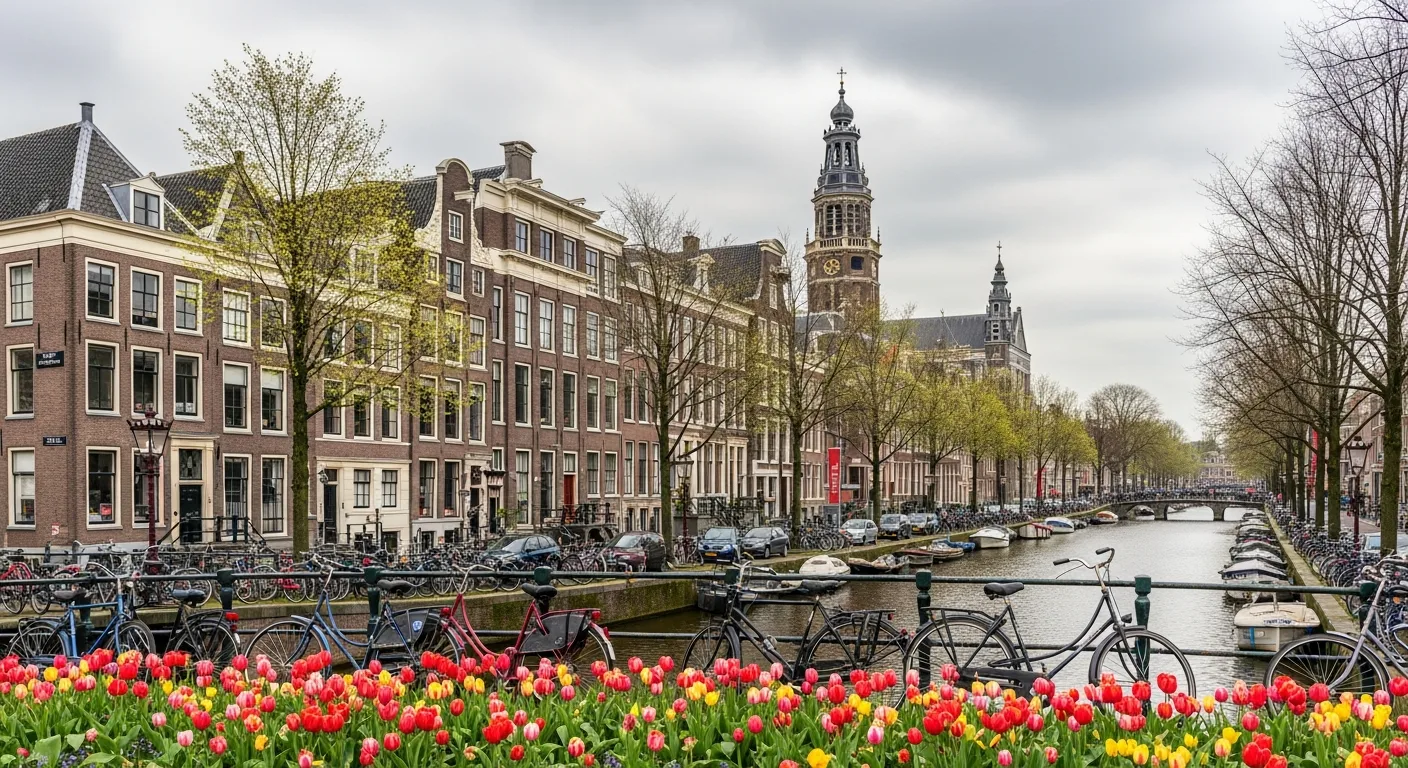
Photos: Wikimedia Commons
A lecture hall at Maastricht University, a Wednesday in October. Twelve students sit around an oval table - one from Lagos, two from Bucharest, a German, an Italian, a couple of Dutch students, an American on exchange - working through a public-health case the tutor handed out that morning. The whole discussion is in English, because the entire programme is. Nobody finds this remarkable. The same hour, at Eindhoven University of Technology, a master’s cohort debugs a robotics assignment in English; in Wageningen, a soil-science seminar runs in English; at the University of Twente, an entire residential campus operates in English. The Netherlands has done something no other country on the European continent has managed at this scale: it built a world-class research system and then taught most of it in a language that is not its own.
Here is the bottom line. The Netherlands runs more than 2,100 full degree programmes taught entirely in English - by a wide margin the largest English-language catalogue in continental Europe (Nuffic / Study in NL). EU and EEA students pay the same flat statutory tuition for an English-taught degree as for a Dutch one, €2,694 for 2026/27 (DUO), and nine of the country’s thirteen research universities sit in the QS World University Rankings 2026 global top 200 (QS 2026). For an international student who wants a top-tier European degree without learning a new language first, this is the most accessible high-quality option on the continent. In our own advising, the Netherlands is the country families overlook and then choose, once they see how much of it already runs in English.
This is a focused guide to the English-taught side of the Dutch system: where the English catalogue is genuinely deep versus thin, which universities teach almost entirely in English, how the bachelor’s-versus-master’s split works, the English-test bar by programme, and the one piece of policy news every applicant needs to track - a 2023 language law that is reshaping English bachelor’s. For the full picture of costs, visas, Studielink and the Orientation Year, read the parent guide, studying in the Netherlands.
Source: Nuffic / Study in NL (English programme count); DUO 2026/27 statutory tuition; QS World University Rankings 2026; university admissions pages 2026; IND.
The headline number - 2,100-plus English-taught programmes - is true, but it hides a split that determines whether you will actually find your subject in English. The honest version is this: the Dutch master’s catalogue is overwhelmingly English; the bachelor’s catalogue is narrower and concentrated at specific universities.
At master’s level, English is effectively the default. Roughly three-quarters of Dutch master’s programmes run entirely in English, and at the research-led institutions the share is higher still: TU Delft delivers nearly all of its master’s in English, Wageningen is fully English at master’s level, and the technical and economics faculties across the country teach their graduate programmes in English as a matter of course. If you are coming for a master’s, your problem is choosing among too many English options, not finding one.
At bachelor’s level the picture is different and more deliberate. A Dutch bachelor’s in English exists where a university decided to build one - for an international cohort, for a specific interdisciplinary concept, or because the whole institution made English its working language. The reliable English-bachelor’s universities are Maastricht (most of the institution), the University of Twente, the university colleges, and named flagship tracks elsewhere: PPLE at the University of Amsterdam, International Business Administration (IBA) at Erasmus Rotterdam, Philosophy, Politics and Economics (PPE) at VU Amsterdam, and most engineering and computer-science bachelor’s at the three technical universities. Outside those, many bachelor’s are still taught in Dutch - which is exactly the gap a non-Dutch-speaker has to plan around.
There is one more wrinkle, and it is current rather than historical. Since 2023 the Dutch government has been advancing the Internationalisation in Balance Act (Wet internationalisering in balans, WIBO), which would require universities to justify teaching a bachelor’s in a foreign language and would slow the growth of English bachelor’s. The law is aimed at bachelor’s, not master’s, and at managing crowding rather than ending English instruction. But it means the English bachelor’s landscape is in motion, and the single most important habit for a bachelor’s applicant is to confirm the language of instruction on the official programme page for the exact intake year you are applying to.
The table below maps the research universities international students ask about most against how much of each is actually taught in English - the metric that matters for this topic, not the overall rank alone. The QS World University Rankings 2026 position is shown for orientation. Every name links to its College Council Atlas profile, except the University of Amsterdam, where we have a full dedicated guide.
| QS '26 | University | English teaching & what it leads in |
|---|---|---|
| 47 | Delft University of Technology (TU Delft) | Nearly all master's in English; English engineering & CS bachelor's · aerospace, architecture, applied physics · top-10 European technical school |
| 53 | University of Amsterdam (UvA) | Deep English master's catalogue; PPLE English bachelor's · communication science, economics, social sciences, law |
| 103 | Utrecht University | English master's + University College Utrecht · broadest research university · sciences, humanities, veterinary medicine |
| 119 | Leiden University | English master's + Leiden University College The Hague · law, area studies, astronomy · oldest in the country (1575) |
| 140 | Erasmus University Rotterdam | English IBA & economics bachelor's, English RSM master's · business, economics · numerus fixus IBA |
| 140 | Eindhoven University of Technology (TU/e) | English engineering bachelor's & master's · Brainport ties to ASML, Philips, NXP · electrical engineering, CS |
| 147 | University of Groningen | Very international; many English bachelor's & master's · astronomy, AI, life sciences, law · cheapest major student city |
| 153 | Wageningen University & Research | Fully English at master's level · #1 in the world for agriculture & forestry · food systems, environment, sustainability |
| 194 | Vrije Universiteit Amsterdam (VU) | English master's + PPE English bachelor's · psychology, business, CS, biomedical · co-runs Amsterdam University College |
| 203 | University of Twente | English-language residential campus; English bachelor's & master's · nanotechnology, biomedical, applied maths · entrepreneurship |
| 239 | Maastricht University | Almost the entire university in English, bachelor's included · Problem-Based Learning · most international in NL · business, law, medicine |
| 279 | Radboud University | English master's + selected English bachelor's · cognitive neuroscience (Donders Institute), linguistics, philosophy |
| Source: QS World University Rankings 2026; College Council Atlas; official university admissions pages 2026. Language-of-instruction shares are indicative; confirm per programme. | ||
Three of these are worth pulling out of the table for the English-taught angle specifically.
Maastricht is the closest thing the continent has to a fully English research university: it built almost everything in English, including bachelor’s, and teaches through small-group tutorials rather than lectures, so an international student is never the odd one out in the room.
Twente is the only Dutch university with a US-style residential campus, and it runs in English, which makes it the easiest landing for a student who wants the everything-in-one-place experience.
Tilburg University (Atlas profile) sits outside the QS top 200 and so falls off the table, but it is a genuine research heavyweight in economics, with English-taught economics, business and social-science programmes - the sharpest target on this list for that field.
If you want the most fully English, most international undergraduate experience the Netherlands offers, look at the university colleges. These are small (300-700 students), residential, selective, English-taught bachelor’s colleges run inside the larger research universities, modelled on US small liberal arts colleges. The best-known are:
Rotterdam (Erasmus University College) and Groningen (University College Groningen) run two more on the same model, so the full count is currently seven. All of them are entirely in English, use holistic admissions (motivation, interview, sometimes a test) rather than a single grade cut-off, and are the programmes most open to a SAT or ACT score as supporting evidence. They are also the most expensive Dutch degrees for EU students in practice, because most charge an institutional supplement above the statutory €2,694 and require living in college housing. For the student who wants the personal, broad, English-from-day-one experience, no other Dutch route comes close.
“Taught in English” means different things in different countries, and in some of them it means a Dutch programme with the slides translated. The Netherlands is the genuine article. English-taught programmes are delivered entirely in English: lectures, tutorials, readings, assignments, exams and your thesis. Faculty publish in English, supervise in English and, at the research universities, are themselves often international. This is not a token international track bolted onto a Dutch programme; it is the programme.
The areas where Dutch still surfaces are practical, not academic. Some part-time jobs, the cheaper end of the housing market, interactions outside the big cities, and bureaucracy at the municipal counter are easier with a little Dutch. None of it touches your degree. Around 90% of the Dutch population speaks English to a working level - the highest in continental Europe - so the gap between “I study in English” and “I live in English” is smaller here than anywhere else on the mainland. Most universities run free or low-cost Dutch courses through their language centres for the students who want to close it.
Language thresholds for English-taught programmes are broadly uniform across the country and tiered by selectivity. The standard bar is IELTS Academic 6.0 or TOEFL iBT 80 for most bachelor’s, rising to IELTS 6.5 / TOEFL 90 at competitive programmes (TU Delft, UvA, Erasmus IBA, Maastricht) and IELTS 7.0 / TOEFL 100 at the most selective tracks and the university colleges. Cambridge C1 Advanced and Pearson PTE Academic are widely accepted. If your secondary education was conducted in English at a recognised school, most universities will waive the test - but verify per programme, because waiver rules differ.
The gap between school English and a 90-plus TOEFL or 7.0-plus IELTS is real and catches students out every cycle. In our advising experience, the students who underestimate the English test are almost always the strong-but-not-native ones who assume their classroom English will carry the exam; it usually lands them in the 70s on TOEFL when a selective programme wants 90-plus. Most need 8-14 weeks of structured preparation to bridge the gap. Our TOEFL app runs full TOEFL iBT practice tests with AI-graded speaking and writing feedback - the closest thing to a mock exam you can do from home, and the right tool to lift a baseline 60-70 into the 90-100 band the selective English-taught Dutch programmes increasingly want.
A note on the SAT: no standard Dutch programme requires it. The SAT (or ACT) is purely additive - useful at the university colleges and at competitive English tracks like PPLE, especially for applicants from school systems with non-standard grading, where a score above 1300 SAT or 28 ACT can strengthen a borderline file. If you are also building a US application where the SAT is central, prepare it once in our SAT app and apply across both systems.
The mechanics are the same for English-taught and Dutch-taught programmes, so this section is short; the full walk-through is in the parent guide.
Everything goes through Studielink (studielink.nl), the single national application portal, where you apply to up to four programmes at once. Deadlines split in two: programmes with numerus fixus (capped intake) close on 15 January, strictly; standard programmes close on 1 May for a September start. Master’s deadlines vary, and the competitive English master’s at TU Delft and Rotterdam School of Management can close as early as 1 December - always read the programme page.
The relevant point for this topic is that the most popular English-taught bachelor’s are also the ones most likely to be capped. International Business Administration (IBA) at Erasmus Rotterdam, PPLE at UvA, the psychology programmes, and selective tracks at the technical universities run numerus fixus, with acceptance rates roughly 10-30% and multi-stage selection (academic record, motivation, sometimes tests or interviews). Outside numerus fixus the logic flips: meet the formal entry and language requirements for an English-taught programme and you are admitted, with no holistic rejection of qualified candidates. For a bachelor’s, your diploma must be judged equivalent to the Dutch VWO (the IB, A-levels, a strong national high-school diploma with the right subjects); for a master’s, you need a relevant bachelor’s, usually a GPA around 7.0/10, the language certificate and a motivation letter.
The English-taught Netherlands is the best fit for a specific profile, and a poor fit for others. Find yourself in the list:
The decisive advantage the Netherlands holds over Germany and most of the continent is the combination: a deep English catalogue, low EU tuition, top-200 research, and the Orientation Year - a 12-month post-study permit for non-EU graduates with no salary threshold and no job offer required. You can study in English, pay little, and stay to work afterwards. Few places offer all four.
We built College Council to remove the two things that most often derail an application to the Netherlands: weak English-test preparation and a chaotic, last-minute process. Every English-taught Dutch programme demands a strong English score, and the gap between school English and a selective 90-plus TOEFL is the most common reason a strong file stalls. Our TOEFL app delivers full TOEFL iBT practice tests with AI-graded speaking and writing feedback, and our SAT app runs the full digital SAT with adaptive practice - so if your plan spans the Netherlands and a US application, you prepare once and apply broadly.
The harder part is judgement: which four Studielink choices to make, whether your diploma clears each programme’s VWO-equivalence bar, whether the English bachelor’s you want still runs in English for your intake year, and which numerus fixus gambles are worth a slot. Those are the questions we work through with families. Create a free College Council account and check your chances - we hold every Dutch university, its admission and language requirements, and a clear picture of how to get in, mapped against your own profile. And if you simply want to see what is taught in English, browse the Netherlands in our university Atlas, where each institution above has a full profile with rankings, programmes and student data.
More than 2,100 full degree programmes are taught entirely in English in the Netherlands - the largest English-language catalogue in continental Europe. The depth is uneven by level: roughly three-quarters of master’s programmes are English-taught, while English bachelor’s are concentrated at specific universities (Maastricht, Twente, the university colleges, and selected tracks at Amsterdam, Rotterdam, Groningen and the technical universities). TU Delft and Wageningen deliver nearly all of their master’s in English, and Maastricht runs almost the entire institution in English at every level.
Yes, though fewer bachelor’s than master’s run in English. The reliable English-bachelor’s universities are Maastricht (most of the institution), the University of Twente, the university colleges (Amsterdam, Utrecht, Maastricht, Roosevelt, Leiden The Hague, plus Rotterdam and Groningen), and named tracks elsewhere: PPLE at the University of Amsterdam, IBA at Erasmus Rotterdam, PPE at VU Amsterdam, and most engineering and computer-science bachelor’s at TU Delft, Eindhoven and Twente. A 2023 Dutch language law (the WIBO bill) is pushing some universities to cap or convert English bachelor’s, so confirm the language of instruction on the specific programme page for your intake year.
The standard bar for English-taught programmes is IELTS Academic 6.0 or TOEFL iBT 80 for most bachelor’s, rising to IELTS 6.5 / TOEFL 90 at competitive programmes (TU Delft, UvA, Erasmus IBA, Maastricht) and IELTS 7.0 / TOEFL 100 at the most selective tracks and the university colleges. Cambridge C1 Advanced and Pearson PTE are widely accepted. If your secondary education was taught in English at a recognised school, most universities will waive the test, but verify per programme.
Yes. The language of instruction does not change the fee. EU/EEA students pay the statutory rate of €2,694 for 2026/27 at every public Dutch university, whether the programme is in English or Dutch. Non-EU students pay institutional rates of roughly €13,000 - €22,000 per year for bachelor’s and €15,000 - €25,000 for master’s, again regardless of teaching language.
No. English-taught programmes are delivered entirely in English, and around 90% of the Dutch population speaks English to a working level, so daily life, banking and most government services are accessible without Dutch. Learning Dutch to A2 - B1 still helps with part-time work, the housing search and any plan to stay after graduation, and most universities run free or low-cost Dutch courses for international students.
Maastricht University runs almost the entire institution in English, bachelor’s included, through its Problem-Based Learning model. The University of Twente, Wageningen and TU Delft deliver nearly all master’s in English. The seven university colleges (Amsterdam University College, University College Utrecht, University College Maastricht, University College Roosevelt, Leiden University College The Hague, Erasmus University College and University College Groningen) are fully English liberal-arts bachelor’s. The University of Amsterdam, Erasmus Rotterdam, Groningen and VU Amsterdam offer strong English bachelor’s tracks alongside a deep English master’s catalogue.
Possibly, at bachelor’s level. The Internationalisation in Balance Act (WIBO), debated since 2023, aims to slow the growth of English-taught bachelor’s at public universities and require a justification for teaching a bachelor’s in a foreign language. Master’s programmes and the research universities’ English catalogue are far less affected, and English remains the working language of Dutch academia. The practical takeaway: master’s in English are secure, but check the language of instruction for any bachelor’s programme for your specific intake year.
The English-taught programme count, ranking and tuition figures in this guide are drawn from official Dutch government, ranking and university sources, cross-checked against College Council’s Atlas dataset of Dutch higher-education institutions. Language-of-instruction shares are indicative at institution level; because individual programmes change their teaching language between intakes - and because the WIBO law is actively reshaping English bachelor’s - always confirm the language of instruction and entry requirements on the official programme page for your intake year.