~14%
overall acceptance rate
Applying to Imperial College London as an international student: UCAS, MAT/STEP, ESAT, UCAT, Medicine deadline 15 Oct and 29 Jan, A*A*A, IB 39+, school-leaving conversion. The complete application guide.

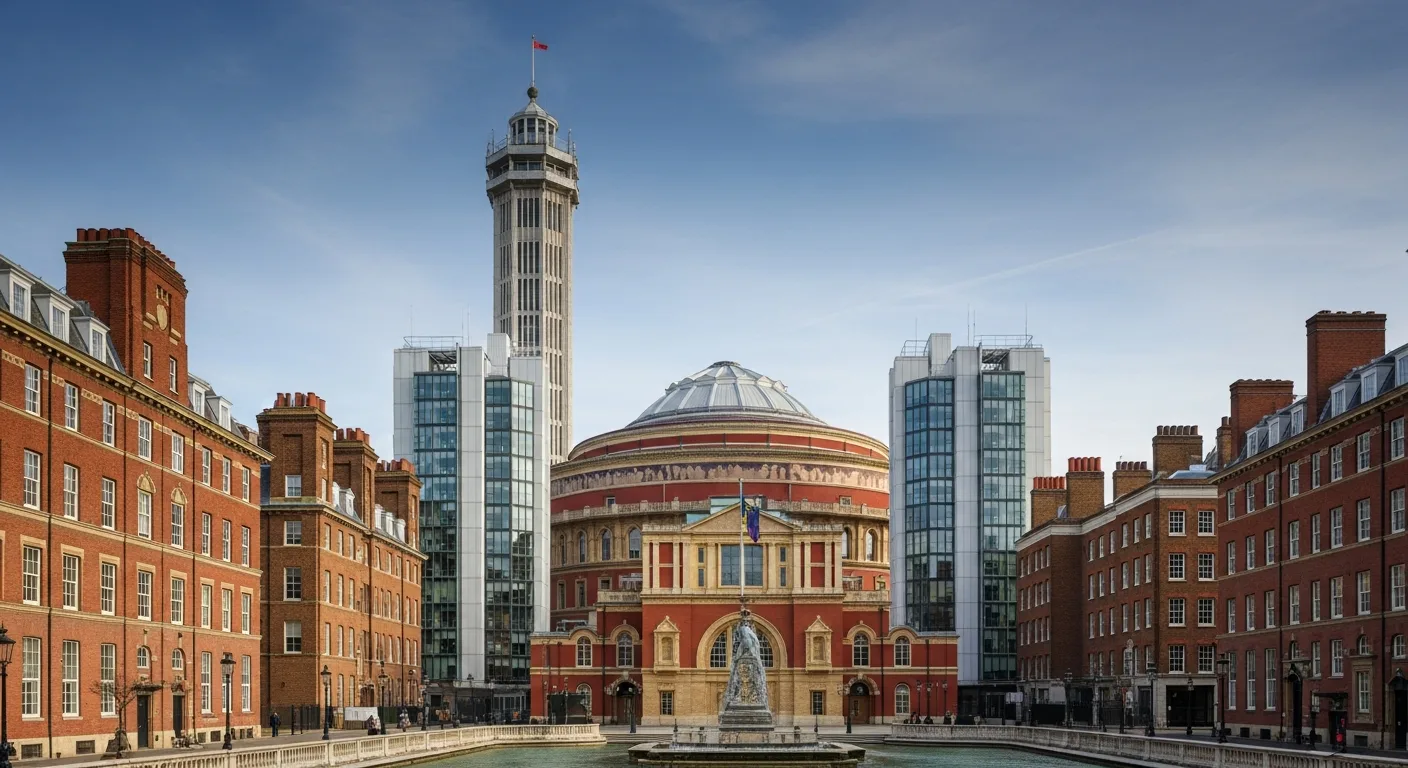
Photos: Wikimedia Commons
The deadline does not move for you: if you are applying to Imperial Medicine, you have until 15 October 2026, 18:00 UK time. If you are applying to Engineering, Computing, Mathematics, Physics or Business, your UCAS deadline is 29 January 2027, 18:00 UK. Imperial does not run rolling admissions, there are no “soft” extensions, and the UCAS portal closes the application automatically at 18:00:01. This is one of the larger traps for international applicants: from where you sit, in your own school calendar, January looks distant and October for Medicine arrives surprisingly fast.
Each year roughly 30-50 international applicants are admitted to Imperial from a typical mid-sized European country (Imperial International Office, 2024/25 figures). The overwhelming majority land in Engineering, Computing, Mathematics and Natural Sciences - only a fraction in Medicine, where competition from across the world is ruthless. National and regional student societies at Imperial each count anywhere from a few dozen to a couple of hundred active members, which makes the college one of the larger international STEM hubs in London alongside UCL.
This article complements the Imperial pillar guide. There you will find the broad context - the institution, the courses and the costs. Here I go one level deeper: which tests to sit (MAT, STEP, ESAT, UCAT), how to fill in UCAS, what the interview looks like, and how the conversion of a national school-leaving qualification into Imperial’s requirements actually works in the 2026/27 cycle.
Imperial does not use the Common App - it uses UCAS. UCAS (Universities and Colleges Admissions Service) is the UK’s central admissions system, where you submit one application to a maximum of five courses (with a single Personal Statement for the whole thing). This is a radically different logic from the American one - you do not write five different essays for five universities, you write one Personal Statement (~4,000 characters, ~47 lines) describing your academic motivation for a specific course (not a university).
The second difference: Imperial is not Ivy League - calling it “the British Harvard” is misleading. The Ivy League is a historic athletic conference of eight universities on the American East Coast; Imperial is part of the Russell Group and the G5 (Oxford, Cambridge, Imperial, LSE, UCL). The practical consequence: no alumni interview, no need-blind admission for international students, no holistic “fit” - Imperial assesses the academic signal: grades, the admissions test, the Personal Statement, the interview. In that order.
The third difference: the admissions tests depend on the course, they are not centralised for the whole university. Mathematics → MAT (and possibly STEP). Engineering, Computing, Physics, Materials → ESAT (since 2024). Medicine → UCAT (the BMAT has been phased out). Business → no additional admissions test. Your choice of course determines your entire axis of preparation.
UCAS operates two main deadlines:
In practice: if you are applying to Medicine, you must have a complete application ready - Personal Statement, references, UCAT - before 15 October 2026. This is a brutal deadline for international applicants, because it collides with the start of the final school year almost everywhere. It requires you to begin preparing at least 12 months in advance.
For Engineering and Computing the January deadline gives more breathing room, but the interview for most courses takes place between December and March 2027. Submitting your application late, right up against January, means you fall into the second wave of interviews (February-March), which is less favourable - most offers have already been handed out.
UCAS Extra (if you are rejected by all five of your courses) and Clearing (after 5 August 2027) barely function for Imperial - a university at this level rarely has spare places in Clearing.
Imperial restructured its admissions tests in 2023-2024. As of the 2026/27 cycle:
Registration for the MAT, STEP and ESAT is through admissionstesting.org (with Pearson VUE as the operator). The UCAT you register for separately at ucat.ac.uk. The cost of the MAT/ESAT for applicants is around £70-80 (roughly $90-105 USD / €82-95 EUR), and the UCAT around £115 (roughly $145 USD / €135 EUR).
As an international applicant, you sit the tests at an authorised Pearson VUE centre - these exist in most capital cities and major cities worldwide, so book at the centre nearest to you. The UCAT can usually be sat at a Pearson VUE test centre or, in some countries, at a British Council office. Reserve your slot at least six weeks in advance - places fill up fast during the application season.
| Course | A-level | IB | National school-leaving (advanced subjects) |
|---|---|---|---|
| Mathematics | A*A*A (Math A*, Further Math A*) | 40-42 (7,7,6 HL) | ~95% Math + 90% second advanced subject |
| Engineering (all departments) | A*A*A (Math A*, Physics A*/A) | 39-41 (7,7,6 HL) | ~92% Math + 90% Physics + ESAT |
| Computing | A*A*A (Math A*, second STEM A*/A) | 40 (7,7,6 HL) | ~92% Math + 88% second advanced subject |
| Medicine (MBBS) | A*A*A (Chemistry, Biology compulsory) | 39-40 (7,6,6 HL) | ~90% Chem + 90% Bio + 88% third |
| Natural Sciences (Chem/Bio/Phys separately) | AAA-A*AA | 38-40 (6,6,6 HL) | ~88-90% course-relevant subject |
| Business (BSc) | A*AA | 38 (6,6,6 HL) | ~88% Math + 85% second advanced subject |
For an international applicant, Imperial recognises most national high school diplomas as equivalent to A-levels, provided you reach a sufficiently high percentage (or the top grade band) in your advanced subjects. The realistic threshold for most STEM courses is the top 90-95% in three advanced subjects, including advanced Mathematics compulsorily for Engineering, Computing and Mathematics, and Physics, Chemistry or Biology respectively as the second course-relevant subject.
Imperial assesses predicted grades (the grades your teachers expect you to achieve) alongside your results so far. In most national systems the equivalent is your interim or term grades from the final two years of secondary school - your subject teachers write the academic reference that UCAS requires, in which they enter a “predicted” final result. This is a pivotal document - a low teacher prediction can block an offer even with a flawless Personal Statement.
If you study in an IB track (these exist in many countries through international and bilingual schools), Imperial tends to find IB easier to compare - the equivalence is more direct, and 39+ points is a realistic benchmark for those admitted. To convert your national school-leaving grades onto a 4.0 GPA (useful when comparing with American alternatives), use the GPA calculator.
The UCAS Personal Statement is a single piece of writing of at most 4,000 characters (~47 lines, ~600-650 words), which goes to all five courses entered in your application. This is the biggest structural trap: if you enter Imperial Engineering but also UCL Medicine, both places receive the same Personal Statement. The industry standard: apply to one field (for example, all five choices are Engineering / Computing) and write tightly for that field.
Imperial weighs the Personal Statement in the top three criteria (grades, admissions test, PS). What works:
International applicants often misuse the Personal Statement as a list of awards - Imperial already sees your awards in the UCAS qualifications and achievements section. The Personal Statement exists for an intellectual narrative, not an inventory.
For an international applicant aiming at Engineering, the critical window is September-October 2026: the ESAT is offered once a year, and the result is valid only for the cycle in which you apply (there is no “rollover” to the following year). Missing the test registration, or a clash with your school obligations at home, is the most common reason for falling out of contention.
For Medicine there are two critical windows: July-August 2026 (UCAT) and September-October 2026 (Personal Statement and reference). Imperial Medicine additionally requires work experience in a clinical setting - volunteering in a hospital, hospice or care home, with at least two documented weeks. Realistic routes anywhere in the world include volunteering with a local hospital, a charitable hospice, or a care home - usually arranged through a department head or a recognised volunteering programme in your own country.
The Imperial interview is fundamentally different from Oxbridge. Oxford and Cambridge run multi-stage, tutorial-style interviews lasting up to 60 minutes. Imperial conducts one interview, shorter and more technical. The format depends on the course:
Three things that work in the Imperial interview:
International applicants often lose on language, not on substance. The interview is conducted in English at a natural pace - if you can follow an academic lecture, you will manage. If an advanced school-leaving exam in English was your ceiling, prepare for the interview by practising technical English (Khan Academy with subtitles on, 3Blue1Brown videos in English).
Imperial’s acceptance rate is about 14% overall (Imperial Admissions Statistics 2024), but the distribution is skewed by course. The real figures for the 2024/25 cycle:
For an international applicant with the equivalent of 92%+ across advanced subjects + an ESAT/MAT score in the top 25% + a strong Personal Statement, realistic chances for Engineering/Computing are 25-35%. This is a higher rate than the global average, because Imperial views graduates of selective STEM and international-track schools favourably - especially candidates from rigorous national-curriculum maths-and-physics streams and IB programmes, as well as olympiad medallists in their national or international competitions.
For Medicine the situation is more dramatic - there are few international places, and a UCAT at 2,700+ (top 10%) plus hospital work experience are in practice the minimum. The number of admitted international medics from any single country tends to be tiny - often just a handful a year from an entire country.
A realistic alternative for international STEM applicants, if Imperial does not work out: ETH Zurich (tuition ~1,500 CHF/year, no interview, open admission on the basis of your school-leaving qualification) and EPFL Lausanne (tuition ~1,266 CHF/year). For comparison with the American option, see the full MIT guide and the MIT admissions cluster.
| Item | GBP/year | USD/year (approx.) |
|---|---|---|
| Tuition Engineering/Computing/Math (international) | ~£41,750 | ~$53,000 (~€49,000) |
| Tuition Medicine (international) | ~£52,000-£59,000 | ~$66,000-75,000 (~€61,000-69,000) |
| Accommodation, hall (Beit/Eastside) | ~£11,500 | ~$14,600 (~€13,500) |
| Food (cooking yourself) | ~£3,500 | ~$4,400 (~€4,100) |
| Transport (TfL student card) | ~£900 | ~$1,150 (~€1,050) |
| Books, materials, insurance | ~£1,500 | ~$1,900 (~€1,750) |
| Total annual cost, Engineering | ~£59,150 | ~$75,000 (~€69,000) |
Imperial does not offer need-blind admission for international students, unlike MIT, Harvard or Princeton. Merit scholarships exist, but they are smaller and more selective:
In practice: studying at Imperial as an international Engineering student costs $75,000 USD a year (€69,000) all in - around $225,000 (€207,000) for a 3-year BSc, and roughly $300,000 (€276,000) for a 4-year MEng. This is the price tag you must set against the realistic ETH/EPFL alternative (where tuition is a fraction of the figure) before you make a decision. The full cost analysis is in the Imperial pillar guide.
| Myth | Fact |
|---|---|
| Imperial is the British Harvard | Imperial is G5 (Russell Group), not Ivy League. Academic assessment, not holistic - no Common App, no alumni interview, no "fit". |
| A national school-leaving qualification is enough without the ESAT | The ESAT is compulsory for all Engineering, Computing, Materials and Physics courses since 2024. Without the ESAT the application is not considered. |
| The Personal Statement can be written generically | The UCAS PS goes to all five courses. Apply to one field and write the PS for it - a mix of Engineering + Medicine ends in rejection on both. |
| BMAT is Imperial's medical test | The BMAT was discontinued in 2024. Imperial Medicine requires the UCAT. Check current requirements on imperial.ac.uk at least once every six months. |
| UK student loans are available to international students | International applicants are treated as overseas - no student loan, no home tuition. Tuition of ~£41,750 a year ($53,000) is out of pocket. |
First: confusing Imperial with Oxbridge on interview style. Oxford and Cambridge run tutorial-style interviews of 50-60 minutes - Imperial runs a more technical 20-30 minutes. Applicants who prepare for “Why Imperial?” waste the time they could have spent practising MAT/STEP-style problems.
Second: ignoring the ESAT. I still meet Engineering applicants who learn in October 2026 that the ESAT even exists. The test has one session a year, with no second chance. Registration must happen in August-September 2026 at the latest.
Third: a Personal Statement written for the university, not for the course. UCAS does not allow a separate PS for each of your five universities. If you apply to Imperial Engineering + Cambridge Engineering + UCL Mechanical + Manchester Engineering + Oxford Engineering, you write one PS for engineering. References to a specific university are disqualifying.
Fourth: underestimating the cost. £41,750 a year in tuition + London as one of the most expensive cities in the world (NUMBEO Cost of Living Index) = ~$75,000 USD a year. By comparison, ETH Zurich costs roughly $13,000 USD a year all in. The Imperial-vs-ETH decision is partly a six-figure budget decision.
Fifth: no work experience for Medicine. Imperial Medicine requires documented clinical experience - a minimum of two weeks of hospital volunteering. Realistic routes anywhere: a structured hospital or hospice volunteering programme, a charitable care organisation, or your local hospital (arranged through a department head). Without it, a Medicine Personal Statement has no factual backing.
International applicants to Imperial Engineering usually have excellent predicted grades, but they come unstuck on the ESAT - which tests speed of reasoning under an 80-minute clock, something most national school systems never train. The strongest applications I have seen pair 95%+ across advanced subjects with six months of ESAT-style problem training in the final year of school. This is not a test you "study" for - it is a test you train for.
Applying to Imperial as an international student is a 12-15-month project with two critical points: the UCAS deadline (15 October 2026 for Medicine, 29 January 2027 for everything else) and the test session (UCAT July-September 2026, MAT/ESAT October 2026). Each of these points gives you one chance per cycle - there is no “do better in September”. For the 30-50 international applicants admitted each year from a typical country, this calendar lines up; for most of the rest, the application falls on one of the two tests.
If you are in your first year of upper-secondary school, you still have around 30 months - enough to build 92%+ predicted grades, prepare for the ESAT/MAT, and write the Personal Statement at your own pace. If you are in your final year and thinking about Medicine, October 2026 is realistic only if you began in February 2026; if you are starting now, aim for the 2027/28 cycle with deferred entry (a gap year). Before you decide, also check the Imperial pillar guide, the comparison with MIT, and ETH Zurich as a continental alternative.
Your next three moves: