
Oxford University
How international students apply to Oxford in 2026 - UCAS deadlines, admissions tests, A-Levels, GBP fees, scholarships and the 39 colleges system explained.

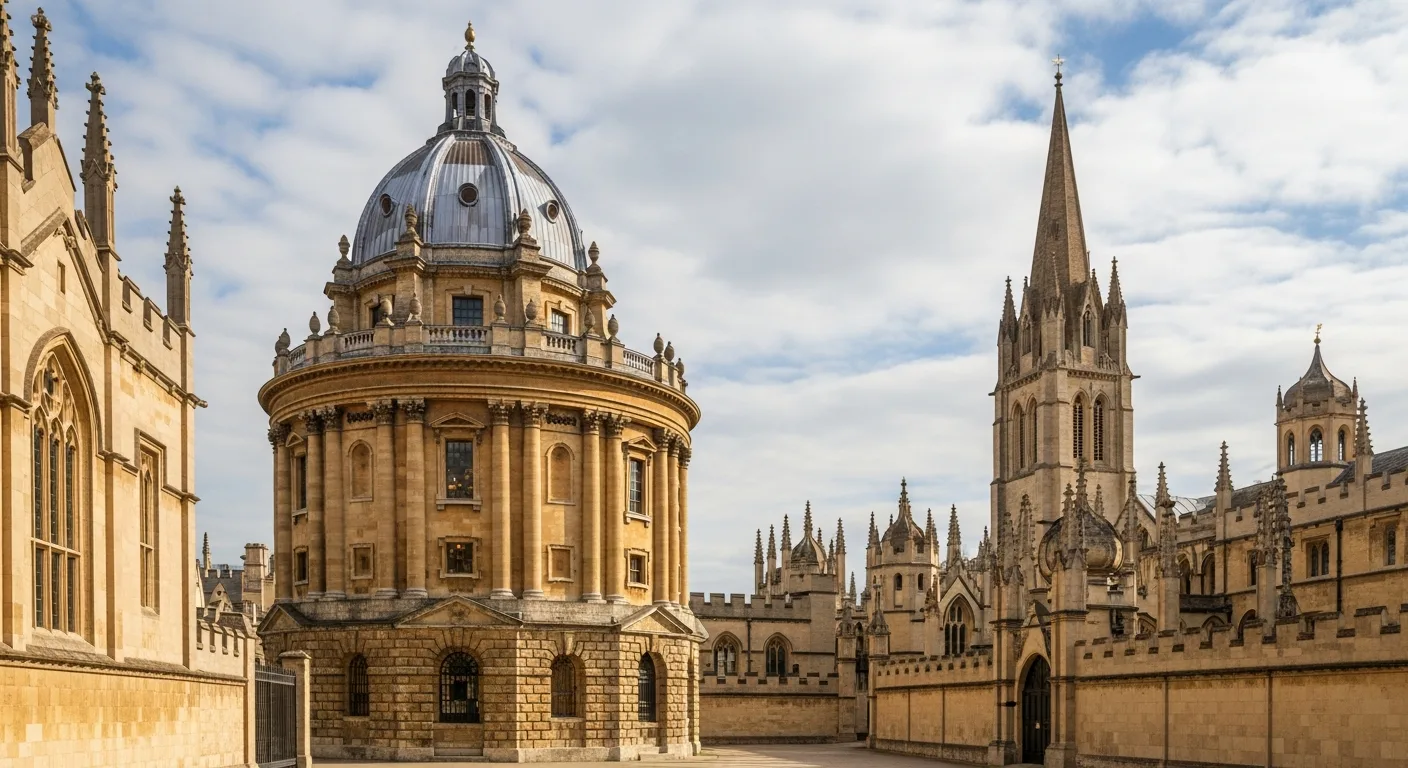
Photos: Wikimedia Commons
When you walk through the gates of the Bodleian Library, you pass walls that remember the fifteenth century. Light falls through stained glass onto stone floors worn smooth by millions of footsteps - the same corridors that J.R.R. Tolkien, Oscar Wilde, Margaret Thatcher and Stephen Hawking once walked. In the quad outside the Radcliffe Camera, students in sub fusc gowns return from their final examinations to be “trashed” by friends with confetti and prosecco, a tradition centuries old. In the dining hall at Christ Church - the very hall that inspired Hogwarts - undergraduates eat dinner by candlelight, while the choir of Magdalen College rehearses in the tower for the May Morning dawn.
This is not a film set. This is an ordinary Tuesday at the University of Oxford: the oldest English-speaking university in the world, an institution that for more than 800 years has shaped people who change the course of history. Oxford is not just another highly ranked university. It is an intellectual ecosystem where, every week, you sit one-on-one with a world-class academic and defend an essay you wrote - the tutorial system, which exists almost nowhere else. Oxford counts 73 Nobel laureates, 30 British Prime Ministers, the inventor of the World Wide Web (Tim Berners-Lee) and the author of Harry Potter among its members of an academic community spread across a small medieval city on the river Thames.
This guide walks international applicants through everything you need to know to apply to Oxford from outside the UK: the UCAS process, admissions tests by subject, the famous tutor-led interviews, course-specific requirements, post-Brexit fees (and how to fund them), and what life is like inside the 39 colleges. If you are also weighing Cambridge, see our Cambridge University guide for international applicants. For a wider picture of UK higher education, our studying in the UK guide covers Russell Group alternatives, the visa system, and graduate routes.
Why Oxford remains Oxford - rankings, reputation, and the tutorial advantage
Oxford has occupied the top three positions worldwide in every major ranking for over a decade: #3 in QS World University Rankings 2026, #1 in Times Higher Education for nine consecutive years (2017-2025), and #5 in Shanghai ARWU. But rankings only tell part of the story. What sets Oxford apart from MIT, Stanford, or Harvard is a teaching model that simply does not scale - and is therefore impossible to replicate at most universities.
The numbers that matter
- 73 Nobel laureates affiliated with Oxford across all categories
- 30 British Prime Ministers educated at Oxford (including Tony Blair, David Cameron, Theresa May, Boris Johnson and Rishi Sunak - five of the last six)
- 74 holders of OBE/CBE in any given year among current faculty
- 140+ Olympic medallists among alumni
- £693 million annual research income (the largest of any UK university)
- 46% international student body - Oxford is one of the most globally diverse top-10 universities in the world
What rankings cannot capture
Numbers describe the institution, but Oxford’s distinctiveness lives in three places that no spreadsheet captures:
- The tutorial system. A weekly conversation with a leading expert in your field is a fundamentally different educational experience from a lecture hall of 300. You cannot hide. You cannot bluff. You learn to argue clearly under pressure - a skill that compounds over three years.
- The Bodleian Library. One of the six legal deposit libraries in the UK, the Bodleian receives a copy of every book published in Britain. It holds more than 13 million printed items. Walking into the Radcliffe Camera reading room as an undergraduate is itself an education in what scholarship looks like.
- The college network. Your college becomes your home, your dining hall, your sports team, your debating society and your friend group for life. Oxford alumni networks are organised college-first, university-second, and that produces a depth of connection most large universities cannot match.
Common misconception: “Oxford is for posh British kids”
This is outdated. The 2024 admissions cycle saw 68.6% of UK undergraduate offers go to state-school applicants (up from 55.6% a decade earlier), and 46% of all students are international. Oxford runs targeted access programmes (UNIQ, Oxford Pathway), commits to the Crankstart Scholarship for low-income UK students, and admits a higher proportion of working-class and first-generation students each year. The popular image of Oxford as Brideshead Revisited belongs to the 1980s.
That said, Oxford is academically brutal. An A* in your strongest subject is the floor, not the ceiling. The tutorial system selects ruthlessly for students who can absorb dense reading lists and defend their conclusions without being fragile about it.
How does Oxford admissions work - UCAS, tests, and interviews
Oxford uses a fundamentally different admissions process from US universities. There is no Common App, no holistic review of extracurriculars, no demonstrated interest, and no SAT. Instead, the system is built around four pillars: academic record, admissions test, written work (some courses), and interview.
The October 15 deadline - non-negotiable
You must submit your UCAS application by 18:00 UK time on 15 October of the year before you intend to start. So for entry in October 2027, the deadline is 15 October 2026. This is roughly three months earlier than the standard UCAS deadline (late January) used by most other UK universities. You cannot apply to both Oxford and Cambridge in the same cycle - UCAS will reject the application.
International applicants should treat this deadline as 14 October at the latest. Time-zone confusion has cost candidates real offers. The UCAS server also slows under heavy load on deadline day.
Step 1: Choose your course (and college)
Oxford undergraduate admission is course-specific. You apply to read one subject (Physics, PPE, Law, Engineering Science, etc.) and you are evaluated on your fit for that subject. Switching is rare and difficult.
- Most popular courses (and acceptance rates 2024 cycle):
- Computer Science: ~7%
- Economics and Management: ~9%
- Medicine: ~10%
- PPE (Philosophy, Politics, Economics): ~15%
- Law (Jurisprudence): ~14%
- Engineering Science: ~17%
- Mathematics: ~18%
- Modern Languages: ~38%
You also choose either a specific college or submit an “open application”, which lets the university allocate you. There is no statistical evidence that one strategy beats the other - choose a college based on size, location, atmosphere or subject strength.
Step 2: Personal statement (UCAS) - academic, not aspirational
The personal statement is 4,000 characters / 47 lines describing why you want to study this subject. Unlike US college essays, Oxford does not want your personal narrative or extracurriculars. Tutors want to see:
- Reading beyond the school syllabus - books, papers, lectures you have engaged with
- Critical reflection - what you found unconvincing, what surprised you
- Subject-specific competence - Olympiads, MOOCs, independent projects
Roughly 80% of the statement should be academic. The remaining 20% can cover relevant extracurriculars (debating for Law, robotics for Engineering, modelling competitions for Maths). Anything that doesn’t connect to the subject is wasted real estate.
Step 3: The admissions test - Oxford’s screening filter
Most courses require a subject-specific test taken in late October or early November. You must register separately through the Tata Consultancy Services (TCS iON) Pearson VUE network - your school does not handle this. International candidates take the test at authorised test centres in their home country.
| Course | Test | Format | Date (2026) |
|---|---|---|---|
| Mathematics, Maths & Stats, Maths & CS, Maths & Philosophy | MAT (Mathematics Admissions Test) | 2.5h, multiple-choice + long-form | 30 October 2026 |
| Physics, Engineering Science, Materials Science | PAT (Physics Aptitude Test) | 2h, problem-solving | 30 October 2026 |
| Computer Science, CS & Philosophy | MAT | 2.5h | 30 October 2026 |
| Medicine, Biomedical Sciences | UCAT (replaced BMAT in 2024) | 2h, computer-based | July - September 2026 |
| Law (Jurisprudence) | LNAT | 2h 15min, MCQ + essay | September 2026 - January 2027 |
| PPE, History, Geography, Economics & Management | TSA (Thinking Skills Assessment) | 2h, MCQ + writing | 30 October 2026 |
| English Literature | ELAT | 90min, comparative essay | 30 October 2026 |
| Modern Languages | MLAT | 1-2h, language-specific | 30 October 2026 |
| History | HAT (History Aptitude Test) | 2h, source analysis | 30 October 2026 |
| Classics | CAT | 1h, source analysis | 30 October 2026 |
These tests are designed to be hard. The MAT, for example, has a median score of around 50/100 - and even strong applicants often score below that. Don’t compare to A-Level or IB scaling; admissions tests measure aptitude, not curriculum mastery. Oxford publishes past papers free on the official admissions site - work through at least 5-7 years of them before sitting the live test.
Step 4: Written work (course-dependent)
For humanities courses (English, History, Modern Languages, Classics, Theology, Music) you submit one or two pieces of marked written work, usually essays from your final year of school. These are not for grade verification - tutors read them to see how you argue, structure, and evidence claims at unsupervised length.
Step 5: Shortlisting
In late November, each college’s tutors review applications and shortlist roughly 40-50% of candidates for interview. The criteria are: predicted/actual grades, admissions test score, personal statement, written work (if applicable), and academic reference. The shortlist threshold varies by subject - competitive courses like Computer Science cut more aggressively than Modern Languages.
If you are not shortlisted, you receive a rejection in late November. If you are shortlisted, you are invited to interview in December.
Step 6: The interview - Oxford’s most distinctive stage
Oxford interviews are not job interviews. They are academic conversations designed to simulate a tutorial. You receive an unfamiliar prompt - a passage, a graph, a mathematical proof, a legal scenario - and you reason through it out loud while tutors press you with follow-ups.
What tutors look for:
- Process, not product. They expect you to be wrong; they want to see how you correct yourself.
- Engagement with new ideas. Can you build on a hint? Can you generalise from a specific case?
- Intellectual honesty. Saying “I’m not sure, but my best guess is X because Y” beats bluffing.
Each shortlisted candidate has 2-4 interviews across 1-3 colleges, each lasting 20-40 minutes. Since 2020, all interviews have been conducted online via Microsoft Teams. International candidates do not need to travel to Oxford.
Step 7: Offers and results
Oxford releases decisions in mid-January. Offers are conditional on grades - typically:
- A-Level: AAA or AAA depending on course
- IB Diploma: 38-40 points with 7,6,6 or 7,7,6 at Higher Level
- Indian CBSE/ISC: 90-95% in five subjects, including Maths/Sciences for STEM
- US AP: 5,5,5 in three relevant APs plus strong SAT/ACT
- French Bac: 16/20 with 17-18 in core subjects
- German Abitur: 1.0-1.3 GPA
- Italian Maturità: 95/100+
- Spanish Bachillerato/EBAU: 9.0+ across the board
- Singapore A-Level: AAA/AAB with H2 distinctions
- Russian Aттестат: 5.0 GPA + Olympiad evidence
International qualifications are evaluated on Oxford’s own equivalency tables - your grades are weighed against country-specific norms, not converted to a US-style GPA.
What does Oxford teach? - courses, faculties, and where Oxford excels
Oxford offers 48 undergraduate courses organised across four divisions: Humanities; Mathematical, Physical and Life Sciences; Medical Sciences; and Social Sciences. Most are three-year BA programmes; sciences and engineering are typically four-year integrated Master’s (MEng, MMath, MPhys, MChem).
Where Oxford has world-leading reputation
- PPE (Philosophy, Politics, Economics) - Oxford invented this degree in the 1920s and it has produced more British Prime Ministers and senior civil servants than any other course. Famous PPE alumni include David Cameron, Liz Truss, Aung San Suu Kyi, Imran Khan, and Benazir Bhutto.
- Modern History - strongest history faculty in the UK by REF research rating; particularly known for medieval, early modern and imperial history.
- Mathematics & Statistics - alumni include Roger Penrose (Nobel Physics 2020), Andrew Wiles (Fermat’s Last Theorem proof), and Hannah Fry.
- Engineering Science - Oxford’s general engineering degree is unique because students don’t specialise until year 3, allowing genuine interdisciplinary work.
- Medicine (BMBCh) - six-year course with three pre-clinical and three clinical years, taught at the John Radcliffe Hospital. Smaller cohort (~150/year) and stronger research orientation than most UK medical schools.
- Law (Jurisprudence BA) - three-year qualifying law degree, with a four-year option including a year abroad in France, Germany, Italy, Spain or the Netherlands. Alumni include UK Supreme Court justices, ICJ judges, and major commercial barristers.
- Computer Science - small course (~30 places/year), heavily theoretical, with strong links to DeepMind and Microsoft Research Cambridge.
Notable joint and unusual courses
- Human Sciences - combining biology, psychology, anthropology and statistics
- Classical Archaeology and Ancient History
- Earth Sciences - four-year MEarthSci with a research thesis year
- Music - academically focused (composition, musicology), not a conservatoire
- Theology and Religion
Open Curriculum vs Oxford specialisation - pick your model
Oxford is the opposite of Brown University’s Open Curriculum. At Oxford you choose your subject in October of Year 12 (age 16) and you commit. There is no double major, no minor system, almost no flexibility to switch after admission. For students who already know what they want to study deeply, this is a feature. For students who want to explore, the Liberal Arts model in the US is a better fit.
How much does Oxford cost - fees, living costs, and Brexit’s impact
Brexit transformed the financial picture for European applicants. Until 2020, EU students paid the same fees as UK students (£9,250/year) and could borrow from Student Finance England. From 2021 onwards, EU students are classified as international (Overseas) and pay 3-5× more.
Tuition fees 2026/2027
| Course type | Home (UK) | International (Overseas) |
|---|---|---|
| Most arts and humanities | £9,250 | £33,050 |
| Sciences (Physics, Chemistry, Biology) | £9,250 | £41,920 |
| Computer Science, Engineering, Maths | £9,250 | £44,240 |
| Medicine (pre-clinical) | £9,250 | £44,240 |
| Medicine (clinical years 4-6) | £9,250 | £48,620 |
Plus a college fee of approximately £9,310/year for international undergraduates not classified as Home (charged separately by your college).
Living costs in Oxford
Oxford’s official living-cost estimate for 2026/2027 is £14,500 - £18,000 per year (39 weeks):
- Accommodation: £6,500 - £9,000 (most colleges house undergraduates in years 1 and 3 minimum)
- Food: £2,000 - £3,500 (college “battels” for hall meals are subsidised but vary)
- Books and academic costs: £400 - £600
- Personal/social/travel: £3,500 - £5,000
- Vacation (rent during summer): £1,500 - £2,500
Total annual cost for international undergraduates
- Humanities/Social Sciences: £47,500 - £52,000 (~USD 60,000-66,000 / EUR 56,000-62,000)
- STEM courses: £55,500 - £62,000 (~USD 70,000-79,000 / EUR 66,000-73,000)
- Medicine clinical years: £62,500 - £66,000 (~USD 79,000-84,000 / EUR 73,000-78,000)
A three-year BA in PPE will cost an international family approximately £145,000 (USD 184,000 / EUR 170,000) all-in. A four-year MEng in Engineering Science: approximately £235,000 (USD 298,000 / EUR 277,000).
How does this compare?
Oxford is significantly cheaper than HYPSM total cost of attendance (USD 91,000+ at Columbia, USD 95,000+ at Stanford). It is comparable to other Russell Group universities at international rates (Imperial £42,000 - £52,000, UCL £35,000 - £45,000, LSE £30,000 - £38,000). Compared to continental Europe, Oxford is dramatically more expensive - ETH Zurich charges ~CHF 1,500/year, Sciences Po charges €14,000 - €15,000/year for international students, German public universities charge €0 - €1,500/semester.
Currency strategy for international families
The £/USD and £/EUR rates have moved significantly since Brexit. Strategies to manage exchange-rate risk:
- Open a Wise or Revolut multi-currency account to hedge transfers across the academic year
- Lock fees in advance if your home currency strengthens against GBP - Oxford allows term-by-term payment but bank transfer fees add up
- Plan for a 5-10% buffer above the published cost of attendance to absorb currency volatility
How to fund Oxford - scholarships, awards, and external funding
Oxford does not offer need-based aid to international undergraduates the way HYPSM does. Most international students fund through a combination of family, government scholarships, and merit awards. The two exceptions are the Crankstart Scholarship (UK only) and the Reach Oxford Scholarship (developing-country undergraduates only). For postgraduate study, Oxford has more substantial international funding - most prominently Rhodes and Clarendon.
Undergraduate scholarships for international students
Reach Oxford Scholarship - the flagship undergraduate award
- Who it’s for: undergraduate students from low-income backgrounds in developing countries (DAC list) who would otherwise be unable to study at Oxford
- What it covers: full tuition, college fees, living grant, and one round-trip flight per year
- Number awarded: ~5 per year
- Eligibility: you must demonstrate financial inability to fund Oxford, have an offer of admission, and meet country eligibility (excludes EU, North America, Australia, NZ, Singapore, Hong Kong, GCC states)
- Application: through the standard Oxford application; Reach is allocated automatically to qualifying applicants
Other undergraduate-level options
- Oxford Bursaries: financial-need top-ups for some students
- College-specific awards: many of the 39 colleges have small annual awards or book grants for international undergraduates - check each college’s website (Christ Church Senior Scholarships, Magdalen Demyships, etc.)
- Oxford Centre for Islamic Studies scholarships for students from Muslim-majority countries
- Said Foundation for students from Jordan, Lebanon, Palestine, Syria
- Aga Khan Foundation for students from East Africa, South/Central Asia
- Foreign and Commonwealth Office Chevening (postgraduate only, but worth flagging early)
Postgraduate scholarships - where Oxford really shines
Rhodes Scholarship
The world’s most prestigious graduate scholarship. Awarded across 25+ regional constituencies worldwide:
- Coverage: full Oxford fees + £18,180 stipend + flights + healthcare for up to three years
- Selection: ~100 scholars per year globally, chosen by national/regional committees
- Eligibility: 18-28 years old at time of application, completed undergraduate degree
- Famous Rhodes alumni: Bill Clinton, Susan Rice, Naomi Wolf, Kris Kristofferson, Bobby Jindal
Constituencies cover: USA (32 places), Germany (3), Australia (10), Canada (11), India (5), South Africa (10+), New Zealand (3), Pakistan (1), Hong Kong (1), Israel (2), China (4), Saudi Arabia/Gulf (2), Zimbabwe (1), Singapore/Malaysia (1), and several “Global” places open worldwide.
Clarendon Fund
- Coverage: full fees + ~£18,180 stipend
- Number: ~200 awards per year for postgraduate study at any Oxford department
- Eligibility: open to all nationalities; no separate application - automatic consideration on admission
Subject-specific postgraduate awards
- Felix Scholarship - Indian and developing-country postgraduates (3-year DPhil funding)
- Hill Foundation Scholarship - Eastern European postgraduates (Russia, Ukraine, Belarus, Moldova, Caucasus and Central Asian republics)
- Weidenfeld-Hoffmann Scholarship - emerging-economy candidates with public-service trajectory
- Skoll Scholarship - MBA candidates focused on social entrepreneurship
- Ertegun Scholarship - humanities postgraduates
- Marshall Scholarship - US citizens (alternative to Rhodes for UK study)
- Fulbright UK - US citizens for one-year master’s
External funding by region
- India: Inlaks Shivdasani Foundation, KC Mahindra, JN Tata Endowment, Aga Khan Foundation
- China: China Scholarship Council (CSC) - funds Oxford DPhils
- South Korea: Kwanjeong Educational Foundation
- Latin America: Fundación Carolina (Spain-affiliated), CONACyT (Mexico), Becas Chile
- Africa: MasterCard Foundation Scholars Program, Mandela Rhodes
- EU (post-Brexit): DAAD (Germany), Erasmus+ (limited), national merit programmes
- Middle East: Said Foundation, Saudi Aramco scholarships, UAE government schemes
- Southeast Asia: Singapore A*STAR, Khazanah (Malaysia), DOST (Philippines)
Loans and alternative financing
International students cannot access UK Student Finance. Options:
- Prodigy Finance - no-cosigner loans for graduate study at Oxford, rates 8-14% APR
- MPower Financing - graduate loans for international students at top universities
- Country-specific student loan schemes (HDFC Credila in India, Sallie Mae in the US, etc.)
What is student life like at Oxford - colleges, traditions, and societies
Oxford’s social life is organised around the 39 colleges, each with distinct character, scale and traditions. Choosing a college matters less academically than emotionally - you’ll spend three years there.
How the college system actually works
- Every undergraduate belongs to one college for the duration of their degree
- College provides: accommodation (typically guaranteed for years 1 and 3 minimum, often all years), dining hall (“hall”), library, JCR (Junior Common Room - undergraduate space), MCR (Middle Common Room - postgraduate), and pastoral support (welfare officer, dean, chaplain)
- Tutorials happen at college level, lectures at university level
- Each college has its own sports teams (rowing, rugby, football, netball), drama society, music groups, and debating culture
- College “Boat Club” rowing rivalry (Summer Eights, Torpids) is a defining undergraduate experience
College categories and recommendations
| Type | Examples | Best for |
|---|---|---|
| Large historic | Christ Church, Magdalen, Merton, Balliol, New College | Tradition, formal hall, networking |
| Mid-size historic | Trinity, Wadham, St John’s, Brasenose | Balance of community and resources |
| Smaller historic | Pembroke, Lincoln, Worcester | Tight-knit community |
| Modern (post-1900) | Wolfson, St Catherine’s, Lady Margaret Hall | Less formal, often more diverse |
| Permanent Private Halls | Regent’s Park, Wycliffe Hall | Religious affiliation, smaller still |
| Graduate-only | Nuffield, St Antony’s, Linacre, Wolfson | Postgraduate community |
International applicants often gravitate toward larger, more international colleges (Magdalen, Wadham, St Antony’s for grad). But academic outcomes don’t differ meaningfully by college - pick on atmosphere.
Traditions you will encounter
- Sub fusc: black robes, white shirts, dark suits worn for matriculation, exams and graduation
- Matriculation: formal ceremony at Sheldonian Theatre marking your entry into the university
- Formal Hall: weekly or nightly candlelit dinner in college, gowns required
- Bopping (bops): college-organised themed parties
- Trashing: post-exam celebration where friends douse you in confetti and sparkling wine (now regulated to designated areas to protect the historic buildings)
- May Morning: 6am celebration on 1 May, with the Magdalen College choir singing from the tower while students gather on Magdalen Bridge
- Encaenia: end-of-year ceremony honouring distinguished visitors
- Eights Week: summer rowing regatta where colleges compete bumps-style on the Isis (the Oxford stretch of the Thames)
Societies and clubs
Oxford has 400+ student societies - from the famous (Oxford Union for debating, Oxford University Conservative Association/OULC for politics, OUDS for theatre, Oxford University Press for student journalism via Cherwell and Isis) to the niche (Tolkien Society, Oxford Quantum Information Society, Oxford India Society).
Particularly relevant for international students:
- Oxford India Society, Oxford China Society, Oxford African Society, Oxford Pakistan Society, Oxford Latin American Society - large diaspora networks that organise dinners, speaker events and career mentoring
- Oxford Investment Society for finance/banking recruitment
- Oxford Entrepreneurship Society for tech/VC tracks
- Oxford Strategy Group for management consulting recruitment
- Oxford Hub for community service and social impact
Academic terms and rhythm
Oxford runs three eight-week terms per year:
- Michaelmas (October - December)
- Hilary (January - March)
- Trinity (April - June)
Each term is intense - typically 1-2 essays per week, a tutorial per week per subject, plus lectures. The vacations (six weeks at Christmas, six at Easter, sixteen in summer) are not holidays - most students are expected to read significantly, complete vacation essays, or do summer research/internships.
How does the UK student visa work after Brexit?
EU/EEA students need a Student visa (formerly Tier 4) to study at Oxford for any course longer than six months. The process is mature, fast, and well-documented - Oxford’s International Student Welcome Service guides applicants through it.
Student visa requirements
- Confirmation of Acceptance for Studies (CAS) from Oxford after you accept your offer (typically issued in May - June)
- Financial proof: cover the full first-year tuition + £1,483/month for nine months living costs (Oxford). For 2026/2027 this is roughly £33,050 - £44,240 + £13,347 = £46,400 - £57,600 in your account for 28 consecutive days before applying
- English language proof: usually waived if your CAS confirms you met Oxford’s English requirement (IELTS 7.5 or TOEFL 110)
- TB test certificate for applicants from listed countries (most of Asia and Africa)
- Application fee: £490 for the visa + £776/year IHS (Immigration Health Surcharge - gives full NHS access)
Application timeline
- Apply up to 6 months before your course starts (so April for an October start)
- Decision typically within 3 weeks for standard applications; priority service available for £500 (5-day turnaround)
- After arrival in the UK, collect your Biometric Residence Permit (BRP) within 10 days at the designated post office
Working during studies
Student visa holders can work:
- Up to 20 hours per week during term time
- Full-time during vacations
- Internships and placements if part of the academic course
You cannot work as a freelancer, run a business, or take a permanent full-time post.
Post-study options - the Graduate route
Since 2021, the UK has run the Graduate Route: a post-study work visa that allows international graduates to stay and work for 2 years after a bachelor’s or master’s (3 years after a PhD), without needing employer sponsorship. This makes Oxford significantly more attractive than it was 2010-2020, when international students had to leave within four months of graduating unless they had a job offer with sponsorship.
After the Graduate Route, you can switch to a Skilled Worker visa if you find an employer willing to sponsor you (most major UK employers - banks, consultancies, tech firms - sponsor freely for Oxford graduates).
Is Oxford right for you? - a candid summary
Oxford is exceptional for a specific kind of student: someone who already knows their subject deeply, wants to be challenged by tutors weekly for three years, and values intellectual rigor over breadth. It’s a poor fit for students who:
- Want to explore multiple disciplines before specialising → consider Brown’s Open Curriculum or Columbia’s Core
- Prioritise extracurriculars and “well-rounded” admissions → US schools weight this far more heavily
- Need need-based financial aid as an international undergraduate → only HYPSM-tier US schools meet 100% of demonstrated need for internationals
- Want a campus-centric American college experience → Oxford is a city, not a campus, and college life is collegiate-British rather than American-collegiate
Who Oxford suits best
You’ll thrive at Oxford if:
- You have a specific subject obsession that has driven your reading beyond school
- You can write and defend an argument under time pressure without crumbling at criticism
- You’re comfortable with academic intensity - five hours of reading per essay, two essays per week, in addition to lectures
- You want a degree recognised globally (Oxford degrees are accepted by virtually every regulator and employer worldwide)
- You want post-study UK work options through the Graduate Route
Strong English required
Oxford does not offer foundation or pathway programmes for international students. You arrive at academic-native English level. If your IELTS is 6.5-7.0 you should plan a year of intensive English preparation before sitting the IELTS Academic 7.5 / TOEFL 110 required for entry. Need to push your TOEFL score? Try PrepClass adaptive TOEFL prep - the free trial lets you diagnose your weak skills before committing to a prep plan.
Next steps
If Oxford is your target:
- Year before application (Year 12 / age 16-17): pick your subject, start reading deeply beyond school, identify your admissions test
- Summer before application: register for IELTS/TOEFL and admissions test; visit Oxford Open Days (June) if possible - virtual sessions also available
- September of application year: draft personal statement, finalise UCAS choices (max 5, only one of Oxford/Cambridge), brief your reference writer
- 15 October 18:00 UK time: submit UCAS - do not wait until the last hour
- Late October/early November: sit admissions test
- November - December: prepare for interview with mock sessions; familiarise yourself with current debates in your subject
- December: interview (online via Microsoft Teams)
- January: decision
- Summer: meet conditional offer, apply for Student visa, prepare for Michaelmas
Want a structured plan? Book a free consultation with College Council - we work with international applicants on Oxbridge admissions, including subject choice, personal statement strategy and interview preparation. We’ve placed students at Oxford from 30+ countries since 2018.
If Oxford doesn’t fit, our other guides will help you triangulate:
- Cambridge University guide - Oxford’s twin, with a more STEM-leaning profile
- Studying in the UK overview - Russell Group alternatives (Imperial, UCL, LSE, Edinburgh, KCL)
- Harvard guide and Stanford guide - US elite alternatives
- Studying abroad cost guide - detailed Oxford fee breakdown by course
Whatever you decide, give yourself 18+ months to prepare. Oxford rewards depth, not last-minute polish - and the candidates who succeed almost always started reading their subject seriously a year before they sat the admissions test.
 IELTS Academic and General Training prep
 All four skills in one place, with Writing and Speaking marked by AI against the band descriptors.

 Prepclass