
Best Courses at LSE - Economics, PPE, Finance, Government 2026
The strongest programmes at LSE: BSc Economics, PPE, Government, Finance, International Relations, Mathematics & Economics, Law, Management. Which one is right for you?

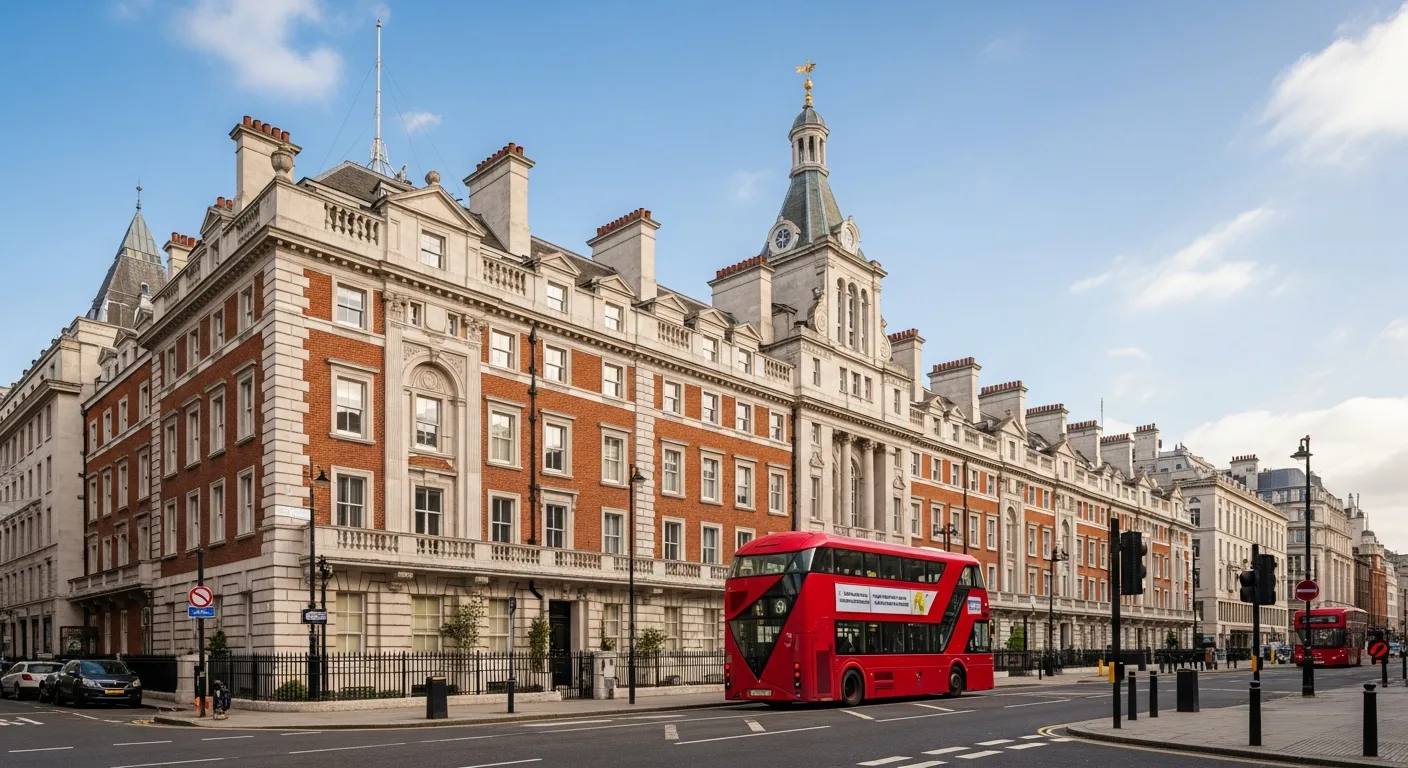
Photos: Wikimedia Commons
LSE Courses - Bottom Line Up Front for International Applicants
LSE is not a "general" university in the mould of Oxford, Cambridge, or UCL - it is a specialist social-science institution in the heart of Holborn, where 12,330 students from more than 140 countries study exclusively economics, politics, law, finance, and related disciplines. There is no medical school here, no engineering faculty, no physics department. What does exist is a globally dominant institution in social sciences - and a degree-level selection decision that matters far more here than at a broader university, precisely because every programme is a concentrated bet on a particular career direction.
Bottom line up front: for an international applicant with strong advanced-level mathematics - A* in A-level Mathematics, or 7 in IB HL Mathematics: Analysis and Approaches - the quantitative routes are realistic: BSc Economics (flagship), BSc Mathematics and Economics, BSc Finance, BSc Accounting and Finance, and BSc Actuarial Science. Without top-tier mathematics, the more accessible and no less prestigious routes include BSc Government, BSc International Relations, BSc Philosophy, Politics and Economics (LSE’s own version of PPE), BSc Social Anthropology, BSc Sociology, and LLB Law (which requires the LNAT admissions test). BSc Management in the Department of Management is a strong business-oriented degree with powerful on-campus City and consulting recruiting.
LSE’s overall acceptance rate is approximately 8.5%, but this is unevenly distributed: Economics and Mathematics and Economics at 5-7%, PPE and Law at 6-8%, Government and International Relations at 8-10%, Social Anthropology and Sociology at 12-18%. For an international applicant from a high-performing school - a selective state school, independent school, or international school with a strong track record of UK university placements - LSE sits as a genuine reach or high-target school for quantitative economics profiles. It is more accessible than Oxbridge for the typical economics applicant, but significantly more selective than the average Russell Group university. The rest of this guide breaks down which course matches your profile, what the application strategy looks like, and what actually awaits you after graduation. For the full context on admissions, fees, and life in London, see our pillar on studying at LSE.
Which Courses at LSE Are the Strongest?
LSE is a specialist social-science institution - there is no medical school, no engineering faculty, no natural sciences department. What it does, it does at the global frontier. BSc Economics in the Department of Economics is the university’s flagship programme and one of the strongest undergraduate economics degrees in the world. In the QS World University Rankings by Subject 2025, LSE’s Economics & Econometrics field ranks in the global top 5. In the Research Excellence Framework (REF) 2021, the Department of Economics placed in the UK’s top tier for quality of research outputs - an indicator that the faculty teaching your degree are themselves at the leading edge of the discipline.
The second major pillar is politics and international relations. BSc Government (Department of Government) and BSc International Relations (one of the world’s oldest IR departments, founded in 1927) both rank in the global top 3 in QS Politics & International Studies 2025. These are not programmes that simply teach political theory in a library - they sit inside a London institution that has trained prime ministers, foreign ministers, and central bank governors, and that maintains live research relationships with institutions such as the European Central Bank, the United Nations, and the World Bank.
The third pillar is finance and accounting. The Department of Finance (which runs BSc Finance and BSc Financial Mathematics and Statistics) and the Department of Accounting (BSc Accounting and Finance) collectively place LSE in the global top 10 in QS Accounting & Finance 2025. The critical distinguishing factor is geography: the City of London is 20 minutes’ walk from campus, and every major investment bank, hedge fund, and asset manager in Europe runs active on-campus recruiting targeted specifically at LSE undergraduates.
The fourth cluster covers law, management, and quantitative methods. LSE Law School offers the LLB Bachelor of Laws (3 years) and LLB with French Law (4 years, including a year at Université Paris 1 Panthéon-Sorbonne). The Department of Management offers BSc Management and BSc Management Sciences (a more quantitative variant). The Department of Mathematics and Department of Statistics together offer BSc Mathematics and Economics, BSc Mathematics with Economics, BSc Mathematics, Statistics and Business, and BSc Actuarial Science - programmes that bridge mathematical rigour and social-science application at an advanced level.
The fifth group encompasses the classic social sciences: BSc Sociology, BSc Social Anthropology, BSc Social Policy, BSc Geography, BSc Environment and Sustainable Development, BSc History, and BSc Philosophy and Economics. These programmes are less obvious in the context of City recruiting, but are academically rigorous and considerably more accessible to international applicants who do not have an extreme mathematics background. They also open legitimate doors into NGOs, research institutions, international development, and policy work.
Are BSc Economics and BSc Mathematics and Economics the Same Course?
No. They are two distinct programmes, although they share a significant portion of the core curriculum. BSc Economics (3 years, Department of Economics) is the classic economics degree - microeconomics, macroeconomics, econometrics, game theory, development economics - plus optional modules in finance, political economy, and the history of economic thought. Entry typically requires A* in A-level Mathematics (or IB 7 in HL Mathematics: Analysis and Approaches), with strong grades in two further advanced-level subjects (typically A* or A at A-level, or 6-7 at IB Higher Level). The cohort is approximately 200-250 students per year, with an acceptance rate of around 6-7%.
BSc Mathematics and Economics (3 years, joint Department of Mathematics and Department of Economics) is substantially more quantitative - formal mathematical analysis, linear algebra, optimisation theory, probability calculus - combined with core economics. The mathematics threshold is higher still: applicants typically need the highest possible grade in both A-level Mathematics and A-level Further Mathematics (or IB 7 in HL Mathematics: Analysis and Approaches), and TMUA (Test of Mathematics for University Admission) or MAT scores are strongly encouraged. The cohort is smaller (approximately 60-90 students per year), and the acceptance rate is approximately 5-6%. This is the programme to target if you are aiming for a career in quantitative finance, academic econometrics, operations research, or a PhD in economics at a top US university - it is one of LSE’s most direct pipelines into Harvard, MIT, and Princeton economics doctoral programmes.
A third variant: BSc Mathematics with Economics - the Department of Mathematics as the primary department, with economics as a minor. Less core economics, more pure mathematics. For an applicant with a national mathematics olympiad background (IMO, a national olympiad medal, or equivalent competition record), this profile carries a real application advantage, and LSE admissions tutors look favourably on demonstrated mathematical distinction beyond exam grades alone.
Application pitfall: LSE treats mathematics as an absolute prerequisite for all three variants. Without strong advanced-level mathematics - regardless of excellence in other subjects - an application to Economics, Mathematics and Economics, or Mathematics with Economics will not be competitive. In practical terms: secure A* in A-level Mathematics (ideally A* in Further Mathematics as well), or IB 7 in HL Maths AA, and consider sitting the TMUA, which is relatively low-cost and can strengthen a borderline application. Rounding out your portfolio with a mathematics-adjacent subject such as Physics or Computer Science signals to admissions tutors that your mathematical aptitude is not a single-subject peak.
How Does PPE at LSE Differ from PPE at Oxford?
BSc Philosophy, Politics and Economics at LSE (3 years) is an interdisciplinary programme combining philosophy (Department of Philosophy, Logic and Scientific Method), politics (Department of Government), and economics (Department of Economics). The cohort is approximately 60-80 students per year, with an acceptance rate of 6-7%. Entry requires strong advanced-level mathematics - typically A* or A in A-level Mathematics (or IB 6-7 in HL Maths AA) - plus strong grades in at least two further advanced subjects.
The key differences from PPE at Oxford (BA Philosophy, Politics and Economics, 3 years) are substantial:
-
Tutorial system - Oxford runs PPE in the celebrated 1:1 or 1:2 tutorial format, with weekly essay-based sessions with a personal tutor who is often a leading academic in the field. LSE PPE is delivered through lectures and seminars (small-group discussion classes), without the classic Oxford tutorial structure. Neither is inherently superior, but the pedagogical experience is meaningfully different.
-
Philosophy - Oxford PPE is deeply rooted in classical political philosophy (Locke, Mill, Rawls, the Anglo-American analytic tradition). LSE PPE skews toward philosophy of science, logic, and scientific methodology - a legacy of Karl Popper, who taught at LSE from 1946 to 1969 and shaped the department’s intellectual DNA. If your intellectual interest lies in how knowledge is constructed rather than who should govern, LSE’s approach may be a better fit.
-
Economics - LSE PPE has a more quantitative core economics stream from year one (Microeconomics 1, Macroeconomics 1, Quantitative Methods in Mathematics). Oxford PPE introduces economics through more intuition-based macro and micro in year one, building quantitative depth in subsequent years. If you are confident in mathematics and want to integrate it into your social-science thinking from day one, LSE’s structure accelerates that process.
-
Location - LSE sits in the heart of London (Holborn, five minutes’ walk from Covent Garden and the City). Oxford is a quieter university town approximately 90 minutes from London by train. For a student planning internships in finance or consulting from their first summer, LSE’s geographic positioning is a practical and frequently underestimated advantage.
-
Admissions test - Oxford PPE requires the TSA (Thinking Skills Assessment) in November, which tests critical thinking and problem-solving under timed conditions. LSE PPE does not typically require an additional admissions test - the Personal Statement and academic grades are the primary assessment tools, meaning preparation effort concentrates on the application essay rather than a separate test.
Bottom line for an international applicant: if you want classical political philosophy in the Anglo-American tradition, a pathway into UK public service, diplomacy, or academia - Oxford PPE carries the historic brand and the tutorial-based depth that the civil service and academe associate with it. If you want PPE as a springboard for finance, consulting, or international economics and policy - LSE PPE is more practically positioned, better integrated with quantitative economics from the outset, and geographically better placed for early-career opportunities. Full comparison in our pillar on Oxford.
BSc Government, International Relations, and Public Policy at LSE
BSc Government (Department of Government, 3 years) is a rigorous BSc in political science - political theory, comparative politics, British and EU institutions, US politics, Middle East studies, post-communist transitions in Europe and Asia. The cohort is approximately 100-130 students per year, with an acceptance rate of around 8-10%. Entry requires strong grades in three advanced-level subjects; advanced mathematics is welcomed but not an absolute requirement, particularly if History, Economics, or a foreign language at the highest grades anchors the profile.
BSc International Relations (Department of International Relations - one of the world’s oldest IR departments, founded in 1927) is a 3-year BSc focused on IR theory, diplomacy, international security, foreign policy analysis, and development studies. The cohort is approximately 100-150 students per year, with an acceptance rate of 8-10%. LSE ranks in the global top 3 in QS Politics & International Studies 2025 - this is a degree with an exceptionally strong reputation in policy institutions: Chatham House, IISS, RUSI, the United Nations Secretariat, and a broad range of foreign ministries send regular recruiters to campus.
BSc Politics and Economics (joint Department of Government and Department of Economics) is oriented towards political economy and the quantitative analysis of public policy. It requires strong advanced-level mathematics - typically A* or A in A-level Mathematics - and is well suited to applicants who want the rigour of economics combined with political context.
BSc Social Policy (Department of Social Policy) focuses on welfare systems, public health, education policy, and housing - the architecture of the modern state. Less selective (approximately 12-15% acceptance rate), but increasingly quantitative in years two and three as students engage with impact evaluation and policy modelling.
For an international applicant aiming for a career in foreign ministry, the United Nations system, the IMF or World Bank, the European institutions in Brussels, or policy think-tanks and research organisations, the combination of BSc Government, BSc International Relations, and BSc Politics and Economics represents a degree stack with direct institutional pipelines. Worth noting: LSE maintains an active relationship with the UK Civil Service Fast Stream - the Cabinet Office visits campus annually, and the FCDO (Foreign, Commonwealth and Development Office) and HM Treasury recruit disproportionately from LSE. For an international student with multilingual credentials and regional expertise - in Eastern Europe, the Middle East, Central Asia, or the Asia-Pacific - this opens realistic pathways into both UK institutions and Washington-based policy bodies such as the Brookings Institution, the Carnegie Endowment, or the Atlantic Council.
Finance, Accounting, and Management - Building a Path to the City
BSc Finance (Department of Finance, 3 years) and BSc Accounting and Finance (Department of Accounting, 3 years) are LSE’s two flagship programmes for careers in investment banking, asset management, private equity, and hedge funds. LSE ranks in the global top 10 in QS Accounting & Finance 2025. Both programmes require strong advanced-level mathematics (A* in A-level Mathematics or IB 7 in HL Maths AA equivalent) and a finance-oriented Personal Statement - acceptance rates are approximately 7-9%.
BSc Financial Mathematics and Statistics (joint Department of Mathematics and Department of Statistics) is the most quantitative option on campus - designed specifically for careers in quantitative trading, risk modelling, structured products, and actuarial work. The cohort is small (approximately 50 students per year), entry requires top grades in A-level Mathematics and Further Mathematics (or IB HL equivalent), and TMUA or MAT results are strongly encouraged. This is a niche degree that consistently places graduates into the most technically demanding roles in the City - quant desks at Goldman Sachs, JP Morgan, and Deutsche Bank actively recruit here.
BSc Actuarial Science (Department of Statistics) is accredited by the Institute and Faculty of Actuaries (IFoA), meaning students earn exemptions from a portion of the professional actuarial examinations during the course of their degree. This is a specialised but highly regarded pathway into insurance, reinsurance, and pension fund management - industries that value the combination of mathematical precision and regulatory awareness that the programme develops.
BSc Management (Department of Management) and BSc Management Sciences are LSE’s business-oriented programmes - broader and more generalist than Finance, covering strategy, organisational behaviour, operations, and marketing alongside quantitative methods. The cohort is approximately 80-120 students per year, with acceptance rates of 9-12%. The Department of Management has a strong on-campus recruiting relationship with McKinsey, BCG, Bain, the Big Four (Deloitte, PwC, EY, KPMG), and major tech firms (Amazon, Google, Meta). If your goal is consulting or general management rather than front-office finance, Management is often the more natural fit than Economics.
One practical advantage that deserves emphasis: the City of London is literally 20 minutes’ walk from the LSE campus (Holborn → Bank Station → the Square Mile). The geographic proximity means that most major financial institutions run insight days, spring weeks, and summer internships explicitly targeted at LSE undergraduates from as early as first year - a structural advantage that programmes in other UK cities, or even in Oxford and Cambridge, cannot match purely on logistics. For an international student, this proximity creates a concrete pathway to a summer internship after year one, with a global firm in London, and from there into a return offer or an international transfer - back to your home market, or into a financial hub in New York, Singapore, or Dubai.
| Applicant profile | LSE course | Application difficulty |
|---|---|---|
| A* in A-level Mathematics and Further Mathematics (or IB 7 HL Maths AA), maths olympiad record | BSc Mathematics and Economics, BSc Financial Mathematics and Statistics | reach |
| A* in A-level Mathematics (or IB 7 HL Maths AA), targeting City finance | BSc Economics, BSc Finance, BSc Accounting and Finance | reach-target |
| A or A* in A-level Mathematics (or IB 6-7 HL Maths AA), interdisciplinary interests | BSc Philosophy, Politics and Economics (PPE) | target |
| Strong humanities profile - A* in History and/or Politics at advanced level | BSc Government, BSc International Relations | target |
| Strong Personal Statement, legal career focus, LNAT prepared | LLB Law, LLB with French Law | target |
| Business profile with strong extracurriculars, solid but not top-tier maths | BSc Management, BSc Management Sciences | match-target |
| Classical humanities background, no advanced mathematics | BSc Social Anthropology, BSc Sociology, BSc History | match |
LLB Law and the Hidden Gems at LSE
LSE Law School offers two flagship undergraduate programmes: the LLB Bachelor of Laws (3 years, approximately 200 students per year) and the LLB with French Law (4 years, including a year at Université Paris 1 Panthéon-Sorbonne, approximately 25 students per year). Both require the LNAT (National Admissions Test for Law) - a critical reasoning and essay-based test sat between October and January. LSE Law placed among the UK’s top law departments in the Research Excellence Framework 2021, at the level of Oxford, Cambridge, and UCL.
For an international applicant, the key practical consideration is jurisdiction. An LLB from LSE does not automatically authorise practice outside England and Wales. If you plan to practise law in the United States, you will need to satisfy individual state bar requirements (many US states require foreign-trained lawyers to sit the bar examination; New York is the most common entry point for internationally trained lawyers). In other common-law jurisdictions - Australia, Canada, India, Singapore - additional conversion or qualifying examinations typically apply. That said, the LSE LLB is an excellent foundation for careers in international commercial law, mergers and acquisitions, investment arbitration, or an LLM at a top US law school (Harvard Law, Yale Law, Columbia Law). LSE Law graduates consistently place into magic circle firms (Allen & Overy, Clifford Chance, Linklaters), white-shoe firms in New York and Brussels, and international organisations including the International Court of Justice and the International Criminal Court.
Hidden gems at LSE that international applicants often overlook:
-
BSc Social Anthropology (Department of Anthropology) - global top 5 in QS Social Anthropology; one of the world’s strongest programmes in social anthropology, with deep links to field research in every major region of the world. Less selective (approximately 12-15% acceptance rate), and more accessible to applicants without a strong mathematics background. Strong pathways into international development, humanitarian organisations, policy research, and journalism.
-
BSc Geography and BSc Environment and Sustainable Development (Department of Geography and Environment) - combining economic geography, urban studies, climate policy, and environmental governance. Increasingly relevant for careers in sustainability consulting, climate finance, and international environmental policy.
-
BSc Philosophy and Economics (as an alternative to PPE, without the politics component) - more tightly focused on philosophy of science, logic, and microeconomic theory. Suits applicants who want the intellectual framework of philosophy without the breadth of a three-field degree.
-
BSc History (Department of International History) - strong in economic history, diplomatic history, and the history of empire and globalisation. A foundation for careers in journalism, international affairs, policy research, and academic history.
Who Are LSE Graduates, and What Do They Actually Do?
LSE has one of the most recognisable alumni networks of any social-science institution in the world. Looking at verified alumni on record at LSE:
-
George Soros (BSc Philosophy, 1952) - investor, philanthropist, and founder of Open Society Foundations. He studied philosophy under Karl Popper at LSE, which he later cited as the intellectual foundation of his theory of reflexivity in financial markets - the idea that market participants’ beliefs about the world inevitably shape the world itself.
-
John F. Kennedy (studied 1935-36) - 35th President of the United States. He spent a year at LSE as a student under Harold Laski before illness interrupted his studies and led him to Princeton and Harvard instead.
-
David Rockefeller (postgraduate studies, 1937-38) - banker, president of Chase Manhattan Bank, and one of the most influential figures in twentieth-century American finance.
-
Mick Jagger (undergraduate, incomplete) - lead vocalist of The Rolling Stones. He studied briefly at LSE before leaving for a music career.
One important clarification worth making: LSE is not an Ivy League institution (the Ivy League comprises eight specific American universities; LSE is a member of the UK’s Russell Group), but it occupies a top-tier position in global rankings for social sciences that is recognised by employers, graduate schools, and governments worldwide. The median starting salary for a BSc graduate, based on publicly reported LSE Careers data, sits at approximately £35,000-45,000 ($44,000-56,000) in year one in the City - with higher bands for Economics, Finance, and Mathematics and Economics graduates. Front-office investment banking roles (analyst programmes at Goldman Sachs, JP Morgan, Morgan Stanley) typically start from £50,000-65,000 ($63,000-82,000) plus first-year bonuses of 50-100% of base salary, making total first-year compensation in the range of £75,000-130,000 (~$94,000-163,000) for the highest-placed graduates.
Real career pathways in distribution across the graduate cohort:
-
Investment banking, sales and trading, asset management - Goldman Sachs, JP Morgan, Morgan Stanley, Barclays, HSBC, Deutsche Bank. Primarily from Economics, Finance, and Mathematics and Economics. The City recruiting pipeline from these departments is among the strongest in the UK.
-
Strategic consulting - McKinsey, BCG, Bain (MBB), Oliver Wyman, Strategy&. Drawn from Economics, PPE, Government, and Management. LSE’s consulting placement rate into MBB rivals that of Oxford and Cambridge, driven by the sheer density of recruiting activity on campus.
-
UK Civil Service Fast Stream - HM Treasury, Bank of England, FCDO, Cabinet Office, HMRC. Primarily from Government, International Relations, and PPE. The Civil Service Fast Stream is a structured graduate leadership programme; LSE is historically one of its strongest feeder institutions.
-
International organisations - IMF, World Bank, OECD, United Nations, WTO. Primarily from International Relations, Economics, and Social Policy. LSE’s location in London - home to numerous international organisation offices - makes networking with future employers practical during term time.
-
Academia and doctoral programmes - Harvard, MIT, Stanford, Princeton economics PhDs. Primarily from Economics and Mathematics and Economics. LSE is consistently ranked among the strongest undergraduate feeders to top US economics PhD programmes in the world, an advantage for any student who considers academic research as a long-term path.
-
International law and M&A - magic circle UK firms (Allen & Overy, Clifford Chance, Freshfields, Linklaters, Slaughter and May), white-shoe firms in New York and Brussels. Primarily from LLB. The training contract pipeline from LSE Law into magic circle firms is direct and well-established.
For an international graduate who returns home after graduating - whether to a financial centre in Southeast Asia, the Gulf, Latin America, or continental Europe - an LSE degree travels exceptionally well. The institution’s global alumni network operates active chapters in more than 50 countries, and in markets where network effects and institutional brand carry significant hiring weight, the LSE connection is concrete and professionally valuable. The LSE alumni community in financial hubs such as New York, Singapore, and Hong Kong is large enough that the first introduction to a senior colleague who shares your degree is rarely more than two degrees of separation away.
Use our GPA calculator to convert your grades to the UCAS Tariff - that is the first practical step in building a realistic picture of where your application sits across LSE’s portfolio of programmes.
Sources
- London School of Economics - Undergraduate Programmes 2025-2026
- LSE Department of Economics - BSc Economics
- LSE Department of Government - BSc Government
- LSE Department of International Relations - BSc International Relations
- LSE Department of Finance - BSc Finance
- LSE Law School - LLB Bachelor of Laws
- QS World University Rankings by Subject 2025 - Economics, Politics, Sociology, Accounting & Finance
- Research Excellence Framework (REF) 2021 - results.ref.ac.uk
- LSE Careers - Graduate Outcomes Reports
- Institute and Faculty of Actuaries (IFoA) - Accredited universities