
KU Leuven - Complete Guide for International Applicants
KU Leuven 2026: Belgium's #1 university, 1425 founding, English master's catalogue, Imec, EUR 1,200/EUR 5,000-8,000 tuition, IELTS 6.5-7.0, Type D visa.

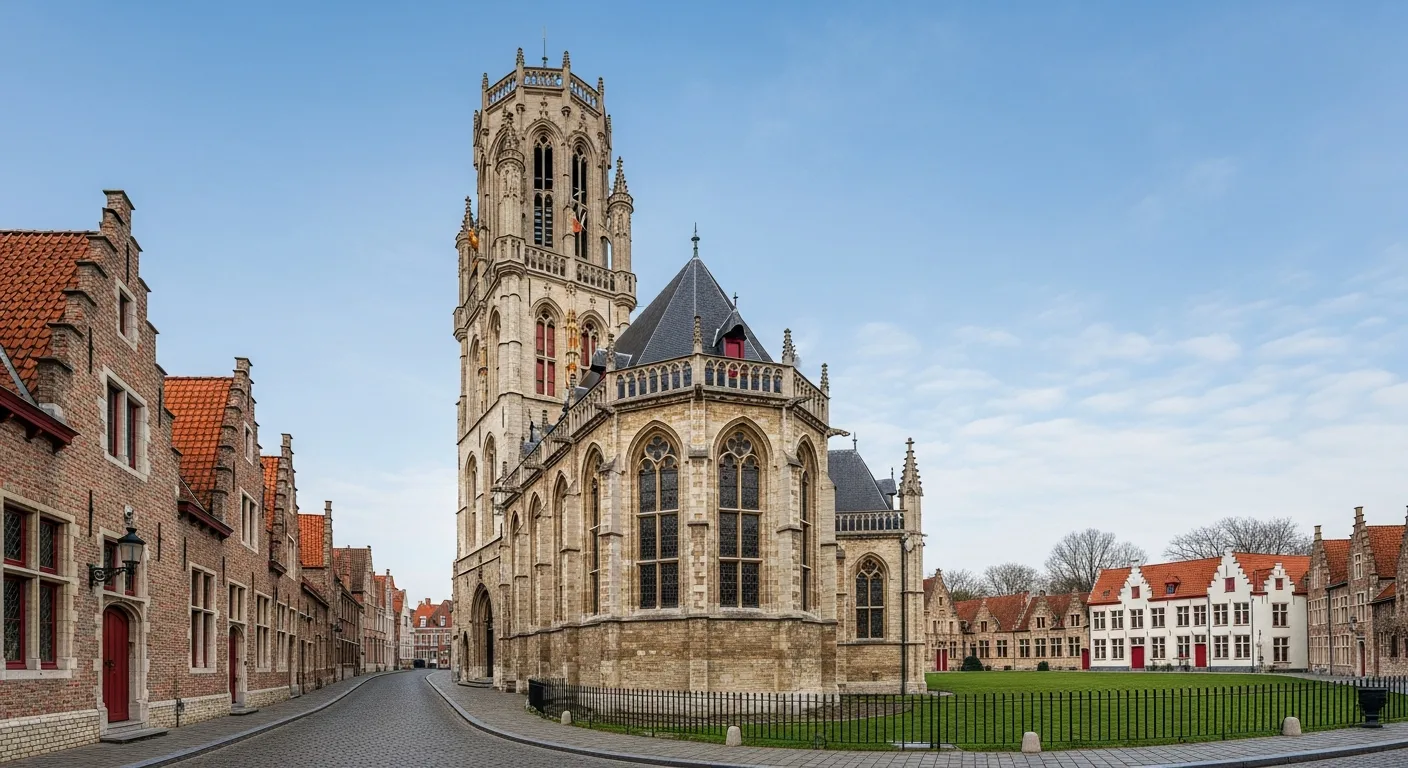
Photos: Wikimedia Commons
It is a Wednesday evening in Leuven, and the Oude Markt - a long, cobbled square locals affectionately call “the longest bar in Europe” - is full of students nursing Belgian beers under heated terraces. A group of biomedical sciences master’s students from Italy, Greece and India are arguing about a paper from Cell. Two engineering students wheel past on bikes carrying a half-disassembled drone they built that afternoon at Imec. Inside one of the bars, somebody is reading a thesis chapter on Aquinas while sipping a Stella - which, fittingly, is brewed half a kilometre away. The bell of the Sint-Pieterskerk strikes seven. Students stream out of the central library - a building partially destroyed twice in the world wars and rebuilt both times - heading to dinner before a late seminar.
This is an ordinary night in a university town that has been doing this since 1425. Six hundred and one years. Through plagues, occupations, two world wars, partition, language reforms and the slow rebuilding of European higher education. KU Leuven - Katholieke Universiteit Leuven - is the oldest Catholic university in the world still in operation, the #1 university in Belgium, and one of the most consistently top-ranked research universities on the European continent. It sits in the global top 50-70 by every major ranking, leads Europe by Reuters’ innovation index, and houses Imec, arguably the most important semiconductor research hub outside Silicon Valley and Taiwan.
For an international student in 2026, the package is unusual: tuition of around EUR 1,200/year for EU students (around EUR 5,000-8,000 for non-EU), a catalogue of 80+ English-taught master’s programmes spanning engineering, AI, business, biomedical sciences, theology, statistics and humanities, a research environment that competes directly with Cambridge, ETH Zurich and Imperial College, and a small Flemish university town that remains genuinely affordable, walkable and twenty-five minutes from Brussels. Add Belgium’s central position in Europe, an English-friendly working culture, and post-study work options that make staying realistic, and KU Leuven becomes one of the strongest under-the-radar choices in European higher education.
This guide walks you through everything you need to know about KU Leuven as an international applicant in 2026: faculties and flagship programmes, the application timeline, language requirements, costs, the Type D visa, scholarships, life in Leuven, the surrounding career ecosystem from Imec to Janssen, and how to convert a KU Leuven degree into a long-term European trajectory. If you are also weighing other destinations, you may want to compare with our guide to studying in the Netherlands or our TOEFL preparation guide for international applicants - both apply directly to your KU Leuven application.
Why KU Leuven - the Strategic Case
The case for KU Leuven rests on five pillars: a six-hundred-year academic pedigree, top-tier global research output, exceptionally low EU tuition, a deep English-taught master’s catalogue, and proximity to one of the densest deep-tech industrial clusters in Europe.
The historical pedigree. KU Leuven was founded in 1425 by Pope Martin V at the request of Duke John IV of Brabant. That makes it older than every Ivy League university combined and predates the printing press by more than two decades. Across its history Leuven has been the academic home of figures who shaped European intellectual life: Andreas Vesalius, the founder of modern human anatomy, taught and researched here in the 16th century; Justus Lipsius, one of the most influential humanists of the late Renaissance, ran the chair of Latin philology; Erasmus of Rotterdam visited and corresponded with the faculty repeatedly; and in modern times Georges Lemaitre - the Belgian priest-physicist who first formulated what became the Big Bang theory - was a Leuven professor. Few universities in Europe carry that combination of continuity and intellectual weight.
The research picture. KU Leuven publishes more peer-reviewed articles per year than any other Belgian institution, and Reuters has named it the most innovative university in Europe in multiple consecutive years. The Faculty of Engineering Science is consistently ranked top 50 globally, with particular strengths in microelectronics (through its tight integration with Imec), mechanical engineering, computer science, materials science and energy. Biomedical sciences are anchored by UZ Leuven, one of the largest academic medical centres in continental Europe, with major contributions to oncology, cardiology, transplantation medicine and neurology. The Higher Institute of Philosophy is one of the most respected centres for analytic and continental philosophy globally. KU Leuven Research & Development (LRD), the university’s tech-transfer office, has spun off more than 150 companies and signs hundreds of industry research contracts every year - making KU Leuven, alongside ETH Zurich and TU Delft, one of the few European universities that genuinely converts research into industry.
The tuition picture. EU/EEA students pay the regulated Flemish tuition rate - around EUR 1,200 per year for both bachelor’s and master’s programmes. This is one of the lowest top-100 university tuition rates in Western Europe, and it covers a research-intensive education at a university competing in the same global tier as Imperial College, ETH Zurich and the University of Edinburgh. Non-EU/EEA students pay institutional rates: EUR 5,000-8,000/year depending on programme, with humanities and social sciences at the lower end and engineering, biomedical sciences and selected master’s at the upper end. Compared with UK rates of GBP 25,000-40,000 for international students or US private-university tuition of USD 50,000-70,000, KU Leuven is dramatically cheaper for an arguably equivalent academic experience.
The English catalogue. KU Leuven offers more than 80 fully English-taught master’s programmes - among the deepest English-taught catalogues at any continental European research university. The Faculty of Engineering Science alone runs roughly 25 English master’s programmes (Computer Science, Artificial Intelligence, Statistics and Data Science, Electrical Engineering, Mechanical Engineering, Bioinformatics, Energy Engineering, Mathematical Engineering, Nanoscience, Mechatronics, and many more). The Faculty of Economics and Business runs Business Engineering, International Business Economics and Management, Quantitative Economics, and a top-ranked Master in Information Management. The Faculty of Bioscience Engineering and Biomedical Sciences combine to offer at least 12 English master’s including Plant Biotechnology, Food Technology, and Molecular Medicine. There are also English programmes in Theology, Philosophy (the famous English MA at the Higher Institute of Philosophy is one of the most international philosophy master’s anywhere), Law (LLM in International and European Law), and Cultural Studies. At bachelor’s level the catalogue is much smaller and predominantly Dutch - non-Dutch-speaking applicants generally enter at the master’s level after a bachelor’s elsewhere.
The career ecosystem. Leuven sits inside one of the most concentrated deep-tech ecosystems in Europe. Imec, headquartered in Leuven, employs over 5,000 engineers and is the world’s leading independent research centre for nanoelectronics and digital technologies - major chip-design partners include TSMC, Samsung, ASML, Intel and Qualcomm. Janssen Pharmaceutica, J&J’s European R&D headquarters, runs its main campus in nearby Beerse. KU Leuven Research & Development has spun off 150+ deep-tech companies, many of which still operate from Leuven’s research parks. Cross the Dutch border 100 km north and you reach Eindhoven’s Brainport region - ASML (the world’s only producer of EUV lithography machines), NXP, Philips Healthcare and DAF are all within a 90-minute drive. Brussels - 25 minutes away - adds the EU institutions, NATO, and the European headquarters of dozens of multinational corporations. For graduates in engineering, computer science, biomedical sciences, AI, business, law and economics, the local labour market is unusually dense and well-paid by European standards.
The 16 Faculties and Where to Apply
KU Leuven is organised into 16 faculties spread across three groups: Humanities and Social Sciences, Sciences-Engineering-Technology, and Biomedical Sciences. Below are the faculties international students should pay particular attention to.
Faculty of Engineering Science. The flagship engineering faculty, ranked top 50 globally. Strong across electrical engineering, computer science, mechanical engineering, materials science, mathematical engineering, energy and chemistry. Tightly integrated with Imec - many master’s theses and PhD positions are co-supervised with Imec researchers, and access to Imec’s advanced semiconductor cleanrooms is essentially unique in academia outside Stanford-Berkeley and Taiwan. Roughly 25 English master’s including Master of Artificial Intelligence, Master of Computer Science, Master of Statistics and Data Science, Master of Electrical Engineering, Master of Mechanical Engineering, Master of Bioinformatics and Master of Nanoscience and Nanotechnology. Acceptance rates vary by track: AI, Bioinformatics and Statistics typically run 15-25% acceptance; broader engineering tracks 30-50%.
Faculty of Engineering Technology. A separate faculty covering applied engineering tracks (electromechanical, chemical, electronic and ICT engineering) with stronger industry-application orientation than the more theoretically-oriented Faculty of Engineering Science. Most teaching is in Dutch at master’s level, but selected programmes are available in English.
Faculty of Science. Mathematics, physics, chemistry, biology, geology and astronomy. Hosts the Institute of Astronomy (one of the most cited astrophysics institutes in Europe) and major centres in theoretical physics and pure mathematics. Master’s offerings in English include Master of Mathematics, Master of Physics, Master of Chemistry, Master of Biology and Master of Astronomy and Astrophysics.
Faculty of Bioscience Engineering. The faculty covering food technology, agricultural engineering, environmental sciences, biotechnology and forest and nature management. Belgium’s leading food-technology faculty, with multiple English master’s programmes (Food Technology, Plant Biotechnology, Forest and Nature Conservation, Agro- and Ecosystems Engineering).
Faculty of Medicine and Faculty of Pharmaceutical Sciences. Together with UZ Leuven these faculties drive Belgium’s largest academic medical centre. International students typically enter at the research master’s level (Master of Biomedical Sciences, Master of Drug Development, Master of Pharmaceutical Care) rather than the doctor of medicine track, which is taught primarily in Dutch and includes Belgian-citizen quotas.
Faculty of Economics and Business. Belgium’s largest business school. Strong programmes in finance, management, marketing, business engineering and economics. Top English master’s include Master of Business Engineering, Master of International Business Economics and Management, Master of Quantitative Economics and Master of Information Management. Dual-degree partnerships exist with HEC Paris, Cornell and several Asian partners.
Faculty of Law and Criminology. Major centre for European and international law. The Master of Laws (LLM) in International and European Law is fully English and one of the most highly regarded LLMs on the continent for students aiming at EU institutions, the European Court of Justice or international firms in Brussels.
Higher Institute of Philosophy. Founded in 1889, this is one of the most internationally renowned philosophy faculties globally. The Master of Arts in Philosophy is fully English and attracts students from over 50 countries. Strong in both analytic and continental traditions, with particular depth in phenomenology, philosophy of mind, political philosophy and ethics.
Faculty of Theology and Religious Studies. The oldest faculty of the university, dating back to 1432. Multiple English master’s and research master’s programmes. The faculty has a global research profile in Catholic theology, ecumenism, biblical studies and patristics, and is the academic home for many doctoral students from religious orders worldwide.
Faculty of Arts. Linguistics, literature, history and area studies. The Master of Cultural Studies is English; most other tracks are Dutch.
Faculty of Social Sciences. Sociology, communication science, political science. The Master of European Studies and Master of Social and Cultural Anthropology run in English.
Faculty of Psychology and Educational Sciences. Mostly Dutch at bachelor’s level, with selected English master’s such as Master of Statistics and Data Science (Psychology specialisation) and Master of Educational Studies.
Faculty of Architecture, Faculty of Movement and Rehabilitation Sciences and the Brussels and Antwerp campuses. KU Leuven also operates campuses in Brussels, Antwerp, Ghent, Bruges, Geel and Kortrijk for specific tracks - primarily engineering technology, business and architecture.
Application Process - Timeline and Requirements
KU Leuven runs a centralised online application portal at apply.kuleuven.be. The process is significantly less bureaucratic than UK or US applications but requires careful attention to deadlines and document quality.
Deadlines. For September 2026 intake, the deadlines are 1 March 2026 for non-EU/EEA applicants and 1 June 2026 for EU/EEA applicants. Some scholarship-tied programmes (Science@Leuven, certain Erasmus Mundus tracks) have earlier deadlines, often 1 February. February intake (where offered) follows 1 October non-EU and 1 November EU deadlines. Apply early - admission decisions are released on a rolling basis, and popular programmes can fill before the deadline.
Required documents. A standard KU Leuven master’s application requires: official transcripts from all post-secondary institutions; degree certificate (or expected graduation date with proof of enrolment); CV (1-2 pages); motivation letter (1-2 pages, programme-specific); two academic reference letters (KU Leuven sends a request directly to your referees through the portal, so make sure their email addresses are correct); IELTS or TOEFL score report (sent directly from the testing body); copy of passport identification page. Some programmes additionally require a research proposal (research master’s, certain MA programmes), a portfolio (architecture), GMAT/GRE (rare - only for selected business master’s), or professional references (executive-style programmes).
Motivation letter - what KU Leuven actually looks for. The motivation letter is the heaviest single qualitative element in your application. KU Leuven admissions committees look for three things: (1) clear evidence that your previous studies prepare you for the specific master’s you applied to (course-by-course alignment matters more than the prestige of your bachelor’s institution); (2) a coherent academic or professional reason for choosing KU Leuven specifically - naming faculty, research groups, courses or industry links shows genuine homework; (3) realistic post-graduation plans. Avoid generic language about “world-class education” or “passion for science.” Be specific. A strong motivation letter mentions named research groups, named professors whose work you have read, and a concrete career or research direction.
Academic references. KU Leuven prefers references from professors who supervised your thesis, taught you in advanced courses, or worked with you on research. Industry references are accepted only as a complement to academic ones and should ideally come from someone with academic credentials (PhD, R&D-leadership experience). Coordinate with your referees at least 4-6 weeks before submission so they have time to write thoughtfully.
Decision timeline. Decisions are released within 6-10 weeks of completed application. KU Leuven is one of the more transparent European universities: rejections include a brief reason; conditional admissions specify exactly which conditions (typically pending degree completion or pending IELTS/TOEFL score) must be met by which date.
Language Requirements - IELTS, TOEFL and Dutch
For English-taught master’s programmes, KU Leuven accepts IELTS Academic, TOEFL iBT, Cambridge English (C1 Advanced or C2 Proficiency) and selected programme-specific alternatives.
Standard thresholds. IELTS Academic 6.5 overall (with no band below 6.0) is the baseline for most engineering, science and humanities master’s. Selected programmes - particularly law, biomedical research master’s, and social sciences with heavy writing components - require 7.0 overall (with no band below 6.5). TOEFL iBT 87+ is the baseline (TOEFL 94+ for the higher-threshold programmes), with no individual section below 20-22 depending on programme. Cambridge C1 Advanced (CAE) at grade C or above is also accepted, as is C2 Proficiency at any grade. Some technical master’s accept the Duolingo English Test from 115.
Exemption pathways. If your previous degree was taught entirely in English at a recognised institution, and you can produce an official certifying letter from that university (typically signed by the registrar), KU Leuven may exempt you from the language requirement. Native English speakers from a small list of recognised countries are exempted automatically. KU Leuven verifies all language certificates directly with the testing body, so apply early to allow time for ETS or IELTS to send the report.
How to prepare. Most international applicants underestimate the IELTS/TOEFL preparation gap, particularly the writing and speaking sections, where the gap between B2 conversational English and the required 6.5-7.0 academic level can be larger than candidates expect. Plan 8-12 weeks of structured preparation. PrepClass offers adaptive IELTS and TOEFL preparation specifically calibrated to the bands KU Leuven requires, with full mock exams, AI-graded writing and speaking feedback, and a band-by-band progress dashboard so you know exactly when you are ready to take the official test.
Dutch - when you actually need it. For bachelor’s programmes (with very few English exceptions) you need Dutch B2 - typically certified through the ITNA test or the CNaVT Profiel Educatief Startbekwaam. KU Leuven runs intensive Dutch summer programmes for incoming bachelor’s students who need to bridge their language level. For English-taught master’s no Dutch is required for admission, but learning Dutch to A2-B1 noticeably improves part-time job options, social integration and your prospects of staying in Belgium long-term. KU Leuven’s University Language Institute offers heavily subsidised Dutch courses for students.
Costs, Funding and Scholarships
The total cost of a KU Leuven master’s year for an international student breaks down as follows.
Tuition. EU/EEA students: around EUR 1,200/year (regulated Flemish rate). Non-EU/EEA students: EUR 5,000-8,000/year depending on programme. The exact figure for your programme is published in the programme’s online fact sheet.
Living costs. Plan EUR 800-1,000/month for student accommodation (EUR 350-500), food (EUR 250-300), public transport (EUR 50, partly free with student passes), study materials, mobile phone, basic entertainment and personal expenses. Leuven is significantly cheaper than Brussels, Amsterdam, Paris or London. A typical academic-year living budget is EUR 8,000-10,000.
Health insurance. EU/EEA students with a European Health Insurance Card (EHIC) are covered for emergency care; for full coverage, register with a Belgian mutualiteit (mutual health insurer) - annual cost around EUR 90-150. Non-EU/EEA students are required to enrol in mandatory Belgian health insurance through a mutualiteit (~EUR 110-150/year) or through a private equivalent.
Books and materials. Most programmes use a mix of textbooks, course readers (cursus) and digital materials. Total budget: EUR 200-400/year. Engineering and architecture programmes can run higher.
Total annual budget. EU students: EUR 11,000-13,000. Non-EU students: EUR 15,000-18,000.
Scholarships
KU Leuven offers a structured scholarship landscape for international master’s students.
Science@Leuven Scholarship. The flagship scholarship for top non-EEA students applying to Faculty of Science master’s programmes. Covers full tuition plus a stipend of around EUR 10,000 for the academic year. Highly competitive - roughly 50-70 awards annually. Application deadline 1 February.
DBOF (Doctoral and Master’s Scholarship Fund). Selective full-tuition scholarships in specific faculties, particularly Engineering Science and Bioscience Engineering, for outstanding non-EEA candidates.
VLIR-UOS Scholarship. Targets students from a curated list of developing countries (Bolivia, Burundi, Cambodia, Cuba, DR Congo, Ecuador, Ethiopia, Ghana, Guinea, Haiti, Indonesia, Kenya, Madagascar, Mali, Morocco, Mozambique, Nicaragua, Niger, Palestine, Peru, Philippines, Rwanda, Senegal, South Africa, Suriname, Tanzania, Uganda, Vietnam, Zimbabwe). Covers tuition, travel, insurance and a monthly stipend.
Erasmus Mundus Joint Master Degrees. KU Leuven leads or partners in over 20 Erasmus Mundus programmes, ranging from Mathematical Modelling to Sustainable Drug Discovery. Scholarships cover full tuition, travel, insurance and a EUR 1,400/month stipend.
Faculty-specific awards. The Faculty of Engineering Science administers the Boschmans Fund and Industrial Research Fund grants. The Faculty of Economics and Business runs the Beoco Foundation scholarships and several alumni-funded merit scholarships. The Faculty of Theology has multiple foundation-funded chairs and tuition waivers for students from religious institutions worldwide.
EU-level options. EU students may qualify for Belgian-government student loans through the Flemish Department of Education if they meet residency or work-side income criteria. Erasmus+ short-term mobility funds are available for KU Leuven students who spend a semester abroad at partner universities.
Apply for scholarships in parallel with your programme application. Many use the same 1 March deadline; some (Science@Leuven, certain Erasmus Mundus tracks) have an earlier 1 February deadline.
Visa, Residency and Working in Belgium
EU/EEA citizens have automatic right of residence in Belgium and need only register at the Leuven city hall (Stadhuis) within 8 days of arrival to receive an EU residence certificate. Non-EU/EEA students need a Belgian long-stay visa.
Type D visa (long-stay, study). Apply at the Belgian embassy or consulate in your country of residence after receiving an official admission letter from KU Leuven. Required documents include: admission letter; proof of financial means (around EUR 770/month for the academic year, demonstrated via blocked account, formal sponsorship letter, or a scholarship award letter); proof of accommodation in Belgium (KU Leuven housing offer, private rental contract, or homestay confirmation); valid passport with at least 6 months remaining; medical certificate from an approved doctor; certificate of good conduct (criminal record extract) from your country of residence; visa fee (around EUR 200). Processing takes 6-12 weeks - apply at least 3 months before your planned arrival.
Registration in Leuven. Within 8 days of arrival, register at the Leuven Stadhuis to begin the residence card (A-card) procedure. The A-card is valid for the duration of your studies and grants legal residence, the right to work part-time (up to 20 hours per week during semesters and unlimited during holidays), and Schengen-area travel.
Working during studies. Both EU and non-EU students can work part-time (up to 20 hours/week during semesters) without an additional permit. Typical wages: EUR 12-16/hour. Student-friendly sectors include hospitality, retail, university tutoring, English-language customer support roles in Brussels-area multinationals, and research-assistant positions through KU Leuven faculties. Working part-time is common and helps materially with cost of living.
After graduation - staying in Belgium. Non-EU graduates qualify for the Search Year Permit (zoekjaarvergunning) - a 12-month residence permit allowing you to look for work, do internships or start a business. Once you find a job above the EU Blue Card salary threshold (around EUR 53,000 gross/year in Flanders for 2026 in many regulated sectors), you can transition to the EU Blue Card, valid for up to 4 years, with a path to permanent residence after 5 years of legal residence and to citizenship after 5 years (10 in some pathways). EU citizens have these rights automatically.
Life in Leuven - A Student-First City
Leuven has roughly 100,000 inhabitants, of whom 60,000 are students - KU Leuven plus three smaller higher-education institutions. The city’s character is fundamentally shaped by this. The historic centre is compact (you can cross it on foot in 25 minutes), heavily pedestrianised, dominated by student cafes, bookshops, brewery culture and the rhythm of the academic year. Outside semester time the city visibly empties.
Housing. KU Leuven runs roughly 4,000 student housing places through its Housing Office, primarily for first-year international students. Rents in university-managed rooms range from EUR 350 to EUR 500/month depending on size and amenities. Apply for housing immediately after receiving your admission letter - supply is limited and demand is high. The private market offers studios from EUR 500-700 and shared apartments from EUR 400-500/room. Most students live in the historic centre or just outside, within 10 minutes’ bike ride of their faculty.
Transport. Leuven is a cycling town. Most students buy a bike (new EUR 250-400, second-hand EUR 80-150) within their first month. Public transport is provided by De Lijn (buses) and NMBS (trains). The Leuven train station offers direct services to Brussels (25 minutes), Antwerp (45 minutes), Ghent (1 hour), Liege (1 hour) and Amsterdam (1 hour 50 minutes via direct intercity). Brussels Airport is 12 minutes by train. The geographic position is unusually convenient: a typical KU Leuven student can attend a guest lecture at ULB Brussels in the morning, a research seminar in Leuven at 14:00 and dinner in Antwerp the same evening.
Food, culture and social life. Leuven’s restaurant scene is dense and student-priced. Meal-deal lunches in central Leuven run EUR 8-12; dinners EUR 15-25. Stella Artois - yes, that Stella Artois - is brewed in Leuven; the brewery offers public tours and the local pubs serve an extraordinary range of Belgian ales beyond the mass-market labels. The Oude Markt (“the longest bar in Europe”) is the centre of nightlife, particularly Wednesday-Saturday. Cultural infrastructure is strong: the M Leuven contemporary art museum, the STUK arts centre (cinema, theatre, music), the Het Depot music venue, and the Botanical Garden are all within 15 minutes’ walk of one another.
Climate. Leuven shares the temperate maritime climate of the Low Countries: mild summers (20-25 C), grey winters (3-7 C), abundant rain spread across the year. Pack waterproof shoes and a good jacket.
International community. Roughly 25% of KU Leuven students are international - including a particularly large cohort of Indian, Chinese, Italian, Spanish, German, Greek, French, Iranian and Brazilian students. ESN Leuven (Erasmus Student Network) and Pangaea (KU Leuven’s international house) run regular events - buddy programmes, language tandems, day trips, cultural festivals - that make settling in dramatically easier.
Career Outcomes - Imec, Janssen and the Brainport Connection
A KU Leuven master’s degree positions you for one of the strongest deep-tech, biomedical and consulting labour markets in Europe. The local ecosystem and proximity to nearby industrial clusters make staying after graduation realistic and attractive.
Imec. The single biggest reason KU Leuven engineering and physics graduates stay in Leuven. Imec is one of the world’s leading independent research centres for nanoelectronics and digital technologies - 5,000+ engineers, an industry budget exceeding EUR 800 million/year, and direct R&D partnerships with TSMC, Samsung, ASML, Intel, Qualcomm and AMD. KU Leuven master’s students in engineering science, computer science, electrical engineering and physics frequently complete their thesis at Imec and transition directly into junior research positions there after graduation. Salaries are competitive by Belgian standards (junior researcher EUR 50,000-60,000/year gross including 13th-month pay).
Janssen Pharmaceutica. Johnson & Johnson’s European R&D headquarters is located in Beerse, 30 minutes from Leuven. Janssen actively recruits KU Leuven graduates in biomedical sciences, drug development, pharmaceutical sciences and bioinformatics.
KU Leuven spin-offs and start-ups. KU Leuven Research & Development has spun off 150+ companies, many of which still operate from Leuven’s research parks (Arenberg Science Park, Haasrode). Recent successful spin-offs include Materialise (3D printing, NASDAQ-listed), Galapagos (biotech), Biocartis (molecular diagnostics), Septentrio (precision GNSS) and many others. The local start-up scene is small but high-quality and tightly connected to academic research.
Brainport Eindhoven. A 90-minute drive north into the Netherlands brings you to the Brainport region - ASML (the world’s only producer of EUV lithography machines), NXP (semiconductor design), Philips Healthcare (medical imaging) and DAF (heavy vehicles). Many KU Leuven engineering graduates take positions at ASML or NXP and either commute from Belgium or relocate to Eindhoven.
Brussels. 25 minutes from Leuven by train. EU institutions (European Commission, European Parliament, European Court of Justice nearby in Luxembourg), NATO headquarters, the European headquarters of dozens of multinationals (Toyota Europe, Coca-Cola Europe, Mastercard Europe, AB InBev - the world’s largest brewer, headquartered in Leuven itself), and Big-Four consulting firms. KU Leuven LLM, business and economics graduates routinely place into EU institutions, EU-focused law firms (Linklaters, Clifford Chance, White & Case, Cleary Gottlieb), and consultancies.
Salaries. Junior engineer or research positions in Belgium for a KU Leuven master’s graduate run EUR 45,000-60,000/year gross including 13th-month pay (in addition to mandatory holiday allowance, meal vouchers and private supplemental health insurance - common Belgian benefits that can add EUR 3,000-5,000/year in real value). Junior consulting and finance positions run higher: EUR 55,000-75,000/year. PhD positions at KU Leuven pay around EUR 2,400-2,600/month net (EUR 38,000-42,000/year gross-equivalent including benefits) - competitive with PhDs at any continental European university.
Long-term path. Belgian permanent residency is available after 5 years of legal residence; Belgian citizenship after 5 additional years (some pathways shorter for spouses of Belgian citizens). The combination of a KU Leuven master’s, 12 months on the Search Year Permit, and a transition to the EU Blue Card or a standard work permit is a well-trodden path for thousands of graduates each year.
Comparing KU Leuven to Other European Options
International students considering KU Leuven typically also evaluate one or more of: ETH Zurich and EPFL (Switzerland), TU Delft and TU Eindhoven (Netherlands), TUM and RWTH Aachen (Germany), Imperial College and Cambridge (UK), and KTH and Chalmers (Sweden). KU Leuven sits in a particular niche within that landscape.
Versus ETH Zurich and EPFL. ETH and EPFL are slightly higher in global rankings, but tuition is comparable for non-EU students (around CHF 1,500/year - extraordinarily cheap), Swiss living costs are double Belgian costs (a student room in Zurich is EUR 800-1,200), and ETH/EPFL admit fewer international master’s students. KU Leuven offers a comparable research environment at one-third to half the all-in cost.
Versus TU Delft and TU Eindhoven. Dutch technical universities run a denser English bachelor’s catalogue and slightly cheaper non-EU tuition (EUR 13,000-22,000/year), but EU tuition at Dutch universities (~EUR 2,500/year) is twice KU Leuven’s EU rate, and Dutch student housing is in genuine crisis. KU Leuven offers comparable engineering quality at lower cost and with a more stable housing situation.
Versus TUM and RWTH Aachen. German universities famously charge near-zero tuition, but the proportion of fully English bachelor’s is much smaller; many German master’s programmes still require some German. KU Leuven’s English catalogue is significantly deeper than RWTH’s.
Versus Imperial College London and Cambridge. UK tuition for non-UK students runs GBP 35,000-45,000/year, with no scholarship for most international applicants - KU Leuven costs roughly 15-20% of that for arguably comparable engineering or biomedical research training.
Versus KTH and Chalmers. Swedish technical universities are excellent and free for EU students, but non-EU tuition (SEK 130,000-310,000/year, ~EUR 12,000-28,000) is higher than KU Leuven’s, and Sweden runs a small English bachelor’s catalogue.
KU Leuven is the right choice if you want a top-50-globally European research university with deep English master’s options at the lowest realistic European tuition, a strong industry ecosystem on the doorstep, and a small, walkable, affordable university town twenty-five minutes from Brussels. It is less obvious for English bachelor’s-level study (where the Netherlands or the UK offer more) or for students prioritising the absolute peak of global brand recognition (where ETH, Cambridge or Imperial still have an edge).
How to Stand Out - Five Practical Tips
After dozens of admission cycles working with international applicants to KU Leuven, a few patterns emerge.
1. Show academic alignment with the specific master’s, not just the university. KU Leuven admissions committees look at how your bachelor’s curriculum aligns with the specific master’s you applied to. If you’re applying to Master of Artificial Intelligence, your transcript should show demonstrable coverage of mathematics, statistics, programming and at least one machine-learning or data-science course. If gaps exist, address them in your motivation letter - a sentence acknowledging “I lack a formal compilers course but completed an open online course in Spring 2025” is far stronger than ignoring the gap.
2. Name research groups and faculty in your motivation letter. The single most common weakness in motivation letters is genericity. Open the KU Leuven research portal, find two or three research groups or labs whose work matches your direction, and name them. Bonus points for citing recent papers. KU Leuven faculty notice when applicants have actually engaged with their work.
3. Coordinate references early. KU Leuven uses an automated reference-collection system through the application portal. Confirm that your referees will respond promptly - the system follows up automatically but a referee who is on sabbatical may simply not see the email. A two-week head start on coordination prevents application delays.
4. Take IELTS or TOEFL early enough that you have time to retake. If you take IELTS for the first time three weeks before the application deadline, you have no buffer if your score is below the required threshold. Plan to take the test 8-12 weeks before the application deadline - this gives you one safe retake window if needed. Adaptive IELTS preparation through PrepClass helps you reach band 6.5-7.0 efficiently and reduces the chance of needing a retake.
5. Apply for scholarships in parallel. Many strong applicants miss scholarship deadlines because they treat scholarship application as a step that comes after admission. Most KU Leuven scholarships have the same or earlier deadline as the programme application - apply in parallel from day one.
Common Pitfalls to Avoid
A short list of avoidable mistakes that cost applicants offers each year.
Underestimating IELTS preparation. Particularly common among students from English-friendly continental European backgrounds (Netherlands, Scandinavia, Germany). Conversational fluency and academic-IELTS bands diverge substantially. A 6.5 IELTS Academic is a genuine bar - plan structured preparation. PrepClass’s adaptive engine catches the most common gaps in writing and speaking before they cost you a retake.
Submitting a generic motivation letter. A motivation letter that could be sent to ten different universities will be visibly recognisable to KU Leuven faculty. Write a programme-specific letter every time.
Applying too late. KU Leuven processes applications on a rolling basis; popular programmes (AI, Computer Science, Bioinformatics, Business Engineering) can fill before the official 1 March deadline. Aim to submit by mid-January for maximum chance.
Forgetting to register at the Stadhuis within 8 days of arrival. Non-EU students who miss this deadline face fines and complications with their A-card. Register the day you arrive if possible.
Not budgeting for housing search time. If you are not allocated KU Leuven Housing Office accommodation, plan to spend the first 1-2 weeks of your stay searching the private market. Book a temporary Airbnb or hostel for that period rather than committing to a year-long lease sight unseen.
Skipping Dutch entirely. Even if you study fully in English, basic Dutch (A2) makes daily life noticeably easier - supermarket signs, doctor visits, government correspondence, part-time job options - and is heavily subsidised at KU Leuven.
The Bottom Line
KU Leuven is the strongest single university in Belgium and one of the most consistently top-ranked research universities in continental Europe. For an international student applying in 2026, the package is unusually favourable: top-50-to-70 global ranking, six centuries of academic continuity, EUR 1,200/year EU tuition (EUR 5,000-8,000 non-EU), an 80+ English-taught master’s catalogue, the Imec semiconductor research hub on its doorstep, EU institutions in Brussels twenty-five minutes away, and a small, walkable, affordable university town with a 600-year continuous tradition.
Pair the right English-taught master’s with a coherent motivation letter, IELTS 6.5-7.0 (or TOEFL 87+), an early scholarship application, and a careful Type D visa timeline, and KU Leuven becomes one of the most asymmetric value choices in European higher education - a top-tier research education at one-fifth to one-third the all-in cost of a comparable UK or US programme.
The next step is to identify two or three KU Leuven master’s programmes that align with your bachelor’s curriculum, plan your IELTS or TOEFL preparation backwards from the application deadline (giving yourself one retake window), and start drafting the motivation letter early enough that it can go through three or four rounds of revision before submission. Use PrepClass to lock down the IELTS/TOEFL component so the language test never becomes the bottleneck on your KU Leuven application.
If you are also weighing other destinations, our guides to studying in the Netherlands and studying in Germany may help you finalise your shortlist. Whichever university you eventually choose, the discipline of building a focused application - clear academic alignment, specific motivation, strong references, solid English test results - will serve you for the entire admissions cycle and beyond.
 TOEFL iBT prep, 2026 format
 Every task type of the new TOEFL, with Speaking and Writing graded by AI.

 Prepclass