#7
ETH Zürich in QS world 2026
#1 in continental Europe; EPFL is #22
Study in Switzerland 2026: ETH #7 and EPFL #22 in QS, the new CHF 2,190/semester international fee, the permit B, scholarships and the German/French question.
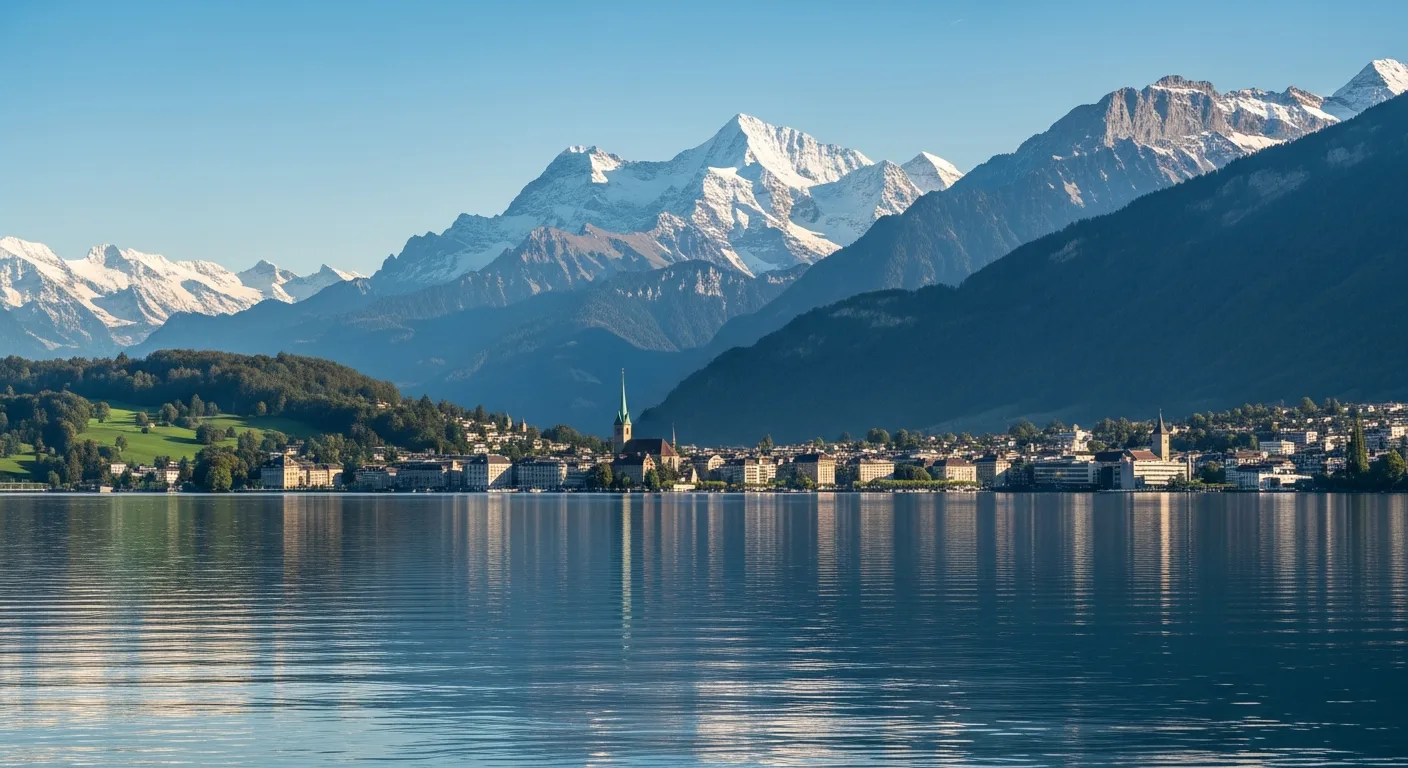
Photos: Wikimedia Commons
You step onto the InterCity train at Zürich Hauptbahnhof bound for Lausanne, under two hours of track along the shore of Lake Zürich, past meadows where dairy cows graze with bells round their necks, beneath the snowfields of the Bernese Alps, and down to Lake Geneva, which in October sunlight looks like molten silver. In most countries a two-hour rail trip changes the landscape. In Switzerland it changes the language, the architectural grammar, even the cadence of academic life: from the German-speaking, granite-cut precision of Zürich to the French-speaking, slightly looser air of Lausanne. And both cultures produce universities that beat Oxbridge in the global engineering tables year after year. That is not coincidence. It is system.
Here is the bottom line, and it has moved since most guides were written. ETH Zürich sits at #7 in the world and EPFL at #22 in the QS World University Rankings 2026 - two universities in the global top 25, which no other country on the European continent can match. The catch that almost every older article gets wrong: from the autumn semester of 2025, students who move to Switzerland to study pay roughly CHF 4,380 a year in tuition at both schools (CHF 2,190 a semester), after the ETH Board tripled the international fee, while Swiss-qualified students still pay CHF 1,460. Even tripled, that is a rounding error next to Oxford’s £37,380 - £62,820 or MIT’s USD 61,000+. Across the College Council families we have advised, Switzerland is the destination people reach for once they have done the maths on the US and the UK and decided the marginal prestige is not worth the marginal debt.
In this guide I will walk you through the entire Swiss system, as an international applicant sees it: the leading universities and what each is actually known for, how the swissuniversities recognition machine treats your diploma, the German-and-French question that decides everything at Bachelor level, the new tuition and a realistic living budget, the ETH and EPFL excellence scholarships and the federal awards, the permit B step by step, and the careers that open onto Google Zürich, Roche, UBS and CERN. If you are weighing world-class STEM without a six-figure debt, this is the most honest answer Europe currently offers.
Source: QS World University Rankings 2026; ETH Zürich and EPFL official tuition pages 2025/26; swissuniversities; State Secretariat for Migration.
Ask why a family ends up choosing Switzerland and you rarely get one answer. You get three, and each one props up the others.
The first is ranking parity. The QS World University Rankings 2026 put ETH Zürich at #7 in the world for the third year running - ahead of Cornell, Princeton’s Ivy peers and Imperial College - and the best university in continental Europe. EPFL sits at #22, the same rank as TU Munich. No other country except the United States and the United Kingdom carries two universities this high, and Switzerland does it from a country of nine million people. The Times Higher Education and ARWU (Shanghai) tables tell the same story. By any honest measure the Swiss federal institutes are in the MIT-Stanford-Cambridge tier for engineering and the natural sciences, and ahead of every German, French, Italian or Spanish competitor.
The second is cost, even after the fee rise. This is the part you have to update in your head. Until 2024, ETH and EPFL charged everyone the same CHF 1,460 a year - a figure that launched a thousand “free Swiss university” headlines. From autumn 2025 the ETH Board tripled the fee for foreign students who move to Switzerland to study, to CHF 2,190 a semester. So an incoming international undergraduate now pays roughly CHF 4,380 a year. That is real, and you should plan for it. It is also still less than one-eighth of Oxford’s overseas fee and less than one-tenth of a US private. A four-year ETH Bachelor at the new international rate runs about CHF 17,500 in tuition; a four-year MIT Bachelor at full freight runs roughly USD 244,000. The asymmetry survives the tripling intact.
The third is the Swiss labour market. Zürich hosts Google’s largest engineering office outside the United States - around 5,000 engineers - alongside Apple’s machine-learning hub, IBM Research’s nanotechnology lab (where the scanning tunnelling microscope earned a Nobel in 1986), and a dense ring of fintech and crypto firms; the Crypto Valley around Zug is 30 minutes away. Add Roche and Novartis in Basel - two of the world’s largest pharma headquarters within a tram ride of each other - plus ABB, Sika, Lonza and Nestlé across the Swiss Plateau. Entry-level pay for an ETH or EPFL Master graduate in tech sits at CHF 100,000-130,000 a year, among the highest on Earth after only the Bay Area and Manhattan.
Put a top-25 degree, tuition an order of magnitude below the Anglosphere, and one of the richest labour markets on Earth on the same campus, and the case answers itself. Even after the fee rise, no country gives you that arithmetic.
Switzerland has roughly a dozen universities of international weight, split between the two federal institutes of technology (ETH and EPFL, funded and run by the Confederation) and the cantonal universities (Zürich, Geneva, Bern, Basel and the rest, funded by their cantons). The federal institutes dominate STEM; the cantonal universities own medicine, law, economics and the humanities; and one specialist - St. Gallen - owns business. Below, each university links to our dedicated guide where one exists, otherwise to its profile in our university Atlas. Treat the QS number as a rough map of reputation, not gospel: what a school is known for matters far more than its overall rank, and St. Gallen is the clearest example - middling in the global table, untouchable in management.
ETH Zürich (QS #7) is the flagship: Einstein took his diploma at the Federal Polytechnic here in 1900, twenty-two Nobel laureates have been affiliated with it, and its computer-science department is regularly rated the strongest in Europe. EPFL (QS #22) is its francophone twin on Lake Geneva - younger, more entrepreneurial, futurist in architecture (the Rolex Learning Center looks like a wave frozen in glass), and a powerhouse in machine learning, microengineering and neuroscience.
Among the cantonal universities, the University of Zurich (QS #100) is the country’s largest, strongest in medicine, law and economics, with a joint Quantitative Finance Master run with ETH that is one of Europe’s best by industry placement. The University of Geneva (QS #155) trades on Geneva’s identity as the world capital of multilateralism: the UN’s European seat, WHO, WTO and the Red Cross are within walking distance, and CERN sits 8 km away. The University of Basel (QS #158), Switzerland’s oldest university (1460), is a life-sciences and medicine hub feeding directly into Roche and Novartis next door. The University of Bern (QS #184) is the broad research university of the federal capital, with notable strengths in space science and climate research. The University of Lausanne (QS #=212) shares the EPFL campus and excels in life sciences, law and the humanities; its HEC Lausanne is a respected business faculty in its own right.
Two more deserve a place on any serious list. The Università della Svizzera italiana (USI, QS #473) is Switzerland’s Italian-speaking university in Lugano, small but internationally connected, with a celebrated Academy of Architecture and strong programmes in communication and informatics. And the University of St. Gallen - known universally as HSG - is the business school: the Financial Times has ranked its Master in Strategy and International Management #1 in the world for fourteen of the last fifteen years. Rounding out the picture, the University of Fribourg is Switzerland’s genuinely bilingual university, teaching in both German and French, with a respected law faculty.
| QS '26 | University | Known for |
|---|---|---|
| 7 | ETH Zürich | Continental Europe's #1 STEM school · CS, physics, engineering, architecture, maths · 22 Nobel laureates |
| 22 | EPFL | Engineering & technology, all Masters in English · AI, microengineering, neuroscience · Lake Geneva campus |
| 100 | University of Zurich (UZH) | Largest Swiss university · medicine, law, economics · joint Quant Finance Master with ETH |
| 155 | University of Geneva (UNIGE) | International relations, public law, life sciences, physics · UN/WHO/CERN on the doorstep |
| 158 | University of Basel | Switzerland's oldest university (1460) · life sciences & medicine · next door to Roche & Novartis |
| 184 | University of Bern | Broad research university of the federal capital · space science, climate research, medicine |
| 212 | University of Lausanne (UNIL) | Shares the EPFL campus · life sciences, law, humanities · HEC Lausanne business faculty |
| 473 | USI (Svizzera italiana) | Italian-speaking, Lugano · Academy of Architecture, communication, informatics |
| FT#1 | University of St. Gallen (HSG) | Business & economics · FT #1 Master in Management for 14 of 15 years · CEO factory |
| BIL | University of Fribourg | Switzerland's bilingual university (German + French) · law, theology, humanities |
| Source: QS World University Rankings 2026; Financial Times Masters in Management 2025 (St. Gallen); official university websites. Ranks describe overall position; subject strength varies. "BIL" = bilingual. | ||
Forget what you know about UCAS in the UK or Studielink in the Netherlands. Switzerland has no central application portal and no single set of requirements. Each university runs its own admissions, and the rules depend first on which of two systems you are entering.
The two federal institutes of technology - ETH Zürich and EPFL - are run and funded by the Confederation, charge the same federal tuition, and select on academic merit through the swissuniversities recognition framework. The cantonal universities (Zürich, Geneva, Basel, Bern, Lausanne, Fribourg, plus USI in Ticino) are funded by their cantons, set their own fees, and in most fields admit any holder of a recognised secondary diploma directly. St. Gallen is the outlier that runs its own entrance test for everyone.
The second fork is language, and at Bachelor level it decides everything. ETH, Zürich, Basel, Bern and St. Gallen teach undergraduates in German (Goethe-Zertifikat C1, TestDaF or DSH); EPFL, Geneva and Lausanne teach in French (DELF B2 / DALF C1); Fribourg offers both; USI teaches in Italian (with some English). This is not a requirement you can negotiate away with strong English - it is the language you will sit exams in. The good news arrives at Master level, where the system flips: around 90% of ETH Master programmes and effectively all of EPFL’s are taught in English, and that is the door through which most international students actually enter the federal institutes.
A British or American applicant should also understand the Basisprüfung, the first-year qualifying examination that ETH and EPFL use instead of selective admission. EPFL in particular lets almost any qualifying matura holder enrol, then fails 40-50% of them after one year (you get one retake). ETH’s first-year filter removes 30-40%. The selection is real; it simply happens after you arrive rather than before.
| Aspect | Detail |
|---|---|
| Two systems | Federal institutes (ETH, EPFL) selected on merit; cantonal universities mostly admit recognised diplomas directly |
| Application | No central portal - apply to each university; ETH via eApply, EPFL via IS-Academia, deadlines ~December - April |
| Bachelor language | German (ETH, UZH, Basel, Bern, HSG), French (EPFL, Geneva, Lausanne), bilingual (Fribourg), Italian (USI) |
| Master language | ~90% of ETH Masters and all EPFL Masters in English - the international entry point |
| Selection | ETH: entrance exam if diploma not recognised. EPFL: open entry, then Basisprüfung fails 40-50% after year one |
| Diploma check | swissuniversities country recognition sheets - the single most-skipped step |
Source: swissuniversities; ETH Zürich and EPFL admissions pages, 2025/26.
Swiss admissions reward planning more than polish; there is no holistic essay, no extracurricular lottery, no interview at Bachelor level. The whole game is your diploma, your subjects and your language certificate.
Start with the swissuniversities country sheet. Each issuing country has a specific recognition statement, and skipping it is the single most common way international applicants lose a slot. If your diploma is on the recognised list - German Abitur, French Baccalauréat (mention bien or above), IB Diploma (typically 36+ with 6/7 in HL maths and sciences), A-Levels (typically AAA in maths and sciences), the European Baccalaureate, the Polish matura with strong extended-level results - you can apply with that diploma. ETH expects roughly the top 5-10% of the issuing country’s cohort. If your diploma is not on the list (most of Asia, Africa, the Middle East and Latin America), you face the Reduced Entrance Examination (four subjects, if you have the right prerequisites) or the harder Comprehensive Entrance Examination (five to six subjects, pass rate around 20-25%), or one completed year at a recognised university.
Lock the language certificate early. Goethe-Zertifikat C1, TestDaF (TDN 4) or DSH-2 for German; DELF B2 or DALF C1 for French. The certificate must be valid when you submit, and getting from B1 to C1 takes most candidates six to twelve months of focused work - plan it as a gap-year project, not an afterthought.
Mind the calendar. ETH’s eApply opens in December for an October start, with the final deadline typically 30 April; EPFL runs a similar window through IS-Academia; the cantonal universities cluster their deadlines in February - April; St. Gallen requires its own HSG admission test plus C1 German or, for the English-taught Assessment Year, TOEFL iBT 100 / IELTS 7.0. No Swiss university uses the SAT for Bachelor admission - if a SAT-friendly European route appeals to you, TU Munich in Germany takes it instead, and you can prepare in our SAT app as a plan B. For the Master-level English requirement, our TOEFL app runs full iBT practice tests with AI-graded speaking and writing.
| University | Entrance exam? | Bachelor language | Tuition / semester (int’l) | Difficulty |
|---|---|---|---|---|
| ETH Zürich | Yes - Reduced/Comprehensive exam if diploma unrecognised | German C1 | CHF 2,190 | Very high |
| EPFL | No - but Basisprüfung fails 40-50% after year 1 | French B2 - C1 | CHF 2,190 | High (internal selection) |
| UZH (Zurich) | No - recognised diploma admits directly | German C1 | ~CHF 720 | Moderate |
| UNIGE (Geneva) | No - recognised diploma admits directly | French B2 - C1 | CHF 500 | Achievable |
| HSG (St. Gallen) | Yes - HSG admission test for all | German C1 / English (Assessment Year) | CHF 3,129 | High |
Source: official university admissions pages and swissuniversities, 2025/26. The CHF 2,190 federal fee applies to students who moved to Switzerland to study; Swiss-qualified students pay CHF 730.
Switzerland’s paradox is sharper than ever: tuition is still cheap by global standards, but living costs are among the highest on Earth, and the two have to be read together.
On tuition, the headline you may have seen - “CHF 1,460 a year for everyone” - is out of date for new international students. From the autumn semester of 2025, ETH and EPFL charge students who move to Switzerland to study CHF 2,190 a semester (about CHF 4,380 a year). Swiss nationals and anyone who earned their school-leaving qualification in Switzerland keep the CHF 730 rate, and students already enrolled before autumn 2025 are grandfathered at the old fee. The cantonal universities did not follow: UZH is around CHF 720 a semester, Geneva just CHF 500 - among the lowest tuition in Europe. St. Gallen is the exception at CHF 3,129 a semester for non-Swiss students, still a fraction of HEC Paris or Bocconi.
On living, Zürich and Geneva sit in the global top five most expensive cities (Mercer), and three line items surprise newcomers. Health insurance is mandatory - every resident must hold basic KVG cover within three months of arrival, around CHF 280-380 a month, and your European Health Insurance Card does not replace it (EU students from Germany, the Netherlands or Scandinavia can sometimes claim a KVG exemption; many cannot). Rental deposits run three months’ rent, held in a blocked Swiss bank account. And accommodation is the brutal line: a room in a shared flat costs CHF 700-1,100 in Zürich, less in Lausanne, Bern or St. Gallen, but the Zürich rental market is one of the tightest in Europe, so apply for student housing (WOKO, FMEL at EPFL) the moment you are admitted.
| City | Shared room | Health insurance | Food | Transport + misc. | Total / month |
|---|---|---|---|---|---|
| Zürich | CHF 700-1,100 | CHF 280-360 | CHF 450-600 | CHF 220 | CHF 2,050-3,180 |
| Geneva | CHF 750-1,200 | CHF 290-380 | CHF 450-600 | CHF 220 | CHF 2,210-3,500 |
| Lausanne | CHF 600-900 | CHF 270-350 | CHF 400-550 | CHF 205 | CHF 1,775-2,605 |
| Bern | CHF 550-800 | CHF 260-340 | CHF 380-520 | CHF 190 | CHF 1,580-2,250 |
| St. Gallen | CHF 500-750 | CHF 250-330 | CHF 350-500 | CHF 175 | CHF 1,475-2,055 |
Source: typical 2025/26 student budgets; ETH and EPFL cost-of-living guidance; comparis.ch insurance ranges. Figures are CHF per month.
Put tuition and living together and an all-in year at ETH or EPFL runs roughly CHF 28,000-47,000 depending on the city - most of it living cost, only CHF 4,380 of it tuition. That is more than Germany, where public universities charge no tuition, but well under a London or Boston year. The compensating factor is the part-time work below.
Switzerland has no unified federal student-aid system like Germany’s BAföG or the US FAFSA. International students assemble funding from three sources.
University excellence awards are the most generous. The ETH Excellence Scholarship (ESOP) covers full tuition plus a stipend of roughly CHF 12,000 a semester (CHF 24,000 a year) - around 60 awards annually, going to roughly the top few percent of incoming Master applicants. The EPFL Excellence Fellowship is structurally similar: full tuition plus up to CHF 25,000 a year, around 60-70 awards. Both are Master-level only, both consider you automatically with your Master application, and both demand a Bachelor GPA in the top few percent of your cohort plus evidence of independent research.
The federal Swiss Government Excellence Scholarships, administered by the Federal Commission for Scholarships and the State Secretariat for Education, Research and Innovation, target doctoral and postdoctoral researchers from over 180 countries. The research stipend was raised to CHF 2,450 a month for the 2026/27 cycle, plus a housing allowance, health insurance and a half-fare rail card. You apply through the Swiss embassy in your home country, usually between August and November of the year before enrolment.
Home-country and bilateral awards are where most international students at ETH and EPFL actually find their funding. Americans use Fulbright; British and Commonwealth applicants use Chevening and Commonwealth Scholarships; Germans use DAAD; Indians the Inlaks Shivdasani Foundation and the J.N. Tata Endowment; Chinese applicants the China Scholarship Council, which has a bilateral PhD agreement with the Confederation; EU students Erasmus+ and Erasmus Mundus. The unromantic truth I give every family: the federal pot is small and fiercely contested, so build your funding plan around your home-country award and treat a Swiss excellence scholarship as upside, not the base case.
Switzerland is not in the European Union but is in the Schengen Area and operates a Free Movement Agreement with the EU and EFTA. For residency, that distinction decides your route.
EU and EFTA citizens need no D-visa. You arrive on your passport or national ID and, within 14 days, register with your municipality (Einwohnerkontrolle / Contrôle des habitants). You bring your admission letter, rental contract, proof of KVG health insurance (or an exemption application) and proof of about CHF 21,000 a year in funds. The municipality issues a permit B for studies, valid one year and renewable, with a job-search extension after graduation.
Non-EU/EFTA citizens - American, British (post-Brexit), Indian, Chinese, Brazilian, Nigerian and others - need a D-visa for studies before travel, applied for at the Swiss embassy in the country of residence with the admission letter, proof of funds (or a scholarship contract), a motivation letter and a written intent to leave after studies (largely a formality - Swiss graduates are routinely granted post-study permits). Processing runs eight to twelve weeks, so apply by May for an October start, then complete the same 14-day registration on arrival and convert the visa to a permit B.
On work, the permit B allows part-time employment up to 15 hours a week in term and full-time in semester breaks, for both EU and non-EU students; non-EU students wait six months after arrival. After graduation, EU/EFTA graduates move straight into employment, while non-EU graduates receive a six-month job-search permit automatically - a binding offer at a graduate level converts it to a work permit without the usual quota pressure.
Student life in Switzerland is as varied as the country, because over 200 km you change language, cuisine and the cadence of the day.
Zürich pairs German efficiency with an unexpected artistic streak - the Niederdorf and Europaallee buzz with cafés and bars, and in summer ETH and UZH students colonise the wooden swimming platforms (Badi) along the Limmat and the lake, probably the most beautiful inland “beaches” in Europe. Winter means fondue, the Langstrasse and a one-to-two-hour train to ski slopes; ETH’s Polyball is the largest university ball in Europe, with over 10,000 guests. Lausanne is the relaxed francophone counterpart - smaller, with one of the loveliest campuses anywhere, the EPFL buildings looking across Lake Geneva to the Savoy Alps and the Lavaux vineyards (a UNESCO site) terracing down to the water. With EPFL and the University of Lausanne together, a third of the city is students, and English is the corridor language even where lectures are in French.
Geneva is a city where diplomacy is the industry, and UNIGE students are part of that ecosystem - the UN, WHO, UNHCR and CERN are potential internships, not abstractions. Over 40% of residents are foreign nationals; Mont Blanc and Chamonix are 45 minutes away. Bern, the federal capital, is the quietest and one of the most liveable - a medieval old town wrapped in a river bend, a 20-minute walk from lectures to parliament. And St. Gallen is a different scale entirely: a small Alpine town where HSG dominates social life and networking is a competitive sport, the student-run St. Gallen Symposium pulling in Fortune 500 CEOs and heads of state. It is an elite club rather than a big campus - a plus if you want intense business relationships, a minus if you prefer the anonymity of a large city.
Two practical truths everyone discovers. Switzerland is genuinely, almost startlingly safe - you leave a laptop on a café table, fetch a coffee, and it is still there. And the public transport runs like the clockwork it is famous for; a Half-Fare Travelcard (around CHF 190 a year, less on renewal) halves the cost of every journey, so a weekend from Zürich to Zermatt and back can cost CHF 40.
An ETH or EPFL degree drops you into one of the densest high-wage labour markets on the planet: Google, Roche, UBS and CERN all sit within a 90-minute train radius of each other. Over 95% of ETH and EPFL graduates find work within six months, and the median starting salary lands between CHF 85,000 and CHF 130,000 depending on sector - pay that, outside the Bay Area and Manhattan, has no real rival.
| Sector | Typical starting salary (CHF/yr) | Leading employers |
|---|---|---|
| Big Tech | 110,000-130,000 | Google Zürich, Apple, Microsoft, Nvidia, IBM Research |
| Strategy consulting | 95,000-135,000 | McKinsey, BCG, Bain (Zürich & Geneva) |
| Banking & finance | 90,000-125,000 | UBS, Julius Bär, Pictet, Swiss Re, Zurich Insurance |
| Pharma & life sciences | 85,000-105,000 | Roche, Novartis, Lonza (Basel cluster) |
| Industrial engineering | 80,000-96,000 | ABB, Siemens, Sulzer, Bühler |
| International organisations | 70,000-90,000 | UN, WHO, UNHCR, CERN (via UNIGE, Geneva Graduate Institute) |
Source: ETH and EPFL career/alumni surveys; HSG graduate report; Swiss Federal Statistical Office. Medians are indicative; actual pay depends on role and employer.
A Google Zürich software-engineering offer for an ETH or EPFL Master graduate runs CHF 110,000-125,000 in base plus equity, totalling roughly CHF 135,000-160,000 in first-year compensation. In banking, a graduate analyst at UBS earns CHF 95,000-110,000 plus a bonus of 30-60% of base, while the Geneva private banks (Pictet, Lombard Odier, Julius Bär) pay less in base but promote faster into client roles. In pharma, Roche and Novartis offer CHF 88,000-105,000 for entry-level scientific roles in Basel, rising into the CHF 130,000-160,000 range within five years. For academics, the ETH/EPFL doctoral stipend runs CHF 50,000-62,000 a year - well above German DFG norms - and a Swiss federal-institute PhD has one of the highest tenure-track placement rates of any doctoral programme outside the US Ivy-Plus and Oxbridge.
Two mistakes sink more Swiss applications than any other, and we built College Council around catching both early: a misjudged diploma-recognition step, and language preparation that starts a year too late. Swiss admissions are unforgiving on detail - the wrong swissuniversities country sheet, a language certificate that expires before submission, or a Bachelor application sent to ETH that assumes EPFL’s open-entry rules can cost you a year. Those are exactly the judgement calls we work through with families, using the same Atlas data that powers this guide: which school fits your subject and language, how your diploma actually converts, and whether to enter at Bachelor level in German or French or wait for the English-taught Master.
On the test side, the Master-level English requirement is the most underestimated step in the whole stack - most international applicants are fluent by Bachelor graduation, then walk into the iBT unprepared for how format-specific it is. Our TOEFL app delivers full iBT practice tests with AI-graded speaking and writing, the closest thing to a mock exam you can run from home, and if Switzerland is your plan A with a SAT-friendly German university as plan B, prepare once in our SAT app. When you are ready to compare schools side by side, register on College Council - we hold every university, its admission requirements and how to get in, and you can check your chances against the real entry bar before you commit a single application fee.
The number changed. From the autumn semester of 2025, students who move to Switzerland to study pay CHF 2,190 per semester at ETH Zürich and EPFL - roughly CHF 4,380 a year, triple the old fee. Swiss nationals and anyone who earned their school-leaving qualification in Switzerland still pay CHF 730 per semester (CHF 1,460 a year), and students already enrolled before autumn 2025 keep the old rate. It is still a fraction of the £24,000 - £62,820 charged in the UK or USD 60,000+ at a US private. The real cost is living: budget CHF 2,000-3,500 a month in Zürich and Geneva, CHF 1,600-2,500 in Lausanne, Bern and St. Gallen.
It depends on the diploma. ETH Zürich publishes a country-by-country recognition list through swissuniversities and accepts most European school-leaving certificates (German Abitur, French Baccalauréat, IB Diploma, A-Levels, European Baccalaureate, and the Polish matura) at a high grade threshold. Diplomas not on that list - most national diplomas from Asia, Africa and Latin America - require the Reduced or Comprehensive Entrance Examination, or one completed year at a recognised university. EPFL is more permissive: a qualifying matura earns direct entry, with selection happening after the first year through the brutal Basisprüfung that fails 40-50% of students.
At Bachelor level ETH Zürich teaches in German (Goethe-Zertifikat C1, TestDaF or DSH typically required) and EPFL teaches in French (DELF B2 or DALF C1). At Master level both schools switch to English - around 90% of ETH Master programmes and effectively all EPFL Master programmes are taught in English. That is where TOEFL iBT 100+ or IELTS 7.0+ becomes the gate, and where focused prep through our TOEFL app saves you weeks of unfocused study.
EU and EFTA citizens do not need a D-visa - the Swiss-EU Free Movement Agreement covers them. Within 14 days of arriving you register with your municipality (Einwohnerkontrolle / Contrôle des habitants) and apply for the permit B for studies, valid one year and renewable. Non-EU students need a D-visa from the Swiss embassy in their home country before travel, then convert it to a permit B on arrival. Both routes require an admission letter and proof of roughly CHF 21,000 a year in funds.
Three pillars. (1) University excellence awards: the ETH Excellence Scholarship and EPFL Excellence Fellowship cover tuition plus CHF 12,000-25,000 a year for the top few percent of Master applicants. (2) The federal Swiss Government Excellence Scholarships, now CHF 2,450 a month for doctoral researchers from over 180 countries, applied for through the Swiss embassy. (3) Home-country awards (Fulbright, Chevening, DAAD, China Scholarship Council, India’s Inlaks) that explicitly fund Switzerland. Cantonal and need-based funds round it out.
Excellently. Switzerland is a Bologna Process member - ETH and EPFL Bachelors equal 180 ECTS, Masters 90-120 ECTS - and bilateral agreements with the EU make Swiss qualifications equivalent for regulated professions across the EU. In the United States, WES or ECE grade an ETH/EPFL Bachelor as equivalent to a four-year US Bachelor’s degree. For unregulated fields - software, data, most engineering - the employer decides, and ETH and EPFL routinely outrank Ivy League engineering schools in QS subject rankings.
Yes. The permit B allows part-time work up to 15 hours per week during term and full-time in semester breaks, for both EU and non-EU students. Non-EU students must wait six months after arrival, with the employer notifying the cantonal labour office. Student wages run CHF 22-32 an hour - well above most of Europe - so 15 hours a week covers a meaningful share of living costs. Teaching-assistant roles at ETH and EPFL pay CHF 30-35 an hour and are the most competitive student jobs on campus.
For research output and reputation in engineering and natural sciences, ETH (QS #7 worldwide, #1 in continental Europe) sits in the MIT/Stanford/Cambridge tier - at a fraction of the tuition even after the 2025 fee rise. EPFL (QS #22) is the same calibre, ahead of TU Munich (also #22 but with no tuition at all). Where ETH/EPFL trail US peers: undergraduate breadth, need-based aid for non-EU students, and the US-style venture network. Where they win: tuition, faculty per student, and proximity to Google Zürich, IBM Research, Roche, Novartis and CERN.
Switzerland is the considered answer, not the obvious one. The obvious destinations remain the United States (deepest research, best aid for the very best, broadest alumni network) and the United Kingdom (English-language, three-year degree, name recognition). Switzerland is what you choose once you have run the maths and noticed that, in fields where employer recognition already saturates above QS rank 20, the marginal benefit of a USD 60,000-a-year tuition over CHF 4,380 is close to zero. Even after the 2025 fee rise that tripled the international tuition, two universities in the global top 25, a labour market paying among the highest entry-level engineering wages on Earth, and residency that scales toward permanent settlement are a combination no other continental country matches.
What you give up: the US-style alumni network, the liberal-arts undergraduate breadth, the single-language application, and - at Bachelor level - a real German or French requirement you cannot dodge. What you gain is a top-tier degree for one-tenth the Anglosphere price, in a country that ranks at or near the top of every index for stability, infrastructure and quality of life that anyone bothers to compile. The federal tuition is now CHF 2,190 a semester for internationals, the permit B is renewed each September, and the InterCity from Zürich to Lausanne runs every hour. The door is open; walking through it comes down to whether you have prepared the diploma, the language certificate, the GPA and the TOEFL score in time.
University rankings are from the QS World University Rankings 2026, cross-checked against College Council’s Atlas dataset of Swiss higher-education institutions. High-stakes current-cycle figures - the new international tuition, scholarship amounts, work and visa rules - were verified against official ETH Zürich, EPFL, swissuniversities and Swiss federal sources in June 2026. The international tuition change is recent and applies specifically to students who move to Switzerland to study; always confirm the exact figure on the relevant university page for your intake year and status.
 TOEFL iBT prep, 2026 format
 Every task type of the new TOEFL, with Speaking and Writing graded by AI.

 Prepclass