
University College London (UCL)
How international students apply to UCL in 2026 - UCAS deadlines, A-Levels, GBP fees, scholarships, the 11 faculties and London's Global University explained.

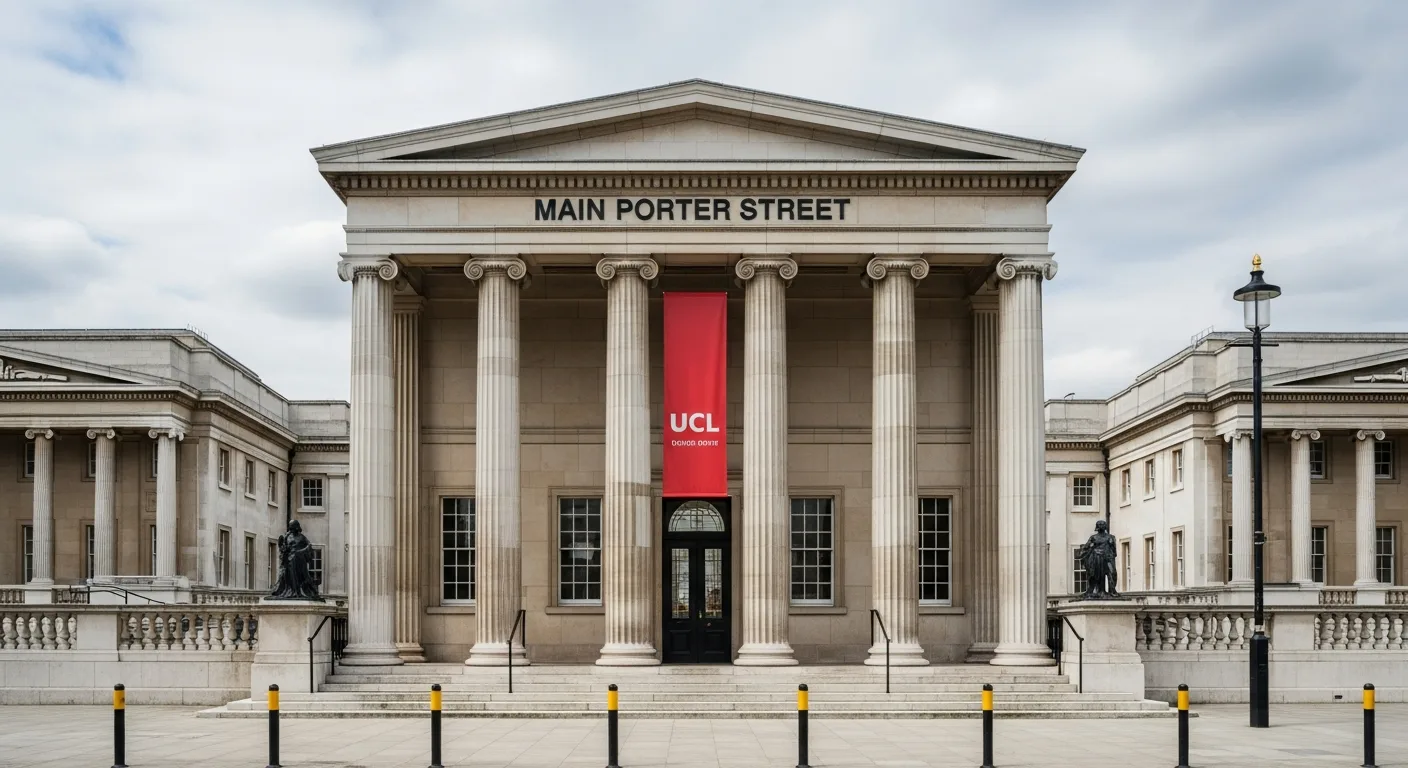
Photos: Wikimedia Commons
When you walk down Gower Street in central London, you pass a long neoclassical portico of ten Corinthian columns rising above the pavement. Through its iron gates and across the South Quad, students cross between lecture halls carrying laptops and architectural models, while the dome of the Wilkins Building catches the light above. A few minutes’ walk away, the British Museum opens its doors to the public for free; the British Library holds one copy of every book ever published in the United Kingdom; and Senate House - the building that inspired George Orwell’s Ministry of Truth in 1984 - sits between them. This is Bloomsbury, the academic heart of London, and at the centre of it stands University College London.
UCL was founded in 1826 as the first university in London and the first English university to admit students of any race, class or religion - a radical break from Oxford and Cambridge, which at the time required Anglican religious tests. From the beginning UCL called itself “the godless college on Gower Street” and built its identity around inclusion, secularism and scientific inquiry. Two centuries later that founding ethos has produced one of the most international universities in the world: 53% of UCL students come from outside the United Kingdom, drawn from over 150 countries. The university calls itself “London’s Global University,” and the label is earned, not aspirational.
UCL today sits at #9 in the QS World University Rankings 2026, making it the fourth-highest-ranked UK university after Oxford, Cambridge and Imperial. Its 48,000 students study across 11 faculties and dozens of specialist schools, including The Bartlett School of Architecture (ranked #1 in the world by QS for Architecture and Built Environment for the past decade), the Slade School of Fine Art, UCL Medical School and the UCL Institute of Education. UCL counts 30 Nobel laureates among its alumni and academic community, including the discoverers of the noble gases (William Ramsay), the structure of vitamins (Otto Hahn at the linked institutes), and the genetic code’s reading frame.
This guide is for international applicants - students applying to UCL from India, Singapore, Hong Kong, Nigeria, the Philippines, Malaysia, Indonesia, the Middle East, Latin America, continental Europe and beyond. We will cover everything you need to apply: rankings and reputation, the UCAS process, course selection across the 11 faculties, the cost of living in London, scholarships available to international students, life in Bloomsbury, the post-Brexit student visa pathway, and a candid comparison of UCL against LSE, Imperial and King’s. By the end you will know whether UCL is the right fit for you and what your application strategy should look like over the next 12 months.
If you are currently preparing your English certification - IELTS or TOEFL - alongside your UCL application, our PrepClass platform offers structured preparation for both exams with adaptive practice tests aligned to UCL’s required score bands.
Rankings and reputation - London’s Global University
UCL’s standing in global rankings is consistent and high. In the QS World University Rankings 2026, UCL sits at #9 globally and #4 in the UK behind Oxford, Cambridge and Imperial. In the Times Higher Education World University Rankings 2026, UCL sits at #22 worldwide. The ARWU (Shanghai Ranking) places it lower at #17, reflecting its slightly lower visibility in some Asian markets compared to Oxbridge. None of these positions has shifted dramatically in the past decade - UCL has been a top-15 global institution since 2010.
What the rankings cannot capture is subject-level dominance. The QS World University Rankings by Subject 2026 place UCL at:
- #1 in the world for Architecture and Built Environment (The Bartlett)
- #1 in the world for Education (UCL Institute of Education, 11 consecutive years)
- #3 in the world for Anthropology
- #5 in the world for Geography
- Top 10 globally for Archaeology, Pharmacy and Pharmacology, Anatomy and Physiology, Statistics and Operational Research
- Top 20 globally for Computer Science, Engineering (multiple branches), Economics, Law, Medicine, Psychology, Linguistics
In other words, UCL is not a single-strength university - it is one of the few institutions globally that combines top-five performance in arts, humanities, social sciences, sciences and professional disciplines simultaneously. Compare this to Imperial (concentrated in STEM and Medicine only) or LSE (concentrated in social sciences and economics only) and the breadth becomes clear.
UCL is a member of the Russell Group - the UK consortium of 24 research-intensive universities - and the League of European Research Universities (LERU), which limits membership to 24 elite European research institutions. It is also part of the U7 Alliance of leading global research universities. These memberships are not branding; they signal that UCL’s research output is taken seriously by peer institutions in continental Europe and North America.
The research profile is exceptional: UCL spent over £560 million on research in the most recent financial year, the highest of any UK university outside Oxford and Cambridge. In the most recent UK Research Excellence Framework (REF 2021), 94% of UCL’s research was rated “world-leading” or “internationally excellent.” UCL is part of the Francis Crick Institute (the largest biomedical research facility in Europe), Alan Turing Institute (UK national institute for AI and data science), and the UCL/Yale Collaborative across the Atlantic.
For international applicants, the practical implication is this: a UCL degree is recognised globally by employers, governments and graduate schools. Whether you return to India for an investment bank, apply to law school in the United States, or take up a graduate research position in Singapore, UCL appears at the top of recruiter lists. The QS Graduate Employability Rankings place UCL #15 worldwide for graduate employer reputation - ahead of LSE and behind only Oxford and Cambridge among UK universities.
A common misconception worth clearing up: the Russell Group is not the UK’s “Ivy League”. The Ivy League is a sports conference of eight US universities; the Russell Group is a research-intensive consortium of 24 UK universities including very different institutions (Birmingham, Leeds, Liverpool sit alongside Oxford and UCL). When recruiters or graduate schools rank UK universities, the meaningful tier above all others is Oxbridge + Imperial + UCL + LSE - the so-called “G5” or “Golden Triangle” universities. UCL is firmly in this top tier.
How to apply to UCL - the UCAS process step by step
Like every UK undergraduate university, UCL admissions go through UCAS (Universities and Colleges Admissions Service). UCAS is a centralised online platform where you submit a single application that can include up to five university choices. This means you do not apply to UCL directly - you submit one UCAS application, list UCL as one of your five choices, and write one personal statement that all five universities will read.
Key dates for the 2026-2027 cycle
- September 2026: UCAS application portal opens
- 15 October 2026 (18:00 UK time): Deadline for UCL Medicine (MBBS) and any Oxbridge-equivalent courses you list among your five choices
- 31 January 2027 (18:00 UK time): Standard UCAS deadline for all other UCL courses
- March - April 2027: UCL releases offers (conditional or unconditional)
- May 2027: UCAS firm/insurance reply deadline
- July - August 2027: Final A-Level / IB results released; conditional offers are confirmed
- September 2027: Term begins
International applicants should treat September 2026 as the working start date, even if the formal deadline is January 2027. Booking IELTS or TOEFL slots in major test centres in India, Singapore, Hong Kong, Nigeria or the Philippines is competitive, and reference letters from teachers in different time zones take longer than students assume.
What goes into the UCAS application
A complete UCAS application has six components:
-
Personal details - name, date of birth, nationality, residency status, fee status declaration. The fee status declaration matters: “Home” (UK domiciled, including settled status holders) pays £9,250/year; “International” pays £25,000 - £40,000/year.
-
Education history - every secondary school you attended from age 11 onwards, with grades to date and predicted grades for any in-progress qualifications.
-
Course choices - up to five university courses. Most international applicants list UCL plus four other UK universities; common UCL companion choices are Imperial, LSE, KCL, Edinburgh, Manchester or Bristol depending on subject. You can apply to only one of Oxford or Cambridge (not both) in a given cycle.
-
Personal statement - a single 4,000-character (~650-word) essay about your academic motivation, subject interest, relevant experience and goals. Crucially, the personal statement must work for all five universities - you cannot write a UCL-specific essay and a different Imperial essay. About 80% of the statement should be about academic interest in your subject; 20% about extracurriculars and broader skills.
-
Reference - one academic reference from a teacher, school counsellor or IB coordinator who can speak to your academic performance and predicted grades. International applicants whose schools are unfamiliar with UCAS conventions should brief their referee on what UK universities expect: subject-specific commentary, evidence of intellectual curiosity, and a clear predicted-grade table.
-
Predicted grades - your school’s official prediction of your final A-Level, IB, or equivalent results. UCL’s offers are usually conditional on these predictions being met (e.g. “AAA at A-Level including Mathematics A”).
Subject-specific admissions tests
UCL is unusual among top UK universities in that most courses do not require an admissions test. This is a deliberate strategic choice - UCL relies on academic transcripts, predicted grades and personal statements to assess applicants, rather than the dedicated tests Oxford and Cambridge use. The exceptions:
- UCL Medical School (MBBS): UCAT (University Clinical Aptitude Test). Sat between July and September each year; registration opens in May. UCAT replaced BMAT in 2024 after Cambridge Assessment discontinued BMAT. The UCAT measures verbal reasoning, decision-making, quantitative reasoning, abstract reasoning and situational judgement.
- Mathematics and Mathematics with Economics: MAT (Mathematics Admissions Test) - the same test Oxford uses, sat in late October.
- History of Art and some history programmes: HAT (History Aptitude Test) - sat in early November.
- The Bartlett (Architecture, BSc/MArch): portfolio submission, sometimes with interview. The portfolio should show design thinking and visual communication, not just finished products.
- Slade School of Fine Art: portfolio review and interview, in person or online for international applicants.
For all other UCL courses - Engineering, Computer Science, Law, Economics, Natural Sciences, Modern Languages - your transcripts, predicted grades, English certification and personal statement are the entire dossier. This is one significant difference between UCL and Oxbridge: UCL believes a strong academic record speaks for itself; Oxbridge wants to see you under live cognitive pressure.
English language requirements
UCL classifies its courses into three English requirement levels:
- Standard: IELTS Academic 6.5 overall with 6.0 in each subtest, or TOEFL iBT 92 with section minimums (R 24, W 24, S 20, L 20).
- Good: IELTS 7.0 overall with 6.5 in each subtest, or TOEFL iBT 100 with section minimums (R 24, W 24, S 23, L 22).
- Advanced: IELTS 7.5 overall with 6.5 in each subtest, or TOEFL iBT 109 with section minimums (R 24, W 24, S 23, L 22).
Most STEM and social sciences courses require Standard or Good. Law, English, Education and arts/humanities typically require Advanced. Medicine requires Advanced. Confirm the level for your specific course on its UCL prospectus page before booking your test date - taking IELTS twice because you missed Advanced minimums by 0.5 is a common and avoidable mistake.
For preparation, our PrepClass IELTS and TOEFL platform provides full mock exams calibrated to UCL’s three requirement bands. Most students need 60-90 days of structured preparation to move from a strong B2 baseline to UCL’s Advanced threshold.
Convert your transcripts and qualifications
UCL publishes country-by-country conversion tables at ucl.ac.uk/prospective-students/international-students for over 150 national qualifications. Some examples:
- Indian CBSE/ISC: 90%+ overall with 95% in subject-specific papers for Standard offers; 95%+ for Advanced offers.
- Singapore A-Levels: A,A,A or higher in three H2 subjects.
- IB Diploma: 36-39 points with 6,6,6 or 7,7,6 at Higher Level. Specific HL subjects often required (e.g. Mathematics HL 6 for Engineering).
- German Abitur: 1.0-1.5 final grade.
- Italian Maturità: 90/100 or 95/100 depending on course.
- Hong Kong DSE: 5,5,5 in three Category A subjects, 5* in core English, plus subject-specific minimums.
- US AP/SAT path: APs (5 in three subjects relevant to course) plus SAT 1450+ accepted by some courses; check course-specific page.
The conversion tables are non-negotiable. UCL’s admissions office uses them as the basis for offer decisions, so there is no point trying to negotiate on your school’s reputation alone.
What to study at UCL - the 11 faculties
UCL is organised into 11 faculties that span every major academic discipline. This is one of the largest faculty structures in the UK and it gives applicants enormous flexibility. Here is what each faculty covers and where it ranks globally.
1. The Bartlett (Faculty of the Built Environment)
The Bartlett is the world’s leading faculty in Architecture and Built Environment - #1 in QS World Rankings by Subject 2026 for the past decade. It contains The Bartlett School of Architecture (BSc, MArch, MA), the School of Planning, the School of Construction & Project Management, the Centre for Advanced Spatial Analysis, and others. Bartlett architecture is famous for experimental, technologically driven design - students work on AI-generated urban models, parametric design, sustainable construction systems and urban policy. Notable alumni include Sir Peter Cook (Archigram), Will Alsop, and dozens of partners at Foster + Partners and Zaha Hadid Architects. Tuition for Architecture BSc 2026/2027: £35,000/year for international students. Portfolio is required.
2. Engineering Sciences
UCL Engineering covers Biochemical, Chemical, Civil, Electronic and Electrical, Mechanical, Computer Science, Medical Physics, Statistical Science and joint MEng routes including the Integrated Engineering Programme (IEP). UCL Engineering ranks top 20 globally in QS for most engineering subjects and is particularly strong in Computer Science (QS #18 globally) thanks to UCL’s role as a founding partner of the Alan Turing Institute. Computer Science MEng is one of the most competitive programmes at UCL, with offers typically AAA and Mathematics required. International tuition for Computer Science 2026/2027: £40,000/year.
3. Mathematical and Physical Sciences
This faculty contains Mathematics, Physics and Astronomy, Chemistry, Earth Sciences, Space and Climate Physics (at Mullard Space Science Laboratory), Statistical Science, and the Department of Science and Technology Studies. UCL’s physics department was central to discovering noble gases and developing X-ray crystallography. Tuition: £33,000 - £37,000/year for international students.
4. Life Sciences
Biological Sciences (Genetics, Biochemistry, Molecular Biology), Pharmacy (UCL School of Pharmacy is QS #5 worldwide), Bioengineering joint programmes with Engineering Sciences, and the Sainsbury Wellcome Centre for neural circuits. UCL Pharmacy graduates regularly join GSK, AstraZeneca, Pfizer and the Wellcome Trust. International tuition for Pharmacy MPharm: £36,000/year.
5. Medical Sciences
UCL Medical School (UCLMS) is one of the most competitive medical programmes in Europe - offers typically AAA including Chemistry, Biology and either Mathematics or Physics, plus UCAT 2,800+ (the cut-off varies year to year). UCLMS partners with multiple London teaching hospitals: University College Hospital, the Royal Free, Whittington and Great Ormond Street. The MBBS programme runs six years for international students (including a one-year integrated BSc). International tuition for Medicine pre-clinical years 2026/2027: £40,000/year; clinical years rise to £52,000/year.
6. Brain Sciences
UCL has the largest concentration of neuroscience research in Europe through the Institute of Neurology (Queen Square) and the Wolfson Institute for Biomedical Research. Undergraduate options include Neuroscience BSc, Psychology BSc and joint Linguistics/Neuroscience routes. The Institute of Cognitive Neuroscience hosts world-leading brain imaging facilities. International tuition: £35,000/year.
7. Population Health Sciences
Global Health BSc, Public Health, Statistics and the UCL Institute of Health Informatics. This is a smaller faculty focused on health systems, epidemiology and biostatistics - strong career routes into the WHO, World Bank Health practice, and major NGOs.
8. Laws
UCL Laws is consistently ranked top 5 in the UK and top 15 globally by QS for Law. The LLB (Bachelor of Laws) is the standard three-year route into the UK legal profession; UCL also offers four-year LLBs with French Law (in partnership with Université Paris II Panthéon-Assas), German Law, Italian Law, Spanish Law and Hong Kong Law. UCL Laws does not require the LNAT (UCL is one of the few top UK law schools that does not). International tuition for LLB 2026/2027: £29,000/year.
9. Social and Historical Sciences
Anthropology (#3 globally), Geography (#5 globally), History, Archaeology, Economics, Political Science (SPP), and the Institute of the Americas. UCL Economics is one of the strongest economics departments outside Oxbridge and LSE - offers typically AAA including Mathematics. UCL also offers Philosophy, Politics and Economics (PPE) for applicants who want the breadth of an Oxford-style PPE outside Oxford itself.
10. Arts and Humanities
English, History of Art, Modern Languages (French, German, Spanish, Italian, Portuguese, Russian, Japanese, Hebrew, Yiddish, Scandinavian Studies), Hebrew and Jewish Studies, the Slade School of Fine Art (Fine Art BA, BFA, MA - portfolio entry only), and Information Studies. The Slade is one of the oldest and most prestigious art schools in the world; alumni include Lucian Freud, Antony Gormley, Patrick Caulfield and Cornelia Parker.
11. UCL Institute of Education (IoE)
Education BA, Education and International Development, Mathematics for Teaching, Childhood, Sociology and Education, and the famous PGCE (Postgraduate Certificate in Education) for those entering the teaching profession. IoE has been ranked #1 in the world for Education by QS for 11 consecutive years.
This breadth is UCL’s distinctive feature. If you are an applicant who knows your direction (Architecture, Medicine, Computer Science), UCL has world-leading specialist faculties to match. If you are an applicant who values interdisciplinary flexibility and wants to combine, say, Archaeology and Ancient History or Mathematics with Economics, UCL’s faculty structure makes this possible in ways that Imperial (STEM only) or LSE (social sciences only) cannot.
Cost of studying and living in London
London is the most expensive city in the UK and one of the most expensive student cities in the world. Be honest with yourself about the budget before you apply, because financial pressure during a three- or four-year programme is the single most common reason international students drop out.
Tuition fees 2026/2027 (international students)
UCL’s international tuition fees vary by faculty and course. The full official fee list is published every spring at ucl.ac.uk/prospective-students/fees. Here are typical 2026/2027 figures:
- Arts and Humanities, Social Sciences, Education: £25,000 - £28,000/year
- Laws (LLB): £29,000/year
- Sciences, Mathematics, Statistics: £33,000 - £37,000/year
- Engineering, Computer Science: £37,000 - £40,000/year
- Architecture (Bartlett BSc): £35,000/year
- Medicine (MBBS) pre-clinical: £40,000/year; clinical years £52,000/year
- Pharmacy (MPharm): £36,000/year
For comparison, Home students (UK domiciled) pay £9,250/year - this rate is capped by the UK government and applies to British citizens and those with settled status. EU students lost Home status after Brexit (since 2021/2022 entry); EU applicants now pay International fees identical to applicants from the United States, India or China. The only EU exception is Republic of Ireland, which retains Home status under the Common Travel Area.
In USD, international tuition at UCL is approximately USD 32,000-51,000/year at 2026 exchange rates - broadly comparable to a US private university such as NYU or Boston University, and significantly cheaper than Ivy League schools (Harvard, Yale, Princeton charge USD 65,000+ in tuition alone).
Living costs in London 2026/2027
UCL estimates international student living costs at £15,000 - £18,000 per year. This estimate is conservative. Realistic budgets:
- Accommodation: £180 - £280/week in UCL halls of residence (varies by hall and catered/self-catered status). £950 - £1,500/month in private flats in Bloomsbury, Camden, Holborn or King’s Cross. Annual: £8,000 - £14,000.
- Food and groceries: £180 - £300/month if cooking; £400 - £600/month if eating out frequently. Annual: £2,500 - £5,000.
- Transport: £91/month for a Zone 1-2 monthly Travelcard with 18+ Student Oyster (30% discount). Annual: £1,000 - £1,300.
- Books, materials, course supplies: £300 - £800/year depending on course. Architecture, Fine Art and Engineering can run higher.
- Personal, social, travel: £1,500 - £3,000/year depending on lifestyle.
- Health surcharge (IHS): £776/year paid up-front as part of student visa application - gives you full NHS access while studying.
Total realistic annual living cost for an international UCL student: £14,000 - £22,000, with most students landing around £16,000 - £18,000. Add tuition and the total annual budget is £40,000 - £62,000 (USD 50,000-78,000 or EUR 47,000-73,000).
Three-year and four-year totals
For a three-year undergraduate degree (most BA/BSc courses):
- Total tuition + living: £120,000 - £186,000 (USD 150,000-235,000)
For a four-year integrated MEng or MSci:
- Total tuition + living: £160,000 - £248,000 (USD 200,000-315,000)
For a six-year MBBS Medicine (international):
- Total tuition + living: £270,000 - £330,000 (USD 340,000-415,000)
Compare this to a four-year US Ivy League undergraduate degree at sticker price (~USD 360,000) and UCL is meaningfully cheaper for non-medical degrees. Compare to a top Asian university (NUS, HKUST) and UCL is significantly more expensive but with stronger global brand recognition outside Asia.
Working while studying
International students on a Student visa can work up to 20 hours/week during term time and full-time during vacations. Realistic part-time earnings in London are £11 - £15/hour for typical student jobs (retail, hospitality, university roles, library shifts). Over a 30-week academic year at 15 hours/week you can earn £4,950 - £6,750 - meaningful but not enough to cover tuition. Treat part-time work as a contribution to living expenses, not a tuition strategy.
Scholarships and financial support for international students
UCL offers a range of scholarships specifically for international undergraduates, but the most generous awards are highly competitive - typically fewer than 30 places against tens of thousands of applications. Major options below.
UCL Global Undergraduate Scholarship
The flagship undergraduate scholarship for international students. Covers full tuition fees plus a living stipend of approximately £15,000/year - total value over three years can exceed £150,000. Eligibility: international applicant (not UK domiciled), demonstrated financial need (family income evidence required), strong academic performance, evidence of community engagement or leadership. Application opens in February, deadline typically end of March. Approximately 30 awards per year worldwide.
Denys Holland Scholarship
Awarded to applicants who would not otherwise be able to fund a UCL education. Value: £10,500 per year for three years (£31,500 total). Eligibility: financial need plus evidence of broad engagement with university life beyond academics - sport, music, debate, volunteering. Open to all nationalities including international students. Approximately 12 awards per year.
Quintin Hogg Scholarship
For students in Engineering Sciences from low-income backgrounds. Value varies but typically £10,000 - £15,000/year. Open to international applicants pursuing Engineering MEng programmes.
Bartlett Promise Scholarship
For students entering Bartlett architecture and built environment programmes who have faced significant financial barriers. Combined tuition relief and living stipend.
UCL Faculty of Laws Scholarships
Several Faculty-level awards including the Jeremy Bentham Scholarship (named after UCL’s intellectual founder, whose preserved auto-icon still sits on display in the Student Centre). Value typically £5,000 - £15,000/year for high-achieving Law applicants from underrepresented backgrounds.
Country-specific awards for international students
- Chevening Scholarship (UK government): for postgraduate study only (not undergraduate). Awarded by country, with priority countries including India, Pakistan, Nigeria, the Philippines, Indonesia, Mexico, Brazil. Covers full tuition plus stipend. Highly competitive.
- Commonwealth Scholarship Commission: for postgraduate study from Commonwealth developing countries. Covers full tuition plus stipend. UCL is one of the major host institutions.
- British Council GREAT Scholarships: £10,000 awards offered annually to applicants from approximately 15 partner countries (varies year to year). Both UG and PG. Apply through UCL after admission.
- Fulbright Commission (US-UK): for US citizens pursuing postgraduate study at UCL. Covers tuition plus stipend. Awarded by the bilateral Fulbright Commission.
External funding and loans
International students are not eligible for UK Student Finance loans (these are reserved for Home students). Realistic external funding options:
- Prodigy Finance: UK-based lender offering loans to international postgraduate students at top universities including UCL. No co-signer required.
- MPower Financing: US-based lender for international graduate students attending US and UK universities. No co-signer.
- Country-specific government schemes: India (Vidya Lakshmi portal, public sector bank education loans), Singapore (CPF education loan, Mendaki tuition support), Nigeria (Nigerian Education Loan Fund), and similar in other markets. Confirm with your Ministry of Education or major commercial banks.
- Family contribution + savings: the most common funding source for international UCL undergraduates.
A common misconception: many applicants assume UCL is significantly cheaper than US universities and therefore “must” be affordable. With three-year totals of USD 150,000-235,000, UCL is a major financial commitment. Run the full numbers - tuition, accommodation, food, transport, health surcharge, flights home - before submitting your UCAS application.
Student life - Bloomsbury and London
UCL’s main campus sits in Bloomsbury, a Georgian neighbourhood in Zone 1 of central London bordered by Euston Road to the north, Tottenham Court Road to the west, New Oxford Street to the south, and Gray’s Inn Road to the east. Within a 10-minute walk of the Wilkins Building you can reach:
- The British Museum (free entry, world’s most visited museum after the Louvre)
- The British Library (every UK book ever published, free reading rooms)
- Senate House Library (the Art Deco tower that George Orwell fictionalised as the Ministry of Truth)
- SOAS, Birkbeck, RADA, the Royal Academy of Dramatic Art
- Russell Square, Tavistock Square, Gordon Square - Bloomsbury’s three main green spaces
- Euston, King’s Cross St Pancras and Russell Square Underground stations - connecting you to all of London
Bloomsbury is the academic heart of London in a literal sense: more universities, libraries and learned societies are concentrated here than anywhere else in the UK. The Bloomsbury Group of writers (Virginia Woolf, E.M. Forster, John Maynard Keynes, Lytton Strachey) lived and worked in these squares in the early 20th century, and the intellectual atmosphere persists.
Halls of residence
UCL guarantees a place in halls for first-year international undergraduates who apply by 31 July before their start date. This guarantee is important because the private rental market in central London is brutal - flat-shares in Bloomsbury or nearby Camden start at £1,000/month and have queues of 20+ applicants per listing.
UCL halls fall into two categories:
Catered halls (breakfast and dinner provided): Astor College, Goldsmid House, Frances Gardner House, Ifor Evans Hall, Ramsay Hall. Weekly cost: £200 - £280. Sociable, easy first-year transition, removes cooking from your time budget.
Self-catered halls (kitchen access): Arthur Tattersall House, James Lighthill House, Max Rayne House, Schafer House, Ramsay Hall, the Garden Halls (a large modern complex shared with SOAS and Birkbeck). Weekly cost: £150 - £240.
After first year, most students move to private flats in Camden (lively, music venues, north of campus), Islington (more residential, slightly further), Holborn (legal district, central), Hackney/Dalston (trendy, longer commute), or Stratford (cheaper, longer commute via Central Line). Typical second-year flat-share costs: £900 - £1,400/month per person for a shared room in a 3- or 4-bedroom flat.
Societies and student culture
UCL has over 350 student societies and 75 sports clubs managed by the UCL Students’ Union at 25 Gordon Street. Major society categories: academic (subject societies - Architecture Society, Economics Society, Medical Society), cultural (every major nationality has a society - Indian, Chinese, Singaporean, Hong Kong, Nigerian, Latin American, Polish, French and so on), political (Labour, Conservative, Liberal Democrat, Greens, debate societies), creative (Drama Society, Film Society, Music Society) and special interest (Quidditch, Knitting Society, Mountain Climbing).
The UCL Volleyball Society, UCL Hockey and UCL Boat Club compete at British Universities & Colleges Sport (BUCS) level. The annual UCL vs King’s College London “Varsity” rivalry - particularly the rugby fixture - is the most-attended UCL sporting event of the year.
For nightlife, UCL students typically gravitate to Bloomsbury pubs for early-evening drinks (Marlborough Arms on Torrington Place is the unofficial UCL pub), Camden for rock and indie venues, Soho for theatre and restaurants, Shoreditch for clubs, and Mayfair for high-end nights out. London’s club closing time is later than most UK cities (most clubs run to 03:00-06:00).
Cultural London on a student budget
The city’s free cultural infrastructure is enormous. The British Museum, British Library, Tate Modern, Tate Britain, National Gallery, Natural History Museum, V&A and Science Museum all charge zero entry fees. UCL’s own Petrie Museum of Egyptian Archaeology, Grant Museum of Zoology and UCL Art Museum are free to all visitors. For theatre, UCL students get discounted tickets at the National Theatre and Royal Court (£10 - £25), and same-day £25 West End stalls through the official theatre apps. The BBC Proms at the Royal Albert Hall offers £6 standing tickets across the eight-week summer season.
Notable UCL alumni - who has studied here
UCL’s alumni list demonstrates the breadth of the institution’s influence:
Politics and law: Mahatma Gandhi (UCL Faculty of Laws, 1888-1891 - Gandhi qualified as a barrister at UCL before moving to South Africa and India); Junichiro Koizumi (former Prime Minister of Japan); Lord Bhattacharyya (founder of the Warwick Manufacturing Group).
Science and technology: Alexander Graham Bell (inventor of the telephone, briefly studied at UCL before emigrating); William Ramsay (Nobel Prize in Chemistry 1904 for the discovery of noble gases); Francis Crick (UCL undergraduate physics; later co-discoverer of DNA structure); Otto Hahn (Nobel Prize in Chemistry 1944).
Literature, film and arts: Christopher Nolan (director of Inception, Interstellar, Oppenheimer - UCL English Literature); Ricky Gervais (creator of The Office - UCL Philosophy); Coldplay’s Chris Martin met fellow band members at UCL; Lucian Freud and Antony Gormley (both Slade School of Fine Art).
Business and finance: Lord John Browne (former CEO of BP, UCL Physics); multiple senior partners at McKinsey, BCG, Bain, Goldman Sachs and Morgan Stanley with UCL undergraduate degrees.
This alumni breadth is one of UCL’s signature features. Where Imperial alumni cluster in engineering and tech, where LSE alumni cluster in finance and government, UCL alumni span every sector - including some of the highest-profile creative figures in the world (Nolan, Gervais, Coldplay).
Student visa - studying at UCL after Brexit
Since 2021, all non-UK students at UCL - including EU citizens - apply through the UK’s Student visa route (formerly Tier 4). The process is reasonably straightforward but requires careful timing.
Documents and process
- Receive an unconditional offer from UCL (typically July or August after final results).
- Pay tuition deposit as required by UCL (varies by course; typically £2,000 - £4,000).
- Receive a CAS (Confirmation of Acceptance for Studies) from UCL. This is a unique reference number that links your application to UCL’s sponsor licence.
- Apply for the Student visa online at gov.uk/student-visa. Application fee: £524 (from outside the UK).
- Pay the Immigration Health Surcharge (IHS): £776/year of study upfront (so £2,328 for a three-year course). This gives you full NHS access during your studies.
- Provide financial evidence: you must show you can cover tuition for one year plus living costs for nine months in London (currently set at £1,334/month inside London = £12,006 total maintenance evidence). Funds must be held in an acceptable account for 28 consecutive days before application.
- Provide TB test certificate (required for applicants from many countries - check UK government list).
- Provide academic transcripts and English language certificate (IELTS or TOEFL approved by UKVI).
- Submit biometrics at a UKVI Visa Application Centre in your home country. Most applicants receive a decision within 3 weeks.
The UK Student visa allows you to study full-time, work up to 20 hours/week during term and full-time during vacations, and travel in/out of the UK freely.
After graduation: the Graduate Route
The UK’s Graduate Route visa allows international students to remain in the UK for two years after graduation (three years for PhD graduates) without sponsorship. This is significant - it means UCL graduates have a two-year window to find skilled employment and apply for a Skilled Worker visa, without the lottery uncertainty of the US H-1B system. Many large London employers (Goldman Sachs, JPMorgan, McKinsey, BCG, Google, Meta, Deloitte, PwC) actively recruit UCL undergraduates with the explicit understanding that a Graduate Route visa bridges them into long-term sponsored employment.
Compared to the US international graduate pathway - where OPT (12 months, 36 for STEM) feeds into the H-1B lottery (success rate around 30% in non-STEM categories) - the UK Graduate Route is significantly more reliable. For international applicants whose primary concern is “can I stay in the country after graduation?”, UCL plus the Graduate Route is one of the strongest options globally.
UCL vs LSE vs Imperial vs King’s - how to choose
These four are London’s elite Russell Group universities. They look superficially similar, but the academic and career profiles are very different.
Imperial College London
A STEM and Medicine specialist. No humanities, no social sciences (except a small Business School). If you are absolutely certain about Engineering, Computer Science, Medicine, Mathematics or natural sciences, Imperial offers the strongest UK undergraduate experience in those fields outside Oxbridge - and arguably the strongest industry recruiting reputation. Smaller than UCL (~22,000 students). Located in South Kensington (Museum District). QS World Ranking 2026: #2 globally.
LSE (London School of Economics and Political Science)
A social sciences specialist. Concentrated in Economics, Finance, Politics, International Relations, Law, Anthropology, Sociology, Statistics. Tiny (~13,000 students total, including substantial postgraduate community). Located on Houghton Street near Holborn. Top destination for City of London careers (investment banking, strategy consulting, hedge funds). LSE Economics is the most competitive economics undergraduate programme in the UK after Oxbridge. QS Ranking 2026: #56 globally - but rankings undersell LSE because it has no STEM to inflate citation counts. By any measure of social-sciences specific reputation, LSE is top 5 globally.
King’s College London (KCL)
The closest peer to UCL - also broad, also Russell Group, also ~32,000 students, also London-based. Particularly strong in Medicine, Law, War Studies, International Relations, Theology. KCL’s Medical School is one of Europe’s largest. Located in The Strand near the Royal Courts of Justice. QS Ranking 2026: #34 globally. KCL is comparable to UCL academically but a step behind in global brand strength.
When to choose UCL
Choose UCL if any of the following apply:
- You want breadth and interdisciplinary flexibility rather than a single specialist focus.
- You are interested in Architecture, Urban Planning or Built Environment (Bartlett is unmatched).
- You are interested in Education or Educational Research (IoE is #1 globally).
- You want a strong international peer group (53% of UCL students are international - the highest figure of the four).
- You want a central London location with easy access to museums, theatres and cultural infrastructure.
- You value research depth across multiple disciplines (UCL outspends LSE and KCL on research and is comparable to Imperial in absolute research budget).
When to choose elsewhere
Choose Imperial if you are an Engineering, CS or Medicine specialist focused on industry placement. Choose LSE if you are aiming for finance, consulting or government careers and want the strongest social-sciences brand. Choose KCL if you are interested in War Studies, International Relations or Theology specifically, or if UCL doesn’t offer your preferred course combination. Choose Oxford or Cambridge if you have the academic profile for them, want the collegiate tutorial system, and prefer a small-city environment over central London.
Conclusion - is UCL right for you?
UCL is the right choice for international applicants who:
- Want a globally recognised UK degree with strong post-graduation visa pathways (the Graduate Route is significantly more reliable than the US H-1B lottery).
- Value interdisciplinary breadth and don’t want to be locked into a single specialist faculty.
- Want to study in central London with all the cultural, professional and social opportunities that brings.
- Are comfortable with a large institution (48,000 students) where you have to take initiative to build your community.
- Have the academic profile for a top-10 global university (AAA or AAA at A-Level, 36-39 IB, equivalent in national qualifications).
- Have realistic financial planning for USD 150,000-235,000 over three years (tuition plus London living costs).
UCL is not the right choice if you are looking for the small-college Oxbridge experience, if you need an institution that makes its admissions decisions through interview (UCL doesn’t, mostly), or if you want a single hyper-specialised faculty (Imperial for STEM, LSE for social sciences are stronger fits).
If UCL is on your shortlist, your next steps are:
- Confirm your course choice by reading the relevant department’s prospectus page on ucl.ac.uk thoroughly. Pay attention to entry requirements specific to your national qualification.
- Book your English certification test (IELTS Academic or TOEFL iBT) for at least 6 months before your UCAS deadline. Use PrepClass to prepare and target UCL’s Standard, Good or Advanced band as required.
- Build your UCAS account and identify your five course choices. UCL plus 2-3 peer institutions plus 1 safety choice is a typical structure.
- Draft your personal statement by August before your application year. Show academic engagement with your subject, not just enthusiasm.
- Brief your referee - international school teachers benefit from explicit guidance on what UK universities look for.
- Calculate the full three-year budget (tuition + accommodation + living costs + flights home) and confirm funding sources before you submit.
UCL has been London’s Global University for 200 years. Whatever you study and wherever you come from, the institution has a place for you to do serious work, meet remarkable peers, and graduate into a global alumni network that opens doors in every major city. The application is competitive but not impossible - and the rewards last a lifetime.
 IELTS Academic and General Training prep
 All four skills in one place, with Writing and Speaking marked by AI against the band descriptors.

 Prepclass