17%
Overall acceptance rate
average across all courses (ox.ac.uk)
How to get into Oxford as an international applicant? UCAS deadline 15 October, written assessments (TSA, MAT), the tutorial-style interview, college choice, A-levels and IB benchmarks. The realistic odds for an international candidate.

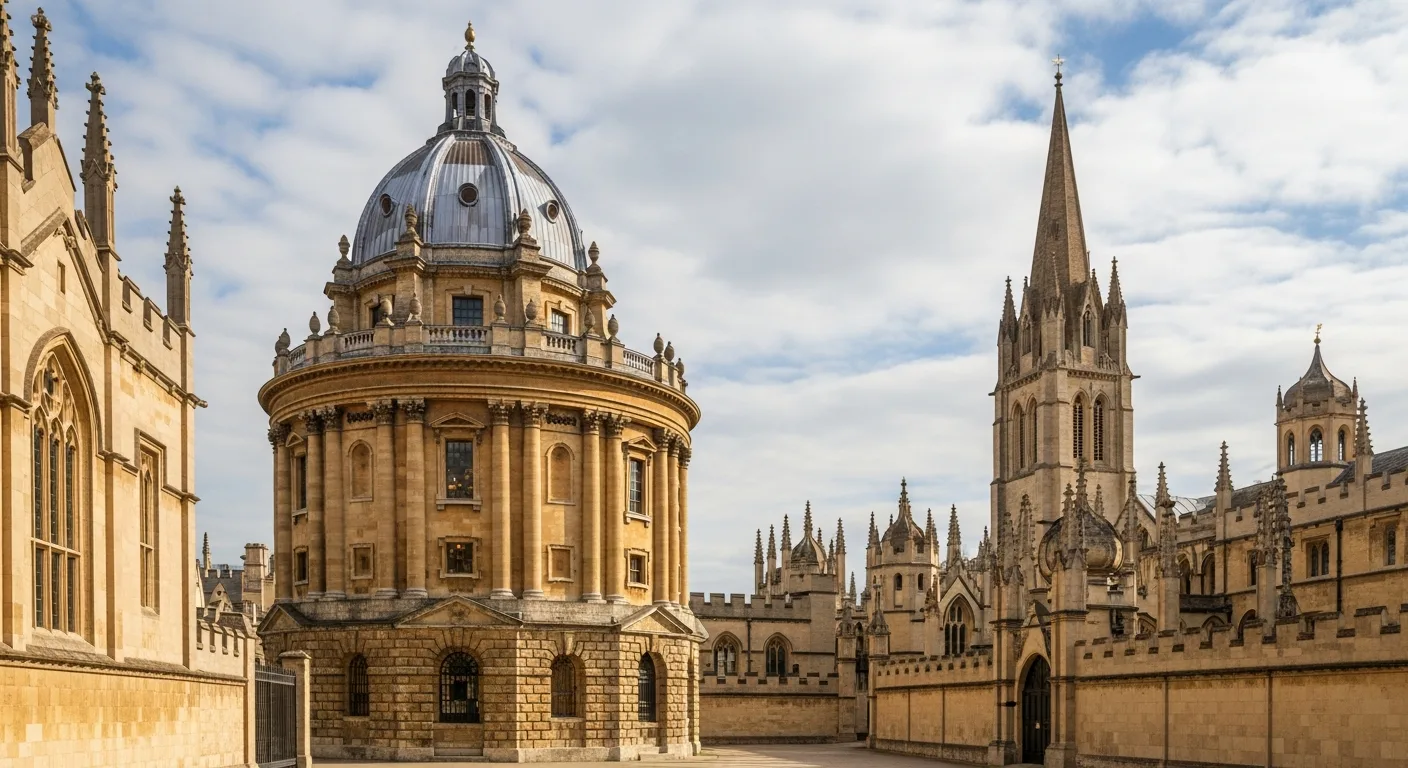
Photos: Wikimedia Commons
A Monday in October, 22:13 local time. You open the UCAS portal, you see the “First Choice” field and the cursor blinking in the course-selection box. You have two weeks until 15 October - a date that cannot be moved, the date on which Oxford closes applications three months earlier than the rest of the United Kingdom. Your personal statement is on its sixth draft, your TSA is booked for 28 October, and your teacher still hasn’t sent the reference. And on the screen, a quote from ox.ac.uk: “We are looking for evidence of academic ability, motivation, and the potential to thrive in the tutorial system.” Three things to unpack over three months of work.
In this article I’ll walk you through the entire Oxford admissions process for an international applicant - from the UCAS calendar, through the written assessments course by course, the tutorial-style interview, the choice of college, the way your school qualifications convert into Oxford’s benchmarks, and the realistic odds for an international candidate. This is an extension of the Oxford study guide pillar, where I cover the campus, costs, colleges and careers. Here we focus solely on how you physically get in.
The short truth. Oxford admits around 17% of applicants (official ox.ac.uk data), but that figure is heavily averaged - the science courses and medicine hover between 7-12%, while Classics and Oriental Studies reach 25-30%. The application goes exclusively through UCAS, the deadline is hard and earlier than for the rest of the United Kingdom: 15 October. By that day, an international applicant must have a complete UCAS application, a personal statement (max 4,000 characters), a teacher reference, and a registered written assessment appropriate to the course (TSA, MAT, PAT, HAT, LNAT, UCAT, etc.).
International qualifications are accepted, but the realistic bar for the most selective courses is AAA at A-level*, or 38-40 IB points with three Higher Level subjects at 6-7. For national systems, that means the equivalent of top grades - the upper band of the Abitur, the highest Baccalauréat marks, a near-perfect High School Diploma backed by strong APs. Grades alone are not enough: your place is decided by the combination of grades, written assessment and interview in December (Oxford invites around 40-50% of applicants). The interview simulates a tutorial - an hour-long 1:1 or 2:1 session with a professor, in which you think out loud and work with material you’ve never seen before.
Oxford is one of the two UK universities (together with Cambridge) that use an earlier UCAS deadline - 15 October instead of the 31 January that applies to everyone else. For an international school-leaver starting in October 2027, that means your complete application has to be in UCAS by 15 October 2026 at the latest.
On that same day you need a registered written assessment for your course - registration opens in early September and closes on 15 October. The exam itself takes place in the second half of October or early November, at an authorised Pearson VUE or British Council centre. As an international applicant you can sit it at a certified test centre in your own country or region - there is a global network of authorised centres, so for most applicants there is one within reach.
Here is a practical timeline for an international applicant: April-June = research courses and colleges, read widely in your field; July-August = draft your personal statement, prepare for the TSA/MAT/PAT/HAT; September = finalise the personal statement, ask your teacher for the reference, register on UCAS and book the written assessment; 15 October = submit; November = sit the written assessment; December = interview (usually online for overseas candidates); January = decisions; May-June = final school exams; August = results and place confirmation. The exact dates of your final exams depend on your national system, but the Oxford milestones above are fixed for everyone.
The written assessment is the second pillar of the application after the personal statement - and it is often this, not your grades, that decides whether you’re invited to interview. Oxford requires different tests depending on the course.
TSA (Thinking Skills Assessment) - for PPE, Economics & Management, Experimental Psychology, Human Sciences. 90 minutes of critical thinking plus a 30-minute essay. The test measures logic and argumentation, not factual knowledge. A realistic bar for PPE: 65+ points (on a 0-100 scale).
MAT (Mathematics Admissions Test) - for Maths, Maths & Computer Science, Maths & Philosophy. 2.5 hours, problems at A-level Mathematics + Further level. The average for successful pure-maths applicants is ~70+/100. An applicant with a national or international mathematical olympiad behind them (more on olympiads and applications below) has a natural advantage here.
PAT (Physics Aptitude Test) - for Physics, Engineering, Materials Science. 2 hours, physics + maths. The bar: 65+/100.
HAT (History Aptitude Test) - analysis of an unseen historical source under time pressure, for History and joint History courses.
LNAT (Law National Aptitude Test) - for Law. UCAT (University Clinical Aptitude Test) - for Medicine (it replaced BMAT from 2024). Other courses have their own tests: ELAT (English Literature), MLAT (Modern Languages), CAT (Classics). The full map of tests by course is published at ox.ac.uk/admissions.
| Course | Test | Duration | Realistic bar |
|---|---|---|---|
| PPE / Economics & Management | TSA | 2 hrs | 65-70/100 |
| Mathematics / CS | MAT | 2.5 hrs | 70+/100 |
| Physics / Engineering | PAT | 2 hrs | 65+/100 |
| History | HAT | 1 hr | source analysis |
| Law | LNAT | 2 hrs 15 min | 27+/42 (sec A) |
| Medicine | UCAT | 2 hrs | 2700+/3600 |
| English Literature | ELAT | 1.5 hrs | comparative essay |
The interview is the moment where Oxford differs most sharply from American universities. It is not a personality test, a motivation test, or a CV check. The interview simulates an hour-long tutorial - the foundational teaching method at Oxford, in which a student meets a professor (a tutor) in a 1:1 or 2:1 group and spends an hour discussing a piece of written work.
The panel is checking not what you know, but how you think out loud. Whether you can work with an unfamiliar text or problem. Whether you revise your argument when someone finds a flaw in it. Whether you cope with the pressure of not having an answer. Whether you ask good questions when the material goes beyond what you’ve studied.
An international applicant usually gets 2-3 interviews, each 25-30 minutes, conducted by 2 tutors from the college. Sometimes there is an additional interview with another (“competing”) college. Since the pandemic, most interviews for candidates outside the UK take place online (Microsoft Teams) - which saves an international applicant roughly £800-1,200 (around $1,015-1,525 / €930-1,400 / about ¥7,000-10,500 in many regional currencies) on travel and a hotel. That removal of the travel barrier is one of the most significant recent changes for overseas candidates.
The best preparation is not memorising answers, but training yourself to think out loud. Work through the sample interview questions on the official Oxford page, then add sessions with a mentor who pushes back on your claims. Never pretend to know something you don’t - the tutors will catch it instantly. Instead, say: “I don’t know that result, but let me try to derive the answer from X.”
Oxford is a collegiate university - 39 independent colleges, which you apply to through UCAS as your first choice. You can name a specific college or submit an open application - in which case the Oxford algorithm allocates you to a college with fewer candidates for your course.
The college affects your accommodation, networking, the formal hall, and some internal scholarships. It does not affect your academic programme (which is central and identical at university level), your degree (always University of Oxford), or your lectures (central, in the faculties).
For an international applicant with no prior Oxford connection, a sensible strategy is the open application. The reason is mechanical: if you name a competitive college (Magdalen, Christ Church, Balliol, New College - historically selective), you’re competing against hundreds of other ambitious candidates. An open application places you where, statistically, you stand a better chance.
If you still want to pick a specific college, look through the Norrington Table (the academic ranking of Oxford colleges published by Cherwell) and the per-college, per-course application data from the annual Admissions Statistical Report. A college with fewer applications for your course is more often a better decision than a “prestigious” one.
Oxford officially accepts a wide range of international qualifications - the ox.ac.uk International Qualifications section lists them. For A-levels, the typical offer is AAA for most courses, rising to AAA* for Maths, Physics and Economics. That is the headline benchmark, and it is the bar most international applicants are measured against if they sit A-levels.
The realistic competitive bar sits at the top of each system. For the moderately selective courses (History, Languages, Geography, Classics) you should be firmly in the top band; for the most selective ones (Maths, Medicine, PPE, Computer Science, Economics & Management) you effectively need the maximum your system offers. The point is that a candidate who merely “meets the minimum” can still lose at the academic-threshold stage, before they ever reach the interview, because they’re competing against applicants with near-perfect predictions.
IB Diploma - the equivalent is 38-40 points in total, with three Higher Level subjects at 6-7 (ideally 7-7-6 for the hardest courses). An IB applicant has a marginally smoother administrative path, because Oxford knows the IB extremely well and doesn’t have to convert an unfamiliar national scale.
National qualifications - if you sit the German Abitur, the French Baccalauréat, the Italian Maturità, a national high-school diploma, or any other system, Oxford publishes the specific benchmark it expects: top-band overall results plus high marks in the subjects relevant to your course. For a US-style High School Diploma, Oxford typically wants a strong GPA backed by three or more AP exams at grade 5 (or SAT/ACT plus APs) in the relevant subjects. Conversion is never one-to-one, so a GPA calculator is useful for comparing systems side by side. Whatever your system, the principle is the same: you need to demonstrate the equivalent of the very top of your cohort.
Remember that these are conditional offers - even if you receive a place in January or February, the offer is conditional on your final exam results in the summer. A drop from a planned A* to a C, or from a projected top IB score to several points below, means the offer is withdrawn, no matter how good your interview was.
The personal statement is 4,000 characters (or 47 lines - whichever comes first) covering your entire academic profile. It is written once for all 5 of your UCAS choices - meaning the same text goes to Oxford, Imperial, UCL, LSE and KCL. This is a fundamental difference from the American system, where the Common App lets you write separate supplemental essays for each university.
UK vs USA specifics: American essays allow and even encourage a personal narrative (“my grandmother taught me Mandarin and that shaped my interest in linguistics”). An Oxford personal statement should be 80% academic - what you’ve read beyond the syllabus, which intellectual problems preoccupy you, what projects you took on independently, which debates or olympiads you entered. The remaining 20% is extracurricular activity, but only if it connects to the course.
What NOT to do: don’t use the Ivy League label when talking about Oxford (the Ivy League is American; Oxford is a UK Russell Group flagship). Don’t quote Steve Jobs, Einstein or any other universal guru. Don’t write that you’ve “always dreamed of Oxford.”
What to do: show that you read beyond the syllabus, name specific books and papers, demonstrate that you can challenge an idea, and describe a research project of your own. Show that you are ready for the tutorial - ready for the weekly cycle of writing an essay under pressure and defending it in front of a tutor.
Let’s be specific. Oxford reports an overall acceptance rate of 17% (official ox.ac.uk data), but that number hides a wide spread by course. The classical and less “fashionable” courses (Classics, Oriental Studies, Geography, Theology) have a real acceptance rate of 25-30%. Mainstream courses (History, Modern Languages, Biology) - 15-20%. The most selective ones (Computer Science, Economics & Management, Medicine) - 7-12%.
Applicants from many regions are under-represented at Oxford - according to the public Admissions Statistical Report, Oxford admits only a few dozen undergraduates a year from across large parts of Central and Eastern Europe and other emerging-market regions. With a strong profile (top predicted grades, a high-percentile TSA/MAT, an academic personal statement, a strong reference from a subject teacher) your real odds are close to the average - i.e. ~15-20% on the less selective courses.
Your real chances come down to three variables. First - your written assessment score. This is filter number one, far more important than your grades. Second - course fit. Third - the interview. Oxford invites ~40-50% of applicants to interview, and admits ~35-50% of those invited. Being an international applicant is NOT a minus - Oxford actively seeks geographic diversity. But that does not mean “lighter criteria.” It means: with an equal profile, an under-represented applicant may have a marginal edge - but only if the rest of the application is at the right level.
Deferred entry is Oxford’s official route allowing a year off between admission and the start of your studies. You apply in the 2026/27 cycle, receive a conditional offer in January 2027, sit your final exams in June 2027, but start not in October 2027 but in October 2028.
Oxford generally accepts deferred entry - most colleges agree, but some require a concrete plan for the gap year (research, work, volunteering, a language course). The most common reasons an international applicant chooses deferred entry: a year of paid work to build a financial buffer before the expensive UK education (~£32,000-44,000 in tuition per year for international students = around $40,600-55,900 / €37,400-51,500, plus £15,000-18,000 a year in living costs), a research placement at a domestic institute, or intensive language study.
There are real funding routes for international students heading to UK universities, but you need to check eligibility carefully before assuming a scholarship will cover Oxford’s fees. Government-backed schemes such as Chevening are aimed mainly at postgraduates, not school-leavers; some home-country governments and national agencies run undergraduate-overseas scholarships, but many are restricted to specific fields or stages of study. Oxford itself offers need- and merit-based support (for example the Reach Oxford Scholarship for students from low-income countries, and the Crankstart Scholarship for UK students). Verify the exact terms on ox.ac.uk and with your home country’s education agency before counting on any award to cover tuition.
This article is a cluster extension of the Oxford study guide pillar, focused solely on admissions. For the full picture of the campus, costs, colleges and careers - return to the pillar. For a comparison with the other half of Oxbridge, see Oxford vs Cambridge - the comparison. For an American alternative in the humanities, see how to get into Harvard. For financial context and scale conversions, see the GPA calculator.
Among Oxford’s notable alumni (oxford.json): Stephen Hawking (BA Physics ‘62, theoretical physicist), Tony Blair (BA Jurisprudence ‘75, UK Prime Minister), Margaret Thatcher (BA Chemistry ‘47, UK Prime Minister), Oscar Wilde (BA Classics 1878, writer). The list shows the two vectors that dominate Oxford - the humanities and law leading to politics and business, and the hard sciences leading to the global intellectual elite.