
£33-44k
International tuition
Band A → Band C, depending on course
How much does Oxford cost for an international student? Tuition Band A £33,050, Band B £38,550, Band C £44,240, Medicine higher. College fee, living in Oxford and the Reach Oxford Scholarship.

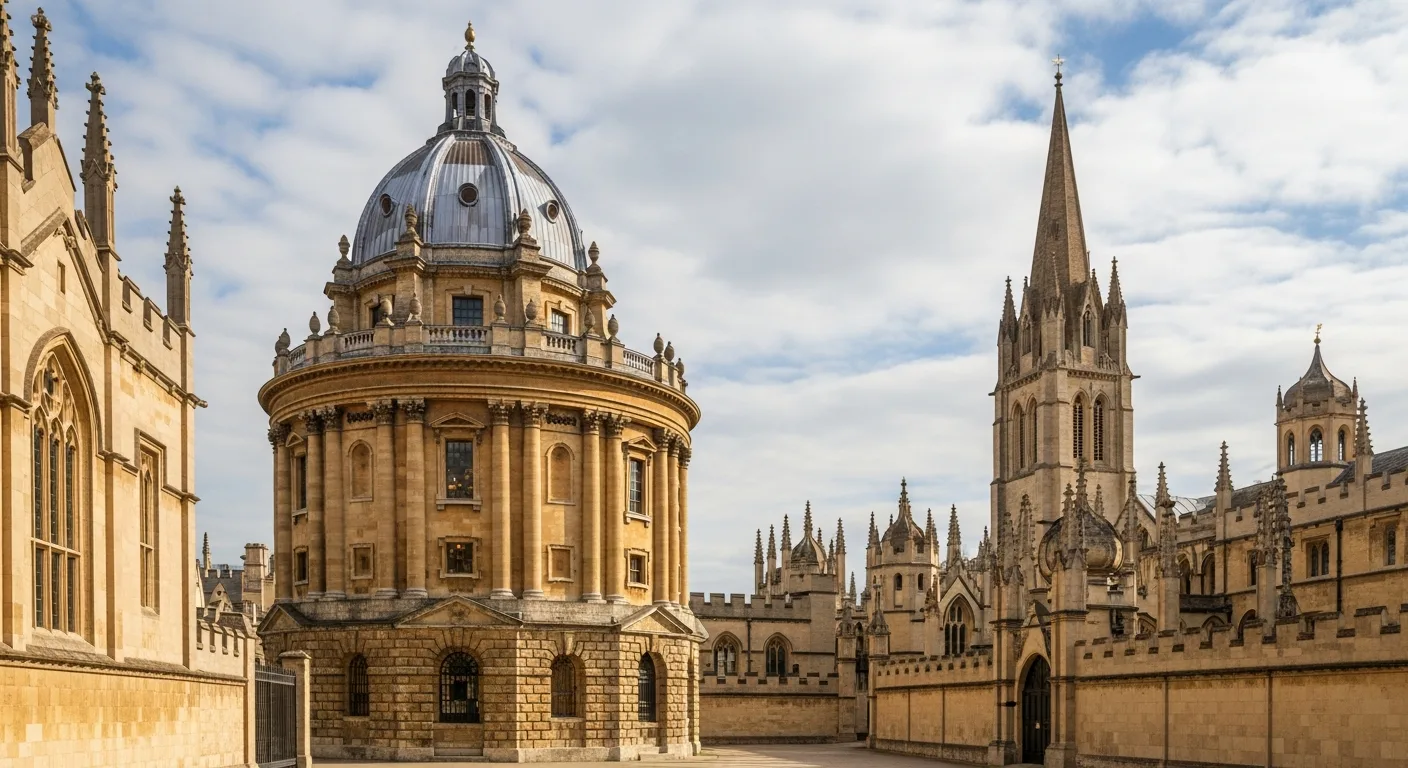
Photos: Wikimedia Commons
An international applicant opens the Oxford Fees & Funding calculator and sees five different tuition figures for a single university. Band A £33,050 for English Literature, Band B £38,550 for Computer Science, Band C £44,240 for Engineering, Pre-clinical Medicine £48,620, Clinical Medicine about £59,260. Plus a separate College fee of around £9,530 - and here comes the question that the home page never answers: why do you pay two different institutions to study at one university?
Because Oxford is a federation of 39 colleges + a central university, and each of them has its own budget. The tuition fee goes to the university, the College fee goes to your college (Magdalen, Balliol, Christ Church, and so on). That is the first thing you have to understand before you start calculating: at Oxford you pay not once but twice - and some scholarships cover only one of those two line items.
Below I break down the real cost of studying at Oxford for an international applicant: tuition per Band, the College fee, the cost of living in Oxford, the scholarships (Reach, Crankstart, Clarendon), the GBP/USD maths at roughly 1.33 USD/GBP, and the difference between the sticker price and the real cost after a scholarship. You will find the full admissions guide in our Oxford study guide pillar.
The short answer: from £33,050 to £59,260 per year, depending on the course. Oxford groups all undergraduate courses into five price bands that reflect the real cost of teaching - the more lab work and expensive infrastructure a course requires, the higher the rate.
Here is the breakdown for the 2025/2026 academic year for international students (which is what every non-UK applicant is after Brexit):
| Band | Tuition 2025/2026 | Example courses |
|---|---|---|
| Band A | £33,050 | Classics, English Language and Literature, History, Law, PPE, Theology, Modern Languages, Philosophy, Economics & Management |
| Band B | £38,550 | Mathematics, Computer Science, Geography, Music, Materials Science |
| Band C | £44,240 | Biology, Chemistry, Earth Sciences, Engineering Science, Physics, Biochemistry |
| Pre-clinical Medicine (years 1-3) | £48,620 | Medicine (pre-clinical phase) |
| Clinical Medicine (years 4-6) | £59,260 | Medicine (clinical phase) |
What does this mean in practice? If you apply for PPE (Politics, Philosophy, Economics) - one of Oxford’s most popular courses with international applicants - you pay £33,050/year. Three years of a bachelor’s degree is £99,150 in tuition alone. At roughly 1.33 USD/GBP that is about $132,000 for the teaching alone. Engineering Science (Band C, a four-year MEng) is 4 × £44,240 = £176,960, or about $235,000. A six-year Medicine degree (3 × £48,620 + 3 × £59,260) is £323,640 = over $430,000 in tuition alone.
These figures do not yet include the College fee or living costs. Tuition is the foundation, not the whole bill.
Oxford is a collegiate university: a federation of 39 autonomous colleges (Magdalen, Balliol, Christ Church, New College, Merton, and so on) + a central university that runs the lectures, the final examinations and oversees the faculties. Every student belongs to one college for the whole of their degree. Your college gives you accommodation, a dining hall, a library, a common room and - crucially - tutorials, the one-on-one or one-on-two teaching sessions with a tutor.
From a budget point of view, this means you pay two different institutions:
The College fee for international students in 2025/2026 is around £9,530 per year. It covers use of the college library, access to tutors, the common room, the gardens, the chapel and the administration. It does not include accommodation or meals - you count those separately under living costs.
Why does this matter for your budget? Because many scholarships cover only the tuition fee - the College fee stays your expense. The Reach Oxford Scholarship covers both elements, but smaller college-specific scholarships often cover only part of the tuition fee. Always read carefully what a scholarship covers before you put it into a financial plan.
Oxford’s official minimum for the 2025/2026 academic year is £14,935 in the “likely” estimate and £17,380 in the upper estimate. You will find these figures in the Living Costs section on ox.ac.uk/feesandfunding. A realistic breakdown looks like this:
College accommodation is your financial ally. Most colleges guarantee a room for the first year, and many (Magdalen, Christ Church, Merton, St John’s) for all three years of a bachelor’s degree. A room in college costs £150-£200/week (usually a 30-week academic let - Oxford has three 8-week terms, plus consultation periods).
The private rental market in Oxford is brutal: a room in a shared house in North Oxford or Cowley runs £700-£900/month plus utilities. Students who move “out of college” in their second or third year often pay 20-30% more than if they had stayed in college accommodation.
Books and materials come to about £600-£800/year - Oxford has one of the largest academic library systems in the world (the Bodleian + the college libraries), so you rarely need to buy anything to own. Transport: a bicycle for £150-£300 (everyone cycles in Oxford), a train ticket to London £25-£40, a budget airline flight home £60-£150 each way.
The Reach Oxford Scholarship is the one full undergraduate scholarship worth fighting for - if you are eligible for it. It covers:
The real cost of study for a Reach scholar: £0. The catch is eligibility: the scholarship is open only to nationals of qualifying developing countries (the list of eligible countries on the OECD-DAC list is updated each year - check it on ox.ac.uk/feesandfunding before the deadline), and it does not cover Medicine. If your home country is not on the eligible list, Reach is not a route for you, and your plan should centre on college-specific funds and home-country financing instead.
What you have to do:
The real odds: Reach awards only a handful of scholarships each year across all eligible countries - this is global competition, not a national lottery. An outstanding applicant from a top secondary school with national-olympiad results has a real chance, but it is not a plan you base the family budget on. Apply in parallel to your home government’s overseas-study scholarship schemes, to private foundations and NGOs that fund study abroad, and to college-specific funds (every college has its own scholarship budget - check each one individually).
The short answer: Crankstart - no; Clarendon - graduate only.
The Crankstart Scholarship (formerly Moritz-Heyman) is a scholarship for UK students who qualify for Home fee status and whose household income does not exceed £32,500/year. It covers the gap between tuition and the cost of study plus a £6,000/year grant. As a non-UK applicant you do not qualify as a Home student - Crankstart is out of reach for international applicants. This is a common mistake in online guides that copy lists of scholarships without verifying eligibility.
The Clarendon Fund is Oxford’s flagship programme, but only at graduate level (master’s, MPhil, DPhil/PhD). It covers full tuition, the College fee and a living grant of about £18,600/year. It awards a few hundred scholarships a year across all of Oxford’s graduate applicants. You apply automatically through your graduate application - there is no separate form.
If your strategy is: bachelor’s at home (at a strong, low-cost domestic university) → master’s/PhD at Oxford with Clarendon - then that is a realistic financial plan. Many international academics at Oxford took exactly that route: a master’s or doctorate funded by Clarendon, Rhodes, or the Oxford-Weidenfeld & Hoffmann programme (aimed at emerging and transition economies).
The second graduate option is the Rhodes Scholarship - the oldest and most prestigious scholarship in the world (founded in 1902). It covers full tuition, the College fee and a living grant. Eligibility depends on your home constituency, so check whether your country has a Rhodes constituency. It awards around 100 scholarships a year globally, with a fixed allocation per constituency.
This is the most important table in the article. The official sticker price from Oxford is one thing - what actually leaves the family account after all scholarships is often an entirely different number.
| Student profile | Sticker price (per year) | Real cost after scholarship |
|---|---|---|
| Band A without scholarship (PPE, History, Law) | £33,050 + £9,530 + £15,000 = £57,580 (~$77k) | unchanged - full amount |
| Band C without scholarship (Engineering, Physics) | £44,240 + £9,530 + £15,000 = £68,770 (~$91k) | unchanged - full amount |
| Reach Oxford Scholarship (any Band) | £57,580-£68,770 | £0 - everything covered + flight home |
| Band B + college fund £5,000 + home-country grant £6,000 | £53,080 (~$71k) | about £42,080 (~$56k) |
| Pre-clinical Medicine without scholarship | £48,620 + £9,530 + £15,000 = £73,150 (~$97k) | unchanged |
As you can see, the difference between the full rate and Reach is practically the entire cost of study. That is why the first thing you must do after deciding to apply to Oxford - if you are eligible - is to submit the Reach application by 15 October. Do not wait for the admissions decision; you submit the Reach application in parallel.
Remember the currency trap too: GBP/USD swings between roughly 1.26 and 1.38. On a budget of £60,000/year, a difference of five cents on the pound is about $3,000 over a year. If a family spreads spending over three years, it is worth buying GBP in tranches when the rate is favourable rather than the whole amount at once.
Cambridge has a nearly identical price structure: international tuition of £30,000-£67,000 (depending on the course, with the Medicine Triposes at the top end), a College fee of around £11,000-£12,500/year (higher than Oxford), and living in Cambridge at around £13,500/year. So broadly the same figures, with a ±£3,000/year swing depending on course and college. You will find the full breakdown in our Cambridge study guide pillar.
Our full guide to the cost of studying in the UK shows that beyond Oxford/Cambridge there are cheaper top-tier options: Imperial College London £39,000-£52,000/year with no College fee, UCL £30,000-£40,000, University of Edinburgh £26,000-£35,000. Edinburgh for a humanities degree costs roughly £30,000 less per year than Oxford.
If Oxford’s costs are out of reach, consider continental European universities: ETH Zurich (CHF 730/semester - about $830), KU Leuven (~EUR 1,100/year), TU Delft, Sciences Po. These are top-100 universities globally that do not demand a six-figure financial commitment from the family.
And one more note: Oxford is NOT part of the Ivy League. The Ivy League is eight American universities on the east coast of the USA. Oxford is a British university in the Russell Group - an alliance of 24 British research universities. Calling Oxford “the British Ivy League” is media shorthand, not an academic category.
Oxford accepts a wide range of school-leaving qualifications, but it requires specific subjects for specific courses: PPE needs strong mathematics plus a humanities subject; Engineering requires top grades in mathematics, physics and chemistry; Medicine requires biology, chemistry and one of (mathematics, physics) at the highest level. You will find the full map of school qualifications → Oxford requirements in the pillar guide.
A grade-point average from a national High School Diploma does not convert 1:1 to the British A-level/IB system, but Oxford looks at percentiles and specific results, not at a single “GPA”. If you want to estimate how your qualifications look on an international scale and compare them with Oxford’s A-level/IB requirements, use the GPA calculator - it converts your school results into a 4.0 equivalent and shows whether you fall within the typical range of admitted applicants.
Next steps if you are considering Oxford: