
Best Degrees at Cambridge
Best degrees at Cambridge: Natural Sciences (NatSci), Engineering, Mathematics with STEP, HSPS, Economics, Computer Science, Medicine, Law. The Tripos system explained step by step.

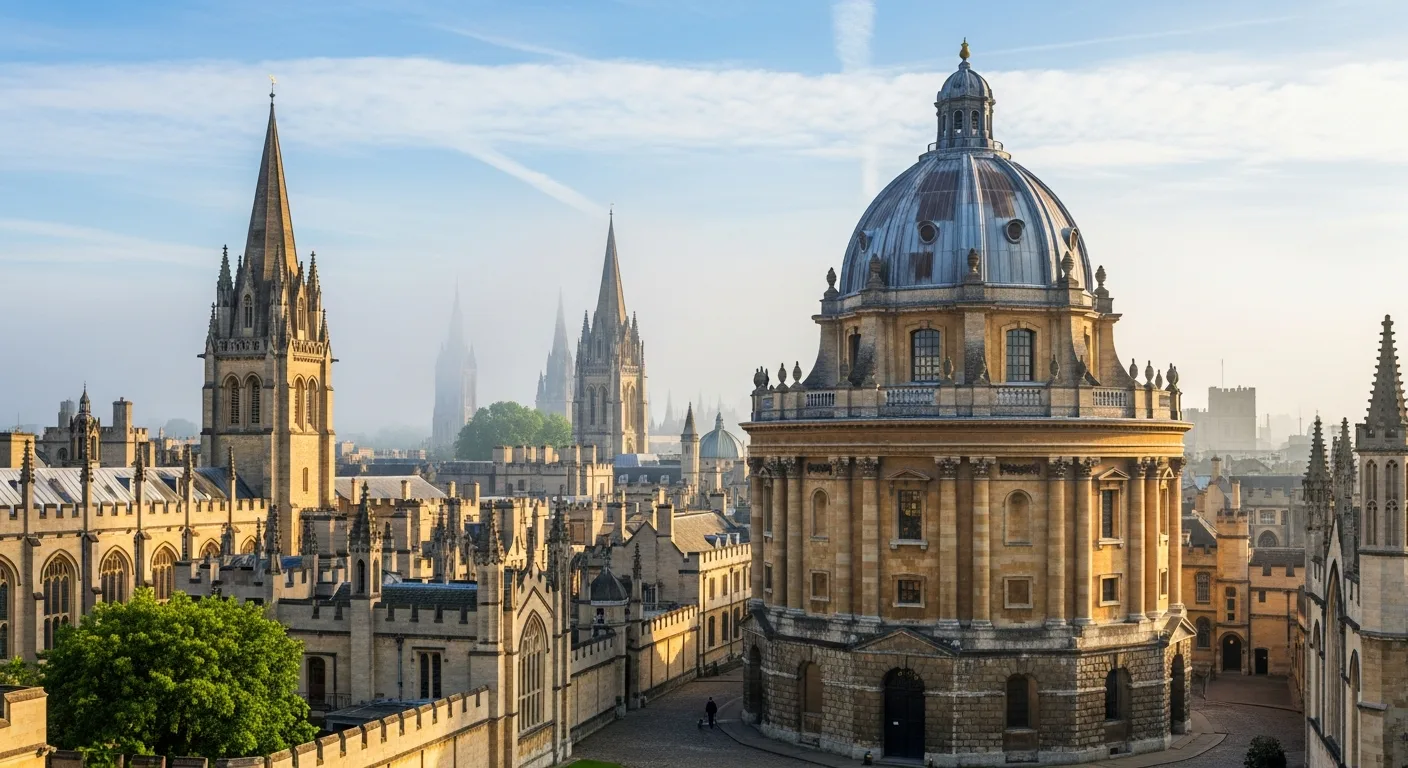
Photos: Wikimedia Commons
Imagine you are in your first year of Natural Sciences at Cambridge. After a morning lecture on organic chemistry in the faculty on Lensfield Road, you walk back to your college - Trinity, if you are lucky - and sit down for a supervision. There are two or three of you. The professor sets you a quantum-mechanics problem you could not crack on your own. They do not ask about your motivation. They ask why your integral diverges to infinity. The next day you face a choice: do you go to the practical class on cell biology or the one on solid-state physics? Because on NatSci you get to choose. This is the Tripos - a system invented in the 15th century that to this day defines what a Cambridge undergraduate degree looks like.
Cambridge is the university where Isaac Newton formulated the laws of mechanics at Trinity College, Charles Darwin studied at Christ’s College, Stephen Hawking earned his doctorate at Trinity Hall and Alan Turing got his start at King’s College. 120+ Nobel laureates - more than any other university in the world (source: Wikipedia - Cambridge Nobel laureates). According to the QS World University Rankings 2026, Cambridge ranks #5 in the world, and in the natural sciences and mathematics it consistently sits in the global top three.
In this guide I will show you the strongest degrees (Triposes) at Cambridge - from the flagship Natural Sciences and Engineering, through Mathematics with STEP, HSPS, Economics and Computer Science, all the way to Medicine and Law. I will explain how the Part IA → IB → II → III system works, how narrowing your specialism plays out, and I will help you decide which Tripos fits an international applicant coming from an A-levels, IB or high-school-diploma background. If you are just starting your research, begin with the main Cambridge admissions guide - that is the parent article to this cluster piece.
How does the Tripos system work and how does it differ from a typical degree?
Tripos is simply Cambridge’s word for an undergraduate degree - historically it derives from the three-legged stool (Greek tripous) on which the examiner sat during disputations in the 15th century. Today every degree at Cambridge has its own Tripos, divided into Parts: IA (year 1), IB (year 2), II (year 3) and - in selected degrees - III (year 4). Each Part is a separate, exam-closed stage in which you can change your specialism. For an applicant used to a system where you pick one subject and stay on that track, this is something genuinely new: you do not choose your degree once for five years, you renegotiate it year by year.
The most flexible of all is the Natural Sciences Tripos (NatSci). In Part IA you pick 3 subjects from a list of 8 (physics, chemistry, mathematics for NatSci, cell biology, evolution and behaviour, physiology, materials science, earth sciences). In Part IB you reduce to 2-3, in Part II to one. A student who starts with physics, chemistry and mathematics can graduate in Part II as a theoretical physicist - or, if she discovers a chemist inside herself, as a chemist. In a degree system where you commit to a subject up front, such a change would mean switching courses and losing a year. On NatSci it is not a switch of course, it is simply the next step in the Tripos.
The second pillar of Cambridge is the supervision system (more detail in our main Cambridge guide). Once a week, in a group of 1-3 people, you meet your supervisor - usually a fellow of your college, sometimes a doctoral researcher in the field - and discuss an essay or problem set you wrote on your own. It is the supervision that mostly makes Cambridge Cambridge, not the lectures. You can watch a lecture on YouTube from MIT. A supervision is a form of learning you cannot copy.
There is one more structural feature that surprises almost every international applicant: at Cambridge you do not just apply to a university, you apply to (or are pooled into) a college. Trinity, King’s, St John’s, Churchill, Newnham and the rest are not dormitories - they are self-governing communities that admit students, employ your supervisors, run their own libraries and pastoral systems, and shape much of your day-to-day life. The Tripos - your academic content and your exams - is set centrally by the University and is identical whichever college you belong to. But your supervisions, your accommodation and the people you live alongside come from the college. For an applicant from a system where “the faculty” and “the campus” are the whole story, learning to hold both layers in your head - University Tripos plus college community - is the first real adjustment. It is also why advice like “which is the best college for NatSci?” is mostly a distraction: the teaching standard is set University-wide, and if a college is short of a specialist supervisor in your exact area, you are sent to one at another college. Choose on atmosphere and fit, not on a perceived academic edge that does not really exist.
The takeaway for planning is concrete. Because the Tripos lets you defer specialisation, the riskiest move is to over-narrow your application too early. A student who applies for a hyper-specific subject elsewhere because it “sounds like the career” can find, two years in, that the field is not what they imagined - and at that point a change is expensive. The Cambridge model front-loads breadth precisely so that the expensive decision is delayed until you have actually studied the alternatives at a serious level. That is a genuine advantage for the intellectually curious 18-year-old, and a poor fit for someone who already knows, with certainty, the one narrow thing they want to do and resents being made to study anything else for two years.
Why is Natural Sciences (NatSci) Cambridge’s flagship degree?
NatSci is the largest and most prestigious science programme at Cambridge - about 700 new students a year (source: Cambridge Faculty of Biology). Why not a standalone “physics” or “chemistry” degree? Because Cambridge assumes a talented 18-year-old may not yet know whether they are a physicist or a molecular biologist. NatSci lets them discover it over the first year, drawing on quite literally some of the best faculties in Europe in each of these fields.
NatSci informally splits into two paths: Physical (physics, chemistry, materials, earth sciences, maths-and-physics) and Biological (cell biology, biochemistry, physiology, neuroscience). The choice between them is not formalised - it happens through the subjects you pick in Part IA. A student with strong advanced results in chemistry and biology naturally lands in Biological NatSci. A maths-and-physics student goes Physical.
The acceptance rate for NatSci ranges around 18-22% depending on the path - roughly the Cambridge average (source: Cambridge Undergraduate Admissions Statistics). Requirements are AAA at A-level or 42 points in the IB (with 7,7,7 at Higher Level). If you are applying with a different national qualification, Cambridge publishes country-specific entry equivalencies - and it expects top-band results in at least three relevant subjects, including mathematics and at least two sciences appropriate to your chosen path. On top of that comes the ESAT (Engineering and Science Admissions Test) - an admissions exam covering mathematics, physics, biology or chemistry - and an interview.
It is worth being precise about what “choice” means here, because the freedom is real but bounded. Some Part IA combinations are timetabled together and some clash, so not every set of three subjects is possible - a few combinations are simply incompatible, and the faculty publishes which subjects pair well with which. Maths for NatSci, in particular, is a load-bearing choice: if you want to keep the physical-sciences door fully open into Part IB and beyond, you almost certainly need to take it in Part IA, because so much of the later physics and chemistry assumes that mathematical machinery. An applicant who imagines they will “do a bit of everything and decide later” should understand that the decisions you make in your first October quietly constrain what is reachable two years on. The system rewards breadth, but it rewards informed breadth.
NatSci also has an interesting side effect: it is the strongest route into Cambridge for the undecided. If you know you want to do science but cannot pick between physics and chemistry, you apply for NatSci and make the decision in Part IB. That same flexibility is why NatSci attracts an unusually high concentration of the strongest school-leavers in the sciences from around the world: a student who has topped national science competitions but is genuinely torn between, say, theoretical physics and biochemistry does not have to gamble the whole of their twenties on a single guess made at seventeen. They can let the first year decide. For an international applicant that is a particularly valuable safety net, because the costs of “choosing wrong” - a transfer, a lost year, an expensive overseas move repeated - are far higher when you are studying abroad than when you are studying at home.
Is Engineering at Cambridge a better choice than Imperial?
Cambridge Engineering is #3 in the UK and top 10 in the world (source: QS Engineering Rankings 2026). But what sets it apart is not the ranking - it is the philosophy of the programme. Every first-year student does the same Engineering Tripos: mechanics, structures, electronics, information, thermodynamics and materials. You do not choose “Mechanical Engineering” or “Aerospace” at the start. You choose after two years, when you know what genuinely interests you.
By contrast, Imperial College London starts you in a specific specialism immediately: you apply for Mech Eng, Aero, Civil, Chemical or EEE and ride that track for all three years. Imperial sits closer to the London job market (the City, finance, consulting) and has stronger links to Big Tech (Google, Meta, DeepMind). Cambridge is closer to the tradition of academic engineering (ARM Holdings was founded here, AstraZeneca, Microsoft Research Cambridge).
Why would an international applicant choose Cambridge? For two reasons. First, if you are not yet sure whether you want to do Mech Eng, Aero or Information Engineering - Cambridge gives you two years to decide. Second, the fourth year (Part IIB → MEng) is the most common route at Cambridge - you leave with a Master of Engineering degree, not a BA. That matters for PhD applications and for some engineering roles that require a master’s-level qualification.
Requirements: AAA at A-level (mathematics plus physics compulsory), 42 IB (7 in maths HL and physics HL), ESAT plus interview. Whatever your qualification, you need top-band results in advanced maths and physics, plus a very strong ESAT score.
One more thing worth weighing as an international applicant: the Cambridge model deliberately keeps the engineer broad for longer, which has a knock-on effect on how your degree reads to employers and graduate schools later. A graduate of Cambridge Engineering can credibly say they understand mechanics, electronics, information systems and thermodynamics as a connected whole before they ever specialised - which is exactly what some of the most demanding employers (systems-heavy aerospace, robotics, energy, deep tech) say they value. The trade-off is that you reach the cutting edge of your eventual specialism slightly later than a peer who started narrow on day one. Neither is “better” in the abstract; they suit different people. If you already know with certainty you want to design jet engines and nothing else, the narrow path loses you nothing. If you suspect the question “what kind of engineer am I?” is genuinely open, Cambridge’s two-year runway is the more honest answer to it.
What sets Cambridge Mathematics apart and what is STEP?
Cambridge Mathematics is the hardest maths degree in the UK and one of the hardest in the world. A standard offer is AAA + 1,1 in STEP - the highest grades across three STEP papers (Sixth Term Examination Paper). STEP is an additional maths exam sat exclusively by applicants to Mathematics at Cambridge and Warwick. It consists of 3 papers (STEP 1, 2, 3), each three hours of open-ended proof questions. STEP is at a far higher level than a standard advanced school-leaving maths exam - it is a test of mathematical thinking, not of knowing techniques.
The Mathematical Tripos is historically the most famous degree at Cambridge. Here studied Newton (Trinity ‘65), Hardy, Ramanujan (through Trinity, though he never formally completed his school qualifications), Turing (King’s ‘34) and Hawking (BA Trinity Hall ‘66, later PhD). The Tripos runs for 3 years with the option of Part III in the fourth year - Part III is a globally elite postgraduate year ending in a MASt (Master of Advanced Study), to which International Mathematical Olympiad medalists travel from all over the world.
Some Mathematics students switch after Part IB to NatSci Physical (continuing physics) or to Mathematical Tripos Part II Applied (applied mathematics, theoretical physics). It shows the flexibility of the system - the choice is never a one-off.
An international applicant for Cambridge Maths should be a maths-olympiad medalist (at national level ideally, regional level as a floor) or have results on a par with the strongest specialist maths schools in their country, the ones that consistently send candidates to top programmes. A perfect score in advanced school maths alone is not enough - STEP checks whether you can prove, not just compute. Start your STEP preparation at least a year before you apply - the best materials are the official STEP archive from Cambridge Assessment Admissions Testing.
It is hard to overstate how different STEP feels from the maths most school systems train you for. National curricula - whether A-level, IB Higher Level, AP Calculus or a continental matriculation exam - overwhelmingly reward speed and accuracy on familiar procedures: differentiate this, solve that, apply the formula you were taught. STEP questions, by contrast, are deliberately unfamiliar. A single question can run for a full page, give you almost no scaffolding, and ask you to discover a method rather than execute one. A strong candidate might attempt six or seven questions in three hours and write full, watertight solutions to only three or four of them - and that can be enough for the top grade, because the marking rewards depth of reasoning over breadth of coverage. This is why the standard advice for the strongest school mathematician in their year is still to spend a full year on STEP: not to learn new content, but to retrain the reflex from “recall the technique” to “build the argument from scratch.” If maths-olympiad-style problem solving already excites you, STEP will feel like home. If your relationship with maths is mostly about getting the right answer quickly, STEP - and Cambridge Maths behind it - may be a harder fit than the headline grades suggest.
How do HSPS, Economics and Law differ as humanities-and-social-science paths?
Cambridge has no PPE degree - that is the flagship programme at Oxford. Cambridge offers three separate Triposes that together cover that space:
HSPS (Human, Social and Political Sciences) is the closest equivalent to PPE. It combines sociology, social anthropology, political science, international relations and - optionally - psychology. It contains neither philosophy nor economics in the core programme. It is a strong path for someone interested in the empirical social sciences, global politics and research on inequality. It is not the right choice for someone who wants to become an economist.
The Economics Tripos is a separate, highly technical degree. Cambridge Economics is #2 in the UK (behind LSE) and top 10 in the world. It requires advanced mathematics at a very high level (A in Maths A-level, 7 in Maths HL IB, top-band results in advanced school maths*) and the TMUA (Test of Mathematics for University Admission). The programme is heavily mathematical - econometrics, microeconomics, macroeconomics, maths for economists. This is not “business” - it is academic economics.
Law (LLB) at Cambridge is a 3-year law degree ending in a BA in Law (even though it is often called the LLB). It requires the LNAT (Law National Aptitude Test) and an interview. Cambridge Law is #1 in the UK (source: QS Law Rankings 2026). For an international applicant there is one important caveat here: English law is a common-law system, and if your home jurisdiction follows the continental (civil-law) tradition, your Cambridge degree will not automatically let you practise law back home. You would need to go through recognition or requalification in your home country and top up subjects in your domestic law if you plan to return.
This is the single most under-appreciated point about reading Law abroad, so it deserves to be spelled out. A law degree is not a portable, universal qualification the way a maths or physics degree largely is. It is, in part, training in one specific legal system. If you study English common law and intend to spend your career inside the common-law world - England and Wales, much of the Commonwealth, the United States with further conversion - then a Cambridge Law degree is among the most powerful starting points imaginable, and the path onward (the routes into the solicitor or barrister professions in England) is well-trodden. But if your real goal is to practise in a civil-law jurisdiction back home, you should think hard before committing three years and considerable money to a degree that trains you in the “wrong” system for that goal. The honest alternatives are to study law at home and use Cambridge for a master’s later, or to choose Cambridge for an adjacent degree (HSPS, Economics, History) and approach law afterwards through your home country’s own conversion routes. None of this makes Cambridge Law a bad choice - it makes it a choice that has to be matched deliberately to where you actually intend to build your career.
| Tripos | Length | Admissions test | Acceptance ~ | What's distinctive |
|---|---|---|---|---|
| Natural Sciences | 3-4 years (BA/MSci) | ESAT | 18-22% | 3-4 subjects at the start, specialisation in Y2/Y3 |
| Engineering | 4 years (MEng) | ESAT | 18-20% | Shared programme for 2 years, specialisation in Part IIA |
| Mathematics | 3-4 years (MMath) | STEP 2 + 3 | ~22% | The hardest maths in the UK - STEP demands proofs |
| Computer Science | 3-4 years | TMUA | 9-11% | The hardest degree to get into at Cambridge |
| Medicine | 6 years (MB BChir) | UCAT | ~18% | 3 years Pre-Clinical + 3 years Clinical at Cambridge Hospitals |
| HSPS | 3 years (BA) | none | ~22% | Sociology, anthropology, politics. No economics or philosophy |
| Economics | 3 years (BA) | TMUA | ~17% | Heavily mathematical academic economics |
| Law (BA Law) | 3 years (BA) | LNAT | ~18% | Common law - needs home-country recognition if you return |
Why does Cambridge Computer Science have a <11% acceptance rate?
Computer Science is the hardest degree to get into at Cambridge — an acceptance rate in the region of 9-11% (source: Cambridge Computer Science admissions). The reason is simple: 100-150 places a year against 1,500-2,000 applications globally. That is lower than most of the Ivy League (see our Ivy League guide).
Cambridge CS differs from Imperial CS or Oxford CS in three ways:
- Strong theoretical foundations. The first year is heavy on discrete mathematics, logic and the theory of computation. Students often complain that “it’s more Mathematical Tripos than CS.” That is intentional — Cambridge builds rigorous theory, not software engineering.
- Proximity to AI labs. DeepMind Cambridge is in the city, Microsoft Research Cambridge is right next to campus. The AI ecosystem around Cambridge in 2026 is comparable to Stanford and MIT, though on a smaller scale.
- Part III (MEng/MASt) — the fourth year is an optional, heavily research-driven year. An excellent route into a PhD at Cambridge, MIT or Stanford.
Requirements: AAA (A* in mathematics compulsory, A* in further mathematics very strongly recommended), TMUA plus a technical interview (you solve a programming or maths problem live). For an international applicant: a top score in advanced school maths, advanced computer science recommended, and a computing or maths olympiad — the IOI or IMO and their national equivalents — very much improves your chances.
A word of warning for the self-taught coder, because it is a recurring source of disappointment. Cambridge CS is not, in any meaningful sense, a “learn to build apps” degree. A teenager who has shipped a polished mobile app, run a small SaaS side-project or grinded competitive-programming ladders has real evidence of drive — but the degree itself is built on the assumption that the interesting questions are why algorithms work, what can be computed at all, and how you prove a system correct, not how to wire up a front-end. The interview reflects this: it is far more likely to probe how you reason through an unfamiliar logic or recursion problem out loud than to ask which framework you prefer. The students who thrive are the ones who find the mathematics genuinely beautiful, not merely a hurdle on the way to engineering. If your love is shipping product, a more applied software-engineering programme — or Imperial’s more systems-and-industry-flavoured CS — may actually suit you better and make you happier. The strongest signal you can send Cambridge is evidence of abstract problem-solving stamina: an olympiad result, a serious dabble in a proof assistant, a research-style project that asks a question rather than builds a tool.
How long is Medicine at Cambridge and is it worth it from an international applicant’s perspective?
Standard Medicine at Cambridge is a 6-year programme: 3 years Pre-Clinical (Natural Sciences-style, lots of biochemistry, physiology, anatomy and genetics — Part IA, IB, II) plus 3 years Clinical at Cambridge University Hospitals (Addenbrooke’s). You graduate with the MB BChir — the British equivalent of a medical doctor’s degree.
Cambridge also runs the Graduate Course in Medicine — a 4-year path for people who already hold a degree (most often in biology, biochemistry or a related science). The acceptance rate for Graduate Medicine is ~6-8% — extremely competitive. It requires the GAMSAT plus an interview.
For an international applicant this is an interesting but far-from-easy path. Upside: an MB BChir from Cambridge is recognised globally — you can work across the United Kingdom, Ireland, Canada, Australia and most of Europe. Downside: after six years you are not yet a fully qualified doctor — in the UK you go through the Foundation Programme (2 years), then specialty training (5-8 years). Returning to practise in your home country usually means diploma recognition plus passing your national medical licensing exam — a process of 6-12 months. A realistic path: 6 years at Cambridge plus 2 years of Foundation in the UK plus a return home for specialty training, or staying in the UK for your whole career.
Requirements: AAA at A-level (Chemistry plus one of Biology/Physics/Maths compulsory), UCAT plus an interview, and volunteering experience in a healthcare setting. With other qualifications you need top-band results in advanced chemistry and biology.
There is also a hard financial and logistical reality to face squarely before falling in love with the idea. Medicine carries the longest training pipeline of any subject here, and for an international student it is also among the most expensive degrees in the world to fund end to end — overseas medical tuition runs well above the already-high overseas rate for other subjects, and you are committing to six years of it, plus living costs in one of England’s pricier cities, before any salary arrives. The number of places open to overseas applicants for Medicine is also tightly capped, which pushes the effective competition for those seats higher than the headline acceptance rate suggests. None of this should deter a genuinely committed, well-funded candidate — but it does mean Medicine at Cambridge is rarely the pragmatic choice for an international student whose main goal is simply to become a doctor as efficiently as possible. If that is your goal, training at home, or in a country that subsidises international medical students more generously, may get you to the bedside faster and at a fraction of the cost. Cambridge Medicine makes most sense for the applicant who specifically wants its science-heavy, research-oriented training and is in a position to fund and stay the course.
Which Tripos fits an international applicant?
The most common mistake international applicants to Cambridge make is trying to map a degree onto what they already know from home — “since I did a maths-and-physics stream in school, I’ll choose Physics at Cambridge.” Cambridge has no standalone Physics degree. There is NatSci with a Physics specialism in Part II and III. The same student applying to Imperial College could choose “Physics” as a separate degree. That is a structural difference, not a marketing one.
Three realistic paths for an international school-leaver:
Path 1: strong maths-and-physics, high academic ambitions. Apply for Mathematics (if you are a maths-olympiad medalist and not afraid of STEP), NatSci Physical (if physics interests you but you do not want to do only mathematics), or Engineering (if you want technical applications, e.g. aerospace, robotics, energy). Check your advanced maths result against the Cambridge benchmark in our GPA calculator — it will show how you stack up against the Cambridge median (converting top maths-and-physics results into an AAA equivalent is realistic, but you need an olympiad to stand out).
Path 2: advanced biology plus chemistry, an interest in medicine. Apply for Medicine (if you are ready for 6 years plus a UK Foundation programme) or NatSci Biological (if you are drawn to research, molecular biology, neuroscience, biotechnology). NatSci Biological leads more often to a PhD and an academic career, Medicine — to clinical practice.
Path 3: humanities and social sciences. This is the hardest. Cambridge HSPS, Economics, Law — all are very strong, but the competition with British candidates from elite private schools (Eton, Westminster, St Paul’s) and with candidates from the US is brutal. A misconception to debunk: “Cambridge admits international applicants more easily because it is looking for diversity.” No. The statistics show that the acceptance rate for international applicants is often lower than for home students (source: Cambridge Admissions Statistics) — because the pool of places for international students is small and the volume of applications is large. An international applicant choosing the humanities has to stand out with more than just grades — national olympiads in philosophy or the humanities, publications, political or civic volunteering.
A point that cuts across all three paths and that international applicants routinely underestimate: the home-versus-international pool dynamic is the quiet force shaping your real odds. Cambridge sets the number of places it offers to overseas-fee students separately from home students, and demand for those overseas seats is intense and global. The practical consequence is that the published, all-applicant acceptance rate flatters your position if you are applying from abroad — you are competing for a smaller slice against a larger, self-selected, very strong international field. The lesson is not “do not apply”; thousands of international students win places every year. The lesson is to calibrate honestly: a profile that would be merely competitive for a home applicant often needs to be clearly exceptional for an overseas one, and the differentiators that move the needle are the portable, internationally legible ones — olympiad medals, genuine research, demonstrable subject obsession — not a slightly higher grade average.
Whatever the path, convert your grades and check how realistic an offer is in our GPA calculator before you start writing your personal statement. If you have 70% in advanced maths, Cambridge Maths is not a realistic choice, no matter how badly you want to get in. If you are in the top band — the game is open, but you need an olympiad, a strong personal statement and proper preparation for the admissions tests.
FAQ — the most common questions about Cambridge degrees
Summary - next steps
Cambridge is a university where the Tripos system forces you to think about your degree as a process, not a one-off decision. An applicant used to a “choose once and stay on that track for five years” model has to readjust. The strongest paths for international applicants are Natural Sciences (if you are undecided within the sciences), Mathematics (if you are an olympiad medalist), Engineering (if you want technical applications) and Medicine (if you are ready for 6+2 years in the UK).
Next steps if you are planning to apply:
- Read the main admissions guide - studying at Cambridge: the complete guide - UCAS, ESAT/TMUA/STEP, interview, deadlines.
- Convert your grades - use our GPA calculator and see how your results compare with a typical Cambridge offer (AAA → top-band results in 3 advanced subjects).
- Compare with Oxford - studying at Oxford University: the complete guide - when to choose Oxford over Cambridge.
- Compare with Imperial - studying at Imperial College London - especially important if you are considering Engineering or Computer Science.
- Start preparing for the admissions test - STEP (for Maths), ESAT (NatSci, Engineering), TMUA (CS, Economics), UCAT (Medicine), LNAT (Law). Each has its own question archive on Admissions Testing.
- Check scholarships - the Cambridge Trust (part-cost awards for overseas undergraduates), the Gates Cambridge Scholarship (for graduate students), and any country-specific scholarship bodies in your home country.
Choosing a degree at Cambridge is not a decision you can put off until October before the UCAS deadline (15 October). It is a process that begins a year to eighteen months earlier - with research, contact with international alumni from your country (Cambridge has active student and alumni societies for most nationalities), reading the syllabuses of the Triposes in the official Cambridge catalogue, and an honest assessment of your own results in advanced mathematics. If you are aiming for Cambridge - decide early and decide on the numbers, not on what sounds prestigious.
Sources and methodology
- University of Cambridge - official site - www.cam.ac.uk - information on the university, admissions and degrees
- Cambridge Undergraduate Admissions - undergraduate.study.cam.ac.uk - the full Triposes catalogue, acceptance statistics, requirements
- Cambridge Assessment Admissions Testing - admissionstesting.org - STEP, ESAT, TMUA - test archive
- QS World University Rankings 2026 - topuniversities.com - international rankings
- Wikipedia - University of Cambridge - facts, history, list of Nobel laureates
- The Cambridge Trust - cambridgetrust.org - scholarships for overseas students
- Gates Cambridge Scholarship - gatescambridge.org - postgraduate funding for international students
- Cambridge University Hospitals (Addenbrooke’s) - cuh.nhs.uk - the clinical teaching hospital for Cambridge Medicine
- College Council - college-council.com - education advisory for international applicants