
~18%
overall acceptance rate
Applying to Cambridge as an international student: UCAS 15 October, My Cambridge Application, ESAT/MAT/STEP, supervision-style interview and choosing a college. A concrete plan for the overseas applicant.

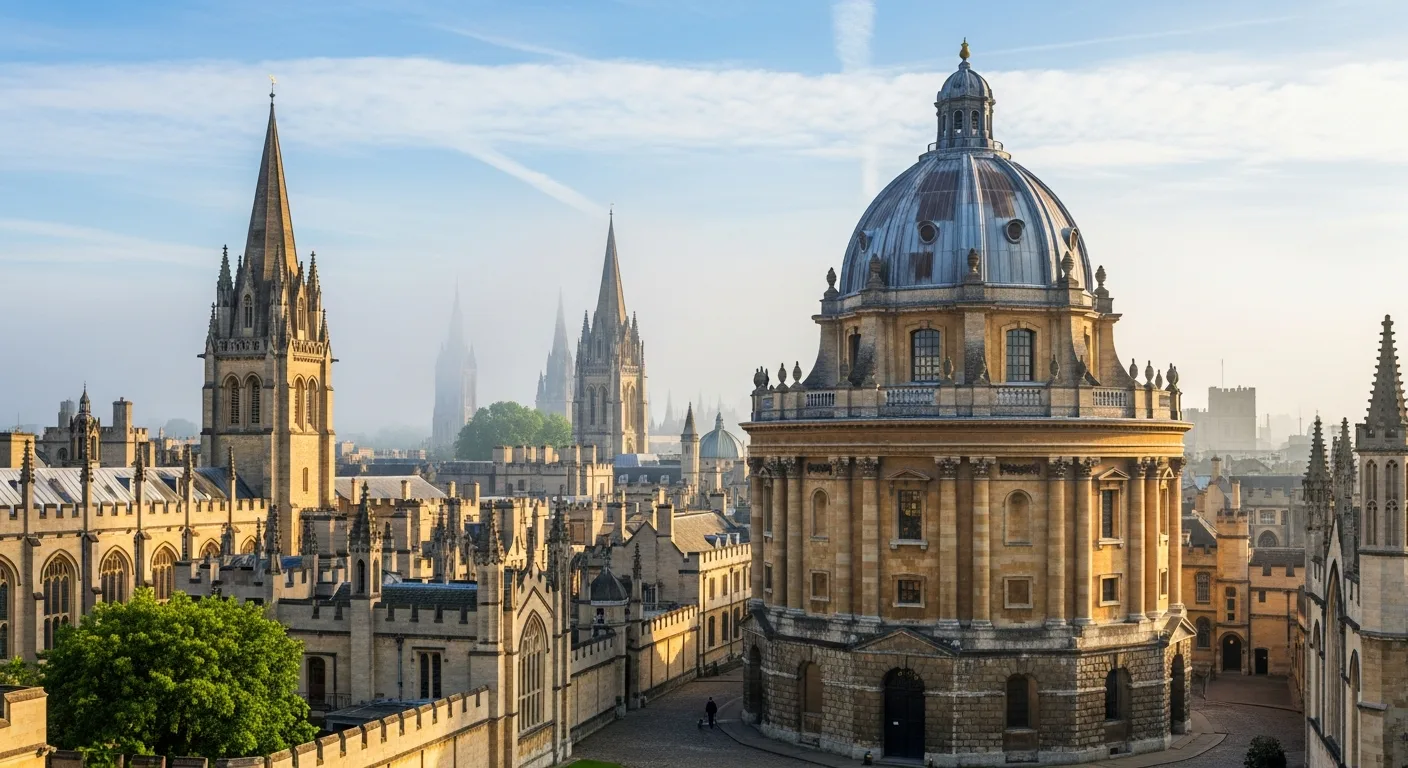
Photos: Wikimedia Commons
15 October 2026, 18:00 UK time. Your UCAS application must be submitted, paid, sent. The UCAS system closes the window for Cambridge with no room for negotiation, and the admissions teams at University of Cambridge treat late submissions as automatically rejected. Three months earlier than the rest of the UK - the first filter that screens out unprepared candidates.
The second thing: Cambridge is a British university, not an American one. There is no SAT, no Ivy League (Cambridge is in the UK; the Ivy League is eight East Coast universities in the USA), no Common App. The application goes through UCAS, and after it you get access to My Cambridge Application - the university’s own portal. This article complements the pillar guide to Cambridge. Here we go one level deeper: deadlines, the ESAT/MAT/STEP tests, the tutor interviews, pooling, reapplication and the realistic outlook for an international candidate.
Three things set Cambridge apart from the standard UCAS route. First, the 15 October deadline, not 15 January - you have three months less than candidates applying to other UK universities. Second, after you submit UCAS you receive an email with a link to My Cambridge Application (MyCApp) - a second form you must complete within a few days. There you give your college preference, additional declarations and, for some courses, written work (essays for submission). Third, for most courses you sit an admissions test (ESAT, MAT, TMUA or STEP, depending on the course) plus you go through an interview in December - academic, supervision-style.
The second mental difference: you cannot apply to Cambridge and Oxford at the same time. UCAS blocks this in the system - you can pick only one of the two universities in a given cycle. This is not advice, it is a hard UCAS rule. The choice is strategic: compare the two systems in our Oxford vs Cambridge admissions breakdown before you commit your choice to the form.
UCAS opens on 1 September. Cambridge requires submission by 15 October, 18:00 GMT - the moment after which the system cuts off access. UCAS is a single file with five university choices (Cambridge takes one slot), a Personal Statement (up to 4,000 characters, split into three questions in the new 2026 format) and one reference from a teacher (Reference). For an international applicant the Reference normally comes from a class tutor, head teacher or college counsellor, alongside converted grades and predicted grades.
After you submit UCAS, a link to My Cambridge Application (MyCApp) lands in your inbox. The completion deadline is usually around 22 October, but you receive the exact date individually. In MyCApp you choose a college (or open application), provide additional information about your school, upload a transcript and - for some courses - essays written at school (up to two, each up to 2,000 words). Since Brexit you are an overseas student; the tuition fees sit within the reference range in the pillar guide.
Cambridge reshaped the testing landscape in 2024. The BMAT (medicine) was retired - from the 2024/25 cycle medicine has no pre-interview test of its own. ENGAA and NSAA were replaced by ESAT (Engineering and Science Admissions Test), run by Pearson VUE.
For an international applicant the key is to register early (esat.org.uk or Pearson VUE) - slots at the nearest centres fill up fast. The ESAT costs about £75 GBP (≈ $95 USD / €88 EUR). The MAT and TMUA are free. STEP costs about £60-80 GBP (≈ $76-101 USD / €70-94 EUR) per paper. Begin preparing at least 6 months before the test; Cambridge past papers are public. The ESAT scale runs from 1.0 to 9.0; a typical offer threshold is 6.5-7.5+ for Natural Sciences, Engineering and Computer Science.
The Cambridge interview is not a motivational conversation. No one will ask “why Cambridge” or “where do you see yourself in 10 years”. The tutor - often your future supervisor - sets a problem: mathematical, physical, a text to interpret, a fragment of code with a bug. Your job is to think out loud, to show your process, not to give a finished answer. It is a miniature supervision - the teaching format you will spend your entire degree in (more in the pillar).
The format: usually two interviews on the same day, 25-45 min each, with different tutors. Sometimes a third (Natural Sciences, for example, test two departments). The tutor sets a problem, you propose an approach, and they steer you with questions like “what would happen if…”, “try it another way”. Silence is allowed - 30 seconds of thought is a better answer than blurting out your first idea. The tutor is looking for a candidate who is teachable: someone who listens to a hint and corrects course.
International candidates have had an online interview option (Zoom or Microsoft Teams) since 2020. Some colleges are returning to in-person interviews in Cambridge - check individually once you receive your invitation. Online or offline, the format stays the same: a problem, thinking out loud, steering. Preparation: solve old olympiad and selection-round problems (for example from the International Mathematical Olympiad or your national maths olympiad) out loud, in front of someone who can put questions to you. Cambridge offers sample interview questions on its site at cam.ac.uk/undergraduate/applying/interviews - work through at least 20 before you sit in front of the camera.
Cambridge is made up of 31 undergraduate colleges. Each college is a separate community: a home, a dining hall, a library, supervision rooms, its own scholarship budget. The choice of college shapes daily life (location, cost of accommodation, atmosphere, sport), but it does not affect the quality of teaching - academic activities (lectures, labs, exams) are shared by everyone.
You have three options to enter in MyCApp:
The statistical truth: the choice of college has no meaningful impact on your chances. The pooling system levels the field between colleges (section below). Choose a college for the personal context: location, size, scholarships, culture. The list of all 31: cam.ac.uk/colleges-and-departments.
The pooling system is the mechanism that levels applications between colleges. Each college receives a pool of applications, assesses them, runs the interviews, but not all strong candidates get a place at their original college - there are simply more applications than places. Those worthy of admission but not fitted in go into the winter pool.
Other colleges review the pool in January-February and can fish you out - offer you a place at theirs, sometimes for the same course, sometimes for a related one. According to Cambridge’s own figures, roughly 20-25% of the students admitted each year reach the university through the pool, not through their original college. A “Pool” decision in January is not a rejection - it means “you have been judged a Cambridge-level candidate, we are waiting for a college that has a slot”.
The practical takeaway: choosing a specific college does not write you off - the pool catches you. Choose the college you actually want to live in, and do not over-stress the decision.
Cambridge does not publish a rigid “qualification → offer” table. It works on equivalence: a typical UK offer is A*A*A at A-level, including an A* in the course subjects. For other international qualifications Cambridge expects, as a rule of thumb:
Specific courses have additional requirements.
The full list: cam.ac.uk/undergraduate/applying/entrance-requirements.
Applying to the USA in parallel? Our GPA calculator converts your school-leaving grades onto the 4.0 scale, weighting advanced/Higher-Level subjects. Cambridge itself does not use GPA - it works on your exam percentages directly.
Since Brexit an international student pays overseas rates; tuition depends on the course and sits within the reference range in the Cambridge pillar. On top of that comes the cost of living in the city - a room in college, meals in hall, transport - running to well over ten thousand pounds a year (roughly $13,000-18,000 USD / €12,000-16,000 EUR). Scholarships: Gates Cambridge (mainly postgraduate), the Cambridge Trust (partial), and college funds (variable). Check cambridgetrust.org and your own college’s page.
The realistic numbers: Cambridge does not publish granular country-by-country statistics, but international students form a substantial part of each undergraduate intake, and the various national and regional student societies in Cambridge each count anywhere from a few dozen to a few hundred active members. The new intake from any single country is typically modest - often in the range of 10-20 people a year holding a given passport. Most are olympiad medallists in their national or international competitions (mathematics, physics, biology, linguistics) and students from selective bilingual or international tracks, alongside individual applicants from smaller towns and less well-known schools.
Reapplication: Cambridge does not penalise it. You reapply in the next UCAS cycle - provided you show a clear change in your profile: better final results, a year of study back home with a strong GPA, a new technical project, a stronger Personal Statement. Repeating the same application with no changes is a waste of time and of the UCAS fee. A share of international candidates only get in on the second attempt, after a year at a strong university back home - that is a legitimate approach.
If you are torn between Cambridge and Oxford, read the Oxford admissions guide - the differences in tutorial vs supervision, in tests (Oxford: TSA, MAT, PAT), in colleges and atmosphere are real. Make the decision once and well - UCAS lets you pick only one.
When is the UCAS deadline to apply to Cambridge? The UCAS deadline for Cambridge is 15 October 2026, 18:00 GMT - the same date as Oxford. That is three months earlier than the standard UCAS deadline (15 January). Being even one minute late means your application is rejected without being read.
Do I have to choose a college, or can I apply without a preference? You have three options: choosing a specific college, an open application (Cambridge assigns you randomly to a college in an under-subscribed pool), or applying through a special access programme. Choosing a college neither raises nor lowers your overall chance of admission - the pooling system levels the field.
Which admissions tests do I need to sit for Cambridge in 2026? It depends on the course. ESAT (Engineering, Natural Sciences, Chemical Engineering, Veterinary - from 2024 it replaced ENGAA and NSAA) is sat in October before the UCAS deadline. MAT - mathematics and computer science. TMUA - economics. STEP 2 and 3 - required conditionally after an offer (mathematics, physics for some). Medicine has not used the BMAT since 2024/25.
What is the Cambridge interview like? The interview is an academic, supervision-style conversation: a tutor sets a problem (mathematical, physical, a text to interpret) and expects you to think out loud. It lasts 25-45 minutes, usually two interviews on the same day. International candidates have had an online option since 2020. There are no “why Cambridge” questions. What counts is how you think, not what you already know.
Will my school-leaving grades be enough to get into Cambridge? Cambridge typically requires the top band (equivalent to AAA at A-level, or 40-42 in the IB) in two or three subjects matching your course (higher-level mathematics for STEM, biology + chemistry for medicine), plus strong passes in your remaining subjects. Grades alone are not enough - the admissions tests and interview weigh at least as much.
What is the pooling system at Cambridge? If your college has no place for you but the tutors judge you worthy of admission, you go into the “winter pool”. Other colleges can fish you out of it and offer you a place. Roughly 20-25% of those admitted each year reach Cambridge through the pool, not through their original college.
Can I reapply if I am rejected? Yes. Cambridge does not penalise reapplication, but it expects a clear change in your profile: better final results, completed study (e.g. a year back home), new achievements, a stronger personal statement. You reapply through UCAS in the next cycle with a fresh application from scratch.
How many international students get into Cambridge each year? Cambridge does not publish detailed country-by-country statistics. In total the university admits about 3,600 undergraduates a year from roughly 22,000 applications (a rate of about 18%). International applicants make up a meaningful share of the intake, with a new cohort of the order of 10-20 people a year from any single country.