£26–36k
International tuition fees: most programmes
Humanities → Engineering
Explore Edinburgh's international tuition fees, living costs, Pollock Halls and scholarships, plus the full cost of a four-year Scottish degree.

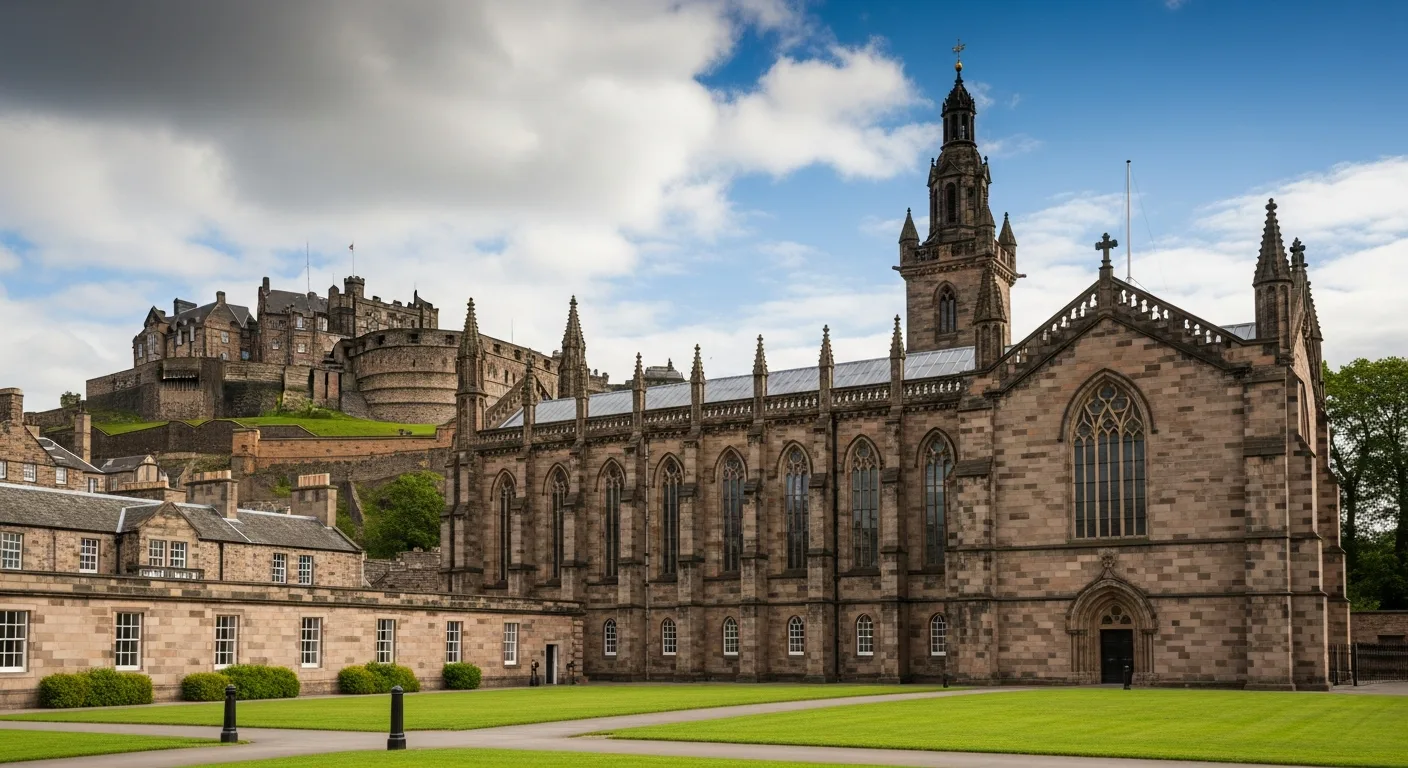
Photos: Wikimedia Commons
At first glance, Edinburgh’s fees compare favourably with UCL’s: international tuition is £26,500–£35,900 a year for most programmes, against £30,000–£40,000 at UCL. But Edinburgh has a feature that changes the calculation: an undergraduate degree takes four years, not three. Under the Scottish system, that means an extra year of tuition and living costs, adding approximately £40,000–£50,000 compared with universities in England.
Edinburgh also has a financial advantage: living in Scotland’s capital is considerably cheaper than living in London. A room costs about 30% less, while food and transport cost 25–30% less. There is also Pollock Halls, part of one of the UK’s best student accommodation systems, with university accommodation guaranteed to first-year international students who meet the application and offer-acceptance deadlines.
This guide breaks down the cost of studying at the University of Edinburgh at international fee rates: tuition by programme, the full cost of a four-year Scottish degree, Pollock Halls, living costs compared with London, and the Edinburgh Global Undergraduate Scholarship and other awards. For admissions, read the complete University of Edinburgh guide.
The short answer is approximately £26,500 to more than £55,000 a year, depending on the programme. Edinburgh groups programmes into fee bands: the more laboratory, clinical or studio teaching involved, the higher the fee.
Here is the approximate breakdown for international students in the 2025/2026 academic year:
| Fee band | Tuition fees for 2025/2026 | Example programmes |
|---|---|---|
| Humanities and social sciences | About £26,500 | History, English Literature, Politics, Philosophy, Economics, Law (LLB) |
| Science, Engineering and computing | About £33,500–£35,900 | Computer Science, Mathematics, Physics, Engineering, Biological Sciences |
| Architecture and studio-based programmes | About £35,900–£38,000 | Architecture, Landscape Architecture |
| Veterinary Medicine | About £38,000–£40,000 | BVM&S |
| Medicine (MBChB) | About £55,000+ | MBChB Medicine |
What does that mean in practice?
These figures exclude living costs in Edinburgh, the other essential part of the budget.
The Scottish undergraduate degree (MA Honours / MSc Honours) lasts four years, compared with three in England. Scottish universities followed the medieval European model of a broader foundation in the early years, while English universities shortened undergraduate degrees to three years in the 19th century.
For your budget, that means an extra year of tuition plus a year of living costs in Edinburgh compared with Oxford, Cambridge, UCL or Imperial.
Here is how the tuition adds up:
| University | Undergraduate degree length | Annual humanities tuition | Total tuition |
|---|---|---|---|
| University of Edinburgh | 4 years | About £26,500 | About £106,000 |
| UCL | 3 years | About £30,000–£35,000 | About £90,000–£105,000 |
| University of Manchester | 3 years | About £25,000–£28,000 | About £75,000–£84,000 |
| Oxford (Band A) | 3 years | £33,050 | £99,150 |
Although Edinburgh’s annual tuition is lower than UCL’s or Oxford’s, the total over four years is comparable or higher. Add another year of living costs, about £13,000, and Edinburgh works out approximately £40,000–£50,000 more expensive than a three-year degree at Manchester, or roughly equal to Oxford Band A.
The extra year buys a different educational model. The first two years of a Scottish degree let you combine subjects such as mathematics, philosophy and history. The third year brings specialisation, and the fourth a dissertation. The structure is closer to US liberal arts than the more focused English degree. If you are not 100% sure what to study, the Scottish system gives you two years to decide; in England, you select your subject through UCAS.
A shorter route: some Edinburgh programmes offer direct entry into the second year for applicants with A-level grades of AAA or an IB score of ≥38. This reduces the degree to three years, saving approximately £40,000–£50,000. Check the individual programme page.
Pollock Halls is Edinburgh’s flagship accommodation complex: several buildings at the foot of Arthur’s Seat, with approximately 1,800 places. It offers a ready-made social setting and is a 15-minute walk from Old College. First-year international students have a university accommodation guarantee if they apply and accept their offer on time.
Catered accommodation (£8,500–£11,000 a year) includes about 14 meals a week in the dining hall. Self-catered accommodation (£6,500–£8,500) means doing your own shopping and cooking.
After the first year, most students move into a shared flat with 2–4 flatmates in Marchmont, Newington, Bruntsfield or Tollcross. These residential neighbourhoods have large student populations and are a 15–30-minute walk from campus. A room costs £600–£850 a month, usually on a 12-month lease, with utilities and internet of about £85–£140 a month shared across the flat.
Yes: this is one of Edinburgh’s strongest financial advantages. Edinburgh is more expensive than Manchester, Glasgow or Newcastle, but considerably cheaper than London across all categories.
| Category | Edinburgh | London | Saving |
|---|---|---|---|
| Room in a shared flat | £600–£850/month | £900–£1,400/month | ~£300–£550/month |
| Monthly public transport pass | ~£60 (Lothian Buses) | ~£170 (TfL Zones 1–2) | ~£110/month |
| Lunch in a pub or café | £8–£12 | £12–£18 | ~£3–£6 |
| Beer in a pub | £4.50–£5.50 | £6–£8 | ~£1.50–£2.50 |
| Annual living budget | £12,000–£14,000 | £16,000–£20,000 | ~£4,000–£6,000 |
The annual living budget of £12,000–£14,000 in Edinburgh versus £16,000–£20,000 in London creates a difference of £4,000–£6,000 a year. Over a four-year Scottish degree, that means £16,000–£24,000 in savings, partly offsetting the extra year: lower living costs cover a substantial share of the fourth year’s tuition.
Edinburgh also offers distinctive everyday benefits: a 15-minute walk onto Arthur’s Seat for views across the city, the UNESCO-listed Old Town, and cycling in the Pentland Hills, a 30-minute bus ride away. There is plenty to enjoy between classes.
The Edinburgh Global Undergraduate Scholarship is the University of Edinburgh’s flagship scholarship programme for international undergraduates. The details for the 2025/2026 academic year are:
The process starts with a UCAS application and a conditional offer. Edinburgh assesses your profile for international scholarships alongside this process. Some awards do not require a separate application, while others require a formal application to Student Funding.
IMPORTANT: check current award details. Edinburgh updates scholarship amounts, eligible-country lists and procedures every year. Do not rely on scholarship lists published in 2022. Always check the current information at ed.ac.uk/student-funding/undergraduate before the deadline.
A second category includes Robertson Scholarships and other awards funded by private donors and Edinburgh alumni. Amounts, criteria and deadlines change annually according to the funds available. Some awards are restricted to a subject, such as Medicine or Engineering; others are open more broadly. The complete list is available at ed.ac.uk/student-funding.
Edinburgh’s published fees are one figure; the amount you and your family pay after scholarships and choices such as direct entry can be another.
| Student profile | Annual sticker price | Actual cost after a scholarship |
|---|---|---|
| Humanities, 4 years, no scholarship | £26,500 + £13,000 = £39,500 | Unchanged: full amount |
| Engineering, 4 years, no scholarship | £35,900 + £13,000 = £48,900 | Unchanged: full amount |
| Humanities + Edinburgh Global at £8,000/year | £39,500 | About £31,500/year |
| Direct entry into year 2: 3 years instead of 4 | £39,500 × 3 = £118,500, rather than £158,000 | Saving of about £40,000 |
| Medicine MBChB, 6 years, no scholarship | £55,000 + £13,000 = £68,000 | Unchanged |
Without scholarships, the full cost of a four-year humanities degree is approximately £158,000.
Continental European alternatives include KU Leuven, TU Delft, Sciences Po and ETH Zurich, all among the global top 100 universities.
Edinburgh belongs to the Russell Group, an alliance of 24 UK research universities. It is one of the group’s two Scottish members, alongside Glasgow. Academically, its peers include Oxford, Cambridge, Imperial and UCL, rather than Scotland’s smaller universities.
See the University of Edinburgh admissions guide for further requirements.
Related tool: GPA calculator.
Next steps if you are considering Edinburgh:
 IELTS Academic and General Training prep
All four skills in one place, with Writing and Speaking marked by AI against the band descriptors.

 Prepclass
