
#27
QS World Ranking
QS World University Rankings 2025
Explore the University of Edinburgh: admissions, tuition, scholarships, and top courses. Your complete guide to applying and studying at this world-class Scottish university.

Photos: Wikimedia Commons
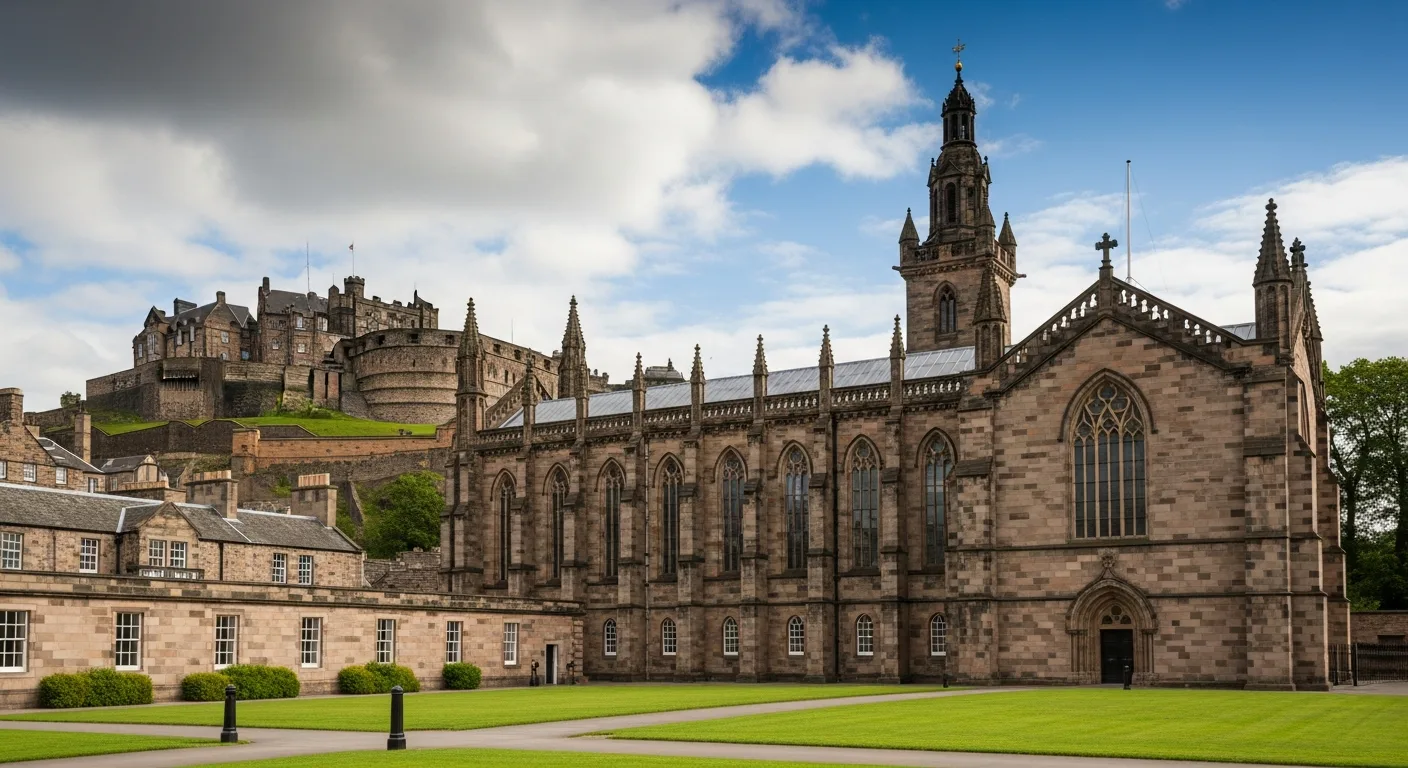
You stand on the Royal Mile on a February morning, breathing in the crisp air that smells of coffee from nearby roasteries and sweet chimney smoke. To your left, the Gothic spire of St Giles’ Cathedral pierces the low-hanging clouds. To your right, stairs lead down through a narrow close, a dark, cobbled alleyway that remembers the Enlightenment. At the end of the street, perched on a volcanic rock, Edinburgh Castle dominates the city skyline like a backdrop from a historical film. But this isn’t a museum - it’s your daily setting as you rush with your laptop to a computer science lecture in Appleton Tower or a philosophy seminar in a building that remembers David Hume.
The University of Edinburgh is an institution that needs no introduction - but its story is worth retelling anyway. Founded in 1583 as the sixth oldest English-speaking university in the world, Edinburgh was the heart of the Scottish Enlightenment, an intellectual movement that gave the world Adam Smith, David Hume, and modern medicine. Today, it’s a university with 19 Nobel laureates, the largest informatics department in the UK, and one of Europe’s strongest centers for artificial intelligence research. And all of this is set in a city that UNESCO has designated a World Heritage site - both the Gothic Old Town and the elegant Georgian New Town.
In this guide, I’ll walk you through everything you need to know to apply to Edinburgh: from the specifics of the four-year Scottish system (and the possibility of shortening it to three years via direct entry), through entry and language requirements, tuition and living costs, to scholarships, comparisons with other Scottish universities, and career prospects. If you’re considering studying in the UK, but Oxbridge seems too risky (or too expensive), Edinburgh is one of the best alternatives in the world. Also, check out our general guide to studying in the UK and compare it with the University of St Andrews, Imperial College London, or UCL.
The University of Edinburgh is not an institution that rests on its history alone: it’s a university that consistently confirms its position with hard data year after year. In the QS World University Rankings 2025, Edinburgh ranks 27th globally, making it the highest-ranked university in Scotland and one of only a few outside London, Oxford, and Cambridge that consistently place in the global top 30. In the THE World University Rankings, its position is similar, around 30th place - and in the Complete University Guide 2025, Edinburgh holds the 12th position in the UK.
What truly distinguishes Edinburgh, however, becomes apparent in subject-specific rankings. The School of Informatics - the largest computer science department in the UK - regularly ranks in the top 10 worldwide for Computer Science (QS). AI research has been conducted here since the 1960s, three decades before AI became a buzzword. Linguistics is top 5 globally. Veterinary Medicine (Royal Dick School of Veterinary Studies) - top 5 globally. Medicine - top 20. Philosophy - top 15, which is particularly significant in the city that gave the world David Hume.
Edinburgh is a member of the Russell Group, an elite association of 24 leading UK research universities, comparable to the American Ivy League. But unlike Oxford or Cambridge, Edinburgh offers a significantly more accessible acceptance rate (~37% vs 13-18% at Oxbridge), making it a realistic goal for ambitious international applicants who want to study at a world-class university without the risk of the application rate hindering their success.
Applying to the University of Edinburgh goes through the central UK system UCAS (Universities and Colleges Admissions Service); the same one you use for Oxford, Cambridge, Imperial, or KCL. Within a single UCAS application, you choose a maximum of 5 universities or programs - Edinburgh can be one of them (or several, if you apply to different programs at the same institution).
A huge advantage of Edinburgh compared to Oxbridge: no interviews and no additional entrance exams for the vast majority of programs. You don’t need to take MAT, PAT, TSA, STEP, or any other test that is mandatory at Oxford and Cambridge. The decision is based on three elements: predicted grades, your Personal Statement (a motivational essay, max 4000 characters, common to all 5 universities), and a teacher’s reference. Exceptions are Medicine (requires UCAT - a psychometric and logical reasoning test, plus an MMI interview) and Veterinary Medicine (also UCAT + interview). This makes the application process significantly simpler and less stressful than at Oxbridge - but no less serious.
The Personal Statement is absolutely crucial because Edinburgh doesn’t conduct interviews. It’s your only chance to stand out beyond your grades. Show your passion for the subject; specific books you’ve read, projects you’ve completed, research questions that fascinate you. Edinburgh values candidates who can think critically and independently, not those who merely recite a textbook.
An important point for international applicants: Edinburgh employs a contextual admissions approach - it considers your educational and socioeconomic background. If you come from a smaller town or a school without a tradition of sending students abroad, this might work in your favor.
Specific academic requirements:
Remember to check our guide on converting Polish Matura results - it explains how your grades translate to foreign systems, including the British one. If you’re torn between IELTS and TOEFL, read our TOEFL vs IELTS guide.
| Program | Polish Matura (Extended Level) | IB (Points) | A-levels | Additional Requirements | Difficulty |
|---|---|---|---|---|---|
| Computer Science (BSc) | 80-85% on Extended Level | 36-38 | A*AA - AAA | Extended Level Mathematics | Competitive |
| Artificial Intelligence (BSc) | 80-85% on Extended Level | 36-38 | A*AA - AAA | Extended Level Mathematics | High |
| Medicine (MBChB) | 85-90% on Extended Level | 37-40 | AAA | Biology + Chemistry, UCAT, MMI | Very High |
| Law (LLB Hons) | 80-85% on Extended Level | 36-38 | AAA - AAB | No subject-specific requirements | Competitive |
| Philosophy (MA Hons) | 75-80% on Extended Level | 34-36 | AAB - ABB | No subject-specific requirements | Achievable |
| Engineering (BEng) | 80-85% on Extended Level | 36-38 | AAA - AAB | Extended Level Mathematics + Physics | Competitive |
This is a crucial point that many international applicants overlook or don’t fully understand. The Scottish education system differs from the English one, and this difference has direct financial and academic consequences.
Standard undergraduate degrees in Scotland last 4 years - not 3 as in England. The degree is called MA (Master of Arts) Honours for humanities programs or BSc (Honours) for science programs. Don’t be misled by the MA title; it’s the equivalent of an English BA, not a Master’s degree. The fourth year is a year of in-depth specialization and research work (dissertation), which gives you an advantage in the job market and for postgraduate applications.
A huge advantage of this system: the flexibility of the first two years. In England, you must commit to a specific program from day one - if you choose Chemistry at Imperial, you start studying Chemistry in October. In Scotland, for the first two years, you can study 2-3 subjects simultaneously (for example, Philosophy + Mathematics + Informatics) before deciding on a specialization in the third year. This is an ideal system for those with broad interests who don’t want to make a final decision at 18.
However, if you have a strong school-leaving diploma with advanced-level subjects (such as the Polish Matura at extended level), an IB diploma, or A-levels, you can apply for direct entry into the second year, which shortens your studies to 3 years and reduces the total tuition cost by a quarter. Direct entry is available for many, though not all, programs; check the specific program page. You lose the flexibility of the first two years, but you save a year and over £26,000.
Edinburgh is not a single-faculty university; it’s a vast, multidisciplinary institution with three main colleges (Arts, Humanities & Social Sciences; Science & Engineering; Medicine & Veterinary Medicine) and dozens of programs. But a few programs particularly stand out and should be on your list if you’re considering Edinburgh.
Informatics and Artificial Intelligence is Edinburgh’s flagship discipline. The School of Informatics is the largest computer science department in the UK - over 500 academic staff - and one of the best in the world. AI research has been conducted here since the 1960s, when Donald Michie (Alan Turing’s collaborator at Bletchley Park) founded the Department of Machine Intelligence. Today, Edinburgh is home to the Edinburgh AI Institute, one of the leading research centers for machine learning, natural language processing, and robotics. The flagship BSc Artificial Intelligence is one of the few dedicated undergraduate AI programs globally; if you’re interested in AI, Edinburgh is one of the top two or three places in Europe, alongside ETH Zurich and Cambridge. Graduates of the School of Informatics go on to work at Google DeepMind, Microsoft Research, Meta AI, Amazon, as well as Edinburgh-based tech companies like Skyscanner, FanDuel, and Administrate.
Medicine at Edinburgh has a tradition dating back to 1726; Edinburgh Medical School is one of the oldest in the world. The MBChB program lasts 5 years (it does not follow the 4-year Scottish system) and combines preclinical sciences with early clinical contact in NHS Lothian hospitals. Edinburgh Medical School is particularly strong in genomics, regenerative medicine, and neurobiology - it was here that the Roslin Institute cloned Dolly the sheep in 1996. Requirements are high: UCAT, MMI interview, IELTS 7.0+, top results in advanced-level science subjects (Biology + Chemistry mandatory; for the Polish Matura, a minimum of 85-90% on extended level).
Law: Edinburgh Law School is one of the best in the UK and the only one that offers an LLB (Hons) program in Scots Law. Scotland has a distinct legal system from England - based partly on continental civil law, which makes Edinburgh a unique place to study law in a European context. If you’re interested in law, but not necessarily English common law, Edinburgh Law School gives you unique competencies you won’t gain at KCL or LSE.
Philosophy: In the city that gave the world David Hume, studying Philosophy at Edinburgh is an experience that cannot be replicated elsewhere. The department ranks in the top 15 globally and offers a unique blend of analytical tradition with the history of Scottish Enlightenment philosophy.
Veterinary Medicine - the Royal (Dick) School of Veterinary Studies is top 5 globally. The BVM&S program lasts 5 years, with practical experience at the modern veterinary hospital on the Easter Bush Campus. If you’re considering veterinary medicine in the UK, Edinburgh and Cambridge are the two best choices.
Let’s be honest; studying at Edinburgh after Brexit is not cheap. International students are treated as overseas students and pay full international tuition fees. This is a fundamental change compared to the situation before 2021, when EU students in Scotland paid £0 tuition (thanks to SAAS - Student Awards Agency for Scotland). If you have settled or pre-settled status in the UK (because you lived there before the end of 2020), you may still qualify for lower tuition fees; check the SAAS website.
Current tuition fees at the University of Edinburgh for international students depend on the program group. Humanities, social sciences, and law are approximately £26,500 annually. Sciences, engineering, and informatics - approximately £32,800. Medicine - from £36,500 to £55,000 annually, depending on the stage of study. Veterinary Medicine - approximately £36,500. Important good news: Edinburgh freezes tuition fees at the level of your starting year; you pay the same amount for the entire duration of the program.
A key calculation you must remember: degrees in Scotland last 4 years, not 3. Even with lower annual rates than some English universities, the total tuition cost is higher. Four years of humanities at Edinburgh is 4 x £26,500 = £106,000 - compared to 3 years at an English Russell Group university (e.g., Manchester or Warwick) for £84,000 - £99,000. But if you use direct entry to the second year, the cost drops to 3 years.
Living costs in Edinburgh are significantly lower than in London, but higher than in Glasgow or Dundee. The University of Edinburgh estimates annual living costs at £10,400 - £15,200. The most important components of a monthly budget: accommodation (halls of residence in the first year, then private); £550 - £750; food - £200 - £300; transport (Lothian Buses, but the city is compact enough that much is walkable); £50 - £70; entertainment - £100 - £200. In total, £900 - £1,300 per month; compared to £1,450 - £2,150 in London.
Tuition + Living Costs in Edinburgh (Academic Year 2025/2026)
Source: University of Edinburgh Finance, Numbeo Cost of Living 2025.
Let’s be realistic; most international students at Edinburgh do not receive full scholarships. Edinburgh is not an American need-blind college that covers 100% of costs. But there are real options that can reduce your expenses if you know where to look.
The Edinburgh Global Undergraduate Mathematics Scholarship is one of the most concrete options for international applicants to mathematics programs: £5,000 - £10,000 annually for the entire duration of studies, awarded based on outstanding mathematics results. If you’re applying for Mathematics, Computer Science and Mathematics, or a related program - this is your first option to explore.
The School of Informatics Global Scholarship offers up to £5,000 annually for outstanding candidates in Informatics and AI. Given that informatics tuition is £32,800, this scholarship covers about 15% of costs; it doesn’t change the game, but it lessens the burden.
Access Edinburgh Scholarships are need-based scholarships: £1,000 - £5,000 annually. You must document financial hardship and apply through the Edinburgh Financial Aid portal after receiving an offer.
The Edinburgh Global Research Scholarship - this is mainly a postgraduate option (Master’s, PhD), but it covers the difference between international and home tuition fees, saving £15,000 - £25,000 annually. If you plan to continue your studies at Edinburgh after your undergraduate degree, it’s worth keeping this on your radar.
National and external funding sources: Explore government scholarship programs or private foundations in your home country that award scholarships for talented students at foreign universities. Banks in your home country may offer student loans; these may not cover full costs but can supplement your funding.
Part-time work during studies: A Student visa allows you to work up to 20 hours per week during term time and unlimited hours during holidays. The minimum wage in the UK for those 21+ is £11.44/hour (2025). Edinburgh has a strong student job market - from cafes and restaurants to tech companies looking for intern/part-time developers.
| Criterion | Edinburgh | St Andrews | Glasgow |
|---|---|---|---|
| QS World Ranking | #27 | #96 | #73 |
| Acceptance Rate | ~37% | ~8-15% | ~50% |
| Student Population | ~36,000 | ~10,000 | ~30,000 |
| Tuition (Humanities, Intl.) | £26,500/year | £28,000/year | £22,000/year |
| Strengths | Informatics/AI, Medicine, Veterinary Medicine, Law | Philosophy, Physics, IR, Tradition | Medicine, Engineering, Arts |
| Atmosphere | Metropolitan, cosmopolitan, festivals | Intimate, traditional, coastal | Artistic, musical, affordable |
| Living Costs (monthly) | £900-1,300 | £800-1,200 | £750-1,100 |
| City | 530,000 - Capital of Scotland, UNESCO | 17,000 - Coastal town | 630,000 - Scotland's largest city |
| Best for | Global prestige + large city + STEM | Intimate experience + tradition | Lower budget + arts scene |
Edinburgh vs St Andrews: St Andrews is intimate, traditional, and coastal; ideal for those who dream of a classic university experience with academic families and Raisin Weekend. But St Andrews is selective (8-15% acceptance rate for popular programs) and doesn’t offer the breadth of programs that Edinburgh does. If you’re interested in Informatics, Medicine, or Engineering - Edinburgh has no competition in Scotland. St Andrews excels in Philosophy, Physics, and International Relations.
Edinburgh vs Glasgow: Glasgow is cheaper and has a fantastic music scene: if live music and indie culture are your priority, Glasgow is hard to beat. But in global rankings, Edinburgh is a class above (#27 vs #73) and offers stronger programs in Informatics, Veterinary Medicine, and Law. Glasgow, however, has an outstanding medical and engineering school.
Edinburgh is a city that makes everyday walks an adventure. Imagine a morning when you walk to a lecture through Grassmarket; a historic square beneath Edinburgh Castle, surrounded by colorful tenements, with views of the castle rising on a volcanic rock. Or a Sunday afternoon when you climb Arthur’s Seat - a 251-meter peak in the city center, rising from Holyrood Park - and see a panorama from the Firth of Forth to the Pentland Hills. It’s a 30-minute walk from the university library.
The main campus of the University of Edinburgh is spread around George Square and Bristo Square in the Old Town; Gothic buildings mix with modern complexes like Appleton Tower (Informatics) and David Hume Tower (Humanities, named after the university’s most famous philosopher). King’s Buildings Campus in the south of the city is home to the sciences (Biology, Chemistry, Physics, Engineering), 20 minutes by bus from the center. First-year students live in Pollock Halls - a complex of residences surrounded by a park at the foot of Arthur’s Seat, with views that are hard to describe.
Every August, Edinburgh becomes the world’s cultural capital. The Edinburgh Festival Fringe is the largest arts festival in the world - over 3,000 shows, concerts, and events in three weeks. The streets turn into an open-air theater, every pub becomes a stand-up comedy venue, and the entire city pulsates with an energy you won’t find anywhere else. In addition, there’s the Edinburgh International Festival (classical music, opera), the Edinburgh International Book Festival (the world’s largest literary festival), the Royal Military Tattoo (a military spectacle in the castle courtyard), and Hogmanay, the legendary Scottish New Year’s Eve with a three-day festival on Princes Street.
Edinburgh is a genuinely cosmopolitan city, home to large, well-established international communities with their own shops, places of worship, and cultural associations. With 47% of the university’s students coming from abroad, you’ll find a society for almost every nationality and background, and a wide network of international and cultural clubs that organize celebrations, film nights, communal cooking, and networking. You won’t be alone.
The Edinburgh University Students’ Association (EUSA) is one of the largest student unions in the UK, with over 300 clubs and societies; from the Edinburgh University Debating Society (one of the oldest in the UK) to the AI Society and the Mountaineering Club (the Highlands are 2 hours away). Teviot Row House - the oldest purpose-built student union building in the world (1889) - is a hub of social life: bars, concert halls, social spaces. The pubs on Grassmarket and Cowgate, literary cafes (Elephant House, where J.K. Rowling wrote Harry Potter), Brew Lab - Edinburgh’s coffee and pub culture are unbeatable.
After graduation, you are eligible for the Graduate Immigration Route (GIR) - a visa allowing you to stay in the UK for 2 years (3 years for PhD) to seek employment without a visa sponsor. The Edinburgh Careers Service actively assists with job searching, CV preparation, and interview practice. Edinburgh has a growing tech hub; companies like Skyscanner (founded by Edinburgh alumni), FanDuel, Administrate, and many AI startups recruit locally.
If you’re preparing for pre-application exams, check out our TOEFL app for IELTS and TOEFL practice with AI feedback, and our SAT app for SAT preparation - although Edinburgh does not require the SAT, a strong SAT score can strengthen your profile in the eyes of the admissions committee.
The University of Edinburgh offers something rare in the British system: global prestige as a top 30 university worldwide, combined with a flexible education system (the opportunity to explore in the first two years), a city with an incredible atmosphere and culture, and an acceptance rate accessible enough that applying isn’t a lottery. If Oxbridge is a dive with a 13% chance of success, Edinburgh is a realistic goal with a significant reward.
Edinburgh isn’t for everyone. If you’re looking for an intimate experience with academic families and traditions, St Andrews would be a better choice. If London and access to the City are a priority, UCL, KCL, or LSE might make more sense. But if you want world-class Informatics or Medicine, a four-year program with a flexible start, a beautiful city with festivals, and a strong international community, Edinburgh is one of the best choices you can make.
Also, check out our other guides to UK universities: Oxford, Cambridge, Imperial, UCL, LSE, Warwick, and Manchester. And if you’re considering studying in other European countries, read our guide to studying in the UK. Good luck!
Article updated: February 8, 2026. Data regarding tuition fees, living costs, requirements, and statistics are from official University of Edinburgh sources and are current for the 2025/2026 academic year. Always verify current information on the official university website: ed.ac.uk.