3
Italian universities in the QS top 200
Polimi 98, Sapienza 128, Bologna 138 (QS WUR 2026)
The 12 best universities in Italy for 2026: Polimi (eng. top 20), Bocconi, Sapienza, Bologna (1088). 3 in the QS top 200, SAT from 950, public tuition €0-4,000.

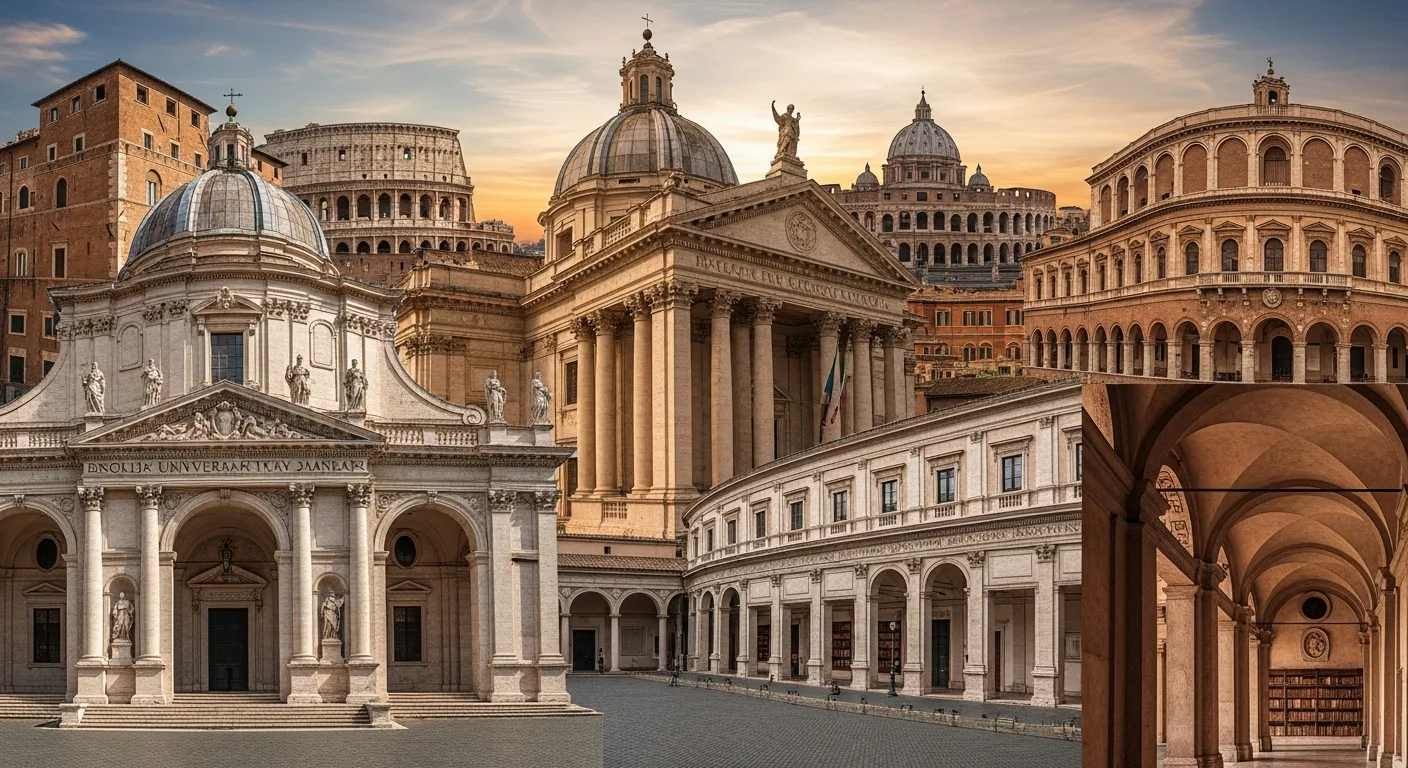
Photos: Wikimedia Commons
In a lecture hall in Padua, under a wooden cathedra that students will tell you is Galileo’s, a first-year sits through a physics class in a department that has not stopped teaching the subject since 1592. An hour’s train south, in Bologna, the law faculty traces an unbroken line back to 1088 - there was a university here before there was a Notre-Dame cathedral. And in Milan, two universities a tram ride apart quietly run the country: Bocconi feeds the banks and consultancies, Politecnico feeds Pirelli and Ferrari. This is the thing the league tables miss. Open the QS World University Rankings 2026 and Sapienza and Bologna sit in the 120s and 130s - respectable, not dazzling. Open the subject tables and the picture flips: Politecnico di Milano is inside the global top 20 for engineering and design, Bocconi competes with LBS and HEC Paris for European business, Sapienza leads the world in classics and archaeology. Italian universities are specialists with a generalist’s reputation, and the headline number tells you almost nothing about whether a given one is the best place on Earth to study your subject.
Here is the bottom line. Three Italian universities sit in the QS World University Rankings 2026 top 200 - Politecnico di Milano (98th, the first Italian university ever inside the global top 100), Sapienza (128th) and Bologna (138th) - with Padua, Politecnico di Torino and the University of Milan filling the next tier in the top 300, and Bocconi ranking top-15 in Europe as a specialist business school outside the general world table. The University of Bologna, founded in 1088, is the oldest in continuous existence anywhere. Public tuition runs €0-4,000 a year under the ISEE income test, the country offers more than 600 English-taught programmes, and the SAT is accepted from as low as 950 - the lowest threshold of any major European system. Across the College Council families we advise, Italy is the one country where the answer to “which is the best university?” routinely surprises people: more often than not, the best choice is also the cheapest.
This is the focused ranking guide. It sits under our complete guide to studying in Italy, which covers ISEE, the visa, scholarships and the full application machinery. Here I do one thing well: rank the universities that international students should actually shortlist, explain how we ranked them, and break the list down field by field - engineering, business and economics, medicine, sciences and humanities - so you can find the best Italian university for you rather than the best on paper.
Source: QS World University Rankings 2026, official university fee and admission pages 2025/26, College Council Atlas dataset.
The table below is College Council’s curated shortlist - the universities I steer international applicants toward first, scored on the five criteria in the next section rather than copied from any single league table. The rank column is our ordering for an international audience, not a literal QS position; the “Standout” column gives the one metric that actually decides the choice for most applicants. Where we publish a dedicated English guide, the name links to it; otherwise it links to the university’s full profile in our Atlas.
| Rank | University | Best known for | Standout |
|---|---|---|---|
| 1 | Politecnico di Milano | Engineering, architecture and design · all engineering masters in English | Top 20 globally for engineering & design (QS subjects) |
| 2 | Bocconi University | Business, economics, finance (private) · near-full English catalogue | Top-15 in Europe for business · 95%+ employment |
| 3 | University of Bologna | Law, humanities, economics · oldest university in the world | Founded 1088 · SAT accepted from ~950 |
| 4 | Sapienza University of Rome | Classics, archaeology, physics · English MEDTECH medicine | Largest university in Europe by enrolment |
| 5 | University of Padua | Sciences, medicine, physics · growing English tracks | Founded 1222 · Galileo taught here · SAT from 1,000 |
| 6 | University of Milan (Statale) | Medicine, law, sciences, humanities · comprehensive research | QS top 300 · central Milan |
| 7 | Politecnico di Torino | Engineering, automotive, aerospace · industry-linked | Stellantis & Piedmont cluster · cheaper than Milan |
| 8 | Vita-Salute San Raffaele | Medicine, psychology, biotech (private) · English MD | Linked to a leading research hospital |
| 9 | University of Pisa | Sciences, mathematics, computer science | Twinned with Scuola Normale & Sant'Anna |
| 10 | LUISS Guido Carli | Economics, political science, law (private) · Rome | The feeder school for Italian public life |
| 11 | University of Trento | Computer science, physics, international studies | Top Italian uni for quality of life · Alpine setting |
| 12 | University of Naples Federico II | Engineering, sciences · large and historic (1224) | Apple Developer Academy · lowest living costs |
| Source: College Council Atlas dataset and dedicated guides; QS World University Rankings 2026 (overall and subject tables); official university websites 2025/26. Rank is CC's curated ordering for international applicants, not an overall ranking. | |||
The order is not accidental. Politecnico di Milano takes the top spot - it is now Italy’s highest in the overall QS table (98th, ahead of Sapienza at 128 and Bologna at 138) and the one Italian university that is genuinely world-class in its own field, running its entire engineering master’s catalogue in English while staying cheap because it is public.
Bocconi sits at two, the single best choice for anyone targeting finance, consulting or economics, and the only private price tag on this list the outcomes actually justify.
Bologna and Sapienza are the value anchors - top-200 research universities with the lowest SAT thresholds in Europe and near-zero tuition under a low ISEE.
Below the twelve, Università Cattolica del Sacro Cuore (Europe’s largest private Catholic university), the University of Florence, Milano-Bicocca and Tor Vergata in Rome all run quality English-taught options worth a look.
No ranking of Italian universities is “correct,” because the only honest answer to “best for what?” depends on what you came to study and what you can pay. What follows is the method behind the list above, so you can re-weight it for your own situation. We scored each university on five things, weighted in this order for an international applicant.
Subject strength does the heaviest lifting. A university that is top-20 in the world for your field beats one that is top-150 overall but mediocre in your subject, which is why we lean on the QS subject tables and the standing of specialist schools - Bocconi, the Scuola Normale - over the headline world rank. A focused polytechnic can be the right pick over a broader, higher-profile comprehensive for the one field it owns.
Next is English-taught access, because for most international applicants a programme that does not exist in English does not exist at all. We weight deep English catalogues - Bocconi, Polimi, the English MD tracks - above otherwise excellent Italian-only departments.
Third comes value under ISEE. Because public tuition is income-tested, a public Italian university is a structural bargain, not a discounted one: a low-ISEE family can pay €156 at Polimi against €15,000-plus at a private peer. That near-zero public tuition lifts Bologna, Sapienza and Padua.
We then factor in admissions accessibility - Italy’s low SAT thresholds and the existence of an English-language route (SAT or IMAT) make some universities genuinely reachable for students locked out of UK or US selectivity. The lower the realistic bar relative to the quality, the higher we score it.
Last come graduate outcomes - employment rate, starting salary and the strength of the recruiting network - and this is where Bocconi and Polimi pull clear of the field on AlmaLaurea data.
The table below applies those criteria to the four flagship picks, so you can see why the “best” depends on what you came for.
| Criterion | Politecnico di Milano | Bocconi | Bologna | Sapienza |
|---|---|---|---|---|
| Type | Public | Private | Public | Public |
| Strongest field | Engineering · design | Business · finance | Law · humanities | Classics · physics |
| Tuition / year | €156-3,900 (ISEE) | €15,000-20,000 | €0-3,000 (ISEE) | €0-3,000 (ISEE) |
| Entry route | TOL-I / SAT Math ~1,240 | Own test / SAT ~1,400 | TOLC / SAT ~950 | TOLC / IMAT / SAT ~960 |
| English catalogue | All eng. masters | Near-complete | Growing | MEDTECH + selected |
| Employment (1 yr) | ~94% | 95%+ | Strong | Field-dependent |
| Source: official university fee and admission pages 2025/26; AlmaLaurea Graduate Survey 2024. Public tuition depends on individual ISEE. | ||||
This is Italy’s strongest hand, and the order is short. Politecnico di Milano is the leader and one of the genuine global heavyweights in its field - inside the QS top 20 for engineering and design, with architecture and design ranking in the global top 10. Every engineering master’s is taught in English, the industrial partnerships are the deepest in the country (Pirelli, Ferrari, Eni, Leonardo, Ferrovie dello Stato), and it runs Double Degree tracks with TU Munich, EPFL and Tsinghua. As a public university it stays cheap: a low-ISEE family pays around €156 a year, capped near €3,900 at the top band.
Politecnico di Torino is the strong second, anchoring the Stellantis automotive and aerospace cluster in Piedmont with real strengths in mechanical, automotive and aerospace engineering, at a lower cost of living than Milan. For engineering inside a comprehensive research university rather than a dedicated polytechnic, Padua, Pisa (twinned with the ultra-selective Scuola Normale and Sant’Anna) and Naples Federico II - home to the Apple Developer Academy - are the names to know. Polimi requires roughly SAT 1,240, accepting SAT Math as a substitute for its TOL-I test; the others sit lower.
Here the answer is unusually clean. Bocconi University is the best university in Italy - and one of the best in Europe - for economics, finance, management and consulting, ranked top-15 on the continent alongside LBS and HEC Paris. It is private, at €15,000-20,000 a year, but the outcome data justifies the price tag in a way no other private Italian university matches: over 90% of master’s graduates are employed within three months, with finance and consulting starting salaries of €45,000-60,000, and roughly a fifth of students hold a merit scholarship. Bocconi runs its own admission test but accepts the SAT or ACT as full alternatives; its formal minimum is low, but the realistic admitted average is around 1,400-1,450, comparable to Oxford.
The alternatives are real but distinct. LUISS Guido Carli in Rome is the feeder school for Italian public life and a serious choice for politics, economics and law, with a strong international network and a lower price than Bocconi. Università Cattolica del Sacro Cuore in Milan runs respected economics and management tracks at more accessible fees. And if value is the priority, the economics faculties at Bologna and Sapienza deliver a top-200 degree under ISEE tuition - a different bet from Bocconi, but a defensible one if the brand premium is not the point.
English-taught medicine is the route most international applicants ask about, and it has its own machinery: admission runs through IMAT, the International Medical Admissions Test held once a year in September, rather than the SAT or the Italian TOLC-MED. The leading public option is Sapienza’s six-year MEDTECH MD, fully in English, with a cut-off that tends to land around 50/100 and an international admit rate of roughly 5-10%. Other strong English-taught MD tracks run at Pavia, Milano-Bicocca, Padua, Bologna, Federico II and Tor Vergata.
On the private side, Vita-Salute San Raffaele in Milan runs a sought-after English MD linked to one of Italy’s leading research hospitals, with research integration that public faculties struggle to match. If you are set on medicine, treat IMAT preparation as a year-long project and apply across several of these programmes at once: the cut-offs move year to year, and pinning your hopes on one is a high-variance bet.
Outside the polytechnics and Bocconi, Italy’s depth shows in its comprehensive and specialist research universities. Sapienza is the largest university in Europe by enrolment and a world leader in classics, archaeology and physics. Bologna remains research-strong across law, philosophy and economics nine centuries after its founding. Padua has been a continuous research centre since 1222 - the same chair of mathematics Galileo held still anchors one of Italy’s strongest physics faculties - and the University of Milan is a QS top-300 comprehensive with deep medicine, law and humanities faculties in the centre of the city. For computer science, physics and international studies in a research-first environment, Trento routinely tops Italian quality-of-life and outcomes surveys.
The names that surprise newcomers are Italy’s two ultra-selective small schools, both in Pisa. The Scuola Normale Superiore and the Scuola Superiore Sant’Anna admit a few hundred students each through their own competitive entrance exams, fund them fully, and produce a Nobel-and-prime-minister hit rate per capita that rivals any institution on the continent. They are not for everyone - admission is brutal and the workload monastic - but for a top science, mathematics or humanities student they are among the best-value elite educations anywhere in the world.
A ranking guide that only sells is not worth reading, so here are the reasons Italy might not be your best option.
The English-taught bachelor’s catalogue is shallow compared with the Netherlands or Ireland - Italy’s English depth is at master’s level, so an applicant who wants a fully English three-year bachelor’s has fewer choices than the headline “600+ programmes” suggests.
Graduate salaries at junior level trail Germany, the Netherlands and Switzerland; Italy’s youth labour market is weak (ISTAT youth unemployment runs around 18-20%, among the higher rates in Western Europe even after recent falls), and only the top-university graduates are well insulated from it.
The bureaucracy is genuinely slow - ISEE Parificato, the visa, the permesso di soggiorno - and rewards early planners, not improvisers.
And outside Milan, daily life needs some Italian, even on an English-taught track.
If those trade-offs are dealbreakers, our companion guides to studying in Germany (free public tuition, Europe’s strongest engineering job market) and studying in the Netherlands (the deepest English-taught bachelor’s catalogue in the EU) are the obvious next reads. For most students who actually do the arithmetic, though, Italy lands on the shortlist: a top-200 degree for a fraction of UK or US tuition, with a pathway to EU citizenship at the end.
We built College Council to remove the two things that most often derail an Italian application: weak test preparation and a chaotic, last-minute process. Italy rewards the SAT more than almost any European system, and at the lowest thresholds, so our SAT app runs the full digital SAT with adaptive practice and analytics, and our TOEFL app delivers full TOEFL iBT mocks with AI-graded speaking and writing - the language certificate every Italian university requires. If you are weighing whether the test is worth it at all, read our piece on whether the SAT is worth it for international students.
The harder part is judgement: which of these universities fits your scores, whether the ISEE maths makes a public university unbeatable for your family, and how to sequence TOLC, IMAT, the SAT and the visa without missing a window. Register on College Council and you get the part no ranking can give you: every university, the exact admission requirements, and a realistic read on how to get in - run your profile through our chances engine to see where you stand. And if you simply want to explore, our Atlas of universities holds the full Italian catalogue - every institution on the list above, and thousands more, with the facts that matter. The full picture of costs, visas and scholarships lives in our complete guide to studying in Italy.
It depends on the field. For overall research weight and global ranking, the University of Bologna (1088, the oldest in the world) and Sapienza University of Rome (the largest in Europe) lead the public sector, while Politecnico di Milano is Italy’s strongest university for engineering, architecture and design, sitting inside the global top 20 for those subjects. For business, economics and finance the answer is unambiguous: Bocconi University is top-15 in Europe. Three Italian universities sit in the QS World University Rankings 2026 top 200 - Politecnico di Milano (98th), Sapienza (128th) and Bologna (138th). For an international applicant the right “best” is the one that fits your subject, your budget under ISEE, and whether you need an English-taught track.
Three Italian universities sit in the QS World University Rankings 2026 top 200: Politecnico di Milano (98th, the first Italian university ever to break the global top 100), Sapienza University of Rome (128th) and Alma Mater Studiorum University of Bologna (138th). The next tier - Padua (233rd), Politecnico di Torino (242nd) and the University of Milan (276th) - sits just outside the 200 but well inside the global top 300. Bocconi is ranked separately as a specialist business and economics school, where it places top-15 in Europe rather than in the general world table. Italy carries roughly 97 universities in total, so the top 200 represents a small, research-intensive elite.
Politecnico di Milano is Italy’s clear leader for engineering, architecture and design, ranked inside the global top 20 for those subjects in the QS subject tables, with every engineering master’s taught in English and partnerships with Pirelli, Ferrari, Eni and Leonardo. Politecnico di Torino is the strong second choice, feeding the Stellantis automotive and aerospace cluster in Piedmont at a lower cost of living. Both are public, so tuition is set by ISEE and can start near €156 a year at the lowest income band.
For English-taught medicine the leading options are Sapienza University of Rome (its six-year MEDTECH MD programme), Vita-Salute San Raffaele in Milan (a private MD linked to a major research hospital), and the University of Pavia, Milano-Bicocca, Padua, Bologna and Federico II tracks. Admission runs through IMAT, the International Medical Admissions Test held once a year in September. Sapienza’s MEDTECH cut-off tends to land around 50/100 with an international admit rate of roughly 5-10%.
Yes, for the right student. Italy combines three universities in the QS top 200 (and three more in the top 300) with the most aggressively income-tested public tuition in Europe (ISEE bands run €0-4,000), more than 600 English-taught programmes concentrated at master’s level, and the lowest SAT thresholds on the continent (Bologna accepts from around 950). The trade-offs are real: a shallower English-taught bachelor’s catalogue than the Netherlands, slow bureaucracy, and daily life that needs some Italian outside Milan. For master’s study and value, Italy is highly competitive.
They are not competitors - they are the leaders in different fields, both in Milan. Bocconi University is the place for economics, business, finance and management, where it ranks top-15 in Europe alongside LBS and HEC Paris, and it is private (€15,000-20,000 a year). Politecnico di Milano is the place for engineering, architecture and design, top-20 globally for those subjects, and public, so ISEE can take tuition from €156 to around €3,900. Choose by subject, not by brand.
Italy has the lowest SAT thresholds in Europe. The University of Bologna accepts from around 950, Sapienza from 960, Padua from 1,000, and Politecnico di Milano requires roughly 1,240 while taking SAT Math as a substitute for its TOL-I test. Bocconi runs its own admission test but accepts SAT or ACT as full alternatives; its formal minimum is low, but the realistic average of admitted students is around 1,400-1,450, comparable to Oxford. Most public universities accept the SAT as an alternative to the Italian TOLC on English-taught programmes.
This ranking is College Council’s curated ordering for international applicants, not a reproduction of any single league table. We scored each university on five weighted criteria - subject strength, English-taught access, value under ISEE, admissions accessibility and graduate outcomes - drawing on the QS World University Rankings 2026 (overall and subject tables), official university admission and fee pages, and our own Atlas dataset of Italian higher-education institutions. Current-cycle figures (tuition under ISEE, SAT and IMAT thresholds, English-taught coverage) were verified against official sources in June 2026; public tuition depends on individual ISEE and rises in small steps, so always confirm the exact figure on the relevant programme page for your intake year.