600+
Fully English-taught programmes
Around three-quarters at master's level
Study in Italy in English: 600+ degrees, Bocconi 27% international, Padua 83 programmes, Sapienza MEDTECH. ISEE tuition €0-4,000, SAT from 950, IELTS 6.0+.

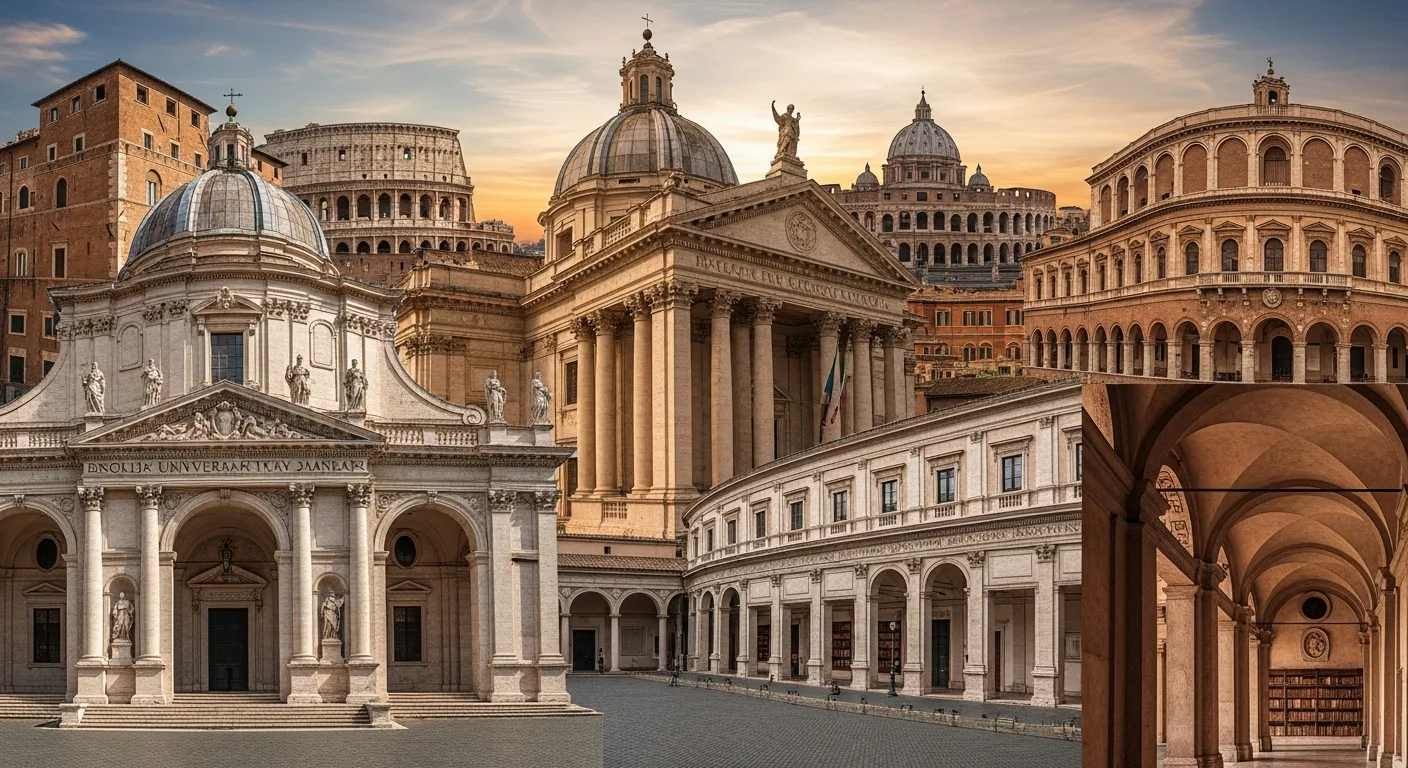
Photos: Wikimedia Commons
A Wednesday lecture in English on machine learning at Politecnico di Milano. The professor is Italian; the slides are in English; the student next to you is from Lagos, the one behind from São Paulo, and the group you join for the problem set afterwards switches between English, Spanish and broken Italian over a €4 plate of pasta in the mensa. Nobody in the room sat an Italian-language exam to get there. This is not a special international track bolted onto an Italian degree - it is the degree, taught start to finish in English, costing a fraction of what the same student would pay in London or Boston. Italy has spent fifteen years quietly building one of the larger English-taught catalogues in continental Europe, and most international applicants still don’t know it exists.
Here is the bottom line. Italy offers more than 600 fully English-taught degree programmes, roughly three-quarters at master’s level, and you can study them on the same ISEE income-based tuition of €0-4,000 a year that Italians pay - there is no English-language surcharge at public universities. Bocconi runs almost its entire portfolio in English and is Italy’s most international university at 27% international students (College Council Atlas); Politecnico di Milano teaches all of its engineering masters in English; Sapienza’s six-year Medicine and Surgery (MEDTECH) is fully English; and the University of Padua lists 83 English-medium programmes in the national catalogue. The catch is that the bachelor’s offer is far shallower than the master’s, and that “taught in English” still leaves you living in Italian outside Milan. Of all the destinations we map for the families we advise, Italy is the one they almost never have on their list at the first meeting - and the one a surprising number choose by the last, once someone actually runs the ISEE arithmetic in front of them.
This guide focuses on one question: how to do a real degree in English in Italy - which universities have genuine depth, where the bachelor’s catalogue thins out, what English certificate you need, how the SAT route works, and how the costs actually land. For the full system - ISEE mechanics, the Type D visa, the permesso di soggiorno and city-by-city living costs - read the parent guide, Study in Italy: complete guide for international students. If you want the broader pecking order, see our sibling pieces on the best universities in Italy and the best student cities in Italy.
Source: Universitaly programme catalogue, College Council Atlas dataset, official university admission pages, QS World University Rankings 2026.
If you take a single point from this guide, make it this. Italy’s English-taught offer is lopsided toward the master’s level - roughly three-quarters of the 600-plus English programmes are postgraduate. At master’s level, Italy is fully competitive with the Netherlands, Sweden or Germany: business, engineering, data science, international relations, architecture, design and the sciences are all available in English at top universities, often with the most generous tuition in Europe behind them.
The bachelor’s catalogue is a different story. English-taught undergraduate degrees exist, but they cluster in a handful of fields and institutions rather than spreading across the system. The reliable undergraduate options are Bocconi’s BSc economics, finance and management family; Politecnico di Milano’s English bachelors in engineering and design; English-taught Medicine and Surgery (six-year, via IMAT) at a dozen public universities; and a scattering of international relations, economics, computer science and biotechnology bachelors at Padua, Sapienza, Bologna, Trento and Milan. If your priority is breadth of choice at undergraduate level - wanting to compare twenty English bachelors in psychology or politics - the Netherlands and Ireland will serve you better. If you have a specific English bachelor’s field in mind, or you are applying at master’s level, Italy belongs squarely on the shortlist.
There is a quiet upside to the master’s tilt. The standard Italian path is a three-year laurea triennale followed by a two-year laurea magistrale, and the English-taught master’s is where Italy concentrates its quality and its scholarships. Many international students do a cheaper bachelor’s at home or in English elsewhere, then come to Italy for a top-150 master’s at ISEE prices - a strategy that gets you the brand, the EU labour-market access and a near-zero tuition bill all at once.
The shortlist below is the set I steer international applicants toward for English-taught study specifically - curated for genuine English-medium depth, reputation and value, not overall size. Treat the rank column as College Council’s curated ordering for English-taught access, not a literal QS ranking; what each university teaches in English matters more than its number. Where we publish a dedicated English guide the name links to it; otherwise it links to the university’s full profile in our Atlas. Programme counts marked “Atlas/Universitaly” are from the national catalogue snapshot and are conservative - universities routinely add English tracks faster than the catalogue refreshes.
| Rank | University | Known for (in English) |
|---|---|---|
| 1 | Bocconi University | Almost entire catalogue in English · economics, finance, management, data science · 27% international (CC Atlas) · admitted SAT ~1,400-1,450 · private (€15,000-19,500) |
| 2 | Politecnico di Milano | All engineering masters in English · architecture and design bachelors in English · top 20 globally · public ISEE tuition (from €156) |
| 3 | Sapienza University of Rome | Six-year English MEDTECH medicine via IMAT · 79 English-medium programmes (Atlas/Universitaly) · engineering, data science, economics |
| 4 | University of Padua | 83 English-medium programmes (Atlas/Universitaly) - among Italy's broadest · science, engineering, economics, psychology · 9% international |
| 5 | University of Bologna | Growing English bachelor's and master's tracks · economics, engineering, international relations · SAT accepted from 950 · oldest university in the world |
| 6 | University of Trento | English-medium computer science, physics, international studies · tight, international graduate cohorts · Alpine research university |
| 7 | LUISS Guido Carli | English economics, politics, management · Rome's policy-and-business network · private |
| 8 | Vita-Salute San Raffaele | Six-year English MD linked to a leading research hospital · medicine, psychology, biotech · private (Milan) |
| 9 | University of Milan-Bicocca | 18 English-medium programmes (Atlas/Universitaly) · English-taught medicine via IMAT · economics, data science, materials |
| 10 | University of Naples Federico II | English-taught medicine via IMAT · Apple Developer Academy · lowest cost of living of any major uni city |
| 11 | University of Milan (Statale) | English masters in data science, medicine, international politics · central Milan · comprehensive research university |
| 12 | Università Cattolica del Sacro Cuore | English economics, management, medicine · Europe's largest private Catholic university · Milan / Rome |
| Source: College Council Atlas dataset (Universitaly programme catalogue, international-student share) and dedicated guides; QS World University Rankings 2026; official university websites 2025/26. Rank is CC's curated ordering for English-taught access, not an overall ranking. | ||
A few notes on the picks. Bocconi sits at number one for English-taught study specifically because language is a non-issue there: nearly the whole catalogue is English, the student body is 27% international (College Council Atlas) - the highest of any major Italian university - and the network into finance and consulting is genuinely global. It is the one private price tag on this list that outcomes justify.
Politecnico di Milano is the public counterweight: every engineering master’s is in English, the architecture and design bachelors run English tracks, and the tuition is ISEE-based, so a low-bracket international student pays a fraction of Bocconi’s fee for a top-20 engineering brand.
Padua and Sapienza carry the volume, each with dozens of English-medium programmes across the sciences and, at Sapienza, the flagship English medical degree.
Beyond the twelve, the Scuola Superiore Sant’Anna and Scuola Normale Superiore in Pisa are worth knowing about - ultra-selective, research-track, increasingly English - and the University of Pisa itself runs strong English-taught science and computing.
Here is the judgement that the catalogue alone will not give you. The mistake I see most often is treating the number of English programmes a university lists as the thing that matters. It is not. Padua’s 83 programmes are spread thin across science and engineering, while Bocconi’s smaller catalogue is dense, coherent and built for one kind of career - and for a student who knows they want finance, the dense option wins easily. Read the table by the fit between a university’s English depth and your field, not by who lists the most courses; an English track that exists on paper but admits four people a year is not the same as one Bocconi runs at scale.
The clearest reason to look at English-taught Italy is medicine. More than a dozen public universities run six-year, fully English Medicine and Surgery degrees admitting through IMAT, the International Medical Admissions Test held each September. Because these are public-university programmes, they sit on the standard ISEE fee scale - meaning a low-ISEE international student can train as a doctor, in English, for a few hundred euros a year. There is almost nothing comparable in the developed world: English-language medicine in the UK runs £30,000 - £60,000 a year, in Ireland often more, and US medical school is a postgraduate degree costing six figures.
Sapienza’s MEDTECH in Rome is the best-known programme, but the English-taught medical map is wide: Pavia, Milano-Bicocca, Padua, Bologna, Naples Federico II, Bari, Tor Vergata and others all run English MD tracks, and on the private side, Vita-Salute San Raffaele in Milan offers an English MD linked to a leading research hospital. The gate is the IMAT, not the language or the fee - scores are programme-specific and the competition is real, with the strongest programmes admitting in single-digit percentages. We cover the exam end to end in our IMAT 2026 guide to medical admissions in Italy; read it before you commit to the medical route.
English-taught admission in Italy combines three moving parts: an entry test, an English-language certificate, and qualification recognition. The parent hub covers the full sequence (Universitaly pre-enrolment, the Type D visa, ISEE); here is what is specific to English-taught programmes.
The entry test varies by programme. For many public-university English tracks the route is TOLC (Test On Line, run by CISIA), with English-language variants, or the university’s own admission test. Crucially for international applicants, many universities accept the SAT as an alternative to TOLC on English-taught programmes, and Italy’s SAT thresholds are the lowest in Europe: the University of Bologna accepts from around 950, Sapienza from 960, Padua from 1,000, and Politecnico di Milano requires roughly 1,240, taking SAT Math in place of its TOL-I test. Bocconi runs its own admission test but accepts SAT or ACT as full alternatives; its formal minimum is low, but admitted students average around 1,400-1,450. English-taught medicine is the exception - it admits through IMAT, not the SAT. If the SAT fits your plan, prepare on our SAT app and read our companion piece on whether the SAT is worth it for international students. For the test itself, see our TOLC 2026 guide.
The English-language certificate is non-negotiable on English tracks. Most public universities accept IELTS 6.0 or TOEFL iBT 80, with selective programmes asking for IELTS 6.5 (TOEFL 90+); Bocconi requires IELTS 6.5 or TOEFL iBT 88. Many also take Cambridge C1 Advanced or the Duolingo English Test, and most waive the requirement if your previous degree was taught in English. The certificate is verified before enrolment, so book early - our TOEFL app runs full iBT mocks with AI-graded speaking and writing, and most students need 8-14 weeks of structured work to move from a school-English baseline to the 90+ band selective programmes increasingly expect.
The third document is qualification recognition - a Dichiarazione di Valore or a CIMEA Attestato di comparabilità confirming your school-leaving qualification (or prior degree, for master’s applicants) is equivalent. Start this early; it routinely takes longer than students expect and gates your enrolment.
The most common misconception about English-taught study in Italy is that English degrees cost more. At public universities, they do not. English-taught and Italian-taught programmes at the same public university use the identical ISEE income-based fee scale, so an English BSc at Padua or an English engineering master’s at Politecnico di Milano costs exactly what the Italian-taught equivalent costs - roughly €156 to €4,000 a year, depending on your family’s ISEE, with international students filing ISEE Parificato to access the same low brackets as Italians.
The expensive English-taught degrees are not expensive because they are in English; they are expensive because they sit at private universities. Bocconi charges €15,000-19,500 (its top ISEE tier, which applies to most non-EU families, runs €16,464 for a bachelor’s and €19,440 for a master’s, per College Council Atlas), with LUISS, Cattolica and San Raffaele in a similar private bracket. Those institutions add substantial merit scholarships - the Bocconi Merit Award covers full tuition plus a living stipend - so the sticker price is not always the real price. The strategic point stands: if minimising tuition is the goal, the public English-taught route is unbeatable, and the language of instruction never changes the bill.
| Route (English-taught) | Tuition per year | Notes |
|---|---|---|
| Public, low ISEE (Polimi, Padua, Sapienza) | ~€156-500 | Same scale as Italian tracks; file ISEE Parificato |
| Public, mid/high ISEE | ~€1,500-4,000 | Caps near €4,000 even at top bracket |
| English-taught medicine (public, via IMAT) | ~€156-4,000 | Six-year MD on the standard ISEE scale |
| Bocconi (private, top tier) | €16,464-19,440 | Merit awards can cover full tuition |
| LUISS / Cattolica / San Raffaele (private) | ~€10,000-17,000 | Own scholarships available |
Source: College Council Atlas (Bocconi ISEE-tier tuition), national ISEE fee policy, official university fee pages 2025/26. Public tuition depends on individual ISEE - confirm on the programme page.
“Taught in English” and “international classroom” are not the same thing, and the gap matters. The honest picture, from College Council Atlas data:
The practical takeaway: expect a more international room on an English track than the university’s overall share implies, and expect Bocconi and the Milan/Rome private universities to feel the most global. Outside the classroom, daily life still runs in Italian everywhere except central Milan - which is why even committed English-track students who learn Italian to A2 - B1 settle in faster.
English-taught Italy is an excellent fit for some profiles and a poor one for others. Use these criteria before you commit:
For the full trade-off against other continental systems - visas, work rights, post-study paths - the parent guide, Study in Italy: complete guide for international students, runs the numbers in detail.
We built College Council to remove the two things that most often derail an English-taught application to Italy: weak test preparation and a chaotic, last-minute process. Italy rewards the SAT more than almost any other European system, and at the lowest thresholds anywhere, so our SAT app runs the full digital SAT with adaptive practice and analytics, and our TOEFL app delivers full TOEFL iBT mocks with AI-graded speaking and writing - the English certificate every English-taught programme requires. We run both ourselves, so you prepare once and apply broadly.
The harder part is judgement: which English-taught programmes actually fit your scores, whether the ISEE maths makes a public university unbeatable for your family, and how to sequence the entry test, the English certificate, the visa and the permesso di soggiorno without missing a window. Register on College Council and you get the part no blog can give you - every university, the exact admission requirements, and a realistic read on how to get in. Run your profile through our chances engine to see where you stand. And if you simply want to explore, our Atlas of universities holds the full Italian catalogue, with the English-taught facts that matter.
Yes. Italy runs more than 600 fully English-taught degree programmes, concentrated at master’s level but with a growing bachelor’s catalogue. Bocconi teaches almost its entire portfolio in English; Politecnico di Milano delivers all its engineering masters in English; Sapienza’s six-year Medicine and Surgery (MEDTECH) is fully English; and the University of Padua lists 83 English-medium programmes across science, engineering and economics in its Universitaly catalogue. You can complete a bachelor’s, a master’s or a single-cycle medical degree without ever studying in Italian, though learning Italian to A2 - B1 makes daily life far easier outside Milan.
No, and it is the single most important thing to understand. Italy’s English-taught offer is roughly three-quarters master’s and one-quarter bachelor’s. At undergraduate level the strong options are concentrated: Bocconi’s BSc economics and management family, Politecnico di Milano’s engineering and design bachelors, Sapienza and Padua’s English BScs, English-taught medicine via IMAT, and a handful of international relations and computer science bachelors at Trento, Bologna and Milan. If you specifically want a wide English bachelor’s choice, the Netherlands or Ireland are deeper; for English master’s, Italy is fully competitive with northern Europe.
Most public universities accept IELTS 6.0 or TOEFL iBT 80 for English-taught programmes, with selective courses asking for IELTS 6.5 (TOEFL 90+). Bocconi asks for IELTS 6.5 or TOEFL iBT 88. Some programmes also accept Cambridge C1 Advanced, the Duolingo English Test, or an exemption if your prior degree was taught in English. The certificate is checked before enrolment, so book the test early - most students need 8-14 weeks of structured preparation to move from a school-English baseline to the 90+ band selective programmes expect.
At public universities, no. English-taught and Italian-taught programmes at the same public university use the identical ISEE income-based fee scale: tuition runs from about €156 to €4,000 a year regardless of teaching language, and international students who file ISEE Parificato access the same low brackets as Italians. The expensive English-taught degrees are at private universities - Bocconi (€15,000-19,500), LUISS, Cattolica, Vita-Salute San Raffaele - where the price reflects the institution, not the language of instruction.
Yes. More than a dozen Italian public universities run six-year, English-taught Medicine and Surgery degrees admitting through IMAT, the International Medical Admissions Test held each September. Sapienza’s MEDTECH in Rome is the best known, alongside Pavia, Milano-Bicocca, Padua, Bologna, Naples Federico II, Bari and Tor Vergata. Tuition follows the standard ISEE scale, so a low-ISEE international student can study medicine in English for a few hundred euros a year - among the cheapest English-language medical degrees in the developed world.
Very. Many public universities accept the SAT as an alternative to the Italian TOLC entry test on English-taught programmes, and Italy’s thresholds are the lowest in Europe: Bologna accepts from around 950, Sapienza from 960, Padua from 1,000, and Politecnico di Milano requires roughly 1,240, taking SAT Math in place of its TOL-I test. Bocconi runs its own admission test but accepts SAT or ACT as full alternatives, with admitted students averaging around 1,400-1,450. A strong SAT is portable across English-taught applications in Italy, the UK and the US at once.
It varies sharply by university. Bocconi is the most international major Italian university at roughly 27% international students, so its English-taught classrooms are genuinely global. Padua sits near 9% and Sapienza near 7% overall, but their English-taught cohorts skew far more international than those figures suggest, because Italian students dominate the Italian-taught majority. Smaller research universities like Trento (around 5% international overall) run tight, English-medium graduate cohorts in computer science and physics. Expect a more international classroom on English tracks than the headline campus figure implies.
English-taught Italy works exceptionally well for master’s applicants, for future doctors who can clear the IMAT, and for any student who wants a top-150 European degree at ISEE prices rather than UK or US fees. It is unmatched on cost: the public English-taught route on a low ISEE is the cheapest path to an English-language degree from a globally ranked university anywhere in the developed world, and the language of instruction never changes the bill. Bocconi adds a genuinely international, finance-and-consulting-grade option at a private price that the outcomes justify.
It works less well if you need a wide English bachelor’s catalogue - the undergraduate offer is concentrated in business, engineering, medicine and a few sciences - or if you flatly refuse to learn any Italian, because daily life outside Milan still runs in Italian even when your degree does not. For most international students who actually run the numbers, though, English-taught Italy lands on the shortlist: 600-plus programmes, near-zero public tuition, English-taught medicine, and a pathway to EU labour-market access is a rare combination. Pick the right level, file ISEE properly, take the English test seriously, and Italy delivers an English-language EU education at a fraction of the cost of comparable alternatives.
In bocca al lupo.
University profiles, international-student shares and English-programme counts are drawn from College Council’s Atlas dataset of Italian higher-education institutions, which links each university to the national Universitaly catalogue (snapshot 2026). Programme counts are conservative: universities add English tracks faster than the central catalogue refreshes. Current-cycle figures (ISEE bands, SAT and English thresholds, entry tests) were cross-checked against official Italian government and university sources in June 2026; public tuition depends on individual ISEE and rises in small steps, so confirm the exact figure on the relevant programme page for your intake year.