€156
Lowest public tuition per year
Flat regional tax + stamp duty at the bottom ISEE band
Cheapest universities in Italy 2026: public tuition €156-4,000 via ISEE, a €22,000 no-tax threshold, plus how non-EU students declare income.

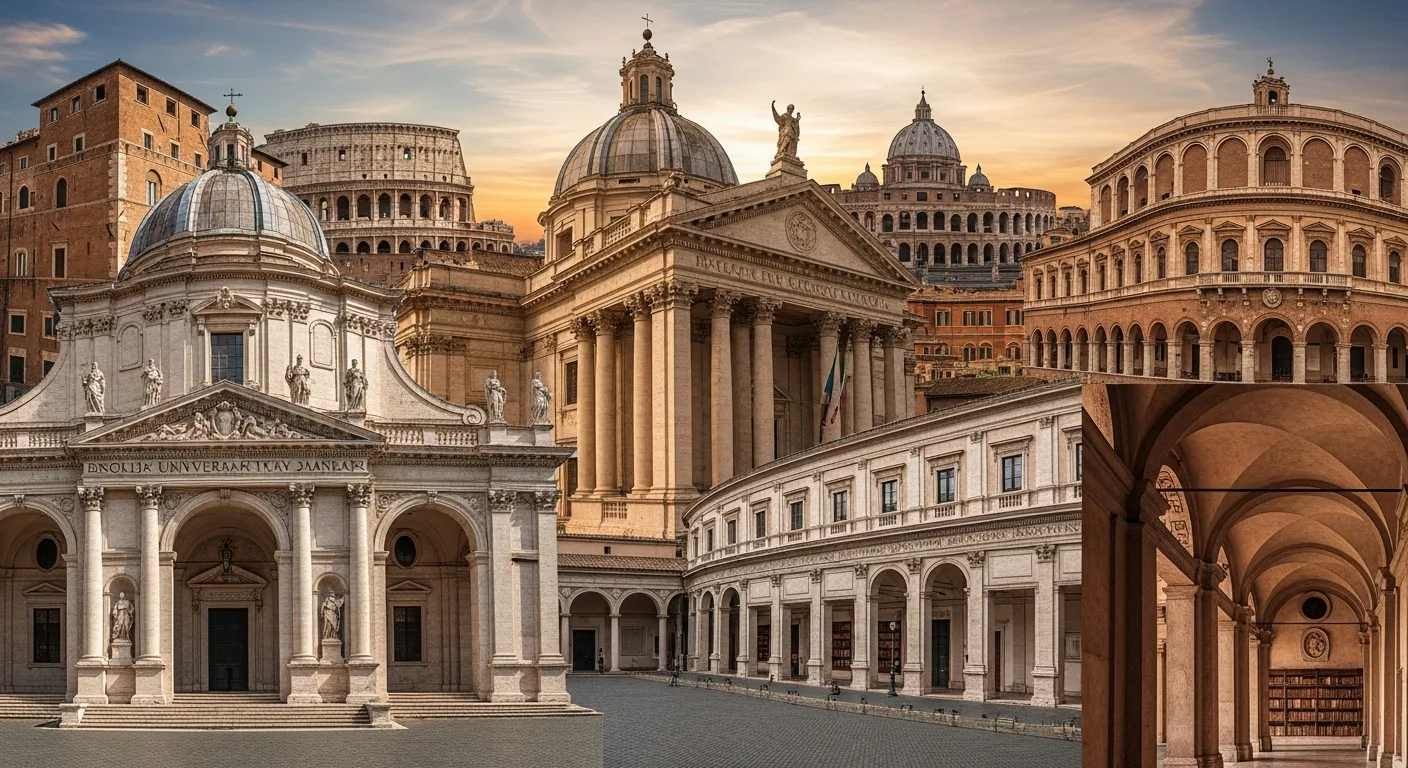
Photos: Wikimedia Commons
The cheapest degree I have ever seen an international student pay for was in Naples. A second-year economics student from Tirana, studying at the University of Naples Federico II, paid €156 in tuition for the year and €280 a month for a room in a shared flat near the Vomero funicular. She ate lunch at the mensa for €3, took the metro on a student pass, and her family’s income - filed through ISEE Parificato at a CAF office the previous autumn - placed her in the no-tax band. Her total cost of attending an 800-year-old public university, all in, came to under €9,000 a year. A friend of hers from the same school back home was paying that much per semester for an undergraduate degree in the Netherlands.
Here is the bottom line. There is no single cheapest university in Italy, because public tuition is set by your family’s income, not by the institution. Every state university uses the same national fee band - roughly €156 to €4,000 a year - and by law there is a no-tax area that takes tuition to zero for any student whose ISEE is at or below €22,000. The University of Bologna, Sapienza, Padua and Naples Federico II all charge the same near-zero fee at the lowest bracket. What actually decides your cost is the city. The southern and smaller public universities - Naples, Bari, Catania, Palermo, Calabria, Lecce - combine that zero tuition with living costs of €600-900 a month, roughly half of Milan, and that is where an Italian degree gets cheap enough to fund on a part-time job. The catch, for non-EU families, is the paperwork: you have to declare your income through ISEE Parificato, or the university defaults you to the maximum €4,000 bracket.
This guide is the cost half of our complete guide to studying in Italy. I will show you exactly how the ISEE bands work, where the no-tax threshold sits, how a non-EU family proves its income, which public universities are cheapest once you factor in the city, and how regional DSU scholarships can take a southern public degree close to free. Read it alongside our sister guides to the cheapest universities in Spain and the cheapest universities in France if you are comparing value across the continent - but Italy is the one where the cost arithmetic hides inside the bureaucracy, and the families who decode it pay a fraction of what their peers pay anywhere else.
Source: national ISEE law (no-tax area), official university fee regulations (regolamento tasse) 2025/26, College Council Atlas tuition dataset, and DSU regional agency figures.
Most rankings of “cheapest universities in Italy” are nonsense, because they list institutions by sticker price as if Italy worked like the UK or the US. It does not. At every one of Italy’s 67 public universities, your tuition is calculated by the same national formula from your family’s economic standing, captured in a single number called ISEE. The University of Bologna does not charge more than the University of Calabria for a low-income student; both charge the statutory minimum. The right question is not which university is cheapest but how do I get into the lowest ISEE band, and which city lets me live cheaply while I do it.
Once you reframe it that way, two levers control your cost. The first is ISEE, which sets tuition and is identical across the public system - so the work is in filing it correctly, not in picking the institution. The second is cost of living, which varies more across Italy than across almost any country in Europe. A room costs €280 in Naples and €650 in Milan for the same kind of flat. Food, transport and going out follow the same north - south gradient. Because tuition is flat, the city is the entire variable, and the cheapest Italian degrees are concentrated in the south and in smaller university towns.
That is why the table below is curated for all-in affordability, not nominal fees. Every university on it is public and runs the same €156-4,000 ISEE band, verified in the College Council Atlas dataset. What separates them is the living cost of their city, the strength of their regional DSU scholarship system, and whether they run the English-taught programmes an international student needs. Where we publish a dedicated English guide, the name links to it; otherwise it links to the university’s full profile in our Atlas.
| Rank | University | Why it's cheap (city · living · known for) |
|---|---|---|
| 1 | University of Naples Federico II | Naples · €600-900/mo, lowest of any major uni city · historic (1224), Apple Developer Academy · rooms from €280 |
| 2 | University of Bari Aldo Moro | Bari · €600-850/mo · large comprehensive (40,500 students) · Puglia coast, very low rents |
| 3 | University of Catania | Catania (Sicily) · €600-850/mo · sciences, medicine, humanities · cheapest island option |
| 4 | University of Salento | Lecce · €550-800/mo · engineering, cultural heritage · small baroque city, lowest cost on this list |
| 5 | University of Palermo | Palermo (Sicily) · €600-850/mo · medicine, law, sciences · big-city life at southern prices |
| 6 | University of Calabria | Rende · €550-800/mo · rare full residential campus, subsidised housing · computer science, economics |
| 7 | University of Perugia | Perugia (Umbria) · €600-850/mo · classic student town · strong DSU, Erasmus hub |
| 8 | University of Cagliari | Cagliari (Sardinia) · €600-850/mo · sciences, engineering, medicine · island living, beaches |
| 9 | University of Bologna | Bologna · €650-900/mo · oldest university in the world (1088), top-150 QS · best value-for-prestige play |
| 10 | University of Padua | Padua · €600-850/mo · sciences, medicine, physics (1222) · 30 min from Venice at half the cost |
| 11 | Sapienza University of Rome | Rome · €750-1,250/mo · largest in Europe, top-150 QS · English MEDTECH medicine (via IMAT), low SAT thresholds on other English tracks |
| 12 | University of Turin | Turin · €750-1,100/mo · comprehensive · strong EDISU/DSU, cheaper than Milan, deep student city |
| All are public universities on the national ISEE band (€156-4,000/year); tuition is identical across them, so ranking reflects all-in living cost and value. Source: College Council Atlas dataset; official university fee regulations 2025/26; living-cost estimates averaged across student cities. Rank is CC's curated ordering for cost-focused international applicants, not an overall ranking. | ||
A few notes on the picks. Naples Federico II is the value champion of the entire Italian system: a major research university (71,900 students) founded in 1224, with an Apple Developer Academy and growing English-taught tracks, in the cheapest large city in the country.
Salento (Lecce) and Calabria (Rende) are the absolute floor on cost - Calabria is one of the few Italian universities with a real residential campus, which means heavily subsidised on-site housing that undercuts even the southern rental market.
Bologna, Padua and Sapienza are the value-for-prestige plays: you pay near-zero tuition at a top-150 QS institution, accepting a slightly higher cost of living than the deep south.
Beyond the twelve, Messina, Genoa, Parma, Siena and Verona all run the same ISEE band with mid-to-low living costs and are worth a look depending on field. The two universities that do not belong on a cheapest list are the private ones - Bocconi (€15,000-20,000) and LUISS (€12,000-15,000) - which we cover in the best universities in Italy guide, where price is justified by network rather than teaching cost.
ISEE - Indicatore della Situazione Economica Equivalente - is a government calculation of your household’s economic standing. It rolls family income, savings, investments and real estate into a single equivalised figure, adjusted for household size. Public universities use that figure to assign your tuition band, and the bands are set partly by national law and partly by each university’s own fee regulation (regolamento tasse e contributi).
The piece that changed the maths for everyone is the no-tax area (no tax area). National budget law fixed a statutory floor below which students pay no tuition at all: as of the current cycle the threshold sits at ISEE €22,000 (raised in stages from the original €13,000). Below it, you pay only the regional student tax (tassa regionale per il diritto allo studio, roughly €120-160 depending on region) and a €16 stamp duty (marca da bollo) - the €140-200 that gets quoted as the “€156 minimum.” Between €22,000 and around €30,000 you get a graduated reduction, and above that you climb toward the cap. A typical public-university structure looks like this:
The exact figures vary by university and by region - some universities (Padua, Trento) run more generous reductions than the legal minimum, and the regional tax differs between Emilia-Romagna, Lazio and Piedmont. But the shape is the same everywhere, and the headline is simple: if your family’s equivalised income lands at or below €22,000, an Italian public degree costs you nothing in tuition. That is not a scholarship you compete for; it is the default the moment your ISEE is on file.
Here is where international families get tripped up, and where the real money is. The standard ISEE is calculated automatically by INPS for residents with Italian tax records. If your family has no Italian fiscal history - which is the case for almost every non-EU international student - you cannot be auto-calculated, so you file ISEE Parificato (equivalised ISEE). It produces the same band placement; it just gets there from foreign documents.
The process runs through a CAF (Centro di Assistenza Fiscale), a tax-assistance office found in every Italian city, often for a small fee or free for students. You bring:
The CAF runs these through the ISEE equivalising formula and issues your ISEE Parificato attestation, which you upload to the university by its deadline (typically September - December for the academic year). Get it on file and you are placed in the same income bands as Italian students - including the no-tax area. Miss it, and almost every university defaults you to the maximum €4,000 bracket for the year, because in the absence of declared income they assume the top tier. That is the single most expensive piece of paperwork you can forget.
In my experience advising families on Italy, the ones who come out ahead are not the ones who chased a scholarship - they are the ones who treated ISEE Parificato as the real admissions test. They started collecting parental tax documents and sworn translations six months early, used a CAF office rather than guessing at the form, and filed before the window closed. The families who leave it until enrolment week routinely pay the top €4,000 band for a full year before they can correct it, if they manage to correct it at all. The entry test gets you the seat. ISEE decides what the seat costs - and for a low-income family, it is the difference between €4,000 and €0.
With tuition flat across the public system, your total cost is dominated by where you live. Italy’s north - south cost gradient is steep, and it is the reason the cheapest universities are clustered in the south.
Naples, Bari, Catania, Palermo, Lecce and Cagliari are the cheapest, at €600-900 a month all-in, with rooms in shared flats from €250-400. These southern cities combine low rents with a low cost of everything else - food, transport, going out - and they host large, serious public universities.
Calabria (Rende) can go lower still thanks to its residential campus and subsidised on-site housing.
In the centre, Perugia, Pisa, Siena and Padua sit at €600-900, classic walkable student towns where a quarter of the population studies.
Bologna runs €650-900 - slightly pricier, but with the best food scene in Italy and a deep student-town economy.
Rome (Sapienza) climbs to €750-1,250, and Turin to €750-1,100.
Milan is the outlier at €850-1,500, which is why no Milanese university appears near the top of a cheapest list even though Polimi and Statale run the same ISEE tuition.
One number changes the whole budget: the university mensa (canteen) serves a full meal - first course, second, side and fruit - for €2-5 with a student card, and for low-ISEE and DSU students it is often free. Cooking at home is cheaper still and culturally normal, and the neighbourhood markets undercut supermarkets on fresh produce. Food is rarely the line that breaks an Italian student budget. Rent is, and rent is what the south solves.
| Route | All-in per year | What’s included |
|---|---|---|
| Public, deep south (Naples / Bari / Lecce, low ISEE) | ~€8,000-10,500 | Tuition ~€0-200 + living ~€650-850/month |
| Public, central town (Perugia / Padua, low ISEE) | ~€9,000-11,500 | Tuition ~€0-200 + living ~€700-900/month |
| Public, Bologna (low ISEE) | ~€9,500-12,000 | Tuition ~€0-200 + living ~€700-900/month |
| Public, Rome (Sapienza, low ISEE) | ~€10,000-13,000 | Tuition ~€0-200 + living ~€800-1,000/month |
| Public, Milan (Polimi / Statale, mid ISEE) | ~€14,000-18,000 | Tuition ~€1,000-1,500 + Milan living ~€1,000+/month |
| For comparison: private (Bocconi) | ~€26,000-32,000 | Tuition ~€15,000-20,000 + Milan living |
Source: official university fee regulations 2025/26; living-cost estimates averaged across student cities. Tuition depends on ISEE; the lowest band assumes the no-tax area.
The no-tax area gets your tuition to zero. The DSU (Diritto allo Studio Universitario) regional scholarship system can get your living costs close to zero too, and it stacks on top of everything above. DSU is administered by regional agencies - ADISU Puglia (Bari/Lecce), ERSU Sicilia (Catania/Palermo), ERSU Calabria, ADiSU Umbria (Perugia), ER-GO (Bologna), DiSCo (Rome/Lazio), EDISU Piemonte (Turin) - and it is a package, not a single grant:
DSU is awarded on a blend of ISEE economic need and academic merit (you must earn a minimum number of credits each year to keep it). EU students - including those with a low ISEE Parificato - qualify on exactly the same terms as Italians. Apply within the regional window, usually September - October, separately from your university enrolment. A southern student who lands a DSU scholarship at, say, Bari or Calabria can have tuition waived, a €5,000+ stipend, free meals and a subsidised room - a degree that costs the family almost nothing. Students with moderate family income who skip the DSU application leave €3,000-7,000 a year on the table; it is the most under-claimed money in the Italian system.
For the full national and private scholarship picture - Borse di Studio del Governo Italiano, the Bocconi Merit Award, Polimi’s Roberto Rocca Project - see the scholarships section of our complete guide to studying in Italy.
The instinct that a €0 public degree must be worse than a €20,000 private one does not survive contact with the rankings. The University of Bologna (founded 1088), Sapienza and Padua (1222, where Galileo held the chair of mathematics) are all top-150 QS research universities, and they charge the same near-zero tuition as everywhere else under a low ISEE.
Naples Federico II runs an Apple Developer Academy and serious engineering and physics. The cheapest universities in Italy are not the weakest - they are the public ones in the cheapest cities, which is a different thing entirely.
Where you genuinely trade up by paying is network, not teaching. Bocconi at €15,000-20,000 buys a finance-and-consulting recruiting machine that a public university cannot match, and LUISS buys access to Italian public life. If your target is investment banking or strategy consulting out of Milan, that network can pay for itself. For almost everything else - sciences, engineering, medicine, humanities, law, computer science - a low-cost public university gives you an equivalent degree at a fraction of the price, with the same recognition across the EU labour market.
Two honest trade-offs come with the cheapest options. First, the deep-south universities teach more in Italian than the northern flagships; the English-taught catalogue is thinner in Naples or Catania than at Bologna, Padua or Sapienza, so confirm your specific programme is English-medium before committing. Second, bureaucracy is slower in the south, and the housing and administrative processes that are merely annoying in Bologna can be genuinely sluggish in Palermo or Naples. Neither is a deal-breaker; both are reasons to start the paperwork - ISEE Parificato above all - months early rather than on arrival. If you want to weigh prestige against pure cost, read it next to our best universities in Italy and best student cities in Italy guides.
The cheapest path also tends to be the most accessible. Italy’s public universities run a generous front door: acceptance rates of 50-80%, with the real selection happening through hard exams during the degree rather than at admission. For international students the entry routes are:
You will also need an English certificate - most public universities want IELTS 6.0+ or TOEFL iBT 80+. Prepare for it in our TOEFL app, which runs full iBT mocks with AI-graded speaking and writing. And budget for one more document: a Dichiarazione di Valore or CIMEA Attestato di comparabilità confirming your school-leaving qualification is recognised in Italy. None of these costs more than a few hundred euros, which keeps the total entry cost far below the application-fee-plus-test load of the US or UK systems.
The two things that make an Italian degree cheap - a correctly filed ISEE and a well-sequenced application - are exactly the two things families most often get wrong. We built College Council to fix both. Italy rewards the SAT more than any European system and at the lowest thresholds, so our SAT app runs the full digital SAT with adaptive analytics, and our TOEFL app covers the English certificate every Italian university requires. You prepare once and apply broadly - the same score travels to your UK and US choices.
The harder part is judgement: whether the ISEE maths makes a southern public university unbeatable for your family, which cities cut your living costs most, and how to line up ISEE Parificato, DSU, TOLC or SAT, the visa and the permesso di soggiorno without missing a single window. That is where we work with families directly, on the same data that powers this guide. Register on College Council and you get every university, the exact admission requirements, and a realistic read on where you stand - run your profile through our chances engine. And if you just want to explore, our Atlas of universities holds the full Italian catalogue, every public university on the shortlist above and thousands more, with the cost and entry facts that matter.
There is no single cheapest university, because public Italian tuition is set by your family’s income through ISEE, not by the institution. Every state university uses the same national band: roughly €156 to €4,000 per year. The lowest-bracket fee (a flat regional and stamp-duty charge of about €140-200) is the same at the University of Bologna, Sapienza, Padua or Naples Federico II. What actually changes your total cost is the city: Naples Federico II, Bari, Catania, Palermo, Calabria and Lecce run living costs of €600-900 a month, roughly half of Milan, which makes the southern public universities the cheapest all-in option in the country.
ISEE (Indicatore della Situazione Economica Equivalente) is Italy’s official measure of household economic standing, combining family income, savings and property into one equivalised figure. Public universities use it to assign your tuition band. By national law there is a no-tax area: students whose ISEE is at or below €22,000 pay no tuition at all, only the regional tax and stamp duty (around €140-200 a year). Between €22,000 and roughly €30,000 you get a graduated discount, and above that you climb toward the €4,000 cap. Filing ISEE correctly is the single most valuable piece of paperwork in the Italian application.
Non-EU students who cannot be calculated through the standard Italian ISEE file ISEE Parificato (equivalised ISEE). You take certified, translated copies of your parents’ income documents - tax returns or an income certificate, plus bank balances and property records - to a CAF (Centro di Assistenza Fiscale) office in Italy, which calculates an equivalent ISEE figure that drops you into the same income bands as Italian families. Without it, most universities default you to the maximum bracket, so the difference between filing and not filing is roughly €4,000 a year.
Italy has no blanket free-tuition model the way Germany does, but the practical effect for low-income students is close to it. Under the national no-tax area, any student at a public university with an ISEE at or below €22,000 pays zero tuition - only the regional student tax (tassa regionale, around €120-160) and a €16 stamp duty. On top of that, regional DSU scholarships add full fee exemption plus a living stipend of €2,000-7,000, free canteen meals and subsidised housing, and EU students with low ISEE Parificato qualify on the same terms as Italians.
The southern and smaller university cities are the cheapest. Naples (Federico II), Bari, Catania, Palermo, Lecce (Salento) and Calabria run monthly living costs of roughly €600-900, with rooms in shared flats from €250-400. Central and northern student towns like Perugia, Pisa, Padua and Bologna sit at €650-950. Milan is the outlier at €850-1,500. Because public tuition is identical everywhere under ISEE, the city is what decides your real cost, and the south is where an Italian public degree gets genuinely cheap.
Not academically. The University of Bologna (founded 1088), Sapienza and Padua are top-150 QS research universities with near-zero tuition under a low ISEE, while Bocconi charges €15,000-20,000. Private universities like Bocconi and LUISS justify their fees through recruiting networks in finance and consulting, not through teaching quality across the board. For most fields - sciences, engineering, medicine, humanities, law - a low-cost public university gives you an equivalent or better degree at a fraction of the price.
For a low-ISEE student at a southern public university, a realistic all-in budget is €8,000-10,500 a year: roughly €0-200 in tuition plus €650-850 a month for rent, food, transport and health cover. In Bologna or Padua budget €9,000-12,000; in Rome (Sapienza) €10,000-13,000; in Milan €14,000-18,000 even at a public university. A regional DSU scholarship can cut the living half by €2,000-7,000, taking a southern public degree close to self-funding.
The cheapest Italian degree is not at a particular university; it is built from three decisions. File ISEE Parificato so your family’s income places you in the no-tax area and your tuition drops from €4,000 to near zero. Choose a southern or smaller-city public university - Naples, Bari, Catania, Palermo, Calabria, Lecce - where living costs are half of Milan’s. And apply for a regional DSU scholarship, which can waive fees, add a €2,000-7,000 stipend, and hand you subsidised housing and free meals on top. Stack all three and a degree from an 800-year-old public university can cost a low-income family under €9,000 a year, with the most fortunate paying close to nothing.
It works less well if you need a deep English-taught bachelor’s catalogue in the deep south, if you are set on a Milan-based private brand for finance, or if you refuse to do the paperwork early. But for the international student who actually runs the numbers, Italy is the rare place where a degree from a top-150 research university - Bologna, Padua, Sapienza - sits among the cheapest in the developed world. The price is not on the prospectus; it is decided by a single form filed at a CAF office months before you ever set foot in the lecture hall. The families who understand that pay near nothing for an education other students borrow six figures to buy.
In bocca al lupo.
Tuition figures are grounded in Italy’s national ISEE framework and each public university’s annual fee regulation (regolamento tasse e contributi), cross-checked against College Council’s Atlas dataset, which records every Italian public university on the €156-4,000 ISEE band. The no-tax-area threshold (ISEE €22,000) and the regional-tax-plus-stamp-duty minimum reflect current national budget law and standard university fee structures; the exact floor and the graduated bands above it are set per university and per region and rise in small steps, so always confirm the precise figure on the relevant university’s fee page for your intake year. Living-cost ranges are averaged across student cities from current rental and student-budget data; ISEE Parificato and DSU procedures were verified against CAF and regional DSU-agency guidance in June 2026.