EPFL Lausanne - Complete Guide for International Applicants
Apply to EPFL Lausanne in 2026 - CHF 1,266/year tuition, French-language Bachelor, English Master, Excellence Fellowship, scholarships and careers explained.
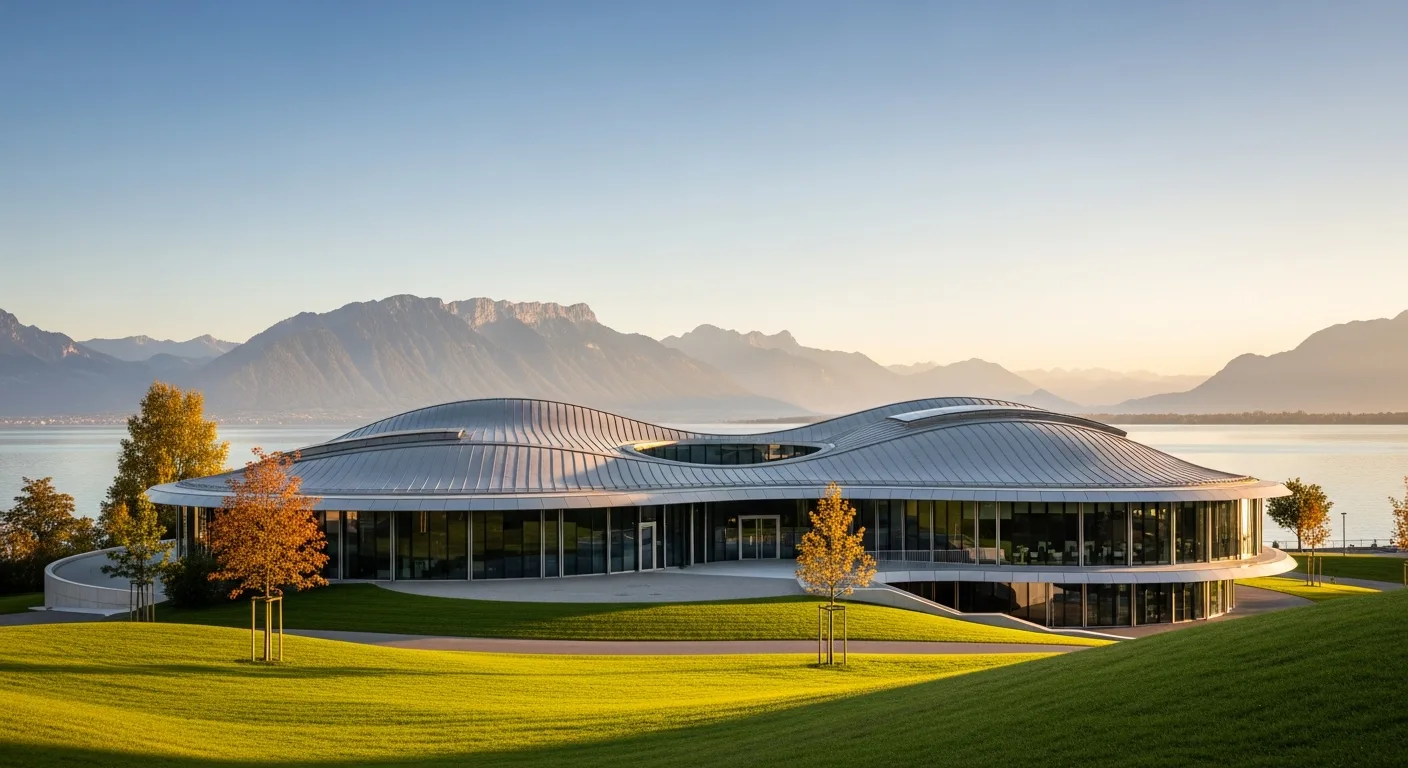
Lead image: Wikimedia Commons
You are standing on the curving roof of the Rolex Learning Center - an undulating organic structure of glass and concrete by the Pritzker-laureate firm SANAA - and the panorama in front of you looks staged. To your left, Lake Geneva flickers in the late-afternoon light. To your right, the Savoy Alps draw the southern horizon. Between the two, the UNESCO-protected Lavaux vineyards step down to the water in stone-walled terraces. Behind you, on a 65-hectare campus, more than twelve thousand students from over 120 countries are moving between laboratories where artificial-intelligence systems, mind-controlled neuroprostheses and plasmonic nanomaterials are being built. This is not a brochure scene. It is a normal Tuesday at EPFL Lausanne.
EPFL - full name École Polytechnique Fédérale de Lausanne, the Swiss Federal Institute of Technology in Lausanne - is one of the two federal technical universities of Switzerland and one of the strongest engineering institutions in the world. In the QS World University Rankings 2025 EPFL sits at #14 globally and #2 in Continental Europe, second only to its sister institution ETH Zürich. What makes that figure striking is the trajectory: EPFL only acquired federal status in 1969. In five decades it has gone from a regional engineering school to the global front rank - an institutional growth curve unmatched in European higher education. And tuition? CHF 633 per semester - less than a single month’s rent in Lausanne.
This guide walks international applicants through everything you need to know to apply to EPFL from outside Switzerland: the swissuniversities equivalence framework, the open-admission Bachelor pathway and the brutal first-year propédeutique filter, the Cours de mathématiques spéciales (CMS), French and English language requirements, costs of living in Lausanne, scholarship pathways, the residence permit system, and post-graduation career outcomes. For the wider Swiss picture, see our studying in Switzerland guide. For a German-speaking comparison, the ETH Zürich guide walks through the parallel STEM path under the German-language system.
Why EPFL Lausanne is exceptional
EPFL is the rare technical university that consistently appears in the global top 15 - competing with MIT, Stanford, Cambridge and ETH Zürich rather than with mid-tier European technical schools. QS World University Rankings 2025 places EPFL at #14, ahead of Yale, Columbia, Princeton and the University of Tokyo. Times Higher Education 2025 places it at #18, and in QS Engineering & Technology 2025 it sits at #12, alongside the Anglo-American leaders. By rankings alone, it is the second-best technical university in Continental Europe, just behind ETH and roughly thirty places ahead of TU Munich, RWTH Aachen and KU Leuven.
Three things stand out when you put EPFL next to other top-15 universities.
First, the research density: EPFL is small - only around 12,300 students - but its publication rate per capita in the Nature Index is among the highest on the planet. The institution behaves like a research lab dressed as a university, channelling federal funding directly into deep-tech laboratories.
Second, the innovation engine: EPFL spins out over 250 startups per year, and the EPFL Innovation Park on the western edge of campus hosts more than 130 active companies, from early-stage seed to publicly listed firms.
Third, the price-to-quality ratio: at CHF 633 per semester - identical for everyone - EPFL is one of the cheapest world-top-20 universities to attend. Imperial College London charges international undergraduates over GBP 40,000 per year. MIT charges over USD 60,000. EPFL charges what a single fortnight at MIT costs.
What sets EPFL apart from ETH Zürich
EPFL and ETH Zürich are sister institutions under the same ETH Domain - federal funding, identical-sized tuition, both consistently in the global top 15. But they are not interchangeable.
EPFL teaches in French at Bachelor level; ETH teaches in German.
EPFL is younger and more startup-oriented - its profile in computer science, microengineering, neurotechnology and life sciences is sharper than ETH’s, which leans toward classical engineering, physics and pure mathematics.
EPFL does not run an entrance exam for diplomas on the equivalence list, where ETH increasingly does for international applicants.
Lausanne sits beside Lake Geneva with a francophone, lakeside atmosphere; Zürich is larger and more corporate.
For an internationally minded STEM applicant, the choice between EPFL and ETH usually comes down to language: French or German, B2 or C1, three years of preparation pointing one way or the other. Once language is fixed, the rest follows.
The numbers that matter
- QS World 2025: #14 globally, #2 Continental Europe, #12 in Engineering & Technology
- Acceptance pattern: open admission at Bachelor level, ~50-65% complete year one
- Tuition: CHF 633 per semester / CHF 1,266 per year (~EUR 1,340 / USD 1,430), identical for all
- Cost of living in Lausanne: CHF 2,000-2,500 per month
- Total annual budget: CHF 25,000-31,000 (~EUR 26,500-33,000 / USD 28,000-35,000)
- Students: 12,300+, with roughly 60% holding non-Swiss nationality
- Faculty: ~350 professors, ~5,200 academic staff
- Departments: 14 sections across five schools
- Spinoff rate: 250+ startups per year, 130+ companies in EPFL Innovation Park
How EPFL Lausanne admissions work - by qualification path
EPFL admissions look almost nothing like the system Anglo-American applicants are used to. There is no Common App, no SAT or ACT, no personal statement, no holistic review, no demonstrated interest. Bachelor admission is determined by diploma equivalence and language certification. Master admission adds GPA, references and a CV. Selection - the real one - happens at the end of year one for Bachelor students, through the propédeutique examinations.
Step 1: Determine your qualification path
EPFL applies the swissuniversities equivalence framework. Your secondary-school diploma falls into one of three categories.
Category A - Direct admission with strong grades. Swiss Matura, German Abitur (1.0-1.8 in core sciences), French Baccalauréat (mention bien or très bien), IB Diploma (36+ points with HL Maths Analysis & Approaches at 5/7), A-Levels (AAA including Mathematics and one science), European Baccalaureate (80%+), Italian Maturità Scientifica (90/100+), Austrian Reifezeugnis (1.0-1.8). Holders of these diplomas, with grades at the published threshold, are admitted directly to the Bachelor without an entrance exam - provided the curriculum included extended Mathematics and at least one extended science (Physics or Chemistry).
Category B - Examen d’admission. Diplomas formally recognised but lacking depth in mathematics or science require the EPFL examen d’admission, a written examination held in Lausanne in late August / early September, covering mathematics, physics and French. Pass rate is approximately 40-50%.
Category C - Cours de mathématiques spéciales (CMS). Diplomas not on the swissuniversities recognition list - most national diplomas from Asia, Africa, Latin America and parts of Eastern Europe - require either the examen d’admission or, more commonly, completion of the CMS: a one-year preparatory programme on the EPFL campus from September to June, costing CHF 633 per semester. The CMS covers mathematics, physics, chemistry and French at university-entrance level; pass the final exams and you start year one of a Bachelor programme. CMS pass rate is approximately 50-60%.
A fourth alternative exists: complete the first year at a recognised university in your home country with strong grades, then apply for transfer. EPFL evaluates the transcript individually and admits selected applicants directly into the relevant Bachelor section.
Step 2: Language certification
For Bachelor programmes, French at B2 level is the floor. Acceptable certificates: DELF B2, DALF C1, DALF C2, TCF B2+, TEF B2. C1-level certificates are also accepted. Native-speaker exemption applies to applicants who completed at least two years of secondary education in a French-medium school.
For Master programmes, English at C1 level is required, since roughly 95% of Master teaching at EPFL is in English. Acceptable certificates: TOEFL iBT 95-100 (with no section below 22), IELTS Academic 6.5-7.0 (with no band below 6.5), Cambridge C1 Advanced 180+, Cambridge C2 Proficiency. Some Master programmes also accept proof of a Bachelor degree taught entirely in English. For TOEFL or IELTS preparation, a structured prep platform like PrepClass - full practice tests with AI-generated feedback on speaking and writing tasks - saves weeks of unfocused study.
Step 3: The application file
The Bachelor application opens in early November and closes on 30 April for autumn-semester start. The Master application closes on 15 December for the autumn semester (some programmes also have a 15 June deadline for spring intake). Both are submitted through the IS-Academia portal on the EPFL website.
The application requires: certified translations of your secondary diploma and final-year transcript (or Bachelor degree and full transcript for Master), language certificate (DELF B2 for Bachelor, TOEFL/IELTS for Master), passport copy, CV, motivation letter (Master only), two academic references (Master only), and a CHF 150 application fee.
EPFL does not require interviews for Bachelor admission. A minority of Master programmes interview shortlisted candidates (Computational Neurosciences, Quantitative Finance, selected Computer Science specialisations). Selection at Bachelor level is based on academic record and language certification; Master selection adds GPA, references and the motivation letter.
Timeline at a glance
- Two years before: begin French language preparation; target DELF B2 by year before enrolment.
- November (year before): EPFL Open Days - visit campus, talk to current students, see laboratories.
- 15 December (year before): Master application deadline.
- January - April: register on IS-Academia and upload Bachelor documents.
- 30 April: Bachelor application deadline.
- Late August / September: examen d’admission (Category B candidates only).
- Mid-September: autumn semester begins - orientation week, first lectures.
- End of year one (June): propédeutique examinations - the real selection filter.
Language requirements - French at Bachelor, English at Master
Here is the fact most international applicants overlook: every Bachelor programme at EPFL is taught in French. Not most. Every single one - including Computer Science, Mathematics, Physics, Mechanical Engineering, Electrical Engineering, Architecture, Chemistry, Life Sciences, Civil Engineering, Materials Science, Microengineering and Environmental Sciences. Some advanced lectures in years two and three may switch to English, particularly in research-active fields, but examinations, problem sets and core teaching at year one are in French. The required level is B2, evidenced by DELF B2, DALF C1/C2, TCF B2+ or equivalent.
For an international applicant without prior French, this means two to three years of language preparation before applying - unless you attended a French-medium school or studied French at extended secondary level. It is a serious commitment, but EPFL does not compromise on it.
If French is the binding constraint, two alternatives are worth considering. ETH Zürich teaches in German at Bachelor level - equally rigorous, similar tuition, ranking just ahead of EPFL globally. Or apply to EPFL at Master level: roughly 95% of Master programmes are taught in English, and the language requirement switches to TOEFL iBT 95-100 or IELTS Academic 6.5-7.0. Many international students complete a Bachelor in their home country (in English, French, or any other language) and use the English-language Master at EPFL as the entry route. For TOEFL preparation, PrepClass provides full-length practice tests with AI feedback on speaking and writing - useful when you need a 100+ score.
Even for English-medium Master students, practical French remains a major asset for life in Lausanne - for finding a flat on the private rental market, dealing with cantonal authorities (the Canton of Vaud is exclusively francophone), securing internships at Swiss-Romande employers, and integrating into local social life. Lausanne is an international city, but it is not London or Amsterdam: French is the default in shops, on public transport, and at the doctor. Most Master students invest in at least A2 - B1 French alongside their studies.
Programmes and sections - what to study at EPFL
EPFL is structured into 14 sections (the EPFL term for departments), grouped into five schools: the School of Basic Sciences (SB), the School of Engineering (STI), the School of Architecture, Civil and Environmental Engineering (ENAC), the School of Computer and Communication Sciences (IC), and the School of Life Sciences (SV). It offers 13 Bachelor programmes and over 25 Master programmes, with the Master almost universally taught in English.
Computer Science (IN) and Communication Systems (SC) form the flagship - EPFL’s School of Computer and Communication Sciences is consistently ranked among the top 15 computer-science programmes worldwide, with particular strength in distributed systems, machine learning, security and human-computer interaction. The school feeds Google’s Zürich engineering office (a 90-minute train away), Microsoft, Apple, Logitech, and a thick local startup ecosystem rooted in the EPFL Innovation Park. Master specialisations include data science, cybersecurity, computer vision and theoretical computer science - taught entirely in English.
Microengineering (MT) is a section that exists almost nowhere else in the world at this level. Born out of the Swiss watchmaking tradition, it now spans precision robotics, MEMS, biomedical microsystems and miniaturised optical instruments. EPFL is the European leader in robotics - the EPFL Robotics Institute runs 25+ laboratories, and EPFL spinoffs (Sensars, MindMaze, Pix4D) sell precision robotics worldwide. For students whose ambition lies between mechanical engineering, electronics and biomedical devices, no European institution matches it.
Life Sciences (SV) spans neuroscience, computational biology, biotechnology and quantitative biology. The Brain Mind Institute runs the Blue Brain Project - a long-term effort to digitally simulate the mammalian brain - and EPFL collaborates closely with the Campus Biotech centre in Geneva, with the Vaud University Hospital (CHUV) and with the Lausanne pharma cluster. For students drawn to the intersection of biology and computation, the EPFL programme is among the strongest in the world.
Physics (PH) and Mathematics (MA) are the academic backbone. EPFL’s physics department leads condensed-matter physics, plasma physics (the Swiss Plasma Center sits on campus), and quantum information. Mathematics covers pure, applied and statistics. Both feed seamlessly into the doctorate and into research roles at CERN (a 50-minute train from Lausanne) and the major European national labs.
Architecture (AR) is housed in ENAC and ranks among the top architecture schools in Europe. The programme integrates architecture, urbanism and civil engineering in ways the major Anglo-American architecture schools cannot match - students design buildings that engineers in the same school certify structurally.
Other notable sections: Mechanical Engineering (GM), Electrical and Electronic Engineering (EL), Materials Science (MX), Civil Engineering (GC), Environmental Sciences and Engineering (SIE), Chemical Engineering and Biotechnology (CGC), Mathematics (MA) and the Financial Engineering Master.
Costs of studying and living in Lausanne
EPFL is a financial paradox: tuition is symbolic, but Switzerland is one of the most expensive countries on the planet. Understanding the duality is essential to budget realistically - and to avoid being blindsided by costs that, from many international perspectives, are eye-watering.
Tuition is CHF 633 per semester (CHF 1,266 per year, ~EUR 1,340 / USD 1,430). Add roughly CHF 100 in administrative fees, materials and student association dues - total CHF 1,500 per year. The rate is identical for Swiss and international students. EPFL is a federal institution funded through the Swiss Confederation budget, and the federal government treats low tuition as strategic infrastructure rather than as a cost to be recovered from students.
Cost of living in Lausanne is the other side of the coin. A room in a student residence run by FMEL (the largest student housing foundation in Lausanne) runs CHF 600-900 per month - and waiting lists are long; apply immediately on acceptance. On the private market, a room in a colocation (shared flat) runs CHF 750-1,200, and a studio costs CHF 1,200-1,800. Food costs CHF 400-600 per month even with home cooking and discount supermarkets (Aldi, Lidl, Migros, Denner). Health insurance is mandatory in Switzerland (an EU EHIC card does not exempt you) and runs CHF 250-350 per month at student rates - Lausanne is in Vaud, where premiums are slightly higher than the Swiss average. Local transport (Mobilis network, plus the SBB Halbtax discount card) adds another CHF 70-100. Add phone, internet and modest entertainment, and a realistic monthly budget is CHF 2,000-2,500 (~EUR 2,120-2,650 / USD 2,260-2,830).
Combined annual cost - tuition plus living - for an international undergraduate is CHF 25,000-31,000 (~EUR 26,500-33,000 / USD 28,000-35,000). That is substantial - but compare it with Imperial College London, where international tuition alone is GBP 40,000+ per year, or with MIT at over USD 60,000 tuition. EPFL offers comparable academic quality at a fraction of the Anglo-American cost.
Working during studies
EU and EFTA students may work up to 15 hours per week during the semester and full-time during semester breaks under the Swiss-EU Free Movement Agreement, with no separate permit required. Non-EU students may also work, but must wait six months after arrival before starting paid employment, and the employer must notify the cantonal labour authority.
Hourly wages in Lausanne for student-level work run CHF 22-30 - well above most European norms and enough to cover a meaningful share of cost of living. A popular path is the assistant-étudiant role - paid teaching assistantship within your section - which combines income with academic experience. EPFL students also work in the EPFL Innovation Park startup scene, in Lausanne tech firms, or as private tutors for high-school pupils preparing the Maturité.
Scholarships at EPFL Lausanne
To be honest: most EPFL students do not receive a scholarship. The institutional grant system is selective, and Bachelor-level funding is more limited than at a US private university. But for those who qualify, the available programmes are generous.
EPFL Excellence Fellowship is the flagship, available to incoming Master students in approximately the top 5% of their Bachelor cohort. It awards CHF 14,000-32,000 per year depending on financial need, plus a tuition waiver in the larger awards. Competition is intense - expect strong references and a Bachelor GPA in the very top range - but the application is straightforward (submit alongside the Master application by 15 December; no separate fellowship form). About 50-80 fellowships are awarded per year across all Master programmes.
EPFL Doctoral Fellowships (EPFL-D) are awarded to outstanding incoming PhD candidates, providing approximately CHF 50,000 per year (gross) for one year. This is competitive with PhD stipends at Stanford, Oxford and Cambridge. After year one, doctoral students typically transition to laboratory-funded contracts at similar or higher rates.
Swiss Government Excellence Scholarships (FCS) are federal-level awards aimed primarily at PhD candidates, postdoctoral researchers and selected Master students from over 180 countries. The scholarship covers tuition plus a living stipend of CHF 1,920 per month, plus health insurance and one return flight. Application is via the Swiss embassy in your home country, typically by November of the year before intended start.
EPFL Pioneer Fellowship awards up to CHF 100,000 to graduates founding a deep-tech startup based on their EPFL research. Combined with the EPFL Innovation Park’s support infrastructure, it is one of the most generous student-entrepreneur grants in Europe.
Cantonal Bourses are need-based grants from the Canton of Vaud for students in financial difficulty, ranging from CHF 6,000 to CHF 16,000 per year. Eligibility is tighter for non-Swiss residents but worth checking.
External and home-country awards stack on top of EPFL funding: Fulbright (US citizens), Chevening (selected Commonwealth nations), DAAD (German nationals), Vanier (Canadians), country-specific Erasmus+ supplements (EU nationals on mobility), and bilateral cultural-exchange schemes administered by individual countries’ education ministries.
A realistic financial strategy for a non-EU international student combines: low tuition + part-time assistant-étudiant work (CHF 8,000-14,000 per year) + scholarship or family support to close the cost-of-living gap. For EU/EFTA students the calculus is easier - full work rights from day one make EPFL competitive on cost with most EU public universities once you account for the higher post-graduation salary potential.
Visas and residence permits
EU and EFTA citizens do not need a D-visa for study in Switzerland - the Swiss-EU Free Movement Agreement covers them. On arrival, you register with your municipality (Contrôle des Habitants) within 14 days, presenting your EPFL admission letter, proof of accommodation, proof of health insurance and financial means (typically CHF 21,000+ per year). The municipality issues a Permit B for studies, valid one year and renewed annually for the duration of your programme.
Non-EU/EFTA citizens need a student D-visa issued by the Swiss embassy in their home country before travel. The application requires the EPFL admission letter, proof of financial means (CHF 21,000+ per year), proof of health insurance, accommodation evidence and a motivation letter. Processing takes 8-12 weeks - apply as soon as your EPFL admission is confirmed. On arrival in Lausanne, the D-visa converts to a Permit B within the first 14 days through the Vaud cantonal migration office (Service de la population, SPOP).
After graduation, EU/EFTA graduates retain full work rights in Switzerland under the Free Movement Agreement. Non-EU graduates receive an automatic six-month post-study residence permit to find qualified employment. Once an employer issues a contract for a graduate-level role, the permit converts to a regular Permit B with work authorisation. The conversion process is straightforward provided the employment is in a field corresponding to your EPFL degree.
EPFL Lausanne versus ETH Zürich versus TU Munich
Three Continental European technical universities dominate the conversation for international STEM applicants. Each occupies a different niche.
EPFL Lausanne: QS #14, French-language Bachelor, English-language Master, CHF 1,266 tuition, Lausanne (CHF 2,000-2,500 monthly cost of living), strongest in computer science, microengineering, life sciences and neurotechnology. Selection filter: probationary first year (35-50% of admitted students do not pass propédeutique). Startup ecosystem: 250+ spinoffs per year, EPFL Innovation Park (130+ companies). Atmosphere: international, francophone, lakeside, dynamic.
ETH Zürich: QS #7, German-language Bachelor, English-language Master, CHF 1,460 tuition, Zürich (CHF 2,000-2,500 monthly cost of living), strongest in computer science, physics, architecture and pure mathematics. Selection filter: Basisprüfung at end of year one. Startup ecosystem: 500+ active spinoffs (Climeworks, GetYourGuide, Scandit). Atmosphere: intensive, Germanic-precise, internationally prestigious.
TU Munich: QS #37, German-language Bachelor (English-language Bachelor available in selected programmes), English-language Master, EUR 0 tuition for EU/EFTA students (EUR 6,000 for non-EU), Munich (EUR 1,100-1,500 monthly cost of living), strongest in computer science, mechanical engineering, physics. Selection filter: examinations, but a more lenient first-year structure. Atmosphere: large, open, Bavarian.
EPFL versus ETH: both are funded federally and charge near-identical tuition. ETH ranks higher and carries marginally stronger global brand recognition, particularly in finance and consulting recruiting; EPFL is sharper in computer science, microengineering, neurotechnology and life sciences, and has the simpler Bachelor admissions path (no entrance exam, but a brutal probationary year). If you speak French - EPFL. If you speak German - ETH. At Master level both teach in English and overlap heavily.
EPFL versus TU Munich: TUM offers free tuition and lower cost of living, but ranks roughly 25 places lower in the QS table. The EPFL brand opens doors that for TUM graduates require additional credentials - particularly in global consulting, finance and international Big Tech. If your budget can absorb Lausanne cost of living (or you secure the Excellence Fellowship or an external scholarship), EPFL is the higher-leverage investment. If your budget is tight and Germany is acceptable, TUM is an excellent alternative.
Student life in Lausanne
Lausanne is a city that quietly recalibrates your standards of urban quality of life. Mercer and the EIU regularly rank it in the global top 15 for quality of life. The lake is clean enough to swim in from May to September. Trains run every fifteen minutes to Geneva, every thirty to Zürich, and every four hours to Paris (TGV Lyria, four hours direct). The Olympic Movement is headquartered here - the Olympic Museum sits ten minutes’ walk from the lake - and the city’s mood is calm, bilingual (French dominant, English near-universal among under-thirties), and outward-facing.
The EPFL campus is one of the architectural showpieces of contemporary Europe. The Rolex Learning Center (SANAA, 2010) - that undulating library and study space with no internal walls, just hills and valleys of floor - is an active student space, not a tourist attraction, and houses the main library, restaurants and group-study areas. ArtLab (Kengo Kuma, 2016) hosts data-driven exhibitions. The EPFL metro stop on the M1 line connects campus to Lausanne city centre in 12 minutes, and to the Lausanne main station in 18.
Agepoly (the student union) federates over 100 student associations. Each section has its own commission organising departmental events, social mixers and academic peer support. Beyond that are the project societies that put real engineering on display: EPFL Racing Team (Formula Student electric race cars), EPFLoop (Hyperloop transport prototypes; SpaceX competition winners), Rocket Team (yes, building rockets), Swiss Solar Boat. Participation in these is more than hobby - it is CV-building and an early gateway into the EPFL Innovation Park startup ecosystem.
Sport and outdoor life are integral. EPFL Sports offers dozens of disciplines for a nominal annual fee - climbing, sailing on Lake Geneva, skiing, cycling, judo, rowing. On weekends EPFL students take the train to Verbier, Crans-Montana or Zermatt for skiing (60-120 minutes), hike the Jura ridge above the city, or kayak in the lake. Lausanne is one hour by car from the French Alps and 90 minutes from the Italian border - for outdoor-minded students, the location is unmatched in Europe. Within an hour by train sit Geneva (CERN, the United Nations European headquarters), Bern (the federal capital) and Montreux (Lavaux UNESCO vineyards, summer Jazz Festival).
International student communities are active and easy to find. EPFL’s international office runs an orientation week tailored to new arrivals, and most national diasporas have informal Lausanne networks reachable through Facebook groups before you arrive. Swiss-Romande social culture is friendlier and more open than Zürich’s German-Swiss equivalent - closer to French than to Germanic norms - and student bars in the Flon district below the cathedral are easy entry points. Beer runs CHF 6-8, a casual restaurant meal CHF 18-25 - Lausanne is expensive, but the salaries and stipends students earn in Switzerland make the maths workable.
Career outcomes after EPFL Lausanne
An EPFL diploma is one of the strongest signals on the European technical labour market. According to QS Graduate Employability Rankings, EPFL sits in the global top 25 for graduate employment outcomes. Median starting salary in Switzerland is CHF 85,000-100,000 per year gross (~EUR 90,000-106,000 / USD 96,000-113,000) - among the highest entry-level engineering compensation on the planet, comparable with US Big Tech offers in Silicon Valley.
Where EPFL graduates go:
- Big Tech and software (~25%): Logitech (founded by EPFL alumnus Daniel Borel - the company’s roots run through the institution), Google, Apple, Microsoft, Meta, Amazon, Nvidia, plus EPFL spinoffs in computer vision, AI and SaaS.
- Pharmaceuticals, biotech and medtech (~18%): Roche, Novartis, Lonza, Sophia Genetics (an EPFL spinoff), MindMaze, plus the broader Lake Geneva biotech cluster.
- Strategy consulting (~14%): McKinsey, BCG, Bain, Roland Berger, Accenture. All maintain Geneva or Zürich offices and recruit on EPFL campus.
- Engineering and industry (~14%): ABB, Hilti, Sensirion, Bühler, Stadler Rail, Nestlé R&D (headquartered in Vevey, 25 minutes from Lausanne).
- Founding own startup (~12%): EPFL Pioneer Fellowship recipients and graduates of the EPFL Spin-Off programme. Notable companies include Climeworks (direct-air carbon capture, co-founded by an ETH/EPFL alumnus), Sophia Genetics (genomic data analytics), Nexthink (digital employee experience), Pix4D (drone mapping), MindMaze (neurorehabilitation).
- Finance and quantitative roles (~9%): UBS, Pictet, Lombard Odier, Bridgewater, Jane Street, Optiver - particularly for graduates of the Master in Financial Engineering.
- Academia and research (~8%): EPFL, ETH Zürich, MIT, Stanford, Max Planck Institutes, CERN, the Pasteur Institute, Swiss research institutes.
The EPFL alumni network is concentrated in Switzerland, France and the wider European deep-tech ecosystem, with growing presence in Silicon Valley and Singapore. Beyond Daniel Borel (Logitech), notable alumni include Bertrand Piccard (the Solar Impulse round-the-world solar flight), the founders of Climeworks, Nexthink, MindMaze and Pix4D, and a long tail of researchers at CERN, ESA and the major European national labs. EPFL alumni events run quarterly in Lausanne, Zürich, Geneva, Paris, London, San Francisco, New York and Singapore.
The EPFL startup ecosystem is one of the strongest in Europe: over 250 spinoffs founded per year, and an active EPFL Innovation Park hosting more than 130 companies. The proximity of Logitech (Apples, Lausanne), Nestlé R&D (Vevey), Roche and Novartis (Basel, two hours away), CERN (Geneva), Campus Biotech (Geneva), plus the broader Lake Geneva pharma - tech complex, gives graduates immediate access to the world’s strongest deep-tech employers without leaving the country.
EPFL Lausanne admissions FAQ - long-form
Conclusion - is EPFL Lausanne right for you?
EPFL is the right university if four conditions hold. First, you target a STEM career at the global top tier - engineering, computer science, life sciences, microengineering, neurotechnology, mathematics, physics, architecture or chemistry. EPFL ranks alongside MIT, Stanford and Cambridge in these fields and below them in nothing. Second, you can commit to French at B2 level by Bachelor entry, or you accept the English-Master route as your entry point. Third, your budget - through scholarships, family resources or part-time work - covers Lausanne cost of living. Fourth, you value research density, a calm international city by Lake Geneva, and a startup-heavy environment over the larger urban scale of Zürich, London or Munich.
If those conditions hold, EPFL offers something unusual on the European map: a top-15 global university for under CHF 1,300 per year in tuition, in a city with one of the highest standards of urban quality of life on the planet, feeding into one of the strongest entry-level salary markets anywhere. If they do not hold - particularly the language commitment - alternatives are worth considering: ETH Zürich (German-speaking equivalent), TU Munich (free tuition, lower cost of living, lower ranking), Imperial College London (English-language, much higher cost), or KU Leuven (English-language Master, lower cost, somewhat lower ranking).
Next steps
- Verify your secondary diploma on the swissuniversities country list (swissuniversities.ch). Determine whether you fall into Category A (direct admission), Category B (examen d’admission) or Category C (CMS).
- Begin French language preparation at least 18-24 months before intended Bachelor entry. Target DELF B2 by the year of application. For Master entry, target TOEFL iBT 95-100 or IELTS Academic 6.5-7.0 - PrepClass provides full practice tests with AI feedback on speaking and writing.
- Visit campus during EPFL Open Days in November of the year before applying. Attend section presentations, talk to current students, and walk the Rolex Learning Center.
- Apply on IS-Academia by 30 April (Bachelor) or 15 December (Master). Pay the CHF 150 application fee and submit certified translations.
- Apply for accommodation immediately on receiving an admission decision - FMEL waiting lists are long. Have a backup plan in place by July at the latest.
- Research scholarships - Excellence Fellowship for Master applicants (automatic), Swiss Government Excellence Scholarships for PhDs (via embassy), home-country awards.
- Plan for the propédeutique year if you enter at Bachelor level. The first year at EPFL is the real selection mechanism - admit yourself mentally to a year of intensive work in mathematics, physics and (depending on section) chemistry or computer science.
EPFL Lausanne is one of the rare European institutions where the combination of academic prestige, low tuition, and quality of life genuinely makes the trip worthwhile from anywhere in the world. The application process is not the obstacle. The first year is. Prepare for it accordingly.