
Cambridge University
How to get into Cambridge from abroad? UCAS, ESAT, STEP, supervisions, 31 colleges, GBP 25,734-40,212 tuition, scholarships and life in Cambridge.

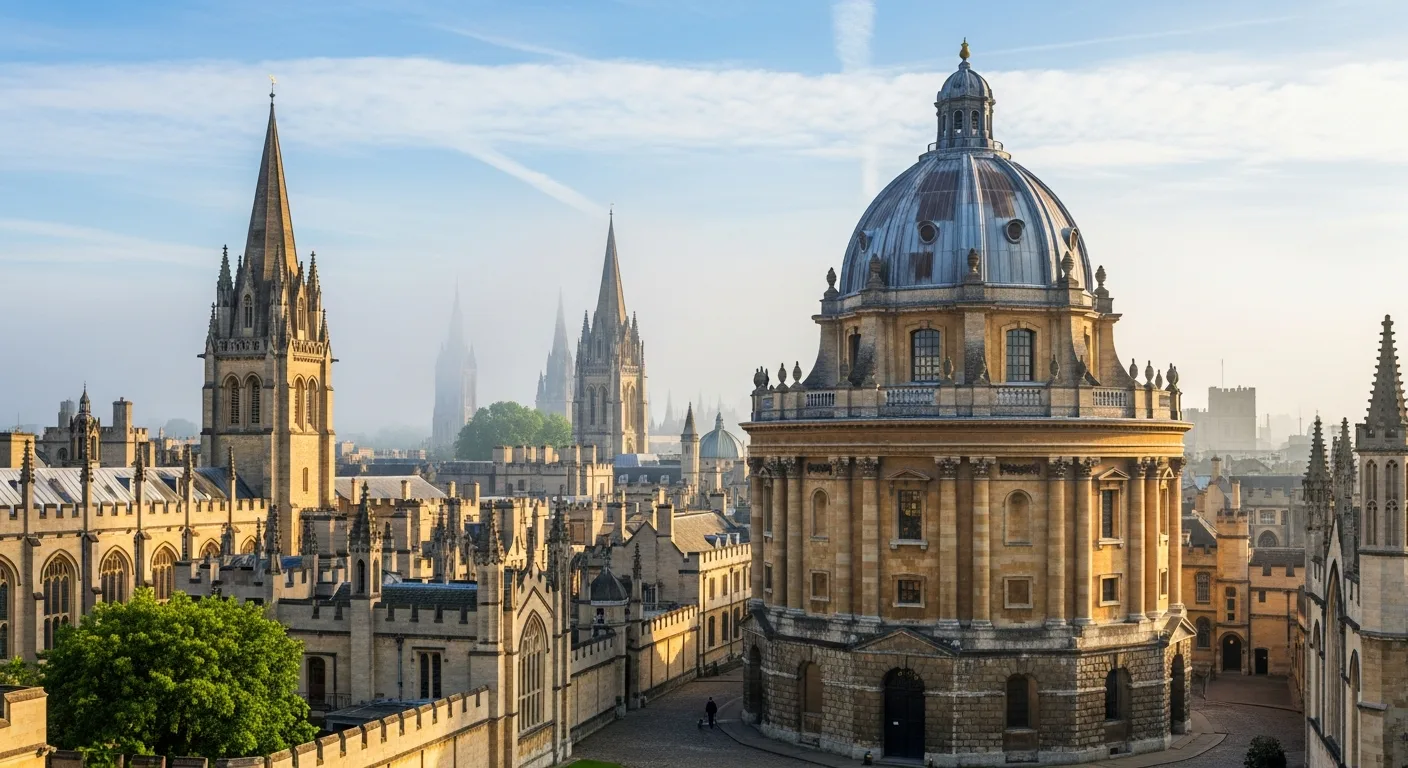
Lead image: Wikimedia Commons
Cambridge University - A Complete Guide for International Applicants
Introduction
You sit in a small room with a low ceiling, across from a professor who has just asked you a question you don’t know the answer to. Through the window you can see the spire of King’s College Chapel, but you don’t have time to admire the view - you have to think. The professor isn’t waiting for a polished response. They’re waiting to see how you arrive at one. This is supervision - the bedrock of a Cambridge education and an experience you will not find in this exact form anywhere else in the world. Once a week, in a group of two or three, you discuss the essay you wrote or the problem set you solved with a supervisor who is, more often than not, world-leading in their field. It is not a lecture. It is one hour in which someone exceptional gives their full attention to you.
Cambridge is the university where Isaac Newton formulated the laws of mechanics, Charles Darwin laid the groundwork for evolutionary theory, Alan Turing imagined a universal computing machine, and Crick and Watson decoded the structure of DNA. More than 120 Nobel laureates are tied to the university - more than any other in the world. But Cambridge is not a museum. It is the Cavendish Laboratory, where breakthrough physics is still being done. It is ARM Holdings, whose processors power the phone in your pocket, born from the engineering department. It is DeepMind and the AI cluster that has grown around the city like a town around a cathedral. Cambridge is, at the same time, the oldest and the most forward-looking, and that is precisely what makes it singular.
This guide walks you through everything you need to apply to Cambridge as an international applicant: how UCAS works, which admissions test your course requires (ESAT, STEP, TMUA, LNAT, UCAT), the realistic cost picture in GBP with USD and EUR conversions, scholarship routes, the college and supervision systems, and how Cambridge compares to Oxford and the Ivy League. Whether you’re studying for A-Levels, IB, Abitur, Bac, Matura, or any national qualification, this article will give you the full map.
A short history of Cambridge
Cambridge was founded in 1209 by scholars who fled Oxford after a town-and-gown dispute, making it the second-oldest university in the English-speaking world. Royal patronage came quickly: King Henry III granted the institution a measure of formal protection in 1231, and over the following centuries the university accumulated colleges, libraries, and chapels around the Cam.
Peterhouse, founded in 1284, is the oldest of the 31 colleges. King’s College Chapel, begun under Henry VI in 1446 and completed under Henry VIII in 1515, is widely considered the finest example of late Perpendicular Gothic architecture in England. Trinity College, founded by Henry VIII in 1546, would later become home to Newton, Maxwell, Russell, Wittgenstein, and a string of figures who reshaped science and philosophy.
The 17th century brought the scientific revolution: Newton’s Principia Mathematica (1687) was conceived and developed at Trinity. The 19th century brought reform - the Cavendish Laboratory opened in 1874 and quickly became the most productive physics lab in history (J.J. Thomson and the electron, Rutherford and the nucleus, Crick and Watson and DNA). Women were admitted to lectures from 1869 (Girton College) but were not awarded full degrees until 1948 - a late date that the university itself does not romanticise.
The 20th century brought computing. Maurice Wilkes built EDSAC at Cambridge in 1949 - the first practical stored-program computer in the world - and the modern Computer Science department traces its lineage directly to that machine. The Computer Laboratory’s alumni list reads like a roll call of the modern web: Hermann Hauser, Andy Hopper, the founders of ARM, the early designers at DeepMind. Cambridge invented modern computer science as a discipline, and the cluster of tech companies in the surrounding “Silicon Fen” is the continuation of that lineage.
What makes Cambridge prestigious
Cambridge consistently sits in the top three universities in the QS World University Rankings and the top five in Times Higher Education. The reasons are not mysterious:
- Research depth. Cambridge is a research-first institution. The Research Excellence Framework - the UK’s official research audit - places Cambridge top or near-top across virtually every discipline measured.
- Nobel pipeline. With more than 120 Nobel laureates affiliated with the university, Cambridge has produced more Nobels than any other institution. Trinity College alone has produced 34, more than most countries.
- Supervisions. No other major research university teaches undergraduates one-to-one or one-to-three at the volume Cambridge does. You write your essay, you sit with a supervisor, they tear it apart, you rewrite - and you do this every week for three years.
- Alumni. Newton, Darwin, Hawking, Wittgenstein, Turing, Keynes, Russell, Babbage, Maxwell, Rutherford. Fifteen British Prime Ministers. The author of a recent best-selling history of physics is, more likely than not, a Cambridge alumnus.
- Industry coupling. “Silicon Fen” - the cluster of tech and biotech firms around the city - was incubated by the university and continues to feed off and into it. ARM, AstraZeneca’s R&D, the Sanger Institute, the Babraham research campus, dozens of AI startups.
Cambridge’s academic offer
Cambridge offers around 30 undergraduate courses (Triposes) and a wide range of postgraduate degrees. The key strengths and unique features:
Mathematical Tripos. The most famous mathematics degree in the world. Newton, Maxwell, Hardy, Ramanujan, Hawking - the lineage is unbroken. The Mathematical Tripos is intentionally rigorous: Part IA covers analysis, vectors, dynamics, and probability; Part II offers more options than any other maths department; Part III (now formally the MMath/MASt) is widely considered the toughest taught year of mathematics anywhere.
Natural Sciences Tripos (NatSci). Unique to Cambridge. Students enter without picking a single science subject - in Part IA you take three of physics, chemistry, biology, materials science, and mathematics, narrow to two in Part IB, and specialise into one for Part II (and Part III if integrated master). This is how Cambridge produces physical chemists, biophysicists, and theoretical biologists who would not exist in a more siloed system.
Engineering. A general engineering degree for the first two years (mechanical, electrical, civil, information, aerospace, biomedical), then specialisation in years three and four. The Department’s graduates founded ARM, designed Concorde’s engines, and built the foundations of modern signal processing.
Computer Science. Direct lineage from EDSAC (1949) and the Wilkes-Wheeler-Gill subroutine library - the world’s first programming book. The Computer Laboratory is where modern CS as a teaching discipline was invented. Three-year BA or four-year integrated master.
Medicine and Veterinary Medicine. Highly competitive, with a pre-clinical pre-clinical Tripos for years 1-3 and clinical training (in Cambridge or affiliated London hospitals) for years 4-6. UCAT is required for Medicine.
Humanities and social sciences. History, English, Classics, Philosophy (called HSPS for the social sciences group), Law, Economics, Land Economy, HSPS. Each Tripos is taught with the same supervision-plus-lectures rhythm - you write essays weekly, you defend them in supervision, you read on your own.
Costs in 2026/2027 - what international students actually pay
Cambridge tuition, set by the university and confirmed annually, is split into bands by course. For 2026/2027 the published international rates are:
- Band 1 (Anglo-Saxon, Architecture, Asian and Middle Eastern Studies, Classics, Economics, Education, English, History, HSPS, Land Economy, Law, Linguistics, Modern and Medieval Languages, Music, Philosophy, Theology): ~GBP 25,734 (~USD 32,500 / EUR 30,000) per year
- Band 2 (Mathematics): ~GBP 27,024 per year
- Band 3 (Geography): ~GBP 30,978 per year
- Band 4 (Architecture, Engineering, Chemical Engineering, Computer Science, Management Studies, Natural Sciences, Psychological and Behavioural Sciences): ~GBP 38,316 per year
- Band 5 (pre-clinical Medicine and Veterinary Medicine): ~GBP 40,212 per year
- Clinical Medicine / Vet years 4-6: ~GBP 67,194 per year
Tuition is not the whole bill. Two extra costs international applicants frequently miss:
- College Fee. Charged by your college on top of tuition for students who do not qualify as Home-fee. The College Fee is roughly GBP 9,000-13,000 per year and covers college-side costs (supervisions, accommodation infrastructure, pastoral care, library access).
- Living costs. Cambridge estimates GBP 12,000-14,000 per year (~USD 15,200-17,700 / EUR 14,000-16,300) for accommodation, food, books, and personal expenses. Most colleges guarantee three years of college accommodation, which makes Cambridge cheaper to live in than London or Oxford-with-private-rent.
A typical international student studying Engineering, Natural Sciences, or Computer Science should budget around GBP 60,000-67,000 per year all-in (~USD 76,000-85,000 / EUR 70,000-78,000). Over three years that is roughly GBP 180,000-200,000.
Brexit and EU students
Until the 2020/2021 academic year, EU students paid Home (UK domestic) fees of GBP 9,250 per year and were eligible for UK student loans. After Brexit, EU students entering from 2021/2022 onwards pay full international rates and are not eligible for UK loans. This has roughly tripled or quadrupled the cost of Cambridge for EU citizens. Irish students remain in the Home category under the Common Travel Area arrangement.
Scholarships and financial aid
Cambridge runs several international scholarship schemes. None are need-blind in the American sense - Cambridge does not promise to meet 100% of demonstrated need for international applicants - but the scholarships available are substantial:
Cambridge Trust. The umbrella body for most international undergraduate funding. The Trust partners with colleges, governments, and donors to fund hundreds of international scholars per year, ranging from partial-tuition awards to full-cost packages. You apply via UCAS and your college; Trust nominations happen automatically for shortlisted candidates.
Cambridge International Scholarship. A flagship undergraduate award covering full international tuition. Highly competitive, allocated on academic merit.
Cambridge European Scholarships and country-specific awards. The Trust administers a long list of country-tagged scholarships - Bell-Gairdner Scholarships for Canadian students, the Hill Foundation programme for Russian-speaking students, the Cambridge European Trust awards for EEA citizens, and more. Check the Cambridge Trust website for the country list.
Gates Cambridge. The flagship full-cost scholarship - but for postgraduate study, not undergraduate. Gates funds about 80 outstanding scholars per year for master’s and PhD work, covering tuition, stipend, and travel. If you’re an undergraduate applicant, plan around the Trust; if you’re going for a master’s or PhD, Gates is the prize.
College-specific bursaries. Many colleges run their own bursary funds for international students in financial need (Magdalene’s bursary scheme, Trinity’s hardship funds, etc.). These are usually applied for after admission rather than at application stage.
Need-based support. Cambridge offers limited need-based bursaries for international students through individual colleges, but unlike the Ivy League, you cannot assume your demonstrated need will be met. Plan as if tuition is on you, and treat scholarships as a hopeful add-on.
How admissions actually work
The Cambridge admissions process has four parts. Miss any one and your application is dead.
1. UCAS application
You apply through UCAS, the UK’s central application portal. Cambridge has its own deadline: 15 October the year before you intend to start (so 15 October 2026 for entry in October 2027). This is roughly three months earlier than UCAS’s standard 31 January deadline. You can apply to either Cambridge or Oxford in a given cycle, but not both.
Your UCAS form includes:
- Five course choices (one of which can be Cambridge)
- A personal statement (4,000 characters) - academic, not motivational; talk about the subject, not your CV
- A reference from your school
- Predicted grades
International applicants who use a non-UK qualification submit transcripts and predicted final grades through their school.
2. My Cambridge Application (the supplementary form)
After you submit UCAS, Cambridge sends you an email asking you to complete the My Cambridge Application form - a Cambridge-specific supplement covering your education in detail, any extenuating circumstances, your college preference (or open application), and other information the university uses to triage candidates. Deadline is usually around 22 October.
3. Admissions tests
Most Cambridge courses require a course-specific admissions test:
- ESAT (Engineering, Natural Sciences, Chemical Engineering, Veterinary Medicine, Computer Science) - October, run by UAT-UK at Pearson VUE centres worldwide.
- STEP (Mathematics) - June, after UCAS offers; STEP papers II and III are conditional in offers (e.g. “1, 1 in STEP II and III”).
- TMUA (Test of Mathematics for University Admission) - October, used for Economics and some Computer Science / Natural Sciences combinations as an additional screen.
- LNAT (Law) - taken between September and January.
- UCAT (Medicine, Dentistry) - July to September.
ESAT, TMUA, and LNAT register separately from UCAS - you book directly with the test provider, often months in advance. Missing an ESAT registration deadline (usually mid-September) is one of the most common ways international applicants disqualify themselves.
4. Interview
If your application is competitive, you’ll be invited to interview in early-to-mid December. International candidates are typically interviewed online - usually one or two interviews, 20-45 minutes each, with academics from your subject. The interview is academic: they will give you a problem (a proof, an unseen poem, an ethical scenario, a data set) and watch how you reason through it. The right answer matters less than how you got there.
Decisions are released in mid-January. Possible outcomes: an offer (conditional on grades), pooled (your application has been moved to the winter pool for other colleges to consider), or rejection.
Required grades for international applicants
Cambridge publishes course-specific offers for each major qualification:
- A-Levels: AAA is the standard offer. Sciences and Mathematics typically require A* in specific subjects.
- International Baccalaureate: 41-42 points overall with 776 in Higher Level subjects (the 7s usually in your subject-specific HLs).
- Abitur (Germany): 1.0-1.2 with specific Leistungskurse at the highest band.
- French Bac: Mention Très Bien with 17-18/20 in core subjects.
- Italian Maturità: 95-100/100.
- Polish Matura: 90-95%+ on extended-level papers, including maths/sciences for STEM.
- Spanish EBAU: 13/14+ overall.
Cambridge evaluates qualifications in context. They know what a 90% Matura means versus a 90% in another system; they know which Bac subjects map to which A-Levels. You don’t need to retrofit your education into the British system.
English language requirements
International applicants must demonstrate English proficiency. The standard benchmarks:
- IELTS Academic: 7.5 overall with 7.0 in each component (some colleges ask for 7.5 in each)
- TOEFL iBT: 110 overall with at least 25 in each section
- Cambridge English C2 Proficiency: Grade A or B (200-230)
If you need to prepare for TOEFL or IELTS to hit Cambridge thresholds, PrepClass runs adaptive practice for both exams with section-by-section scoring built around the official rubrics.
The college system
Cambridge has 31 colleges - semi-autonomous communities that handle accommodation, supervisions, dining, pastoral care, and a portion of admissions. The university handles lectures, exams, and degree classification.
Why colleges exist
Mediaeval universities were just confederations of colleges - places where scholars lived together, shared a kitchen and a chapel, and brought in lecturers as needed. Most universities later centralised everything into faculties and dorms. Cambridge (and Oxford) didn’t. The college system survives because it works: small communities give you a built-in social and academic group, your supervisor is usually a fellow at your college, and most of your day-to-day life happens within walls that are at least 400 years old.
Choosing a college
You can apply to a specific college or submit an “open application,” in which the central admissions office assigns you to a college that has space. Two pieces of advice for international applicants:
- The pool equalises everything. If your first-choice college can’t make an offer but rates you highly, the winter pool sends you to other colleges that may. About 20-25% of admissions come through the pool, and roughly 1 in 4 pooled applicants gets an offer from a different college. So strategising “which college has fewer applicants” is mostly a waste of time.
- Pick on culture, not on prestige. All 31 colleges teach every Tripos. The differences are in size (Trinity is the biggest with ~700 undergrads; Peterhouse is among the smallest with ~250), age, food, accommodation quality, and atmosphere. Mature colleges (Hughes Hall, St Edmund’s, Wolfson) admit students 21+ only.
Famous colleges include Trinity (Newton, Russell), King’s (Turing, Keynes), St John’s (Wordsworth, Wilberforce), Pembroke (Pitt the Younger, Hughes), Magdalene (Lewis, Pepys), and Churchill (modern, science-heavy, founded in 1958). Newer colleges like Robinson (1977) and Homerton (full college status from 2010) are often less oversubscribed and excellent options for first-time international applicants.
Life in college
Most colleges guarantee three years of college accommodation. You eat in hall (Cambridge college dining halls are not a tourist attraction; they are where you get dinner). You join the Junior Combination Room (JCR) - your student union. You row, or you don’t row. You go to formal hall in a black gown a few times a term. You sit your supervisions in your supervisor’s office, which is most likely in the same college.
Supervisions - the real reason to come to Cambridge
Lectures and labs are mostly faculty-run and largely indistinguishable from a strong research university anywhere. The difference is supervisions.
A supervision is a one-hour meeting, once or twice a week per subject, in groups of one to three students with a supervisor - usually a fellow, postdoctoral researcher, or PhD student in the field. You submit work in advance (an essay, a problem set, a translation) and the hour is spent dissecting it. The supervisor will challenge your assumptions, demand you defend each step, and push you to a deeper understanding than you had walking in. By third year, your supervisor is often a leading researcher in your specific area and the conversation is, effectively, a research discussion.
Across three years, an undergraduate at Cambridge has roughly 200-300 hours of supervision teaching. That is more individual academic attention than you would get at almost any other institution in the world, and it is the single biggest reason Cambridge graduates leave with the reasoning style they do. It is also the reason teaching is hard work - there is nowhere to hide in a supervision.
Cambridge vs Oxford vs the Ivy League
vs Oxford. Academically near-identical: both 31-college (Oxford 39), both supervision/tutorial-based, both top of the UK rankings. Oxford has a slight edge in humanities (PPE, English) and policy; Cambridge has a slight edge in maths, sciences, and engineering. Oxford is more “central” as a city; Cambridge is smaller and more flat-and-watery. You can apply to one but not both. If you are torn, pick the course (the differences in the Tripos vs the Course matter more than the city).
vs the Ivy League. A different model entirely. Ivy League undergraduate education is:
- Four years (Cambridge is three for most subjects)
- Liberal arts based - you take many subjects in many departments
- Need-blind for most US students and need-aware for most international students at most schools, with promises to meet 100% of demonstrated need
- Roughly USD 90,000 per year sticker, often heavily subsidised by aid
Cambridge undergraduate education is:
- Three years (mostly), single-subject
- Specialised from day one
- Need-aware with limited international aid
- Roughly GBP 60,000 per year all-in for international students
If you want to defer a major choice and try philosophy, computer science, and economics in the same year, the US is a better fit. If you already know you want to read mathematics or natural sciences and you want depth from year one, Cambridge is unbeatable.
Life in Cambridge the city
Cambridge is small - about 145,000 people - and the centre is mediaeval and mostly walkable. You bike everywhere (the bike-to-work-or-lectures rate is among the highest in Europe). The Cam runs through the city; punting on it in summer is an actual thing students do. Pubs are plentiful and ancient (the Eagle, where Crick announced “we have found the secret of life,” still serves pints). London is 50 minutes by train from Cambridge station.
Term is short (eight weeks, three times a year - Michaelmas in October-December, Lent in January-March, Easter in April-June). The intensity inside term compensates: a Cambridge term feels like a full semester everywhere else, compressed.
International students make up about 38% of the student body and have a strong support network - the Cambridge International Office, the SU’s international officer, plus dozens of country-specific societies. The first weeks (called Freshers’ Week) are designed around helping you find your footing.
Practical tips for international applicants
- Start at least 18 months early. UCAS opens in May; Cambridge’s deadline is 15 October. Test registrations open in summer and close before the UCAS deadline. Working backwards, you should start preparation in the spring of the year before your intended entry - choosing your subject, prepping for ESAT/STEP/TMUA, drafting your personal statement.
- Take the admissions test seriously. ESAT and STEP are not the LSAT or the SAT - they are exam-style and require subject-specific preparation. Past papers are the best resource and freely available. Plan 100-200 hours of test prep over 3-6 months.
- Personal statement = academic, not motivational. This is the single biggest mistake international applicants make. Cambridge admissions tutors do not care that you are “passionate” about engineering. They care that you have read three books beyond the syllabus and can write 500 words explaining what fascinated you about each.
- Practice supervision-style reasoning out loud. The interview is essentially a mock supervision. Find a tutor - or a smart friend in your subject - and practise reasoning out loud through unfamiliar problems. The point is not to be right; it is to be thoughtful, articulate, and willing to follow a problem when it surprises you.
- Visa: plan early. UK Student visa requires a CAS (Confirmation of Acceptance for Studies) from Cambridge, financial evidence, English proof, and a Tuberculosis test for some countries. Apply as soon as you receive your unconditional offer in August. Build in 4-6 weeks of buffer before your start date.
- Don’t outsource your application. Cambridge admissions tutors read thousands of applications. They notice the ones written in a paid consultant’s voice. Write your personal statement yourself, get one or two trusted readers, and stop after the third draft.
Conclusion
Cambridge is one of three or four genuinely top-tier universities in the world, and the application process - while demanding - is rational and transparent in a way few elite universities are. There are no quotas you can’t see, no algorithms scoring your “well-roundedness.” You take a test. You write about your subject. You sit in a room (or on Zoom) with two academics and reason through a problem. If you are good at the things Cambridge wants you to be good at, you have a real shot.
The supervisions, the colleges, the 800 years of intellectual lineage - all of it is real, and all of it shapes the people who graduate. If you can imagine yourself sitting at a low table in a small room, pencil in hand, defending a proof while looking out at King’s College Chapel, start the application. The deadline is 15 October.
For exam preparation in English (IELTS, TOEFL) or test logic for ESAT/TMUA-style papers, PrepClass provides adaptive practice and full-length mocks. For broader UK and Oxbridge planning, see our Oxford guide, our UK study costs guide, and our Ivy League comparison piece.