€2,694
EU/EEA statutory tuition / year
Same at every public university; 2026/27 (DUO)
Study in the Netherlands 2026: TU Delft, UvA, Erasmus, Maastricht. €2,694 EU tuition, 2,100+ English programmes, Studielink, numerus fixus, Orientation Year.

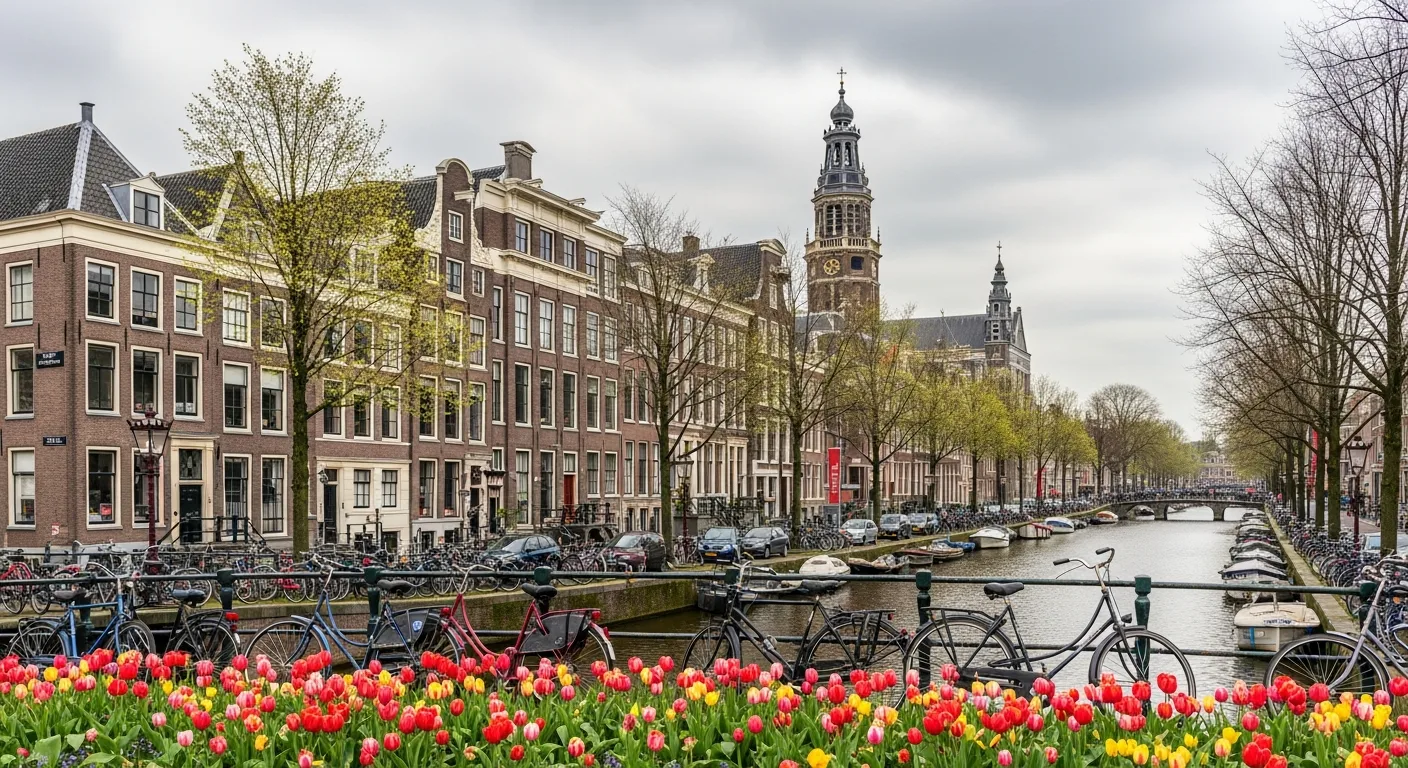
Lead image: Wikimedia Commons
It is a Tuesday morning in Utrecht. Thousands of students sweep along the canals on bicycles: a girl with a laptop bag balanced on her rear rack, a guy with a box of stroopwafels strapped to his handlebars, three friends shouting across the road in Spanish about an econometrics midterm. At a tram stop, someone is reading seminar notes for a political science course in English, in the geographic centre of the Netherlands. A café sandwich board promises “studentenkorting”, a student discount on coffee. This is not a postcard. It is an ordinary weekday in a country that has quietly turned itself into one large, English-speaking, bicycle-powered university town.
Here is the bottom line. EU and EEA students pay a flat statutory tuition of €2,694 for 2026/27 at every public Dutch university, the same figure at TU Delft as at a regional university of applied sciences (DUO). The Netherlands runs more than 2,100 fully English-taught programmes, the largest English catalogue in continental Europe, and nine of its thirteen research universities sit in the QS World University Rankings 2026 global top 200 (QS 2026). For an international student weighing more than their home country offers without British or American price tags, the package is hard to beat - and across the College Council families we advise, it is the destination most likely to win once they run the actual numbers.
In this guide I will walk you through the entire Dutch system: the WO - HBO binary that trips up newcomers, the universities that anchor each region and what each is genuinely known for, how Studielink works, what numerus fixus actually demands, cost of living city by city, the scholarships open to international students, the BSN paperwork and student visa, and the Orientation Year that turns a Dutch degree into a European career. If you are comparing destinations, read our companion guides to studying in the UK and studying in Germany; for a large share of the families we advise, it is the Dutch numbers that end up reshuffling the shortlist.
Source: DUO 2026/27 statutory tuition; QS World University Rankings 2026; Nuffic / Studyinnl; Studielink; IND.
The case for the Netherlands rests on four things that reinforce one another: low EU tuition, the deepest English-taught catalogue on the continent, a research base that lands nine of thirteen universities in the QS global top 200 from a country of 18 million, and one of Europe’s most welcoming routes to staying after you graduate.
Start with tuition. EU/EEA students pay the statutory wettelijk collegegeld, set nationally and equal across institutions: €2,694 for the 2026/27 academic year (DUO). That figure buys you a place at a top-50 world university for less than a single month’s rent in central Amsterdam. Non-EU students pay institutional fees instead - roughly €13,000 - €22,000 a year for bachelor’s and €15,000 - €25,000 for master’s, with engineering and business at the top of the range. Against UK international fees of £24,000 - £40,000 or US private tuition of $40,000 - $70,000, the Netherlands is mid-market on full international rates and one of the best-value destinations in Europe for EU citizens.
Then the quality. The Netherlands has thirteen publicly funded campus-based research universities (the Universities of the Netherlands association counts fourteen members including the distance-learning Open University), and nine of them sit in the QS World University Rankings 2026 global top 200 (QS 2026). TU Delft is #47 worldwide and a top-10 European engineering school; the University of Amsterdam is #53; Wageningen is ranked first in the world for agriculture and forestry. Leiden, founded in 1575, has produced sixteen Nobel laureates. The Dutch government funds research heavily; baseline funding dwarfs what tuition could cover, so undergraduates study alongside genuine frontier work rather than in teaching-only institutions.
The English-taught catalogue is the country’s most distinctive advantage. More than 2,100 programmes run entirely in English, roughly three-quarters of master’s programmes and a large slice of bachelor’s. No other country in continental Europe comes close. TU Delft delivers nearly all its master’s in English; Maastricht runs almost the entire university in English, bachelor’s included; Wageningen is fully English at master’s level. There is also a small, high-quality cluster of Liberal Arts and Sciences “university colleges” (Amsterdam, Utrecht, Maastricht, Roosevelt and Leiden University College The Hague), modelled on US small liberal arts colleges, residential and capped at a few hundred students per cohort.
Finally, the way to stay. Non-EU graduates automatically qualify for the Orientation Year, a 12-month residence permit with no salary threshold and no employer sponsorship, during which you can take any job, freelance or start a business. From there the move to a 5-year Highly Skilled Migrant permit is smoother than almost anywhere else in Europe, and the 30% tax ruling sweetens the first years of a Dutch salary. EU and EEA citizens have all of these rights from day one. The full mechanics are in the post-study section below.
The Netherlands has thirteen research universities (WO) and around thirty-six universities of applied sciences (HBO). The table below lists the research universities international students ask about most, with their QS World University Rankings 2026 overall position. Treat the rank as a rough map of reputation, not a verdict - what a university is known for matters more than its number, and several of these lead Europe in a specific field while sitting mid-table overall. Every name links to its College Council Atlas profile, except the University of Amsterdam, where we have a full dedicated guide.
| QS '26 | University | Known for |
|---|---|---|
| 47 | Delft University of Technology (TU Delft) | Engineering, architecture, aerospace, applied physics · top-10 European technical school · the Dutch MIT |
| 53 | University of Amsterdam (UvA) | Comprehensive research · communication science, economics, social sciences, law · PPLE bachelor's |
| 103 | Utrecht University | Broadest research university · natural and social sciences, veterinary medicine, humanities · geographically central |
| 119 | Leiden University | Oldest in the country (1575) · law, humanities, area studies, astronomy · 16 Nobel laureates · LERU |
| 140 | Erasmus University Rotterdam | Business and economics · Rotterdam School of Management · Erasmus MC medicine · IBA bachelor's |
| 140 | Eindhoven University of Technology (TU/e) | Engineering and tech in the Brainport region · deep ties to ASML, Philips, NXP · electrical engineering, CS |
| 147 | University of Groningen | Research-intensive, very international · astronomy, AI, life sciences, law · cheapest major student city |
| 153 | Wageningen University & Research | #1 in the world for agriculture & forestry · food science, environmental policy, sustainability |
| 194 | Vrije Universiteit Amsterdam (VU) | Interdisciplinary research · psychology, business, computer science, biomedical · PPE bachelor's |
| 203 | University of Twente | Engineering and entrepreneurship · nanotechnology, biomedical, applied maths · only true US-style campus |
| 239 | Maastricht University | Problem-Based Learning · most international university in NL (50%+ from abroad) · business, law, medicine |
| 279 | Radboud University | Sciences and medicine · cognitive neuroscience (Donders Institute), linguistics, philosophy |
| Source: QS World University Rankings 2026; College Council Atlas; official university sites 2026. Ranks describe overall position; subject strength varies. | ||
A few of these deserve a sentence beyond the table. TU Delft sits in a small canal-ringed town between The Hague and Rotterdam, with a pure engineering culture and cheaper rent than Amsterdam.
Erasmus runs the IBA - an English-taught, numerus fixus International Business Administration bachelor’s that is one of the most competitive in continental Europe.
Maastricht teaches almost entirely through small-group tutorials rather than lectures, the model it pioneered, and is the only place in the country where you will rarely sit in a room of 300 people.
Wageningen is small, specialised and unmatched in its field: if your future is in agri-tech, food systems or sustainability, it belongs at the top of your list regardless of its overall rank.
Below the research universities sit the HBO universities of applied sciences - Hanze in Groningen, HvA in Amsterdam, Saxion, Fontys, Avans, NHL Stenden. Their bachelor’s degrees run four years rather than three, are more practical, and build in mandatory internships. They do not appear in global rankings, but they are the right path for students aiming straight at industry rather than a research master’s.
A Dutch undergraduate degree is shorter and more structured than its US cousin and organised around a sharp binary that defines the whole system.
WO (Wetenschappelijk Onderwijs) means the research universities: Delft, Amsterdam, Leiden, Utrecht, Groningen and the rest. Their bachelor’s degree takes three years, the master’s one or two. WO is the academic track: theoretical, research-led, and the route to a master’s and PhD. This is where international rankings, frontier research and the most competitive admissions live. To enter, you need a school-leaving qualification judged equivalent to the Dutch VWO (pre-university diploma): the IB, A-levels, the European or French Baccalaureate, the German Abitur, or a national high-school diploma with strong grades and the right subjects.
HBO (Hoger Beroepsonderwijs) means the universities of applied sciences. Their bachelor’s takes four years, is practice-oriented, and embeds internships into the curriculum. HBO maps to the Dutch HAVO entry level, carries lower formal requirements, and produces graduates trained for direct entry into a profession. It is publicly funded and charges the same statutory tuition as WO for EU students.
There is a third option worth knowing: the university colleges. These are small (300-700 students), English-taught, residential, selective bachelor’s-only colleges run inside the larger WO universities - Amsterdam University College (joint UvA/VU), University College Utrecht, University College Maastricht, University College Roosevelt in Middelburg and Leiden University College The Hague. They offer a broad, interdisciplinary US-style liberal arts curriculum, holistic admissions and the most personal academic environment in the country. They are also the programmes most open to a SAT or ACT score as supporting evidence.
Dutch admissions are simpler and more numerical than the UK or US, but the most popular programmes are genuinely selective. Three things define the process.
Studielink is the single national application portal (studielink.nl). Every applicant, Dutch, EU or international, uses the same platform to apply to up to four programmes at once (fewer than the UK’s five, so choose strategically). You create an account, add your secondary diploma, select programmes and submit; Studielink forwards each application to the university, which then runs its own document, language and sometimes motivation check. Non-Dutch transcripts that are not in English or Dutch need a sworn translation.
The deadlines split in two. Programmes with numerus fixus close on 15 January - strictly, with no extension. Standard programmes without a cap close on 1 May for a September start, and some accept applications later. Master’s deadlines vary widely, from 1 December for competitive tracks at TU Delft and RSM to 1 May or later elsewhere. Always read the specific programme page.
For a bachelor’s, most programmes accept any diploma equivalent to the Dutch VWO. UK universities convert A-levels directly; Dutch universities map national diplomas through the Nuffic database, focusing on relevant subjects (mathematics and physics for engineering, biology and chemistry for medicine, mathematics for economics). A Polish matura is recognised: standard programmes typically expect an average around 70-85% on relevant extended-level (rozszerzony) subjects, while competitive tracks such as PPLE at UvA, IBA at Rotterdam and the university colleges expect 85% and above. For a master’s, you need a relevant bachelor’s from an accredited university, usually a GPA around 7.0/10 (about 3.0/4.0 or a UK 2:1), a language certificate and a motivation letter; the most quantitative programmes may ask for the GRE or GMAT.
Numerus fixus is the capped-intake system. Around fifty bachelor’s programmes use it - all medicine, dentistry, veterinary medicine and pharmacy, most psychology, International Business Administration at Rotterdam, and selective tracks at the technical universities. The deadline is 15 January, selection is multi-stage (academic record, motivation, sometimes tests or interviews), and each applicant is ranked, with seats awarded top-down. Acceptance rates run roughly 10-30% depending on the programme. Outside numerus fixus, the logic flips: if you meet the formal entry and language requirements, you are admitted. There is no competition and no holistic rejection of qualified candidates the way UK admissions can reject on the strength of a personal statement.
Now the question every international student asks: do you need the SAT? No standard Dutch programme requires it. The SAT (or ACT) is purely additive - useful at the university colleges and at competitive programmes like PPLE, especially for applicants from school systems with non-standard grading, where a score above 1300 SAT or 28 ACT can strengthen a borderline file. If you are also building a US application where the SAT is central, prepare it once in our SAT app and apply across both systems.
Language thresholds for English-taught programmes are broadly uniform. The standard bar is IELTS Academic 6.0 or TOEFL iBT 80 for most bachelor’s, rising to 6.5 / 90 at competitive programmes (TU Delft, UvA, Erasmus IBA, Maastricht) and 7.0 / 100 at the most selective tracks and the university colleges. Cambridge C1 Advanced and Pearson PTE are widely accepted, and if your secondary education was conducted in English at a recognised school, most universities will waive the test - though you should verify per programme.
The gap between school English and a 90+ TOEFL or 7.0+ IELTS is real and catches students out every cycle. Most need 8-14 weeks of structured preparation to bridge it. Our TOEFL app runs full TOEFL iBT practice tests with AI-graded speaking and writing feedback - the closest thing to a mock exam you can do from home, and the right tool to lift a baseline 60-70 into the 90-100 band selective Dutch programmes increasingly want.
Dutch itself is not required for an English programme. But the difference between A2 Dutch and none is large: better part-time work, an easier housing search, smoother interactions outside the big cities, and a far gentler transition if you decide to stay. Most universities run free or low-cost Dutch courses through their language centres.
Tuition is heavily subsidised; living costs are where the real budget lives, and they vary sharply by city.
| City | Total monthly | Rent (room/studio) | Notes |
|---|---|---|---|
| Amsterdam | €1,300 - €1,700 | €700 - €1,200 | Most expensive; brutal housing market; vibrant international scene |
| Utrecht | €1,150 - €1,500 | €600 - €950 | Central, well-connected; tight housing |
| The Hague | €1,100 - €1,450 | €550 - €900 | Political and diplomatic capital; comfortable but pricey |
| Rotterdam | €1,000 - €1,350 | €500 - €850 | Modern, multicultural; better rent than Amsterdam |
| Leiden | €1,000 - €1,300 | €500 - €800 | Picturesque student city; tight rental market |
| Eindhoven | €950 - €1,250 | €450 - €750 | Tech hub (Brainport); good value |
| Maastricht | €900 - €1,200 | €450 - €700 | Charming, international; cheaper than the Randstad |
| Tilburg / Nijmegen | €850 - €1,150 | €400 - €650 | Mid-sized; affordable; strong student scenes |
| Groningen / Enschede | €800 - €1,100 | €350 - €650 | Cheapest major student cities; lively, northern/eastern |
The single largest source of stress for international students is housing. The Netherlands is in a structural housing crisis, worst in the Randstad (Amsterdam, Utrecht, The Hague, Rotterdam), where international students compete with Dutch students and the wider rental market. Average waits for student rooms in Amsterdam run past two years. In our advising experience, the students who arrive into a settled room and not a hostel are almost never the ones who got lucky - they are the ones who started looking the moment their offer landed. The advice that matters most in this entire guide: start your housing search four to six months before arrival, not after. Use SSH (the largest student-housing provider) and DUWO before falling back to private listings on Kamernet, ROOM.nl and Pararius. Several universities (TU Delft, Maastricht, Twente, Erasmus, Wageningen) guarantee or assist with first-year international housing; check whether yours does before you commit. And note that “Dutch only” rental listings, though still posted, are illegal under Dutch anti-discrimination law; stick to university-sponsored housing and reputable agencies.
The rest of the monthly budget is more forgiving. Health insurance is legally required: as a non-working student you can use EU EHIC or an international student plan (€50 - €80/month); the moment you take any paid job, Dutch law requires the basic Dutch insurance (basisverzekering, €140 - €160/month in 2026, partly subsidised for low-income students via zorgtoeslag).
Food runs €200 - €300 if you cook, with Lidl and Aldi the cheapest.
Transport is the great Dutch saving: buy a second-hand bike (€50 - €150) and a good lock in your first week, because the bicycle covers most daily journeys; EU students who work enough hours unlock the student travel product for trains and trams.
Putting it together, an EU student’s all-in annual budget runs €13,500 - €22,000; a non-EU student paying institutional tuition lands at €24,000 - €44,000.
Several channels are open to international students, and the right one depends on where you are from.
The Holland Scholarship is the flagship and the most accessible: a one-off €5,000 grant for non-EEA bachelor’s and master’s students starting at a participating institution, funded jointly by the Ministry of Education and the universities. Around thirty universities take part; deadlines fall around 1 February.
The Orange Tulip Scholarship, run by Nuffic offices abroad, offers country-specific awards of €3,000 - €25,000 for students from a defined list (Indonesia, China, Mexico, Vietnam, Brazil, India and more) - the most generous Netherlands-only option if you qualify.
Erasmus Mundus Joint Master Degrees are EU-funded, fully funded master’s scholarships (stipend, tuition, travel) for consortia including a Dutch university; highly competitive at roughly a 10% acceptance rate.
Most universities also run institutional scholarships: the Amsterdam Excellence Scholarship (€25,000) at UvA, the Justus & Louise van Effen Scholarship (full tuition plus a stipend) at TU Delft, the Leiden Excellence Scholarship Programme, the Eric Bleumink Fund at Groningen, and the Maastricht University High Potential Scholarship (full tuition plus stipend). Read the international-scholarships page of every university on your Studielink list and apply to each scheme you are eligible for; most are competitive, so budget assuming no award and treat any you win as a bonus.
For EU students who work part-time in the Netherlands (at least 56 hours a month), Dutch student finance (studiefinanciering) administered by DUO becomes available - a basic grant, a favourable student loan, and the student travel product for trains and trams. It is one of the most generous student-support systems in Europe; if you qualify, apply through DUO in your first weeks.
For non-EU students the paperwork is more streamlined than Germany’s, but it has a strict order and real deadlines.
Student visa (MVV + residence permit). Non-EU/EEA students need an MVV entry visa plus a study residence permit, applied for by your university through the IND under the combined TEV procedure. Once admitted, the university initiates the application; you pay the IND fee (around €254 in 2026), provide documents (admission letter, passport, proof of roughly €13,100 - €14,200 in living funds for the year, sometimes a TB test), and collect the MVV at an embassy. Processing typically runs six to ten weeks. EU/EEA citizens need no visa - they register with the local municipality within five days of arrival.
BSN (Burgerservicenummer). The Dutch citizen service number is the master key to everything: a bank account, a rental contract, health insurance, a paid job, taxes. You receive it by registering at the municipality (gemeente) of your address within five days of arrival, bringing your passport, residence permit (non-EU), proof of address and, in some municipalities, an apostilled birth certificate - verify before you travel. This is the equivalent of the German Anmeldung: your first-week priority. After the BSN comes DigiD, the digital identity for government services, requested online and posted to you within a few working days, and a bank account (ING, ABN AMRO, Rabobank, Bunq or Revolut), needed for rent, wages and direct debits.
The one rule students break most: as soon as you take any paid job, even university tutoring, you must switch from international student insurance to Dutch basisverzekering. Failing to do so triggers fines and back-payment of premiums. Sort out the right insurance before you take any paid work.
Dutch academic culture is flat, informal and intensely interactive. First names for professors are normal, office hours are genuinely open, and feedback is direct to a degree that surprises students from more indirect cultures - it is neither rude nor personal, and most people recalibrate within a few months. Teaching leans on tutorials, group work and continuous assessment rather than a single end-of-year exam; Maastricht takes this furthest with Problem-Based Learning, where small groups work through real problems and the tutor only moderates.
Life happens in the city, not on a self-contained campus (Twente, with its US-style residential model, is the exception). Student associations, the Erasmus Student Network and a dense calendar of sports clubs, study trips and societies do the social heavy lifting, and the bicycle does the rest - most of your time outside class is spent on two wheels between cafés, libraries and parks. The weather is grey and wet for much of the academic year, which affects more students than expect it; the ones who thrive build routines and join things early. Part-time work is common and the timetable assumes it: EU students work without restriction, non-EU students up to 16 hours a week in term or full-time over summer, at €12 - €16 an hour in hospitality, retail, tutoring and English-speaking roles at the international employers clustered in Amsterdam and Rotterdam.
This is where the Dutch value proposition becomes genuinely strategic, especially for non-EU graduates.
The Orientation Year (zoekjaar hoogopgeleiden) is the single best post-study permit in continental Europe: a 12-month residence permit, available to non-EU graduates of Dutch universities, with no salary threshold and no job offer required. You can take any job, change employers freely, freelance or start a business, and you may apply within three years of graduating. The IND processes most cases within 90 days. EU/EEA graduates have these rights automatically.
When you find a qualifying job, you move to the 5-year Highly Skilled Migrant (kennismigrant) permit, sponsored by a recognised employer. The 2026 IND gross monthly salary thresholds (excluding the 8% holiday allowance) are €3,122 for graduates moving straight from the Orientation Year, €4,357 for under-30s and €5,942 for those 30 and over (IND). The reduced graduate rate is what makes the student-to-skilled-migrant transition smoother here than anywhere else in Europe. On top of that sits the 30% ruling - historically a tax-free allowance of 30% of gross salary for the first five years, now being phased down to 27% for new entrants from 2027, but still one of the most valuable skilled-migrant incentives on the continent. After five years of legal residence you can apply for permanent residency, and after five years (or three with a Dutch partner) for citizenship, both requiring A2 Dutch and the civic integration exam.
The job market rewards all of this. The Netherlands has structural shortages in IT, engineering, healthcare and education. Starting salaries for STEM and business graduates run roughly €38,000 - €55,000 in Amsterdam, Utrecht and Eindhoven, somewhat lower in the regions. The major employers (ASML, Philips, Booking.com, Adyen, ING, ABN AMRO, Shell, Unilever, and the consulting and legal firms clustered in Amsterdam and The Hague) recruit hard from Dutch universities. Median graduate earnings three years out land around €40,000 - €55,000 gross. A Dutch master’s plus the Orientation Year is, for the organised graduate, one of Europe’s most reliable launchpads into a skilled career.
We built College Council to remove the two things that most often derail an application to the Netherlands: weak test preparation and a chaotic, last-minute process. Dutch universities do not require the SAT, but they all demand a strong English-language score, and many of our students run a parallel US application where the SAT is central. Our TOEFL app delivers full TOEFL iBT practice tests with AI-graded speaking and writing feedback, and our SAT app runs the full digital SAT with adaptive practice - so if your plan spans the Netherlands and the US, you prepare once and apply broadly.
The harder part is judgement: which four Studielink choices to make, whether your diploma clears each programme’s VWO-equivalence bar, and which numerus fixus gambles are worth a slot. Those are the questions we work through with families. Create a free College Council account and check your chances - we hold every Dutch university, its admission requirements, and a clear picture of how to get in, mapped against your own profile. And if you simply want to explore what is out there, browse the Netherlands in our university Atlas, where each of the institutions above has a full profile with rankings, programmes and student data.
EU/EEA students pay the statutory tuition rate of €2,694 for 2026/27 at every public Dutch research university (WO) and university of applied sciences (HBO). Non-EU students pay institutional rates of roughly €13,000 - €22,000 per year for bachelor’s and €15,000 - €25,000 for master’s. Living costs add €900 - €1,600 per month: Amsterdam and Utrecht run €1,200 - €1,600, while Groningen, Maastricht, Tilburg and Enschede are closer to €900 - €1,200. A realistic annual budget is €13,500 - €22,000 for EU students and €24,000 - €44,000 for non-EU students.
No. The Netherlands offers more than 2,100 fully English-taught programmes - by far the largest English-language catalogue in continental Europe. Around 95% of the Dutch population speaks English to a working level, so daily life, banking, healthcare and most government services are accessible without Dutch. Learning Dutch to A2 - B1 still helps with part-time work, social integration and any plan to stay long-term, and most universities offer free or low-cost Dutch courses for international students.
TU Delft (QS #47) is the leading technical university, top 10 in Europe for engineering. Erasmus University Rotterdam (Rotterdam School of Management) is a top-tier European business school. University of Amsterdam (QS #53) and Leiden (the oldest, founded 1575) lead in humanities, law and social sciences. Utrecht (QS #103) is the broadest research university. Groningen is strong in AI, astronomy and life sciences. Maastricht is the most international, famous for Problem-Based Learning. Wageningen is ranked #1 in the world for agriculture and forestry.
Numerus fixus is a capped intake used for the most oversubscribed bachelor’s programmes - medicine, dentistry, psychology, International Business Administration at Rotterdam and selective tracks at the technical universities. The application deadline is 15 January, a month earlier than the standard 1 May, and it is strictly enforced. Selection is multi-stage: academic record, motivation, sometimes tests or interviews. Each applicant is ranked and seats are awarded top-down. Programmes without numerus fixus admit any applicant who meets the formal entry and language requirements.
The Netherlands runs a binary system. WO (Wetenschappelijk Onderwijs) research universities such as Delft, Amsterdam, Leiden, Utrecht and Groningen produce theoretical, research-oriented degrees and lead to a master’s and PhD; their bachelor’s takes 3 years. HBO (Hoger Beroepsonderwijs) universities of applied sciences such as Hanze, HvA, Saxion and Fontys focus on practice, with mandatory internships and 4-year bachelor’s degrees. Both are publicly funded and charge the same statutory tuition for EU students. WO is the academic path; HBO is the professional one.
The Holland Scholarship is a one-off €5,000 grant for non-EEA bachelor’s and master’s students at participating institutions. The Orange Tulip Scholarship offers country-specific awards (€3,000 - €25,000) for students from countries including Indonesia, China, Mexico, Vietnam and Brazil. Erasmus Mundus Joint Master Degrees fund students worldwide with full stipends. Most universities also run institutional awards - the Amsterdam Excellence Scholarship (€25,000) at UvA, the Justus & Louise van Effen Scholarship at TU Delft and the Maastricht University High Potential Scholarship among them. EU students working part-time in the Netherlands can access DUO student finance.
Yes. EU/EEA students can work without restriction. Non-EU/EEA students need a work permit (TWV) arranged by the employer and may work either 16 hours per week year-round or full-time during June, July and August. Typical part-time wages are €12 - €16 per hour. Student-friendly work includes hospitality, retail, tutoring and English-speaking roles at international employers such as Booking.com, Adyen, ASML and Philips. EU students who work at least 56 hours a month qualify for DUO student finance and the student travel product.
Non-EU graduates of Dutch universities qualify for the Orientation Year (zoekjaar hoogopgeleiden) - a 12-month residence permit to find work, change employers freely or start a business, with no salary threshold. To then move to the 5-year Highly Skilled Migrant permit, the 2026 IND salary thresholds (excluding holiday allowance) are €3,122/month for graduates coming straight from the Orientation Year, €4,357/month for under-30s and €5,942/month for those 30 and over. The 30% tax ruling (phasing down to 27% from 2027) is a major incentive. After 5 years of legal residence you can apply for permanent residency. EU/EEA citizens hold these rights automatically.
The Netherlands is one of the best-value high-quality study destinations in Europe. EU/EEA students get top-200 research universities at €2,694 a year; non-EU students pay institutional fees that still undercut UK and US private rates, against a deeper English-taught catalogue than any country on the continent. The post-study regime (the Orientation Year, the Highly Skilled Migrant route, the 30% ruling) is the most welcoming in Europe for international graduates, and the labour market that follows is one of the strongest.
It is the right choice if you want a fully English academic experience, top-tier research universities, urban student life built around the bicycle, and a clear path from degree to career and long-term residence. It is the wrong choice if you need free tuition (Germany or Norway are better), a US-style residential campus (only Twente delivers that), guaranteed first-month housing (no city in the Randstad guarantees it), or sunshine. For the student who fits the model, academically capable, comfortable in English and willing to handle the housing market and the BSN paperwork, there are few better places in Europe to study, and a Dutch master’s from Delft, RSM, UvA or Maastricht opens doors across the EU and beyond.
University rankings are drawn from the QS World University Rankings 2026 and cross-checked against College Council’s Atlas dataset of Dutch higher-education institutions. High-stakes current-cycle figures (tuition, visa rules, salary thresholds, deadlines) were verified against official Dutch government and university sources in June 2026. Institutional (non-EU) tuition is set per programme and rises most years, so always confirm the exact figure on the relevant programme page for your intake year.