#24
PSL - QS World Ranking
Highest-ranked university in France
Sorbonne Université & PSL Research University: study in Paris. Learn about admissions, costs, scholarships, and programs. How to get into Sorbonne?

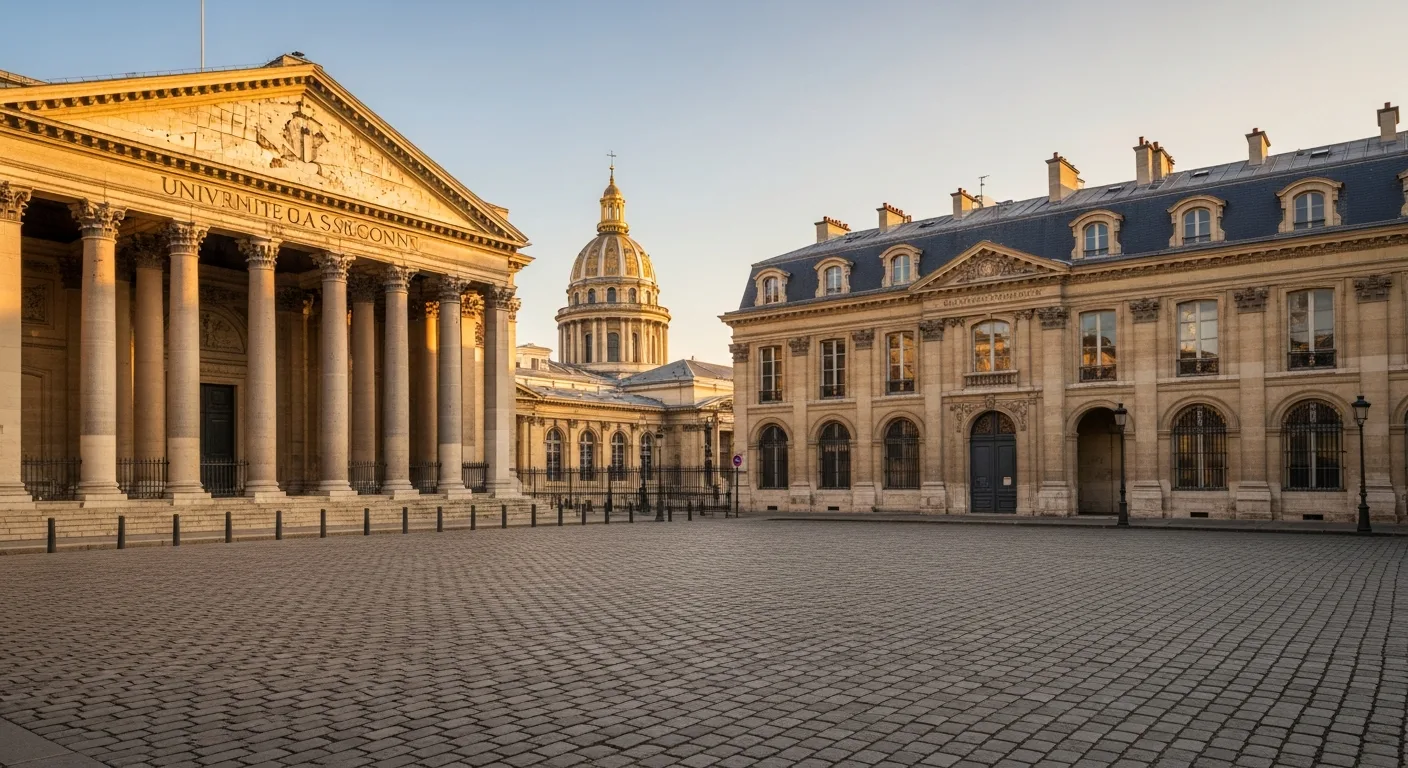
Photos: Wikimedia Commons
You stand in the courtyard on rue des Écoles, gazing at the 17th-century coat of arms carved into the stone facade. Behind you is the Pantheon, where Marie Skłodowska-Curie, a Pole who earned two degrees and two Nobel Prizes at this university, rests. To your left, through a narrow street filled with bookstores and cafes where Hemingway wrote his first stories a century ago, you can see the Luxembourg Gardens - a favorite study spot for students who prefer to read Sartre under a chestnut tree than in a library. It is here, in the heart of the Latin Quarter, that Europe’s intellectual pulse has beaten for over 800 years.
When we speak of “studying at the Sorbonne,” the reality is more complex - and more fascinating - than the name itself suggests. The historical Sorbonne is a building. But its legacy is now carried by two distinct, world-class institutions: Sorbonne Université (QS #60, over 55,000 students, a powerhouse in sciences and humanities) and PSL Research University (#24 in QS, France’s highest-ranked university, a federation of elite grandes écoles such as ENS, Dauphine, and Mines Paris). Both operate in Paris, both offer studies for less than 300 EUR per year for EU citizens, and both educate Nobel laureates with a frequency most universities worldwide can only dream of - a combined total of over 55 Nobel laureates and Fields Medalists.
In this guide, I will explain the exact differences between Sorbonne Université and PSL, how to navigate the French Campus France admissions system without unnecessary stress, how much student life in Paris truly costs (hint: a full meal for 3.30 EUR is no joke), what scholarships are available for international candidates, and why Paris, despite its image as an expensive city, offers one of the best value propositions in European higher education. If you are also considering other universities in the region, check out our guides on Sciences Po Paris and ETH Zurich.
Before you compare Sorbonne with other universities in Europe, you need to understand one crucial thing: in France, two institutions share the legacy of the historical Sorbonne, but they are listed separately in rankings - and both perform exceptionally well.
PSL Research University ranks 24th in the QS World University Rankings 2025, making it the highest-ranked university in France, above Sciences Po, HEC Paris, or Polytechnique. In the Times Higher Education 2024 ranking, PSL is positioned 33rd, and in the Shanghai Ranking (ARWU) - in the top 40 worldwide. PSL’s Mathematics (#10 worldwide in QS by Subject) is one of the best on the planet; this is not an exaggeration, it’s a statistic confirmed by 12 Fields Medals awarded to researchers associated with ENS. Physics, philosophy, chemistry, and economics - in all these fields, PSL remains at the forefront of European excellence.
Sorbonne Université ranks 60th in QS 2025, but the overall ranking does not tell the full story. In the Shanghai Ranking, which places more weight on research output, Sorbonne is in the top 35 worldwide, higher than many universities with better QS positions. In subject rankings, Sorbonne shines: Mathematics (#24 worldwide), Earth and marine sciences (#24), Classics and ancient history (#16), Physics - all in the absolute European elite. This is the university where Marie Curie’s laboratory discovered polonium and radium, where the tradition of the Bourbaki mathematical group still shapes thinking about abstract mathematics, and where marine scientists from Roscoff conduct research at one of the oldest marine biology centers on the continent.
For comparison: Sciences Po Paris, a leader in political science in Europe, does not appear in general rankings due to its narrow specialization. If you are interested in political science and international relations, Sciences Po is your destination. If STEM, humanities, or medicine, Sorbonne and PSL are the right addresses. And if you are considering other European scientific powerhouses, compare them with ETH Zurich (QS #7, engineering sciences) or KU Leuven (QS #61, broad profile).
This is the most common source of misunderstanding among international applicants, so let’s clarify it once and for all. Sorbonne Université and PSL are two completely distinct institutions, although both have roots in the historical Sorbonne and both operate in the Latin Quarter.
Sorbonne Université was formed in 2018 from the merger of the former Paris-Sorbonne University (Paris-IV, humanities) and Pierre and Marie Curie University (Paris-VI - sciences and medicine). It is a large public university with over 55,000 students, divided into three faculties: the Faculty of Science and Engineering (Jussieu campus, mathematics, physics, computer science, chemistry, biology), the Faculty of Humanities (Sorbonne campus in the Latin Quarter - literature, languages, history, philosophy, art), and the Faculty of Medicine (Pitié-Salpêtrière and Saint-Antoine hospitals). Admissions are relatively open; it is a classic public university, not an elite grande école.
PSL (Paris Sciences et Lettres) is a federation of 11 prestigious higher education institutions and research institutes, formally established in 2019. PSL includes some of France’s most renowned academic institutions: ENS (École Normale Supérieure) - a “genius factory” educating future scientists (Sartre, Bourdieu, 15 Nobel laureates); Université Paris-Dauphine, a leader in economics, finance, and management; Mines Paris - an elite engineering school founded in 1783; ESPCI Paris, applied physics and chemistry (where the Curies conducted their research); as well as music and drama conservatories, the La Fémis film school, and École des Beaux-Arts. Each PSL school conducts separate admissions and is significantly more selective than Sorbonne Université.
The key difference in practice: if you are interested in sciences or humanities in a traditional university format - with a large student body, a wide range of programs, and relatively open admissions, choose Sorbonne Université. If you are aiming for an elite grande école with small groups, prestigious selection, and a specific career path (ENS = research and teaching, Dauphine = finance, Mines = engineering) - aim for PSL.
The French admissions system differs fundamentally from the British UCAS or the Dutch Studielink. As an international applicant (e.g., with a foreign secondary school leaving certificate), you must go through Campus France, a central platform managed by the French Ministry of Higher Education. This is not an option - the Campus France procedure is mandatory for all candidates from outside the French education system, even if you are an EU citizen and do not require a visa.
The process begins with registration on the Études en France (Campus France online portal) (campusfrance.org), usually starting in November of the year preceding your planned studies. On the portal, you fill out a personal form, upload documents (your secondary school leaving certificate translated into French (sworn translation) with an apostille, language certificates, CV, motivation letter), and then select your programs. For Bachelor’s degree programs (Licence) at public universities - including Sorbonne Université, the DAP (Preliminary Admission Request) procedure applies, allowing you to list up to 3 programs. The DAP deadline typically falls in January - February.
After submitting your documents, you will have a Campus France verification interview - online or at your local Campus France office. This is not an entrance exam, but an interview to check your motivation, language proficiency, and understanding of your chosen field. University responses arrive on the Études en France portal between May and June.
For Master’s degree programs (Master), the procedure is often simpler; you apply directly through the university’s portal (Mon Master for Sorbonne Université) or the platform of the specific PSL school, with a language certificate and documents. Many Master’s programs are English-taught, which significantly simplifies the process.
Each school within PSL conducts separate admissions - and each is different. ENS International Selection includes document evaluation, a written exam, and an interview; approximately 30 international candidates are admitted annually. Dauphine recruits for its Bachelor’s degree (DEGEAD) directly on the university’s platform for international candidates. Mines Paris primarily recruits for engineering Master’s programs, either through a concours (competitive entrance exam) or an international track.
Key requirements:
Remember: as an EU citizen, you do not need a student visa; an ID card or passport is sufficient. You can find more about converting your secondary school diploma in our guide on recognising your diploma abroad.
| Program / University | Secondary Diploma | IB | Required Language | Selectivity |
|---|---|---|---|---|
| Licence Sciences (Sorbonne) | Good average, advanced math/physics | 30-34 | DELF B2 (French) | Medium |
| Licence Humanities (Sorbonne) | Good average in humanities subjects | 30-33 | DELF B2 / DALF C1 | Achievable |
| Licence Medicine (Sorbonne) | 85%+ in advanced math/biology | 35-38 | DALF C1 (French) | High |
| ENS International Selection (PSL) | Top 5-10% of cohort + 1-2 years of university study | 38+ | English or French C1 | Extremely High |
| Dauphine DEGEAD (PSL) | Advanced Math 85%+, good average | 34-37 | DELF B2 (French) | High |
| English-taught Master (Sorbonne/PSL) | Bachelor's degree, good average | n/a | IELTS 6.5+ / TOEFL 90+ | Medium-High |
The educational offerings of both universities are vast, but a few areas stand out particularly, both in terms of research quality and career prospects. Below, I describe those worth noting as an international applicant.
Mathematics at Sorbonne Université is one of the strongest mathematics departments in the world - a direct heir to the tradition of the Bourbaki group, which revolutionized abstract mathematics in the 20th century. In the QS by Subject ranking, Sorbonne’s Mathematics ranks 24th worldwide, and even higher in the Shanghai Ranking. The department collaborates with the Henri Poincaré Institute and many CNRS (National Center for Scientific Research) laboratories. If you dream of an academic career in mathematics, Sorbonne is one of the best places on Earth - and annual tuition costs less than a single textbook at Princeton.
Physics and Chemistry at Sorbonne have legendary roots; it was here that Marie Curie discovered polonium and radium, and Jean Perrin confirmed the existence of atoms. The Jussieu campus on the Left Bank of the Seine houses some of the largest physics and chemistry laboratories in Europe. The program combines solid theoretical foundations with access to research infrastructure that is simply unavailable at most universities. For international students with strong advanced secondary-school results in physics and chemistry, Sorbonne offers an alternative to Imperial College London - at costs over 95% lower.
ENS (École Normale Supérieure) within PSL is probably the most selective university in Europe; outside of Oxford and Cambridge, there is no institution with a comparable density of talent per square meter. ENS educates future scientists, philosophers, and intellectuals - alumni include 15 Nobel laureates, 12 Fields Medalists, and a list of French prime ministers. Students admitted as normaliens (the main program) receive civil servant status and a stipend of ~1,300 EUR/month in exchange for a commitment to public service for 10 years. International candidates can apply through the International Selection, without the French concours (competitive entrance exam), but with rigorous document evaluation, a written exam, and an interview. Approximately 30 individuals from around the world are admitted annually.
Dauphine (PSL) is the only university in France with EQUIS accreditation - which places it in the league of European business schools alongside CBS in Copenhagen or LSE in London. It specializes in economics, finance, management, and applied mathematics (including actuarial science and data science). The Bachelor’s program DEGEAD (Diplôme d’Études en Gestion et Économie Appliquée à la Décision) requires strong mathematics results but offers excellent prospects in the financial sector in Paris, one of Europe’s largest financial centers.
Mines Paris (PSL) is an elite grande école d’ingénieurs (elite engineering school) founded in 1783 - older than Polytechnique. The ingénieur civil (civil engineering program) (a 3.5-year engineering degree after classes préparatoires (preparatory classes for grandes écoles) or an international track) covers energy, materials science, robotics, geo-engineering, and data science. Mines graduates go on to work for the largest engineering and energy companies in France and worldwide, such as TotalEnergies, EDF, Airbus, and Saint-Gobain.
Humanities at Sorbonne - classical and modern philology, history, philosophy - continues a tradition that has shaped European thought since the Middle Ages. The Faculty of Humanities in the Sorbonne building in the Latin Quarter is where Abelard, Thomas Aquinas, and Émile Durkheim lectured. Contemporary programs combine classical erudition with modern research methods. For international students interested in cultural studies in a European context, Sorbonne offers a depth you won’t find in Anglo-Saxon programs.
Let’s be honest, Paris is one of the most expensive cities in Europe. But there’s a fundamental paradox here that makes Sorbonne one of the best value propositions among world-class universities: tuition is practically zero, and the French student support system drastically reduces real living costs.
As an EU citizen, you pay state-regulated tuition fees: 170 EUR/year for a Licence (Bachelor’s degree), 243 EUR/year for a Master (Master’s degree), and 380 EUR/year for a Doctorat (PhD). In addition, there’s the mandatory student contribution CVEC (Student and Campus Life Contribution) - 103 EUR/year. This means that a three-year Bachelor’s degree at one of the best universities in the world costs less than 820 EUR in tuition fees; compare that to over 80,000 GBP for three years at Cambridge or over 70,000 GBP at UCL. An exception in the PSL ecosystem is Dauphine, which, as a grand établissement (a specific category of French public higher education institution), charges tuition fees dependent on family income (from 0 to several thousand EUR per year). ENS is free, and normaliens (ENS students with civil servant status) receive a stipend.
Where’s the catch? In living costs. A realistic monthly budget for a student in Paris is 1,000-1,500 EUR (approx. 1,080-1,620 USD), but smart use of the French support system can significantly reduce this amount. Accommodation is the biggest expense: CROUS residences (French regional student services, similar to student dorms) cost 250-550 EUR/month, a private room in the city center - 600-900 EUR, in the suburbs, 450-700 EUR. A key element: APL (Personalized Housing Aid) - a state housing allowance for which every student in Paris qualifies, regardless of nationality. APL covers 50 to 200 EUR per month depending on rent and income.
Food is another area where the French system surprises. CROUS university restaurants, known as restos U, serve a full meal (main course, starter, dessert, bread) for 3.30 EUR. That’s not a typo; for less than the price of a coffee in central Paris, you get a hot meal. Dozens of such restaurants operate in Paris, many in the immediate vicinity of the Jussieu and Sorbonne campuses. Transport costs ~44 EUR/month thanks to the Imagine R card (an annual student card for the entire Parisian metro, RER, buses, and trams). Velib’ - the city bike service - costs 37 EUR/year for students.
Another saving: health insurance is free. Every student in France is automatically covered by Sécurité Sociale (French public health insurance) - the public health insurance system covering ~70% of medical costs. Additional mutuelle (supplementary health insurance) costs 10-50 EUR/month, but is not mandatory.
Let’s be realistic: with tuition fees below 300 EUR per year, the main financial challenge is not study fees, but the cost of living in Paris. Fortunately, the French system offers several significant sources of support, in addition to options from your home country.
CROUS scholarships (bourses sur critères sociaux, social criteria scholarships) are the main form of financial aid in France. EU students can apply based on family income. The amount ranges from 0 (tuition and CVEC exemption only) to ~6,300 EUR/year at the highest threshold. Low-income students receive an additional exemption from CROUS housing fees. You submit your application via DSE (Dossier Social Étudiant, Student Social File) on messervices.etudiant.gouv.fr - the process must begin in the spring of the year preceding your studies.
The Eiffel Excellence Scholarship is one of the most prestigious scholarships from the French government, aimed at outstanding international students. At the Master’s level: ~1,180 EUR/month plus coverage of travel, insurance, and accommodation costs. At the Doctorate level: ~1,700 EUR/month. The rule is: you don’t apply directly; the university nominates you after you are admitted to a program. Approximately 400 scholarships are awarded annually to students from all over the world, so competition is real but achievable.
PSL schools have their own support systems. ENS - students admitted as normaliens (ENS students with civil servant status) receive a stipend of ~1,300 EUR/month for 4 years (in exchange for a public service commitment). Sorbonne Université offers the MIEM (Masters Internationaux) program with scholarships for international Master’s students. Dauphine has a scholarship system based on social and academic criteria.
From your home country’s side, it’s worth checking your national academic exchange agency, which often offers student mobility programs. Erasmus+ - many Sorbonne and PSL programs participate in exchanges, so if you start your studies in another EU country, you can spend a semester or a year at Sorbonne through Erasmus. Many countries also run private foundations offering scholarships for study abroad. For language exams (IELTS, TOEFL, DELF), prepare with our TOEFL app; the platform offers full practice tests with AI feedback.
| Criterion | Sorbonne Université | Sciences Po Paris | ETH Zurich |
|---|---|---|---|
| QS Ranking 2025 | #60 (ARWU top 35) | n/a (specialization) | #7 |
| Strengths | Mathematics, physics, chemistry, medicine, humanities | Political science, international relations, law | Engineering, computer science, natural sciences |
| Tuition (EU) | 170 EUR/year | ~0-15,400 EUR/year (income-based) | ~1,460 CHF/year |
| Living Costs (monthly) | 1,000-1,500 EUR | 1,000-1,500 EUR | 1,600-2,000 CHF |
| Language of Study (Licence) | Mainly French | French + English | German (1st - 2nd year), English (3rd year) |
| English-taught Programs (Master) | Dozens of programs | Most programs | Most programs |
| Selectivity | Medium (Licence), high (Master) | High (~15-20%) | Open admissions, high attrition |
| Number of Students | ~55,000 | ~14,000 | ~24,000 |
| Atmosphere | Large university, Latin Quarter, intellectual | Elite, international, political | Technical, intensive, alpine |
| Best for | STEM, humanities, medicine | Political science, law, public policy | Engineering, computer science, natural sciences |
Paris is a city that needs no introduction, but Paris seen through the eyes of a student is a completely different experience than the Paris from tourist brochures. Let’s start with the place where you’ll spend most of your time: the Quartier Latin (Latin Quarter, 5th and 6th arrondissements), a historic student district whose name comes from the Latin spoken by students on its streets since the 13th century. Here you’ll find the campuses of Sorbonne Université and most PSL schools - and here, amidst narrow streets full of bookstores, cafes, and affordable restaurants, true academic life unfolds.
The Luxembourg Gardens is a garden that replaces your library on warm days; hundreds of students sit here with laptops and books on metal chairs placed under chestnut trees. The Pantheon - where Marie Curie rests - is literally around the corner. Shakespeare and Company, the legendary English-language bookstore where Hemingway and Fitzgerald once slept, stands by the Seine, a short walk from campus. The Bibliothèque Sainte-Geneviève - one of the most beautiful libraries in the world - is open late and offers an atmosphere where even homework feels like an intellectual privilege.
CROUS university restaurants - known as restos U - are a phenomenon you won’t find in any Anglo-Saxon education system. For 3.30 EUR, you get a full meal: main course, starter, dessert, and bread. Dozens of such establishments operate in Paris, including directly on the Jussieu and Sorbonne campuses. Low-income students pay even less - as little as 1 EUR per meal. This isn’t charity soup; it’s state policy, which believes that a hungry student is not an effective student.
The Cité Internationale Universitaire de Paris in the 14th arrondissement is a unique place on the map of student Paris - a complex with 43 student residences representing various countries, many of which run a house for students from their own nation. Rooms start from ~500 EUR/month with APL. The Cité is not just accommodation; it’s a cultural center with events, exhibitions, concerts, and debates. If you’re looking for an international community within a student budget, this is one of the best places in Paris.
Museums in Paris are free for EU students under 26 - the Louvre, Musée d’Orsay, Centre Pompidou, Musée Rodin. Student tickets for opera, theatre, and cinema cost 5-10 EUR. Sports: campuses have their own sports facilities, and municipal swimming pools cost 3 EUR. EU students can legally work without restrictions (no work permit required). The minimum wage (SMIC) in France is ~11.88 EUR/hour gross (2026), which at 20 hours per week yields ~950 EUR/month, enough to cover most living costs. Popular jobs include: tutoring (12-25 EUR/hour), hospitality, university assistantships (monitorat), and internships (stages) - which are often mandatory and paid in France.
Let’s be honest about the downsides: Paris is expensive (especially accommodation), French bureaucracy can be frustrating, and winter months can be grey and rainy. Finding accommodation is difficult - start looking immediately after acceptance. But if you are looking for a city that simultaneously educates, inspires, and changes the way you think, Paris is in a category rivaled by perhaps only three or four other places in the world.
Studying at Sorbonne Université or one of the PSL schools is an opportunity for world-class education - in one of the most beautiful and inspiring cities on Earth, at a price that is absurdly low compared to universities of similar reputation. A three-year Bachelor’s degree for less than 820 EUR in tuition fees, full meals for 3.30 EUR, free museums, free health insurance, and the possibility to work without restrictions - this is not an offer that can be easily ignored.
The main challenges are French language proficiency at the Licence level, Campus France bureaucracy, and the cost of living in Paris. But if you approach the process with a plan, start learning French early enough, prepare your documents without rushing, and realistically budget - Sorbonne is within your reach.
Next steps:
Paris awaits. Sorbonne awaits. It’s your turn.
Last updated: February 8, 2026. Information on requirements, costs, and deadlines may change; always verify on the official university websites: sorbonne-universite.fr and psl.eu.