
London School of Economics (LSE)
How international students apply to LSE in 2026 - UCAS, A-Levels, GBP fees, scholarships, LSE100, tutorial system, and the social-sciences-only edge.

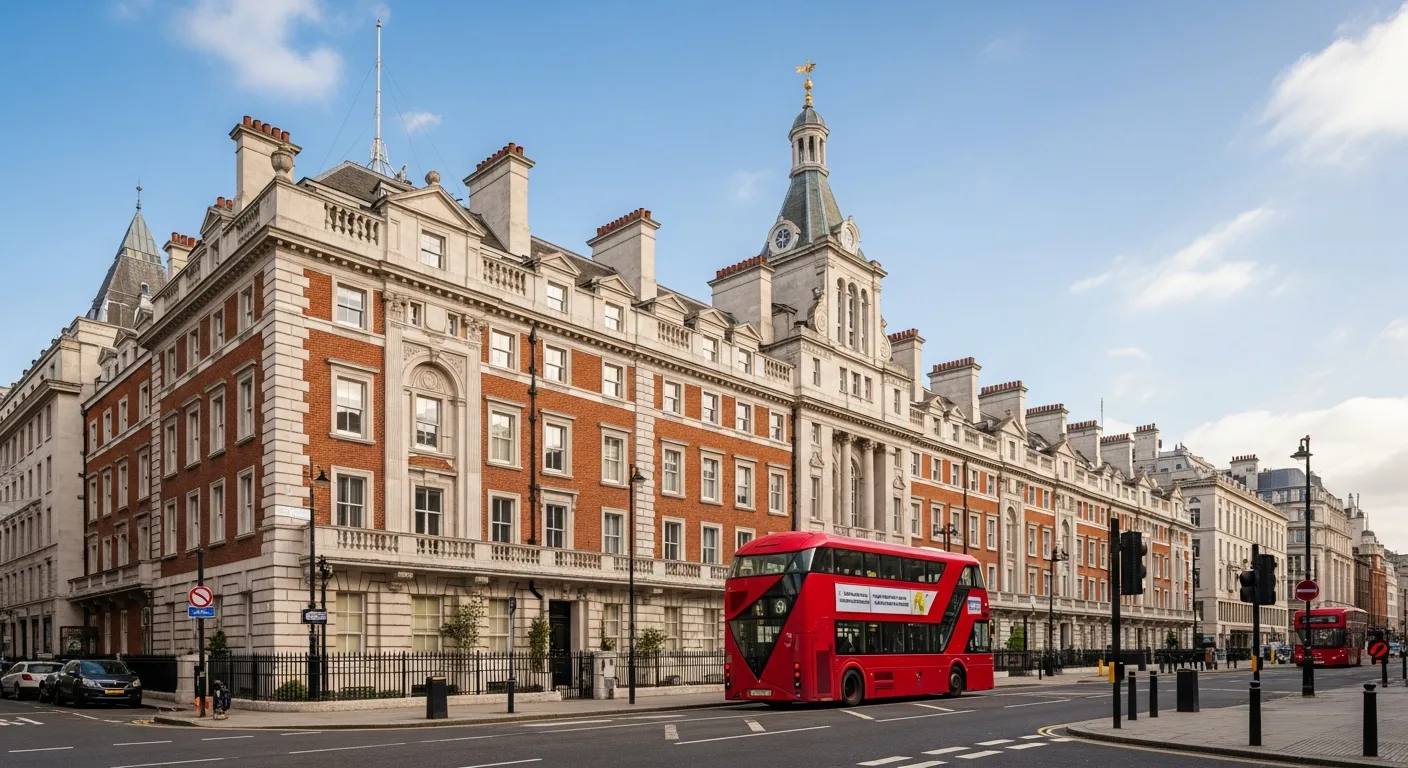
Lead image: Wikimedia Commons
When you turn off the Strand and walk into Houghton Street on a Monday morning, the first thing that hits you is the density. Students with takeaway cups debate the latest IMF report; the Indian Society hands out flyers for a gala; outside Centre Building a banner advertises an evening lecture by a former Greek prime minister. To your right rise the white columns of the Old Building, where Beveridge drafted the architecture of the British welfare state. To your left, the glass facade of Marshall Building, opened in 2022, tilts toward a roof terrace overlooking the West End. There is no quad and no gown. There is no traditional campus at all - just a few city blocks at the very heart of London, where global politics, economics and social theory have been shaped continuously since 1895.
The London School of Economics and Political Science carries the same weight in the social sciences that MIT carries in engineering or Harvard Law in jurisprudence. Founded by members of the Fabian Society - Sidney and Beatrice Webb, Graham Wallas, George Bernard Shaw - LSE has held to a single mission for one hundred and thirty years: rerum cognoscere causas, “to know the causes of things.” It is the only university in the world devoted entirely to the social sciences that consistently ranks at the absolute top globally. The alumni list reads like a who’s who of the twentieth century: 18 Nobel laureates (Hayek, Krugman, Sen, Coase, Lewis), more than 55 heads of state and prime ministers (including John F. Kennedy, who studied at LSE before transferring to Harvard, Lee Kuan Yew of Singapore, George Papandreou of Greece, Cyril Ramaphosa of South Africa), George Soros, and - perhaps surprisingly - Mick Jagger, who studied accounting and finance at LSE in 1961 before The Rolling Stones became his day job.
This guide walks international applicants through everything you need to know to apply to LSE from outside the UK: the UCAS process, the LNAT for Law, course-specific A-Level and IB requirements, the personal statement (which at LSE is absolutely decisive), post-Brexit fees and how to fund them, the Houghton Street experience, and where LSE graduates end up. If you are weighing other UK options, see our Oxford University guide for international applicants, Cambridge guide, Imperial College guide and UCL guide. For a wider picture, our studying in the UK guide covers the Russell Group, the visa system and the Graduate route.
Why LSE is the global standard for social science
LSE has occupied the top three positions worldwide for social sciences in every major ranking of the last decade: #2 globally for Social Sciences and Management (QS World University Rankings 2026, behind only Harvard); #1 in the UK for Economics, Sociology, Politics, Law and Social Policy; and inside the global top ten for Finance, Accounting, International Relations and Anthropology. Overall LSE sits around #50 in QS - much lower than its subject rankings - because it does not teach engineering, medicine or natural sciences, and overall rankings reward breadth.
This concentration is the defining strategic choice. While Oxford, Cambridge, Harvard and Stanford spread research budgets across hundreds of disciplines, LSE puts everything into a narrow band: economics, politics, law, sociology, anthropology, international relations, social policy, finance and management. The result is a faculty density unmatched anywhere - at any given time the Department of Economics employs more than 60 full-time academics, several of them Nobel laureates or future contenders, in a building you can walk across in two minutes.
The numbers that matter
- 18 Nobel Prize laureates across Economics, Peace and Literature (Friedrich Hayek, Paul Krugman, Amartya Sen, Ronald Coase, Arthur Lewis, Robert Mundell, William Vickrey, James Meade, John Hicks, Christopher Pissarides among them)
- 55+ heads of state and prime ministers educated at LSE, including five of the last six Greek prime ministers
- 73% international students - the highest proportion of any leading UK university (Oxford and Cambridge sit around 23-46%)
- 155+ countries represented in the LSE student body in any given year
- £300 million+ annual research income - the largest in Europe for the social sciences
- #1 in the UK for graduate starting salaries in 9 out of the last 10 years (HESA Graduate Outcomes survey)
What the rankings cannot capture
Rankings measure citations and reputation surveys; they cannot measure what it feels like to attend an evening lecture by a former Federal Reserve chair, then queue at the same coffee bar where they get their espresso. LSE has built that experience into its culture - the LSE Public Events programme runs 200+ free public lectures every year, drawing speakers like Christine Lagarde, Olaf Scholz, Janet Yellen, Yanis Varoufakis, Joseph Stiglitz, Mark Carney and Kristalina Georgieva. As an undergraduate you can attend any of them. Many students attend two or three a week.
Common misconception: “LSE is just an economics school”
It is not. Economics is the single best-known department, but LSE’s sociology, anthropology, law and international relations departments are equally elite. The Department of International Relations is the largest in the world and produced both Susan Strange and the modern English School of IR theory. The Law School ranks consistently in the top five UK law departments and produced more UK Supreme Court justices per graduate than any other institution. The misperception persists because the City of London hires so heavily from Economics, but LSE’s true edge is breadth across the social sciences.
How LSE admissions work - UCAS, the LNAT, and no interviews
Applications go through UCAS, the central UK undergraduate platform. You may apply to a maximum of five UK universities in one cycle, but UCAS rules forbid applying to both Oxford and Cambridge in the same year. LSE is not subject to that restriction - you can apply to LSE alongside Oxbridge or Imperial without conflict.
The 15 January deadline - three months later than Oxbridge
LSE’s UCAS deadline is 15 January at 18:00 UK time for entry the following October. This is the standard UCAS deadline and is three months later than the 15 October Oxbridge deadline. Use the extra time. International applicants should still begin preparing 9-12 months before, because UCAS reference logistics, IELTS/TOEFL slots and (for Law applicants) LNAT registration windows close earlier.
Step 1: Choose your course (and only one)
LSE admits you to a specific BSc, BA or LLB programme, not to “the university”. You commit to your course at the moment you submit UCAS - there is no major-shopping after arrival. Read the course handbook on the LSE website carefully. Each programme lists exact module structure, A-Level requirements and competition ratios. Some flagship courses to know:
- BSc Economics - the institution’s signature degree, 800+ applicants per year for ~150 places (~5% acceptance), often AAA with A* in Maths required
- BSc Philosophy, Politics and Economics (PPE) - LSE’s answer to Oxford PPE, more rigorous on the economics side
- LLB Bachelor of Laws - three-year qualifying law degree; LNAT required
- BSc International Relations - taught by the largest IR department globally
- BSc Mathematics and Economics - for students who want quantitative finance or economics PhD pipelines (often AAA with two A* in Maths and Further Maths)
- BSc Government and Economics, BSc Politics, BSc Sociology, BSc Anthropology and Law, BSc Accounting and Finance - all in the global top 10 for their subjects
Step 2: The personal statement - your only narrative chance
Because LSE does not interview, the personal statement is your one and only opportunity to convince admissions tutors you should be admitted. LSE has been remarkably explicit about what it wants. Quoting from the LSE Undergraduate Admissions site directly: the personal statement should be “primarily academic and largely about the subject you wish to study (around 80%).”
What that means in practice:
- Demonstrate you have already started studying the subject. If you apply for Economics, show you have read past the school syllabus - Piketty, Acemoglu, Banerjee and Duflo, Mariana Mazzucato, Daniel Kahneman, Esther Duflo. If you apply for International Relations, you should reference Mearsheimer, Wendt, Susan Strange, Buzan, Acharya. If you apply for Law, show you understand legal reasoning and can engage with cases or jurisprudential arguments.
- Show you can think critically, not just recite. “I read Piketty” is weak. “I found Piketty’s empirical case persuasive but his policy proposals under-theorised compared to Stiglitz’s framing” is what LSE wants.
- Avoid the US-style narrative essay. Stories about overcoming hardship, sports captaincies and Model UN trophies are not what LSE measures. Save those for US applications.
- Roughly 20% can cover non-academic experience - but only when it ties to the academic interest. An internship at a refugee NGO that shaped your interest in development economics is in. An award for school basketball is out.
International applicants from countries with very different essay traditions (notably India, Pakistan, Singapore and parts of Eastern Europe) often default to a more emotional, narrative style. Resist. Read three or four successful personal statements from current LSE students if you can find them - they read like undergraduate dissertation proposals, not autobiography.
Step 3: Predicted grades - the silent killer
UCAS asks your school to provide predicted grades - your teachers’ best estimate of your final A-Level, IB or national exam results. LSE takes these very seriously. Applicants whose predictions do not meet the published minimum are frequently rejected before anyone reads their personal statement. Make sure your school understands UCAS predicted grading. If your school is unfamiliar with the system (common for international schools outside the UK and Commonwealth), it may be worth requesting a meeting with the head teacher to ensure predictions reflect your trajectory honestly. LSE expects predictions at the published minimum or above for any course - typically AAA to AA*A for A-Level routes, 38-40 points for IB.
Step 4: The LNAT - only for Law
If you apply for LLB Bachelor of Laws, you must register and sit the LNAT (Law National Aptitude Test) between 1 September and 25 January in your application year. The LNAT is a two-section test: 42 multiple-choice questions on reading comprehension and reasoning (95 minutes), plus a 40-minute essay on a current-affairs topic from a choice of three. The multiple-choice section is computer-marked; the essay is sent to LSE for human review. Average LSE Law admits score around 28-30 out of 42 on the multiple-choice section.
The LNAT does not test legal knowledge - it tests verbal reasoning. Practice with the official LNAT prep materials and time yourself ruthlessly. The single biggest mistake international applicants make is running out of time in Section A.
For all non-Law courses, there is no admissions test. LSE briefly required the TMUA for BSc Mathematics and Economics in past cycles, but the 2026 entry cycle does not require it.
Step 5: English language requirements
International applicants whose first language is not English must provide one of the following:
- IELTS Academic 7.0 overall with 7.0 in each component (Reading, Writing, Listening, Speaking)
- TOEFL iBT 100 overall with 25 in Reading, 24 in Listening, 27 in Writing, 24 in Speaking
- Cambridge C1 Advanced or C2 Proficiency at grade A or B with all sub-scores 185+
- PTE Academic 69 overall with 69 in each component
These are the higher of LSE’s two language tiers; some courses (Law in particular) require the higher 7.5 / TOEFL 109 tier. Plan to take the test 6-9 months before the UCAS deadline - IELTS results are valid for two years and you want time to retake if needed. Our team has guides on TOEFL preparation and IELTS strategy, and you can practise with adaptive sets in our PrepClass TOEFL prep app.
Step 6: Decisions and offers
LSE does not interview undergraduates. The Admissions Committee evaluates the full UCAS file (predicted grades, personal statement, reference, GCSE/equivalent results, LNAT for Law) and issues decisions on a rolling basis between late January and the end of March. International applicants typically hear by mid-March.
Offers are almost always conditional: meet specific final exam grades (e.g. “AAA at A-Level with A in Mathematics” or “39 IB points with 7,7,6 at HL including 7 in HL Maths”). When your final results are released in July or August, you upload them to UCAS. If you meet the conditions, the offer becomes unconditional and you start in late September.
What LSE teaches - courses, departments and where it leads the world
LSE is structured around 24 academic departments, all in the social sciences and quantitative disciplines that intersect with them. The undergraduate portfolio covers about 40 named BSc, BA and LLB programmes. The strongest in global rankings are below.
Where LSE has world-leading reputation
- Economics - #1 in the UK and #5 globally (QS Subject Rankings 2026); the Department’s research output sits alongside Harvard, MIT, Stanford and Princeton
- Finance - top 3 globally; the MSc Finance is the most cited finance master’s in Europe
- Sociology - #1 in the UK; the home of Anthony Giddens (former director and architect of “Third Way” social theory)
- International Relations - the largest IR department in the world
- Law (LLB and LLM) - top 5 in the UK; LSE law alumni include UK Supreme Court justices and the architect of the European Convention on Human Rights, Hersch Lauterpacht
- Anthropology - global top 3 (Malinowski, who founded modern social anthropology, taught here)
- Social Policy - the discipline was effectively invented at LSE by William Beveridge and Richard Titmuss
- Accounting - top 5 globally and the only UK department that consistently outranks the major US business schools
Notable joint and unusual courses
LSE runs several dual-degree programmes with other elite universities - these are highly competitive but offer two degrees and two campuses:
- LSE - Sciences Po Dual BSc / BA - two years in Paris (Sciences Po), two years in London (LSE); awarded both degrees
- LSE - NYU Stern - HEC MIM (TRIUM) - at master’s level, but with strong undergraduate pipelines
- LSE - Columbia University Dual BA in International and World History - two years at each institution
- LSE - Peking University (PKU) Double Master’s in International Affairs
These programmes admit roughly 20-40 students per cohort and are decided by separate committees.
Open Curriculum vs LSE specialisation - pick your model
UK degrees are far more specialised than US ones. At a US Ivy you might study chemistry, comparative literature and ancient Greek alongside your major. At LSE you commit to one named programme and take its core modules every year, with two or three optional modules in years 2 and 3. If you want flexibility, look at US schools or the LSE General Course - a one-year study-abroad option for non-LSE students. If you want depth and immersion in social science from week one, LSE is the model.
LSE100 - the institution’s signature interdisciplinary core
Every undergraduate at LSE takes LSE100, a compulsory year-long interdisciplinary course taught in years 1 and 2 alongside your main subject. It uses real-world problems (climate change, inequality, financial crises, AI policy) as case studies and trains you to apply economic, sociological, political and ethical lenses to a single question. It is one of the very few mandatory cross-disciplinary cores at any leading UK university, and it is what most LSE alumni say differentiated their education from a pure economics or pure law degree elsewhere.
The classroom format is built around classes (LSE’s name for tutorials/seminars): groups of 8-15 students meeting weekly with a class teacher to discuss readings, present arguments and defend positions. The lecture-class structure is the standard at LSE - it is not the one-on-one Oxford tutorial, but it is far more interactive than the lecture-only model at most large universities.
How much LSE costs - fees, living costs and Brexit’s impact
Tuition fees 2026/2027
| Status | Annual tuition (GBP) | Equivalent (USD) | Equivalent (EUR) |
|---|---|---|---|
| UK Home students | £9,535 | ~$12,100 | ~$11,200 EUR |
| International (most BSc) | £25,728 - £28,176 | ~$32,600 - $35,700 | ~$30,200 - $33,100 EUR |
| International (BSc Accounting & Finance, BSc Finance) | £29,712 | ~$37,700 | ~$34,900 EUR |
| LLB Bachelor of Laws (international) | £27,696 | ~$35,100 | ~$32,500 EUR |
After Brexit, EU and EEA applicants are charged the international rate, not the Home rate. This is a material change from pre-2021 - the gap is roughly £18,000 per year.
Living costs in London
London is one of the four most expensive student cities in the world. LSE itself estimates international undergraduates need approximately £15,000 - £20,000 per year for living costs on top of tuition.
| Category | Per year (GBP) | Notes |
|---|---|---|
| Accommodation (LSE halls) | £8,500 - £12,500 | Bankside House, Passfield Hall, High Holborn - central |
| Accommodation (private flat) | £10,000 - £18,000 | Shared in zones 2-3; rent is the single biggest variable |
| Food | £2,500 - £3,500 | Mostly cooking at home with occasional eating out |
| Transport (TfL) | £900 - £1,400 | Student Oyster gives 30% off Travelcards |
| Books and supplies | £400 - £700 | LSE Library covers most; a few core textbooks per term |
| Personal, social, mobile | £2,000 - £3,500 | London prices for everything |
| Total estimate | £14,300 - £21,600 | LSE’s official central estimate is £15,500 - £18,500 |
Total annual cost for international undergraduates
For a typical BSc programme in 2026/2027:
- Tuition: £27,000 (median international BSc fee)
- Living costs: £17,000 (LSE central estimate)
- Visa, insurance, flights: £1,500 - £3,000 (Student visa £490, Immigration Health Surcharge £776/year, two return flights, NHS access)
- Total annual budget: approximately £45,500 - £47,000
In other currencies (April 2026 rates):
- USD 57,000-60,000
- EUR 53,000-55,000
- INR 47-51 lakh
- SGD 76,000-80,000
Multiply by three for a full BSc and you are looking at roughly £140,000 / USD 175,000 / EUR 165,000 total cost of attendance.
How does this compare to other UK and US options?
LSE international fees are slightly below Oxford and Cambridge (£33,000 - £44,000 international) and Imperial College (£35,000 - £44,000), but London living costs offset that difference. Compared to HYPSM in the US, LSE is dramatically cheaper:
- HYPSM (Harvard, Yale, Princeton, Stanford, MIT) full sticker: USD 88,000-95,000 per year
- LSE total cost: USD 57,000-60,000 per year
- Three-year LSE BSc vs four-year US bachelor’s: LSE saves you one year of cost entirely - roughly USD 95,000 on the Stanford comparison
Currency strategy for international families
If your home currency is volatile against GBP (INR, NGN, ARS, TRY, EGP have all weakened materially against sterling in the last five years), consider locking forward rates with a forex broker for at least the first year of fees. Wise and Revolut offer multi-currency accounts with mid-market rates that are typically 3-5% better than high-street banks. International student loans without a UK co-signer are available from Prodigy Finance (covers LSE postgraduates and select BSc students) and MPower Financing (focused on STEM, but adds Economics and Finance for LSE).
How to fund LSE - scholarships and external funding
LSE is need-aware for international undergraduates - your financial need is considered alongside academic merit, but most aid is targeted at students who would otherwise be unable to attend. The package is generous compared to most UK universities, but smaller in absolute terms than HYPSM’s need-blind packages for internationals at Harvard, Yale and Princeton.
Undergraduate scholarships for international students
LSE Undergraduate Support Scheme - the flagship undergraduate award
The LSE USS is need-based and assessed automatically when you apply. It can cover up to £18,000 per year for the lowest-income international applicants, and partial awards up to £6,000 are common for students from middle-income families. Awards are renewable for all three years of study contingent on academic performance. To be considered, complete the LSE Financial Support form by the published deadline (usually late April).
LSE Stelios Scholarships - Greek and Cypriot nationals
Funded by the Stelios Philanthropic Foundation, these awards provide full tuition and living costs to outstanding Greek and Cypriot applicants. Roughly 5-10 awards annually, decided by separate committee on academic merit and demonstrated leadership. One of the few near-full-cost awards open to international undergraduates at LSE.
Other undergraduate-level options
- The LSE Anniversary Scholarships - merit-based, £18,000 per year for three years, awarded to a small number of exceptional applicants
- The Uggla Family Scholarship Programme - full-cost award for Swedish nationals
- The Atlantic Fellows for Social and Economic Equity - leadership-focused fellowship; postgraduate entry but undergraduate alumni often pipeline in
- External: Chevening (UK government) - postgraduate; one of the most prestigious global awards
- External: Commonwealth Scholarships - for applicants from Commonwealth low- and middle-income countries
Postgraduate scholarships - where LSE really delivers
LSE Master’s Bursary
Need-based award covering up to £18,000 per year of MSc tuition or living costs. Open to all international and UK postgraduates. Around 200 awards per cycle. Apply within the LSE Graduate Financial Support form by the late April deadline.
LSE Graduate Support Scheme
The umbrella programme covers fees for several hundred MSc students per year, including the Anthony Giddens Scholarships, Vandervell Scholarships and several donor-funded awards. Decisions are made on need and academic merit combined.
Subject-specific postgraduate awards
The Department of Finance runs several MSc Finance scholarships for top admits; the Department of Economics participates in the Economic and Social Research Council (ESRC) doctoral funding pipeline; the Department of Law offers LLM scholarships specifically for Commonwealth and developing-country applicants.
External funding by region
- South Asia (India, Pakistan, Bangladesh, Sri Lanka): Inlaks Shivdasani Scholarship (postgrad), Aga Khan Foundation, J.N. Tata Endowment, Commonwealth Scholarship, Chevening
- East and Southeast Asia (Singapore, Hong Kong, Indonesia, Philippines, Vietnam): Chevening, LPDP (Indonesia), Hong Kong Jockey Club Scholarship, Singapore Public Service Commission scholarships
- Africa: MasterCard Foundation Scholars Programme (LSE is a partner institution), Chevening, Commonwealth Scholarships, Mandela Rhodes (post-graduate, South Africa)
- Latin America: Chevening, Fulbright Argentina/Brazil/Mexico equivalents, OAS (Organization of American States) scholarships, Santander Universities
- Middle East: Chevening, Saïd Foundation (Syria, Lebanon, Jordan, Palestine), Kuwait National Scholarship
Loans and alternative financing
For international students who do not qualify for need-based aid:
- Prodigy Finance - UK-based lender specialising in international postgraduate and select undergraduate loans; no co-signer required; typical rates 8-12% USD-denominated
- MPower Financing - US-based; focused on STEM and finance master’s; up to USD 100,000 per programme
- Lendwise - UK-based, specifically for UK postgraduate study including LSE MSc programmes
What student life is like at Houghton Street
LSE is not a campus university. There is no sprawling green; there is a five-block precinct in central London (WC2A, between the Royal Courts of Justice and Covent Garden) where every building belongs to LSE. The Marshall Building, Centre Building, Old Building, New Academic Building, Lionel Robbins Library and Saw Swee Hock Student Centre form the academic core. Aldwych is a two-minute walk; the British Museum is fifteen minutes; Soho is twenty.
How accommodation works
LSE guarantees a place in halls of residence to all first-year international undergraduates who apply by the deadline. There are around 12 halls, ranging from the iconic Bankside House (700+ rooms, on the Thames south bank with views of St Paul’s) to the smaller Passfield Hall in Bloomsbury and High Holborn in central London. Halls are catered or self-catered; weekly rents range from £180 to £280.
In years 2 and 3, most students move into private rented flats, typically sharing with three or four flatmates in zones 2-3 (Camden, Islington, Hackney, Bethnal Green, Stockwell, Brixton). Expect to pay £900 - £1,500 per month per person for a shared flat. London rents are high, but transport across the city is fast and the Tube/bus network covers everywhere.
Societies, clubs and the LSE Students’ Union
The LSE Students’ Union (LSESU) is one of the largest in the UK with over 200 societies including:
- Investment Society - runs trading competitions and pipelines into Goldman Sachs, Morgan Stanley, JPMorgan
- LSE Consulting Society - case-study workshops feeding into McKinsey, BCG, Bain
- LSESU Hayek Society, LSESU Marxist Society, LSESU Conservative Society, LSESU Labour Society - political clubs across the spectrum
- Indian Society, Chinese Society, Pakistan Society, Nigerian Society, Latin American Society, MENA Society - large diaspora communities reflecting LSE’s 73% international student body
- Athletic Union - 50+ sports clubs from rowing on the Thames to ultimate frisbee in Hyde Park
- LSESU Drama Society, Choir, Music Society, Film Society - strong arts despite no arts degrees
The Students’ Union runs the Three Tuns (the campus pub, in Saw Swee Hock Student Centre), the gym, club nights and the welfare office. It is genuinely active in UK student politics and was the lead campus organiser of the 2010 fee protests and the 2018 anti-Brexit student campaigns.
Public lectures - the secret weapon
The LSE Public Events programme is what makes LSE different from any other university in the world. Around 200 lectures and panels per year, all free and almost all open to the public. Recent speakers include Janet Yellen, Olaf Scholz, Mark Carney, Christine Lagarde, Joseph Stiglitz, Yanis Varoufakis, Kristalina Georgieva, Cyril Ramaphosa, Ngozi Okonjo-Iweala (WTO), and Adam Tooze. As an undergraduate you have priority booking and can attend up to four or five a week if you are organised.
The library and study spaces
The Lionel Robbins Building Library, redesigned by Norman Foster, is one of the world’s largest social science libraries with over 4 million printed items and digital subscriptions to almost every economics and social science journal that exists. It is open 24 hours during term and exam periods. Students typically describe it as “intense” - at 11pm in May it is full of undergraduates working on dissertations.
Academic terms
LSE runs three short, intense terms (Michaelmas, Lent, Summer) of ten weeks each, plus reading weeks. Final exams happen in the Summer term and weight heavily toward final degree classification - many courses base 70% or more of the final mark on year-three exams. The pressure profile is unusual: years 1 and 2 are intense but not high-stakes; year 3 is genuinely make-or-break.
London as the campus
The most honest thing anyone can tell you about LSE student life is: the campus is London. You will spend less time on Houghton Street than you would on a traditional campus. You will spend more time in the British Library, on the Tube, at industry events in Canary Wharf or the City, in West End theatres, in galleries, at internships in Mayfair offices. If you want a self-contained university bubble like Oxford or Cambridge or a US liberal-arts college, LSE is not it. If you want a graduate-school-intensity environment integrated into a global capital from age eighteen, LSE is unrivalled.
What LSE graduates do - careers, the City, and global outcomes
LSE has the highest median graduate starting salary of any UK university for many social science fields, and one of the highest graduate employment rates globally. The 15-month outcome data (HESA Graduate Outcomes survey) shows roughly 94% of LSE graduates in highly skilled employment or further study. Where do they go?
Investment banking, hedge funds, asset management
Roughly 35-40% of LSE Economics, Finance and Mathematics & Economics graduates enter financial services - by far the largest single sector. The City of London (Square Mile) and Canary Wharf are physically adjacent to LSE, and the recruiting pipelines are entrenched.
- Bulge bracket banks: Goldman Sachs, Morgan Stanley, JPMorgan, Citi, Bank of America, Barclays, Deutsche Bank, UBS, Credit Suisse - all run dedicated LSE campus programmes
- Hedge funds and quants: Citadel, Bridgewater, Two Sigma, Millennium, Marshall Wace, Brevan Howard
- Private equity and asset management: Blackstone, KKR, Apollo, BlackRock, Fidelity, Schroders
- Spring weeks in year 1 (one-week internships) feed into year-2 summer internships, which feed into year-3 graduate offers - the pipeline is mechanical and starts in your first term
Management consulting
15-20% enter consulting. The MBB firms (McKinsey, BCG, Bain) hire LSE heavily, as do Oliver Wyman, Strategy&, Deloitte Monitor, and the Big Four advisory practices. LSE’s location - McKinsey’s London office is a 15-minute walk from Houghton Street - makes networking trivial.
Public sector, policy and international organisations
LSE’s brand carries unusual weight in policy circles. Notable employers:
- International Monetary Fund (IMF) - LSE is among the top 5 alumni feeders globally
- World Bank - same
- United Nations (UNDP, UNICEF, UNHCR, OCHA, ILO) - strong recruiting pipeline
- Bank of England, Federal Reserve, European Central Bank, People’s Bank of China - dozens of LSE alumni in central banks
- UK Civil Service Fast Stream - LSE consistently in the top 3 universities for placements
- OECD, WTO, EU institutions - LSE alumni are over-represented in Brussels and Geneva
Tech and product
A growing minority - 8-12% - go to tech. Stripe, Palantir, Revolut, Wise, ByteDance, Shopify and the FAANG companies all run LSE recruiting. Product management roles dominate; engineering pipelines are smaller given LSE’s no-CS-degree position.
Graduate school and academia
Around 15-20% of LSE undergraduates go directly to graduate school - most often LSE itself for a master’s (LSE Master’s bursaries support this), Oxford or Cambridge for taught master’s, or US PhD programmes in economics, political science and sociology. LSE economics graduates are over-represented in top-10 US economics PhD programmes (Harvard, MIT, Stanford, Princeton, Chicago, Yale, Berkeley, Northwestern, Penn, Columbia).
The UK Graduate visa route - two years post-study
After Brexit and the introduction of the Graduate route (Tier 2 unsponsored), all international students completing an LSE degree are entitled to two years of post-study work in the UK without a sponsor (three years for PhD graduates). This is critical for international applicants concerned about post-study options. After those two years, the standard Skilled Worker visa route applies - most LSE graduates entering finance or consulting are sponsored automatically by major employers (Goldman Sachs, McKinsey, BCG and similar all sponsor at scale).
For US-bound applicants, LSE is also a strong feeder into US graduate programmes followed by F-1 OPT and the H-1B lottery - but the H-1B lottery success rate is approximately 30% non-STEM and is unreliable. The UK Graduate route is far more predictable.
How to prepare for IELTS, TOEFL and the LNAT
Three exams sit between most international applicants and an LSE offer: IELTS or TOEFL (English certification), and for Law applicants only, the LNAT. Plan exam prep on a six-month timeline; do not assume strong general English will carry you through the academic versions.
For TOEFL preparation our adaptive question banks cover all four sections with scoring calibration to the latest 2026 rubric - try the PrepClass TOEFL prep app for unlimited practice. For IELTS, our IELTS Academic strategy guide walks through the band 7.0 ceiling that LSE specifically requires. Many international applicants get blocked at LSE because they hit IELTS 7.0 overall but fail to clear 7.0 on Writing - practise Writing Task 2 (the 250-word argumentative essay) intensely and have your responses scored by a certified examiner before exam day. Our TOEFL vs IELTS comparison helps you choose between the two for UK university applications.
For the LNAT, the official LNAT prep book is the single best resource. The two patterns most international applicants miss: (1) the multiple-choice section is a reading comprehension test, not a logic puzzle test - your accuracy on inference and assumption questions matters more than speed; (2) the essay is graded on argument structure and clarity, not original opinion. Pick the topic where you have the clearest argument, not the most interesting one.
Is LSE right for you? - a candid summary
LSE rewards a specific profile and punishes the wrong fit. Be honest about both.
Who LSE suits best
- You already know what social-science discipline interests you, and you want depth from year one
- You are competitive - genuinely fine with a small cohort where everyone is high-achieving and ambition is the social norm
- You are interested in finance, consulting, policy, or international affairs as career outcomes
- You want a global city, not a sequestered campus, as your university experience
- You can write a personal statement that demonstrates intellectual engagement with your subject
- Your A-Level / IB predictions are at the published minimum or above
- Your IELTS / TOEFL is at or above the LSE bar (7.0 / 100) by the time you apply
Who LSE does not suit
- You want a US-style liberal-arts experience with major-shopping and a strong campus community
- You are looking at engineering, medicine, or pure natural sciences (LSE does not teach them)
- You want low-pressure undergraduate years with most evaluation by coursework - LSE weights final-year exams heavily
- You want sport or extracurriculars to be the centre of student life - they exist but they are not the culture
- You need a small, intimate university - LSE is intense, urban and fast-moving
Strong English required
LSE teaches at a high register from week one. Even after meeting IELTS 7.0, expect the first term to be challenging if English is not your native language - the readings are dense, the lecturers vary in accent (LSE faculty come from 60+ countries), and seminar participation is graded. Many international students do an additional six weeks of intensive academic English in the summer before LSE. Our PrepClass adaptive English practice is calibrated to academic register and is widely used by incoming LSE first-years from non-English-speaking countries.
Next steps
If LSE is on your list:
- Identify your target course - read the LSE Undergraduate Handbook for that programme today. Note the exact A-Level / IB requirements and whether the LNAT applies.
- Plan your English certification - book IELTS or TOEFL for 8-10 months before the 15 January UCAS deadline. Practise daily with the PrepClass TOEFL app.
- Start the personal statement in September - first draft, then six revisions through October to mid-December.
- Lock in predicted grades in October, with a meeting with your school to ensure they understand UCAS requirements.
- Consider a parallel HYPSM application - the deadlines do not conflict (US Regular Decision is 1 January; UCAS 15 January) and the application elements (essays, recommendations) overlap. If you are at the LSE level academically you should also be a competitive HYPSM candidate.
LSE is not the easiest UK option, and it is not the right fit for everyone. But for the right candidate - someone who already thinks like a social scientist and wants to learn from the people who have shaped the modern social sciences - there is no better place in the world to spend three years.