€0-4k
Public tuition per year (ISEE)
Income-tested; many international students pay €0-2,500
Study in Italy 2026: Bocconi, Politecnico Milano, Sapienza, Bologna. ISEE tuition €0-4,000, 600+ English programmes, TOLC/IMAT/SAT entry, the Type D visa.

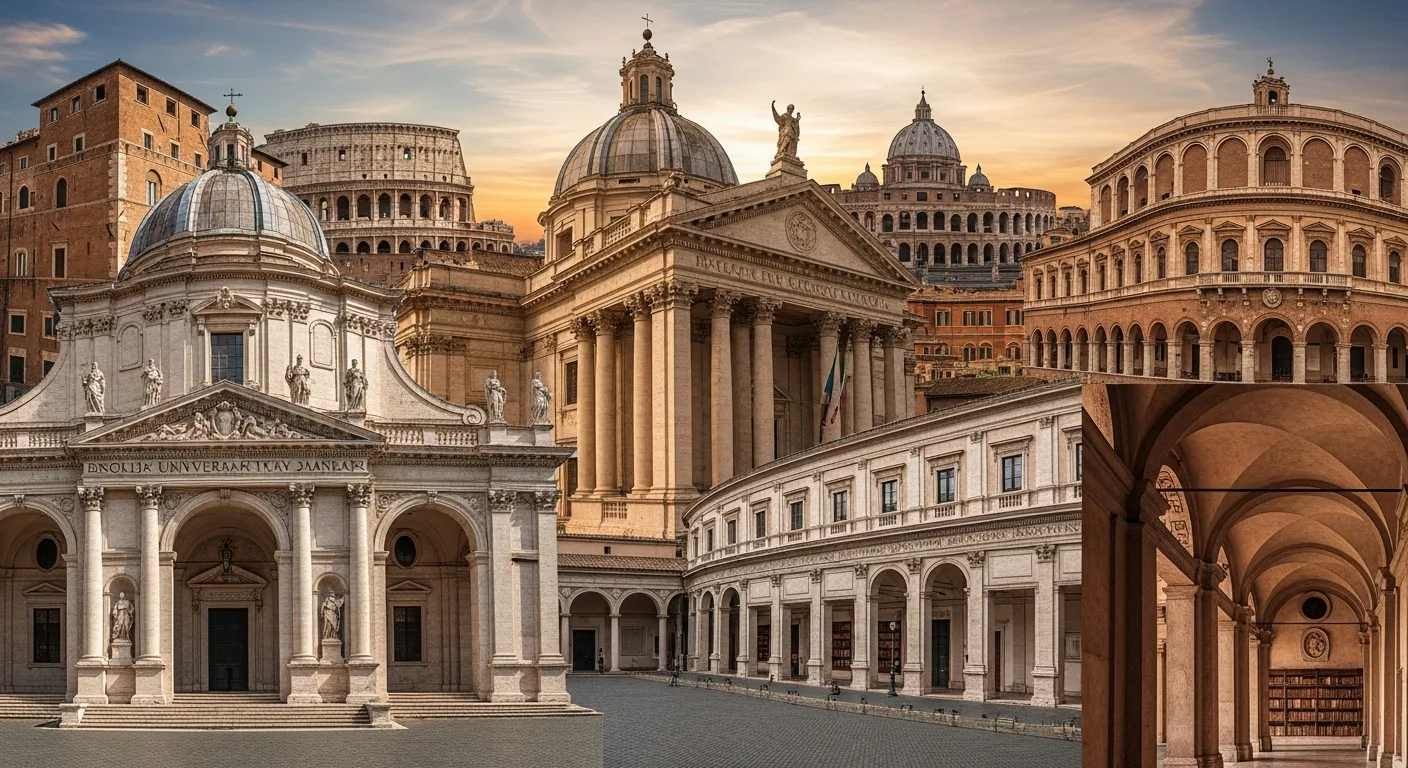
Lead image: Wikimedia Commons
It is a Thursday afternoon in Bologna. The portici - the covered arcades that stretch nearly forty kilometres across the old city - are full of students walking home from lectures with espresso cups still in hand. A group is arguing over an econometrics problem set on the steps of the Archiginnasio, the sixteenth-century seat of the oldest university in continuous existence. At a bar nearby, a postdoc explains, in lightly accented English, why his entire PhD costs less than a single semester at any private university back home. He pays €156 a year. His tuition is set by ISEE, the Italian income-based fee system, and his family’s income places him at the bottom of the curve. This is not a thought experiment. It is an ordinary academic day in a country that hosts more than 1.8 million students, runs Europe’s oldest universities, and offers some of the most aggressively income-tested tuition in the developed world.
Here is the bottom line. Public Italian tuition runs from €0 to about €4,000 a year, calibrated to family income through ISEE, while six universities sit in the QS top 200 and the country offers more than 600 English-taught programmes, concentrated at master’s level. The University of Bologna, founded in 1088, is the oldest in the world; Politecnico di Milano ranks inside the global top 20 for engineering and design; and Bocconi competes with INSEAD, LBS and HEC Paris for European business and finance. The catch is the paperwork: ISEE Parificato, the TOLC or IMAT entry tests, and, for non-EU students, a Type D visa and a permesso di soggiorno applied for within eight days of arrival. Across the College Council families we have advised, Italy is the destination where the cost arithmetic comes out lowest for a top-150 degree - and the one families most often cross off their list early, scared away by the paperwork before they have run the numbers.
In this guide I will walk you through the entire Italian system: how ISEE actually works in your favour, the universities that anchor each region and what each is known for, the TOLC, IMAT and SAT routes, the real cost of living city by city, the scholarships open to non-Italians, the visa and codice fiscale steps, and how to turn an Italian degree into a long-term career anywhere in the EU. If you are weighing Italy against other continental options, read our companion guides to studying in Germany and studying in the Netherlands - but plan to spend a little longer on this one, because Italy’s value is hidden inside its bureaucracy, and the students who decode it pay a fraction of what their peers pay elsewhere.
Source: QS World University Rankings 2026, Universitaly, official university fee pages, AlmaLaurea 2024.
There is no single reason Italy belongs on an international shortlist; there are four, and they compound. The first is aggressively income-tested public tuition. Public universities run on ISEE - Indicatore della Situazione Economica Equivalente - which sets fees from your family’s income, savings and assets. The result is one of the most progressive tuition systems in Europe: low-income families pay between zero and a few hundred euros; mid-income families pay €1,000-2,500; the top bracket caps at €3,000-4,000. International students who file ISEE Parificato access the same rates as Italians. Against UK international tuition of £24,000-40,000, US private fees of $50,000-80,000, or Dutch international rates of €13,000-22,000, public Italian tuition is a structural bargain rather than a discount.
The second is depth of quality. Italy carries six universities in the QS top 200 and several outright leaders in their fields. Politecnico di Milano sits in the global top 20 for engineering and design across QS subject tables. Bocconi ranks top-15 in Europe for business and management, alongside LBS and HEC Paris. Bologna remains research-strong across law, philosophy and economics nine centuries after its founding. Sapienza is the largest university in Europe by enrolment and a world leader in classics and archaeology. The University of Padua has been a continuous research centre since 1222 - Galileo held its chair of mathematics for eighteen years - and the Scuola Normale Superiore and Sant’Anna in Pisa are among the most selective institutions on the continent.
The third is the English-taught catalogue, which Italy has built out hard over the past fifteen years. The country now offers more than 600 fully English-taught programmes, roughly three-quarters at master’s level. Bocconi delivers nearly its entire portfolio in English; Politecnico di Milano teaches all of its engineering masters in English; Sapienza’s six-year Medicine and Surgery (MEDTECH) is fully English and admits through IMAT; Bologna, LUISS and Padua run growing English bachelor’s and master’s tracks. The bachelor’s catalogue is shallower than the Netherlands or Ireland, but at master’s level Italy is fully competitive with most of northern Europe.
The fourth is the post-study path. Italy automatically grants international graduates a 12-month residence permit to find work, with no salary threshold and no employer sponsorship required. Once you find qualifying employment you transition to a work permit; clear the EU Blue Card salary threshold (around €36,000, lower for shortage occupations) and you gain intra-EU mobility and accelerated residency rights. After five years of legal residence you qualify for permanent residency, and after ten (four for EU citizens, or two if married to an Italian) for citizenship - which carries full rights across all 27 EU member states. For applicants with Italian heritage, jus sanguinis citizenship is often available far sooner.
Be honest about the trade-offs, though. The Italian administrative state is famously slow, the housing market in Milan and Rome is brutal, and outside Milan daily life genuinely requires some Italian. None of these is a deal-breaker, but each is a reason to plan early rather than improvise on arrival.
Italy has around 97 universities - 67 public, 19 legally recognised private, and 11 online. The shortlist below is the set I steer international applicants toward first, curated for English-taught access, reputation and value. Treat the rank column as College Council’s curated ordering for international students, not a literal QS ranking; what each university is known for matters more than its number. Where we publish a dedicated English guide, the name links to it; otherwise it links to the university’s full profile in our Atlas.
| Rank | University | Known for |
|---|---|---|
| 1 | Politecnico di Milano | Engineering, architecture and design · top 20 globally · all engineering masters in English · public ISEE tuition (from €156) |
| 2 | Sapienza University of Rome | Largest university in Europe by enrolment · classics, archaeology, physics · English MEDTECH medicine via IMAT |
| 3 | University of Bologna | Oldest university in the world (1088) · law, humanities, economics · SAT accepted from 950 |
| 4 | Bocconi University | Business, economics, finance (private) · top-15 in Europe · admitted SAT ~1,400-1,450 · 95%+ employment |
| 5 | University of Padua | Sciences, medicine, physics · founded 1222, Galileo taught here · 30 minutes from Venice |
| 6 | University of Milan (Statale) | Comprehensive research university · medicine, law, sciences, humanities · central Milan |
| 7 | Politecnico di Torino | Engineering, automotive, aerospace · Stellantis and Piedmont industry cluster · cheaper than Milan |
| 8 | University of Pisa | Sciences and mathematics · twinned with the ultra-selective Scuola Normale Superiore |
| 9 | Vita-Salute San Raffaele | Medicine, psychology, biotech (private) · linked to a leading research hospital · English MD |
| 10 | University of Trento | Research and quality of life · computer science, physics, international studies · Alpine setting |
| 11 | University of Naples Federico II | Large, historic (1224) · Apple Developer Academy · lowest cost of living of any major uni city |
| 12 | University of Turin | Comprehensive · humanities, economics, medicine · strong student city alongside Polito |
| Source: College Council Atlas dataset and dedicated guides; QS World University Rankings 2026; official university websites 2025/26. Rank is CC's curated ordering for international applicants, not an overall ranking. | ||
A few notes on the picks. Politecnico di Milano has the deepest industrial partnerships of any Italian university - Pirelli, Ferrari, Eni, Leonardo, Ferrovie dello Stato - and runs Double Degree tracks with TU Munich, EPFL and Tsinghua; its architecture and design rank inside the global top 10.
Bocconi is the only private institution on this list whose price tag (€15,000-20,000) is genuinely justified by outcomes: over 90% of master’s graduates are employed within three months, with finance and consulting starting salaries of €45,000-60,000.
Sapienza and Bologna are the value plays - top-150 QS institutions with the lowest SAT thresholds in Europe and near-zero tuition under a low ISEE.
Beyond the twelve, LUISS Guido Carli (private, Rome), Università Cattolica del Sacro Cuore (Europe’s largest private Catholic university), Politecnico/Scuola Normale/Sant’Anna in Pisa, and Milano-Bicocca all run quality English-taught options worth a look.
The Italian degree structure follows the Bologna model the country itself named: a three-year laurea triennale (bachelor’s), then a two-year laurea magistrale (master’s), with a handful of single-cycle programmes - Medicine (six years), Architecture and Law (five) - that combine the two. The academic year runs October to June across two semesters, and assessment leans heavily on oral exams, a feature that surprises international students used to written finals. Italian universities also believe in selection during the degree rather than at the gate: public-university acceptance rates run a generous 50-80%, but the exams are hard and completion rates sit around 55%, so the filter happens after you arrive, not before.
The structural divide that matters most is public versus private. The 67 public universities run on ISEE and are the value engine of the whole system. The recognised private universities - Bocconi, LUISS, Cattolica, Vita-Salute San Raffaele - charge market fees but offer their own merit scholarships, often steep. For most international students the public route is the rational default, with private universities justified only where the brand and network are the point (Bocconi for finance and consulting, LUISS for Italian public life, San Raffaele for medicine).
ISEE deserves its own treatment because it is the single most important financial decision you will make. It is a government calculation of household economic standing - income, savings, real estate and assets rolled into one equivalised index - and public universities use it to assign you to a tuition band:
International families file ISEE Parificato through a CAF (Centro di Assistenza Fiscale) office in Italy, submitting certified, translated copies of parental tax returns, bank statements and property records. A student whose family earns at the median of their home country might pay €156 a year at Politecnico di Milano with a properly filed ISEE - and the maximum €3,500-4,000 without one. Over a five-year bachelor’s-plus-master’s that gap is €15,000-20,000. ISEE is paperwork that pays better per hour than almost any job; file it, and file it on time (typically September - December), because the window does not reopen.
Here is the thing the university websites bury in a sub-page. In my experience advising families on Italy, the ones who come out ahead are not the ones who chased a scholarship - they are the ones who treated ISEE Parificato as the real admissions test: started the document collection six months early, used a CAF office rather than guessing at the form, and got the certified parental tax translations in before the deadline. The families who leave it until enrolment week routinely pay the top €4,000 band for a year before they can correct it, if they correct it at all. The entry test gets you the seat; ISEE decides what the seat costs.
Italian admissions are more variable than the Dutch or German systems - each programme sets its own process - but a handful of national mechanics matter for international students.
Start with Universitaly, the national pre-enrolment portal run by the Italian Ministry of University and Research (MUR). Non-EU applicants living abroad must pre-register on Universitaly, link to their chosen Italian embassy or consulate, and complete a visa pre-application before departure. EU students skip this and apply directly through each university’s own portal - Apply@Polimi for Politecnico, Studenti Online for Bologna, InfoStud for Sapienza, apply.unibocconi.it for Bocconi. The Universitaly process is paperwork-heavy but free, and the embassy step is mandatory for anyone needing a study visa.
The standard entry test for public-university programmes is TOLC (Test On Line CISIA), a computer-based exam offered in multiple sessions per year at centres across Italy and at select international locations. The variants are TOLC-I for engineering, TOLC-E for economics, TOLC-F for pharmacy, TOLC-MED for Italian-taught medicine, TOLC-SU for humanities and TOLC-AV for veterinary medicine, each scored 0-50 with a per-university cut-off. For English-taught medicine - Sapienza’s MEDTECH plus Pavia, Milano-Bicocca, Bari, Padua, Bologna, Federico II, Tor Vergata and others - the route is IMAT, the International Medical Admissions Test run by the Italian Ministry of University and Research (MUR), held once a year in September. Competitive scores are programme-specific; Sapienza’s MEDTECH cut-off tends to land around 50/100 with an international admit rate of 5-10%.
For international applicants the friendliest route is often the SAT, which many universities accept as an alternative to TOLC on English-taught programmes - and Italy’s thresholds are the lowest in Europe. The University of Bologna accepts from around 950, Sapienza from 960, Padua from 1,000, and Politecnico di Milano requires roughly 1,240 while taking SAT Math as a substitute for its TOL-I test. Bocconi runs its own admission test but accepts SAT or ACT as full alternatives; its formal minimum is low, but the realistic average of admitted students is around 1,400-1,450, comparable to Oxford. A strong SAT also doubles as a portable score if you are applying to US, UK and Italian universities at once. If the SAT is part of your plan, prepare on our SAT app - full digital-SAT practice with adaptive analytics - and read our companion piece on whether the SAT is worth it for international students.
Two more documents complete the picture: an English-language certificate (most public universities want IELTS 6.0+ or TOEFL iBT 80+; Bocconi asks for IELTS 6.5+ or TOEFL 93+), and a Dichiarazione di Valore or CIMEA Attestato di comparabilità confirming your school-leaving qualification is equivalent. For language prep, our TOEFL app runs full iBT practice tests with AI-graded speaking and writing - the closest thing to a real mock you can do from home. Most students need 8-14 weeks of structured work to move from a school-English baseline to the 90+ band that selective English-taught programmes increasingly expect.
| When | Stage | What happens |
|---|---|---|
| October - December | Research and register | Shortlist programmes, confirm English vs Italian tracks, register for SAT (College Board) or TOLC (CISIA), start TOEFL/IELTS prep. |
| January - March | Tests | Sit the SAT (repeatable - send your best) or TOLC. Begin IMAT prep if applying to English-taught medicine. |
| February - April | Submit applications | Apply through each university’s portal; non-EU students register on Universitaly. Bocconi runs early rounds from November. |
| May - June | School-leaving exams | Sit your leaving exams; submit sworn-translated results. No apostille needed within the EU. |
| May - July | Ranking lists (graduatorie) | Universities publish admission lists. Polimi and Bocconi decide in May - June; Sapienza and Bologna in July - August. |
| July - September | Confirm, visa, ISEE | Accept your seat, file the visa pre-enrolment (non-EU), start the housing search, and begin ISEE Parificato collection. |
| September - October | Enrolment | Apply for the permesso di soggiorno (non-EU, within 8 days), file ISEE and DSU, and start the academic year. |
Source: Universitaly, CISIA/TOLC, official university admission portals, 2026/27 cycle. Dates vary by university - always confirm on the programme page.
Tuition is the easy part: with ISEE Parificato filed, most international students at public universities pay €0-2,500 a year, and Politecnico di Milano starts at €156. The harder line to budget is living costs, which vary more sharply across Italian cities than across almost any other European country. The same monthly budget that funds a comfortable life in Bologna leaves you sharing a flat with three roommates in Milan.
Milan is the most expensive: €850-1,500 a month, with a room in a shared flat at €500-750 and a student transport pass at €22. It also has the largest part-time market - finance, fashion, tech, English-language support.
Rome runs €750-1,250, with rooms at €400-650 and food and transport 15-20% cheaper than Milan; most Sapienza and LUISS students live in San Lorenzo, Trastevere or Pigneto.
Bologna, a true student town where a quarter of the population studies, runs €650-900 with rooms at €350-550 and the best food scene in Italy.
Padua (€600-850, rooms €300-500) is small, walkable and 30 minutes from Venice.
Naples is the cheapest major university city at €600-900, which makes Federico II an under-appreciated value play.
Turin sits in the comfortable middle at €750-1,100, cheaper than Milan with a strong automotive and tech base feeding internships.
One number that surprises newcomers: the university canteen, or mensa, serves a full meal - primo, secondo, contorno and fruit - for €2-5 with a student card. For the price of one lunch in London you can eat five times in a Bologna mensa. Cooking at home is both cheaper and culturally normal, and the local mercato rionale markets undercut supermarkets on fresh produce. The practical effect is that food is rarely the line that breaks a student budget in Italy; rent is.
| Route | All-in per year | What’s included |
|---|---|---|
| Public, regional (Bologna / Padua, low ISEE) | ~€8,500-11,000 | Tuition ~€0-200 + living ~€700/month |
| Public, Rome (Sapienza, low ISEE) | ~€10,000-12,500 | Tuition ~€0-200 + living ~€800/month |
| Public, Milan (Polimi, mid ISEE) | ~€13,000-18,000 | Tuition ~€1,500 + Milan living ~€1,000/month |
| Private (Bocconi, with scholarship) | ~€24,000-30,000 | Tuition ~€12,000 (after reduction) + Milan living ~€1,000/month |
| For comparison: Imperial College London | ~€50,000 | ~£38,000 tuition + London living |
Source: official university fee pages 2025/26; living-cost estimates averaged across student cities. Tuition depends on ISEE.
Italy is not Germany - there is no universal free-tuition model - but the scholarship infrastructure for non-Italians is genuinely strong, and it stacks. The headline national scheme is Borse di Studio del Governo Italiano, run by the Ministry of Foreign Affairs through Italian embassies, covering tuition plus a monthly stipend (around €900) for master’s and PhD candidates from designated partner countries; applications open February - April.
The workhorse, though, is the DSU (Diritto allo Studio Universitario) regional scholarship system, administered by agencies such as ER-GO (Emilia-Romagna/Bologna), DiSCo (Lazio/Rome) and EDISU (Piedmont/Turin). DSU is a package, not a single grant: full tuition exemption, a living stipend of €2,000-5,500 depending on region and whether you live away from home, free or near-free canteen meals, and priority access to subsidised university accommodation. It is awarded on a blend of ISEE economic need and academic merit, and EU students - including those with low ISEE Parificato - qualify on exactly the same terms as Italians. Apply within the regional window (usually September - October); students with moderate family income who skip the DSU application leave €3,000-6,000 a year on the table.
The private universities add their own. The Bocconi Merit Award covers full tuition plus a €12,000 living stipend, and the Bocconi International Award covers full tuition for top international applicants; roughly a fifth of Bocconi students hold a merit scholarship of some kind. Politecnico di Milano’s Roberto Rocca Project funds engineering students from selected emerging markets through the Tenaris-Techint Group, and its merit scholarships run €5,000-10,000 a year. LUISS and Cattolica both award partial-to-full tuition scholarships on application strength. EU-wide, Erasmus+ covers exchange semesters and Erasmus Mundus funds joint master’s degrees; many countries also run their own national academic-exchange agencies offering portable top-up funding that travels with you.
EU and EEA students need no visa: you arrive, register, and study under freedom of movement. Non-EU students need a Type D (long-stay) student visa, and the sequence has a cost and a deadline at every step, so build it into your timeline early.
It begins with Universitaly pre-enrolment and your acceptance letter, which you submit to your local Italian consulate alongside financial proof - typically €6,000-9,000 a year shown in your or your family’s account - and travel documents. Visa processing runs 4-8 weeks; apply about 90 days before arrival. Apply for your codice fiscale (Italian tax code) at the same time, because you need it to sign a lease, open a bank account, buy a SIM or register with the health service.
Within eight days of arrival, you must apply for the permesso di soggiorno per studio (study residence permit). The process uses the Kit Giallo (yellow kit) from any Italian post office: you submit photocopies of passport, visa, accommodation registration, financial proof and enrolment, then attend a Questura appointment for fingerprinting. The permit is valid for one year and renewable, and costs roughly €70-80 plus a €16 marca da bollo. Non-EU students should also register with the Servizio Sanitario Nazionale (SSN) for an annual flat fee of around €700, which buys full national healthcare on the same terms as Italian citizens; EU students use their EHIC card instead.
On work rights, student-permit holders can work up to 20 hours a week during term and full time during breaks, capped at 1,040 hours a calendar year, with no separate work permit required. And on the long game: five years of legal residence opens the door to the EU long-term residence permit, ten years (four for EU citizens, or two if married to an Italian) to citizenship and full EU rights across all 27 member states.
Italian student life is not a separate world from “real” life; it is woven into it. There are no walled Oxbridge-style campuses or sterile academic parks - faculty buildings sit on piazzas where pensioners drink coffee, and the trattoria next to the library serves pasta e fagioli for €6. From day one you are part of Italian life, not observing it from behind a gate.
Bologna is arguably the best student city in Europe: a quarter of the population studies, the porticoes run forty kilometres, Via Zamboni strings together faculties, bars and bookshops, and the political and artistic scene is the liveliest in Italy.
Milan is the cosmopolitan opposite - fashion, design and finance, lived at a London-like tempo, with Navigli aperitivo (a Spritz and a buffet for €8-12 is effectively dinner) and day trips to Lake Como an hour away.
Rome wraps Sapienza in the densest concentration of monuments per square metre in the Western world; San Lorenzo for cheap bars and pizza al taglio, Trastevere for evening aperitivo, the Ostia beaches thirty minutes away by metro.
Padua, Turin and Naples trade big-city energy for lower rents and tighter communities.
Three rituals are worth knowing. The mensa delivers a full meal for €2-5 and is a genuine institution. Aperitivo - the early-evening drink-with-snacks - is the daily social anchor. And the festa di laurea, where a graduate is crowned with a laurel wreath while friends read mock-heroic speeches and the whole family picnics on a piazza, is the most Italian thing you will witness. International communities are sizeable and active in Milan, Bologna and Rome; you will rarely be the only foreign student in the room.
Be honest about the Italian labour market: youth unemployment runs around 22% on ISTAT figures, among the highest in Western Europe. But graduates of the top universities are largely insulated from it. Politecnico di Milano graduates report a 94% employment rate within a year of graduating, and Bocconi over 95% (AlmaLaurea 2024) - these are the target schools for Italy’s largest employers and the international firms that recruit from them. Median starting salaries vary by field: €30,000-45,000 for engineering, €45,000-60,000 for finance and consulting (Bocconi, Milan), €28,000-40,000 for business management, and €32,000-50,000 for software engineering.
Milan is the clear launchpad: the Italian stock exchange, the major banks (UniCredit, Intesa Sanpaolo, Mediobanca), the consultancies (McKinsey’s Milan office is among the largest in Europe), and the fashion-and-luxury houses (Gucci, Prada, Armani, Luxottica) all recruit there, alongside the engineering and energy giants - Ferrari, Leonardo, Enel, Eni, STMicroelectronics. Turin feeds the Stellantis automotive cluster; the Emilia-Romagna corridor around Bologna runs a dense pharma and engineering economy (Chiesi, Menarini); and research-track graduates flow into CERN, ESA, CNR and INFN. As an EU citizen you can work in Italy without any further permit, and an Italian degree from a top university travels well - many graduates use it as a launchpad to London, Zurich, Frankfurt or Amsterdam.
| Sector | Main hub | Leading recruiters |
|---|---|---|
| Engineering & Technology | Milan / Turin | Ferrari, Leonardo, STMicroelectronics, Enel, Google, Amazon |
| Consulting & Advisory | Milan | McKinsey, BCG, Bain, Deloitte, Accenture, EY |
| Finance & Banking | Milan | Goldman Sachs, J.P. Morgan, UniCredit, Intesa Sanpaolo, Mediobanca |
| Fashion, Design & Luxury | Milan / Florence | Gucci, Prada, Armani, Ferragamo, Luxottica |
| Pharma & Biotech | Emilia-Romagna / Milan | Chiesi, Menarini, Dompé, Zambon, Bracco |
| Research & Academia | Nationwide / EU | CERN, ESA, CNR, INFN, European universities |
Source: AlmaLaurea Graduate Survey 2024 and Polimi/Bocconi employment reports; indicative sector mapping, not a single-survey statistic.
We built College Council to remove the two things that most often derail an Italian application: weak test preparation and a chaotic, last-minute process. Italy rewards the SAT more than almost any European system - and at the lowest thresholds - so our SAT app runs the full digital SAT with adaptive practice and analytics, and our TOEFL app delivers full TOEFL iBT mocks with AI-graded speaking and writing, the language certificate every Italian university requires. CC runs both directly; you prepare once and apply broadly.
Beyond the apps, the harder part is judgement: which universities fit your scores, whether the ISEE maths makes a public university unbeatable for your family, and how to sequence TOLC, IMAT, SAT, the visa and the permesso di soggiorno without missing a window. That is where we work with families directly, drawing on the same data that powers this guide. Register on College Council and you get the part no blog can give you: every university, the exact admission requirements, and a realistic read on how to get in - run your profile through our chances engine to see where you stand. And if you simply want to explore, our Atlas of universities holds the full Italian catalogue - every institution on the shortlist above, and thousands more, with the facts that matter.
Public Italian universities use the ISEE income-based fee system: tuition ranges from near €0 for low-income families to about €4,000 per year at the top bracket, with most international students who file ISEE Parificato paying €0-2,500. Politecnico di Milano starts as low as €156 a year at the lowest band and caps around €3,900. Private universities charge market rates: Bocconi runs €15,000-20,000, LUISS €12,000-15,000, Cattolica €5,000-11,000. Add living costs of €600-900 per month in Bologna, Padua or Naples and €850-1,500 in Rome or Milan.
It depends on the programme. Italy offers more than 600 English-taught programmes, concentrated at master’s level: Bocconi runs almost its entire master’s catalogue in English, Politecnico di Milano teaches all its engineering masters in English, and Sapienza’s Medicine and Surgery (MEDTECH) is fully English. For Italian-taught programmes you need CILS or CELI level B2, verified before enrolment. Even on English tracks, learning Italian to A2 - B1 makes daily life much easier outside Milan, where less English is spoken in shops, banks and public offices.
Yes, and the thresholds are among the lowest in Europe. The University of Bologna accepts from around 950, Sapienza from 960, Padua from 1,000 and Politecnico di Milano requires roughly 1,240 (accepting SAT Math as a substitute for its TOL-I test). Bocconi’s formal minimum is lower, but the realistic average of admitted students sits around 1,400-1,450. Many public universities accept SAT as an alternative to the Italian TOLC test on English-taught programmes.
Non-EU applicants complete the pre-iscrizione (pre-enrolment) procedure through the Universitaly portal and their local Italian embassy or consulate before applying for a Type D student visa. EU students apply directly through each university’s portal. Entry routes vary by programme: TOLC (CISIA) for engineering, economics and pharmacy; IMAT for English-taught medicine; the university’s own test or SAT/ACT at Bocconi. Applications typically open October - February for September enrolment.
ISEE (Indicatore della Situazione Economica Equivalente) is the Italian indicator of equivalent economic status, calculated from family income, savings and assets. Public universities use ISEE bands to set tuition: low-income families pay close to zero, higher brackets pay the maximum of around €3,000-4,000 per year. International students file ISEE Parificato, submitting certified, translated copies of their parents’ tax returns and asset records to a CAF office in Italy. A properly filed ISEE can take your tuition from €4,000 down to under €200 - it is the single most valuable piece of paperwork in the whole process.
Three layers exist. The Italian government runs Borse di Studio del Governo Italiano through its embassies, covering tuition plus a monthly stipend for masters and PhD candidates. Each region runs DSU (Diritto allo Studio Universitario) scholarships covering tuition, a €2,000-5,500 living stipend, free canteen meals and subsidised housing, awarded on ISEE and merit - EU students qualify on equal terms. Private universities add their own: the Bocconi Merit Award covers full tuition plus a €12,000 stipend, and Politecnico’s Roberto Rocca Project funds engineers from selected emerging markets.
Yes. EU/EEA students can work without restriction. Non-EU students on a study residence permit can work up to 20 hours per week during term and full time during breaks, capped at 1,040 hours per calendar year, with no separate work permit needed. Typical hourly wages run €8-12 in hospitality, retail, English tutoring and customer support, with university research and tutoring roles at €12-18. Milan has the strongest part-time market; Rome leans toward tourism; Bologna has a deep university-town economy.
Graduates qualify for a 12-month job-seeker residence permit (permesso di soggiorno per attesa occupazione) with no salary threshold and full freedom to take any job. Once you find qualifying employment you move to a work permit, and Italy operates an EU Blue Card for highly skilled migrants with a salary threshold around €36,000 (lower for shortage occupations). After five years of legal residence you can apply for permanent residency; after ten (four for EU citizens, or two if married to an Italian) for citizenship. Bocconi and Politecnico graduates report employment rates above 94% within a year (AlmaLaurea 2024).
Italy works exceptionally well for some students and less well for others. It works if you qualify for low-bracket ISEE rates and want to minimise tuition - engineering at Politecnico, medicine via IMAT, and a top-150 degree from Bologna or Sapienza all become structural bargains. It works if you value the depth of European universities (Bologna 1088, Padua 1222) and want EU labour-market access without UK or US tuition. And it works if you are targeting elite business or engineering and want Bocconi or Politecnico at a fraction of the cost of INSEAD, LBS or HEC Paris, with comparable rankings.
It works less well if you need a deep English-taught bachelor’s catalogue (Ireland or the Netherlands will serve you better), if you want maximum graduate salary at junior level (Germany, the Netherlands and Switzerland pay more), if you need a fast, frictionless bureaucracy, or if you flatly refuse to learn any Italian. For most international students who actually do the maths, though, Italy lands on the shortlist - the combination of near-zero public tuition, English-taught master’s options, historic prestige and a pathway to EU citizenship is rare. Plan ahead, file ISEE properly, apply early, take the language test seriously, and Italy delivers an EU education at a fraction of the cost of comparable English-language alternatives.
In bocca al lupo.
University rankings and profiles are drawn from the QS World University Rankings 2026 and cross-checked against College Council’s Atlas dataset of Italian higher-education institutions. Current-cycle figures (ISEE bands, tuition, entry tests, visa rules, work rights) were verified against official Italian government and university sources in June 2026; public tuition depends on individual ISEE and rises in small steps, so always confirm the exact figure on the relevant programme page for your intake year.