
#67
QS World Ranking
QS World University Rankings 2026
University of Warwick: admissions, requirements, costs, and scholarships. How to get into Warwick? Explore WBS, Maths, Economics, MORSE. A guide for international applicants.

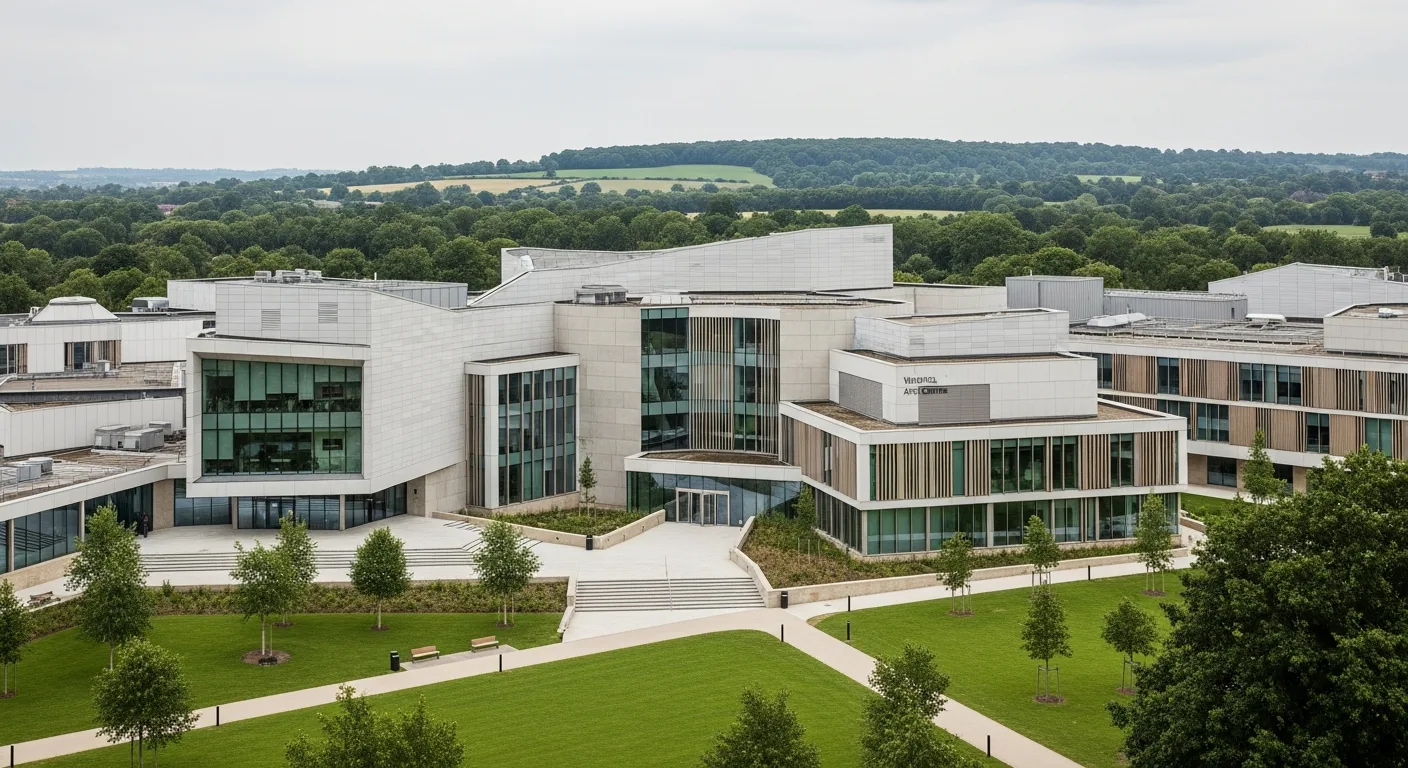
Photos: Wikimedia Commons
You stand atop a hill overlooking the campus, watching the morning mist shroud the green fields of Warwickshire, the very county where Shakespeare penned his first sonnets. Below you, a modern 290-hectare campus unfolds, where tens of thousands of students from 130 countries are heading to their morning lectures. At the Warwick Arts Centre (the second-largest arts venue in the entire UK), the technical crew is setting up the stage for the evening performance. In the Warwick Business School building, a recruiter from Goldman Sachs is setting up banners for today’s Spring Week session. On the notice board, someone has pinned a poster from one of the international student societies, inviting students for a get-together on Saturday. This isn’t London, nor Oxford - this is the University of Warwick, an institution that, in less than six decades since its founding, has grown into one of the most respected academic institutions in the British Isles.
Warwick is a university of paradoxes. Founded in 1965 as part of a post-war wave of new universities, it lacks the centuries-old tradition of Oxbridge, yet recruiters from the City of London treat its graduates on par with those from institutions that have existed for seven centuries. Located near Coventry (a city most Britons associate with the automotive industry, not academic prestige), it offers a campus student experience unlike any you’ll find at a London university. And above all: Warwick combines a world-class Warwick Business School with Triple Crown accreditation, one of the best mathematics departments in Europe, and target school status for McKinsey, Goldman Sachs, and Google - all with living costs 30-40% lower than in London.
In this guide, we’ll walk you through everything you need to know as an international applicant: from admissions requirements and the UCAS process, through cost and scholarship details, to the realities of student life on one of the best campuses in the UK. If you’re considering other UK universities, compare Warwick with our guides to University of Oxford, Cambridge, LSE, and Imperial College London.
The University of Warwick ranks 67th globally in the QS World University Rankings 2026, placing it in the top 10 among British universities, higher than many competitors with significantly longer histories. In the Times Higher Education 2025 ranking, Warwick is in the global top 110, and in national rankings (Complete University Guide 2026-10th place and Guardian University Guide 2026-9th place), it consistently holds a spot in the top ten universities in the UK.
But it’s the subject rankings that truly showcase Warwick’s strength.
Mathematics and Statistics: top 20 globally in QS, placing Warwick’s mathematics department alongside Cambridge, MIT, and Stanford in the global elite.
Economics & Econometrics: top 30 globally, on par with LSE and UCL in many categories.
Business & Management Studies: top 50 globally, driven by the power of Warwick Business School, one of the few business schools in the world with Triple Crown accreditation (AACSB, EQUIS, AMBA). In the Financial Times European Business Schools 2024 ranking, WBS is in the top 10 in Europe - higher than many business schools that cost twice as much.
What’s truly crucial for you as a future graduate: Warwick holds higher positions in employer reputation rankings than in general academic rankings. In QS Employer Reputation, Warwick is in the global top 50, meaning employers value graduates from this university even more than the overall ranking might suggest. Warwick is a member of the elite Russell Group (an association of 24 leading UK research-intensive universities). It’s a university where Goldman Sachs, McKinsey, BCG, and Google come to recruit - not a university from which you have to travel to London to find a job.
All applications for undergraduate studies in the UK go through the central UCAS (Universities and Colleges Admissions Service) system, which is the British equivalent of a centralized admissions process, covering all universities in the country simultaneously. The system is much simpler than for Oxbridge, as Warwick, in most cases, does not require an interview or additional entrance exams (with the important exception of mathematics, which we’ll discuss shortly).
Through UCAS, you can apply for a maximum of 5 programs at different universities, or even all five at Warwick if you’re considering several courses. You write one common Personal Statement (max. 4,000 characters), which is sent to all five chosen programs; therefore, it’s beneficial for your choices to be thematically consistent. You include a reference from a teacher or school counselor with your application. The fee is £28 for the entire application, regardless of whether you choose one program or five.
The deadline for Warwick is January 29, 2027 (for the 2027/28 cycle), which is the standard UCAS deadline for most UK universities (exceptions being Oxford, Cambridge, and medicine, with an October 15 deadline). After submitting your application, Warwick reviews it within a few weeks to several months and sends a conditional offer, an offer dependent on your final exam results. This is when you find out what results you need to achieve in your final exams.
The Personal Statement is the most crucial element of your application to Warwick. Unlike Oxbridge, where interviews play a key role, Warwick makes decisions primarily based on your academic results and Personal Statement. Focus on your academic passion, experiences related to your chosen course (readings, projects, competitions, online courses), and explain why this particular program at Warwick is ideal for you. Avoid generalities; admissions officers read thousands of applications and immediately recognize generic statements.
A key exception applies to mathematics. For applicants to BSc Mathematics or MMath, Warwick may issue a conditional offer dependent on the result of the STEP (Sixth Term Examination Paper) exam, the same exam required by Cambridge. STEP is one of the most challenging mathematics exams in the UK. Warwick typically requires a Grade 1 or Grade 2 in STEP 2 or STEP 3. The exam is taken in June, after receiving an offer. Not every mathematics applicant receives a STEP conditional offer; if your results are outstanding (97%+ in the Polish Matura extended level or a 7 in Math HL in IB), you might receive an offer without STEP. However, it’s worth preparing for this possibility. The Cambridge STEP Support Programme is a free, excellent resource for materials. Preparation for STEP requires a minimum of 6 months of intensive work.
You can find more about converting Polish Matura results to the British system in our separate guide. Information about the SAT exam for universities in the UK can be found in our guide to studying in the UK with SAT.
| Program | Polish Matura (Extended Level) | A-levels | IB (points) | Required Subjects | Difficulty |
|---|---|---|---|---|---|
| BSc Mathematics / MMath | 90%+ in Mathematics | A*A*A - A*A*A* | 39-41 (HL 6-6-6) | Mathematics HL / Extended Level | Very High |
| BSc Economics | 85%+ in Math + 85%+ overall | A*AA | 38 (HL 6-6-6) | Mathematics HL / Extended Level | High |
| BSc Computer Science | 85%+ in Math + 85%+ overall | A*AA | 38 (HL 6 in Math) | Mathematics HL / Extended Level | High |
| BSc Accounting & Finance (WBS) | 80%+ in Math + 80%+ overall | AAA | 36 (HL 6-6-5) | Mathematics HL / Extended Level | Medium-High |
| BSc MORSE | 85%+ in Math + 85%+ overall | A*AA | 38 (HL 6-6-6) | Mathematics HL / Extended Level | High |
| BA History / English | 80%+ in Humanities Subject | AAA - AAB | 36-38 (HL 6-6-5) | Humanities Subject | Medium |
Warwick requires proof of English language proficiency from all applicants whose first language is not English. The university distinguishes between two levels of requirements: Standard (most programs) and Higher (Law, some Humanities programs). IELTS Academic 6.5 overall (min. 6.0 in each component) is the standard, while Higher programs require 7.0 overall (min. 6.5 in each component). TOEFL iBT: 92 (min. 22R, 21L, 23S, 21W) and 100+ respectively. Warwick also accepts Cambridge C1 Advanced (min. 176), C2 Proficiency (min. 185), and Duolingo (115-130 depending on the program).
Preparing for a language exam? Check out our TOEFL app, a platform offering full practice tests with AI feedback to help you achieve your required score. If you’re wondering which test to choose, read our TOEFL vs IELTS guide.
Warwick Business School is at the heart of the university’s prestige and the reason many students choose Warwick over its competitors. WBS holds Triple Crown accreditation (AACSB, EQUIS, AMBA), a distinction shared by less than 1% of business schools worldwide. In the Financial Times European Business Schools 2024 ranking, WBS is in the top 10 in Europe, competing with institutions like Copenhagen Business School, ESCP Business School, and Rotterdam School of Management.
The flagship undergraduate program (BSc Accounting and Finance) offers a direct path to the Big 4 (Deloitte, PwC, EY, KPMG) and investment banking. WBS is one of the few business schools in the UK where undergraduate students have real access to recruitment in top-tier financial services even during their studies, through dedicated spring weeks and summer internships. BSc Management offers broad business preparation with a flexible curriculum allowing for specialization in later years. BSc International Management stands out with its compulsory year abroad; exchanges with universities such as ESSEC Paris, NUS Singapore, or HKU Hong Kong offer an experience that transforms career and life perspectives.
The WBS graduate employment rate exceeds 95% within 6 months of graduation. Goldman Sachs, J.P. Morgan, Morgan Stanley, McKinsey, BCG, and Bain regularly host recruitment sessions on the Warwick campus. This isn’t a brochure promise; these are concrete events to which you receive an invitation as a WBS student.
Warwick’s mathematics department is one of the best in Europe (top 20 globally in QS), with 100% of its research rated as “world-leading” or “internationally excellent” in the latest Research Excellence Framework. This isn’t a department that merely teaches well; it’s a department that creates new mathematics.
BSc Mathematics is a classic three-year program. MMath is a four-year version with in-depth specialization, required if you plan an academic career or a PhD. BSc Mathematics and Statistics is ideal preparation for data science and actuarial science (two industries where demand for talent significantly outstrips supply). But Warwick’s true unique offering is BSc MORSE (Mathematics, Operational Research, Statistics and Economics), an interdisciplinary program combining four disciplines into one degree. MORSE is a flagship Warwick program, particularly valued by employers in quantitative finance, strategic consulting, and technology. The combination of four disciplines provides graduates with a skill set unmatched by any other university in the UK.
Warwick’s Department of Economics is one of the top 5 economics departments in the UK (alongside Oxford, Cambridge, LSE, and UCL). Particularly strong in applied economics, game theory, and econometrics, Warwick educates economists who are equally at home in academia and investment banking. BSc Economics has a strong mathematical component; it’s economics with real analytical tools, not descriptive economics. BSc EPAIS (Economics, Politics and International Studies) is Warwick’s equivalent of Oxford’s PPE: similar prestige, a less stressful admissions process.
Warwick’s Computer Science department is one of the fastest-growing at the university. BSc Computer Science and MEng Computer Science prepare students for careers at Google, Amazon, Microsoft, Meta, and Palantir (companies that regularly recruit on campus). BSc Discrete Mathematics combines mathematics with theoretical computer science, an ideal foundation for specialization in cryptography or algorithmics.
Warwick also offers modern engineering programs in collaboration with the Warwick Manufacturing Group (WMG), a research unit working with Jaguar Land Rover, Tata Motors, and Rolls-Royce. BEng Automotive Engineering is the only such program in the Russell Group, featuring direct collaboration with the automotive industry and placements with manufacturing partners.
Following Brexit, EU students are treated as international students and pay full international tuition fees. Tuition fees depend on the department and program type; differences are significant. Humanities and social sciences cost £26,840 annually, economics: £29,230, WBS programs: £31,450, mathematics and computer science: £33,390, and engineering and lab-based sciences reach £36,130. This translates to approximately €31,400 - €42,300 or $34,100 - $45,900 annually (at approximate current exchange rates). Amounts increase by 3-5% annually, so over three years of study, you will pay more than three times the annual tuition.
An important difference compared to Oxbridge: Warwick does not charge additional college fees. At Cambridge, you must factor in £10,000 - £11,000 annually for college fees, which makes Warwick significantly more affordable, even if the base tuition looks similar.
But it’s the living costs that truly set Warwick apart from its London competitors. Coventry is a city with living costs 30-40% lower than London, and the campus lifestyle at Warwick eliminates one of the biggest expenses for a student in the UK: transport. On campus, you walk everywhere. Everything (halls of residence, library, lecture halls, Warwick Arts Centre, sports facilities) is within a 15-minute walk. In London, the same student spends £150 - £200 per month on an Oyster card. At Warwick: zero.
On-campus accommodation at Warwick costs £120 - £160 per week (£5,500 - £7,500 annually) compared to £200 - £350 per week for a hall of residence in central London. Food in Coventry is 25-35% cheaper than in the capital. Over three years of study, you save £21,000 - £36,000 (approximately €24,600 - €42,100 or $26,700 - $45,700) on living costs alone compared to London universities. This amount could cover half a year’s tuition or allow you to live without additional debt.
The estimated total cost of a three-year degree at Warwick for an international student: humanities around £111,000 (approx. €130,000 / $141,000), economics/WBS around £123,000 (approx. €144,000 / $156,000), mathematics/computer science around £136,000 (approx. €159,000 / $173,000), engineering around £144,000 (approx. €168,000 / $183,000). For comparison, three years at LSE is £150,000 - £170,000, and at Oxford with college fees: £160,000 - £200,000+.
Let’s be honest: most international students at Warwick do not receive a scholarship covering full tuition fees. Warwick is not Harvard, with an endowment allowing for need-blind admissions. But available options can significantly reduce the financial burden if you know where to look.
The Warwick Undergraduate Global Excellence Scholarship is the flagship scholarship for international students, covering from £2,000 up to full tuition in exceptional cases. The application is submitted separately (not via UCAS), usually by March - April. It requires a motivational essay and documentation of academic and extracurricular achievements. Competition is high, but applicants with outstanding results and a strong extracurricular profile have a realistic chance.
Warwick Business School offers its own scholarships: the WBS Dean’s Award (up to £5,000/year tuition reduction) and the WBS Scholarship for Excellence. Both are awarded automatically based on the UCAS application, without the need for a separate application. Individual departments have additional options: Mathematics Scholarships (based on STEP/MAT results), Engineering Scholarships (in collaboration with WMG and industry partners), and Economics Scholarships for candidates with the best results.
It’s also worth looking at funding from your home country: national scholarship agencies, government study-abroad grants, Erasmus+, regional and local-government scholarships, and private foundations that support overseas study. Following Brexit, EU students do not qualify for UK government student loans, but private international loans (Prodigy Finance, Future Finance) are an option requiring additional formalities.
| Criterion | Warwick | LSE | Manchester |
|---|---|---|---|
| QS Ranking 2026 | #67 | #50 | #34 |
| Economics (QS Subject) | Top 30 | Top 10 | Top 60 |
| Business (Accreditations) | Triple Crown (WBS) | No Business School | Triple Crown (AMBS) |
| Tuition (Econ., Intl.) | £29,230/year | £30,960/year | ~£30,000/year |
| Living Costs (Annual) | £10,000 - £14,500 | £17,000 - £26,000 | £12,000 - £16,000 |
| Acceptance Rate | ~14% | ~8% | ~55% |
| University Type | Campus university | City university (London) | City university (Manchester) |
| Target School (Finance) | Yes - top tier | Yes - top tier | Yes - second tier |
| Atmosphere | Campus, strong community | Urban, cosmopolitan | Urban, student-focused |
| Best for | MORSE, WBS, Mathematics, campus life | Economics, Political Science, Finance | Broad STEM, wide choice, Manchester |
Warwick is a campus university, and this is a fundamental difference compared to London universities, which are spread across many buildings scattered throughout the city. Warwick’s campus spans over 290 hectares of green space on the outskirts of Coventry. It’s essentially a self-contained town with its own ecosystem: shops, restaurants, a bank, a post office, a sports center with a swimming pool and gym, and even a cinema. First-year students are guaranteed on-campus accommodation, meaning that from day one, you’re immersed in the community, without the need to search for housing or commute by bus, as is common at many city universities.
The Warwick Arts Centre (the second-largest arts venue in the UK after London’s Barbican) is a place you won’t find on any other campus in the UK. A 550-seat theatre, art galleries, a concert hall, a cinema; world-class artists regularly perform here. This isn’t just a student cultural corner; it’s a full-fledged artistic institution that attracts audiences from across the West Midlands region. If you’re interested in art, theatre, or film, the proximity of the Warwick Arts Centre alone is a compelling reason to choose this university.
Warwick Students’ Union is one of the most active in the UK, with over 300 societies: from international and cultural societies (regular meetings, shared meals, holiday celebrations, and networking) to academic investment and debating clubs, and even quirky ones like the Cheese Society or Quidditch Club. Iconic student events (POP! on Tuesdays and Skool Dayz on Saturdays) are rituals that bind the community together. Warwick Volunteers is one of the largest volunteering programs among British universities.
One of the most frequently discussed topics among Warwick students is the so-called campus bubble: the feeling that student life is contained within the campus, with limited interaction with the city. Coventry (approx. 350,000 inhabitants) is a former industrial city that doesn’t have the reputation of London, Edinburgh, or even Manchester as a cultural hub. Let’s be honest: Coventry is not Copenhagen. But it has its advantages; in 2021, it was UK City of Culture, which brought a wave of investment in arts and infrastructure. The Coventry Transport Museum is one of the most important automotive museums in Europe. Restaurants and pubs are affordable.
And above all, Warwick’s location is strategically brilliant in terms of connections. Birmingham is 20 minutes by train (the second-largest city in the UK, with an excellent restaurant scene, clubs, galleries, and concerts). London is an hour by train, meaning networking events, career fairs, and weekend trips to the capital are absolutely feasible. Birmingham Airport (BHX) is 30 minutes from campus, with direct Wizz Air and Ryanair flights to a wide range of European cities. A flight home for the weekend? Absolutely doable.
Warwick is recognized as a target school by leading firms in finance and consulting, and this term has a very specific meaning. Target school means that Goldman Sachs, J.P. Morgan, Morgan Stanley, McKinsey, BCG, and Bain conduct dedicated recruitment sessions on campus: presentations, workshops, assessment centers. They offer spring weeks and summer internships specifically aimed at Warwick students. They maintain a higher quota of interview invitations for Warwick students than for non-target universities. This isn’t an abstract reputation; these are concrete doors that are opened wider.
According to LinkedIn data, Warwick is in the top 5 UK universities for the number of alumni in investment banking and management consulting (alongside Oxford, Cambridge, LSE, and Imperial). The median graduate salary is £28,000 - £32,000 in their first job (approx. €32,800 - €37,400 / $35,600 - $40,600). In finance and consulting, this is £45,000 - £65,000 (approx. €52,600 - €76,000 / $57,200 - $82,500); in technology: £35,000 - £50,000 (approx. €40,900 - €58,500 / $44,400 - $63,500). WBS and MORSE graduates are among the highest earners among all Warwick alumni.
If you’re planning exam preparation before applying, check out our TOEFL app for TOEFL and IELTS practice with AI feedback. And if you’re also considering European universities that accept the SAT, our SAT app can help you prepare for the SAT exam. Although Warwick does not require the SAT, an SAT score can strengthen your application to some European universities listed in our SAT exam guide.
The University of Warwick is a university that combines something rarely found in British higher education: the prestige of a target school for the City of London with a campus lifestyle and significantly lower costs than metropolitan universities. If you’re seeking a world-class education in economics, business, mathematics, or computer science (with real career prospects at Goldman Sachs, McKinsey, or Google), while also valuing a cohesive student community and not wanting to pay London prices for accommodation, Warwick is one of the best choices you have.
Warwick isn’t for everyone. If you dream of living in the heart of London, daily contact with the City, and the cosmopolitan atmosphere of a metropolis, LSE or King’s College London would be better choices. If the highest global prestige and a tutorials system are priorities, Oxford and Cambridge remain at the top. But if you’re looking for an optimal balance between educational quality, career prospects, lifestyle, and cost, Warwick is hard to beat.