Oxbridge and Top University Interviews
Master your Oxbridge, Harvard, and top university interviews. Get sample questions, proven answer strategies, and expert advice from alumni to ace your 2026 admissions.

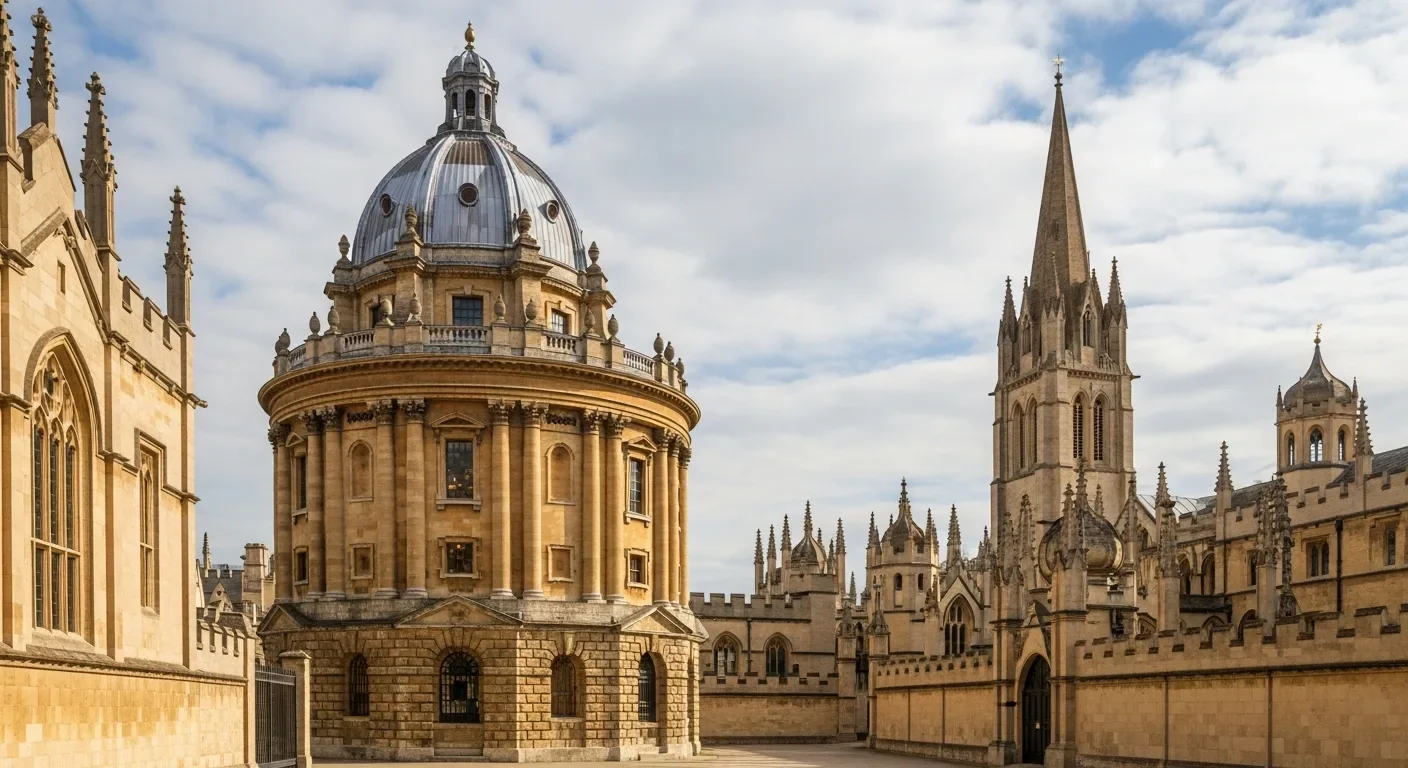
Photos: Wikimedia Commons
You’re sitting in a small room in one of Oxford’s colleges. Outside - stone walls, ivy, and a rainy sky. Across from you sits a professor in a worn sweater, who has just placed a sheet of paper with an equation you’ve never seen before. Or perhaps they’ve handed you a fragment of text in a language you don’t know and asked: “What can you tell me about the structure of this language based on what you see?” Your heart is pounding, your hands are slightly sweaty - but this isn’t the moment to prove how much you know. This is the moment to show how you think.
An Oxbridge interview isn’t an oral exam. It’s not a job interview. It’s not a knowledge quiz. It’s a simulation of what your studies would be like - the weekly tutorials at Oxford or supervisions at Cambridge, where you sit one-on-one with a distinguished academic and solve a problem together. If you understand this one thing, you’ll understand everything you need to know about preparation.
Every year, thousands of candidates from around the world - including international applicants - face this challenge. Many are academically brilliant but stumble at the interview because they didn’t know what to expect. Not because they weren’t strong enough. But because no one told them that an Oxbridge interview operates under entirely different rules than anything they had encountered before. This guide will change that. I’ll walk you through the format, typical questions, answer strategies, differences between Oxford and Cambridge, the specifics of US university interviews, preparation for medicine and law interviews, and finally - a concrete preparation plan you can start today.
If you’re not yet familiar with the admissions process for these universities, start with our guides: studying at Oxford University and studying at Cambridge University. And if you’re just considering studying in the UK and don’t know how the UCAS system works - read our guide to applying through UCAS.
Why do universities conduct interviews?
Before you start preparing, you need to understand why Oxford, Cambridge, and other top universities even invite candidates for interviews. It’s not a formality, and it’s not a stage you can “pass” with memorized answers.
The Oxbridge interview exists for one reason: grades and predicted grades don’t tell you how you think. You might have excellent scores in every subject in your high school exams and simultaneously be someone who perfectly memorizes material but struggles to apply it in a new situation. Oxford and Cambridge aren’t looking for people who can repeat what they’ve learned. They’re looking for people who can think on their feet - absorb new material, analyze it, draw conclusions, and respond to prompts.
Here’s what tutors actually assess:
- Thought process - how you arrive at an answer, not just the answer itself. The tutor wants to see how you break down a problem, what assumptions you make, and why.
- Intellectual flexibility - can you change your approach when something isn’t working? Do you respond to the tutor’s hints and build new reasoning upon them?
- Curiosity and enthusiasm - is it clear that you enjoy thinking about the subject? Do you ask follow-up questions? Do you spot connections that weren’t explicitly suggested?
- Resilience under pressure - can you think clearly when you don’t know the answer? Do you say “I don’t know, but I’ll try this…” instead of falling silent?
- Ability to learn in real-time - an interview is effectively a mini-lesson. The tutor gives you new material and observes how quickly you grasp it and what you do with it.
In other words: the interview answers a question that no written exam can - will this candidate thrive in the tutorial/supervision system? Will they be able to get the most out of a weekly hour with a professor? Will they be a partner in academic discussion, rather than a passive recipient of knowledge?
That’s why memorized answers are useless. Tutors ask questions for which there is no single correct answer - or for which the answer requires thinking that cannot be prepared in advance. An interview is not a test of knowledge. It’s a test of potential.
What an Oxbridge interview assesses
Not encyclopedic knowledge - but thought process and academic potential
Source: University of Oxford Admissions, University of Cambridge Admissions - official interview process descriptions
Oxford vs Cambridge - differences in interview format
Although Oxford and Cambridge are collectively known as Oxbridge, their interviews differ in several key aspects. If you’re applying to one of these universities, you need to know exactly what to expect - because preparing for an Oxford interview is a bit different from preparing for Cambridge.
Oxford typically conducts 2-4 interviews, each lasting 20-30 minutes. Interviews take place at the college you applied to - but if your application is strong, you might be invited for an additional interview at another college (a so-called open offer interview or winter pool interview). Oxford more often gives you material to work on during the interview - a text excerpt, an equation, a graph, experimental data - and observes what you do with it. The format is more “problem-solving live.” For international applicants (including those from traditional education systems), interviews are conducted online via Microsoft Teams - since the COVID-19 pandemic, Oxford has maintained this format for overseas applicants.
Cambridge usually conducts 2-3 interviews, also 20-30 minutes each, but Cambridge has a stronger tradition of pooling - if the college you applied to doesn’t offer you a place, your application might be sent to another college, which may then invite you for an additional interview (the Winter Pool). Cambridge places a slightly greater emphasis on discussion and deepening answers - the tutor more often asks “why do you think that?” and guides you deeper into the topic. For international applicants, Cambridge also conducts interviews online, although some colleges may require an in-person visit for selected courses.
A key difference concerns admissions tests: at Oxford, admissions tests (MAT, PAT, TSA, LNAT) are taken before the interview, and their results influence the decision to invite you. At Cambridge, some tests (e.g., the former STEP) are taken after receiving a conditional offer, although ESAT and TMUA are taken before the interview. This means that at Oxford, the filter before the interview is stricter - a smaller percentage of candidates are invited.
| Aspect | Oxford | Cambridge |
|---|---|---|
| Number of interviews | 2-4 (including potential additional college interview) | 2-3 (+ potential from Winter Pool) |
| Duration | 20-30 minutes each | 20-30 minutes each |
| Timing | December (approx. 2 weeks) | December (approx. 2 weeks) |
| Format for international candidates | Online (Microsoft Teams) | Online (most common) |
| Question style | On-the-spot material - live problem-solving | Discussion and deepening - "why do you think that?" |
| Admissions tests | Before interview (MAT, PAT, TSA) - filter for invitation | Some before (ESAT, TMUA), STEP after conditional offer |
| Pooling | Open offer interview at another college | Winter Pool - strong tradition, frequent additional interviews |
| % invited | ~50-60% of candidates (after test filter) | ~75-80% of candidates |
Interview format - what to expect step-by-step
Regardless of whether the interview takes place at Oxford, Cambridge, or online, the typical process looks like this:
Before the interview. You receive an invitation by email, usually in November. For online candidates - a meeting link and technical instructions (check camera, microphone, internet connection). For in-person candidates - information about the college, date, time, and accommodation (many colleges offer free lodging).
Start of the interview. The tutor introduces themselves, eases the atmosphere, and asks about your journey or how your day is going. This isn’t assessed - it’s a moment to catch your breath. It lasts 1-2 minutes.
Main phase (15-25 minutes). The tutor asks questions related to your subject. They might give you material to read (text, equation, graph, image), wait a moment, and then ask for your comments. They might ask a question directly. Key point: the tutor guides you through the problem, adding hints and probing questions. It’s not a monologue - it’s a dialogue.
Conclusion. The tutor asks if you have any questions. You can ask something related to the course or college - this isn’t assessed, but it shows interest.
Duration of one interview: 20-30 minutes. Most candidates have 2-3 interviews spread over 1-2 days. Each interview is conducted by a different tutor and covers a different aspect of your subject.
Online vs. in-person. If you are an international candidate, your interview will most likely be online. The format is identical - the tutor may share their screen with material or ask you to write on a virtual whiteboard (e.g., Oxford sometimes uses a whiteboard for mathematics). Make sure you have:
- A stable internet connection (preferably wired, not Wi-Fi)
- A quiet, well-lit room
- A camera at eye level
- Paper and pen handy (inform the tutor you’ll be writing)
- A Plan B in case of technical failure (college phone number)
Sample interview questions - by subject
This is the section you’re looking for - specific examples of questions asked in interviews. Remember: the point is not for you to know the answers to these questions in advance. The point is for you to understand their style and practice thinking aloud on similar problems.
Sample Oxbridge Interview Questions
Real questions from official Oxford and Cambridge collections - practice thinking, not answers
Source: University of Oxford Sample Interview Questions 2024, University of Cambridge Admissions - publicly available examples
Mathematics and Sciences. Questions are usually computational or proof-based - you’re given a problem you haven’t seen before and must solve it step-by-step in front of the tutor. The tutor provides hints if you get stuck. Common topics: algebraic manipulation, logic, proving, estimation (Fermi problems), applications of geometry.
Humanities and Social Sciences. You’ll receive a text excerpt (a poem, an article, a historical source) to read on the spot - you’ll have 5-10 minutes to read it - and then discuss it with the tutor. Questions relate to interpretation, argumentation, and evaluation of evidence. For PPE and Economics, questions like “how would you solve this social problem?” are common - the tutor tests whether you can view a problem from multiple angles.
Natural Sciences and Medicine. A combination of scientific knowledge and logical reasoning. You might be given experimental data and asked to interpret it, or a biological/chemical problem to solve from first principles. For Medicine - ethical questions (e.g., “who should receive a kidney transplant if there’s only one available - a 30-year-old with two children or a 60-year-old who is a brilliant surgeon?”) and questions demonstrating scientific thinking.
How to think aloud - a crucial skill
Thinking aloud is the most important skill for an interview and simultaneously the one that candidates from traditional education systems most often neglect to practice. In many education systems, we are taught to provide ready-made answers. In an Oxbridge interview, you must show the path to the answer, even if (and especially when) you don’t know it yet.
What does this mean in practice?
Imagine the tutor asks: “How many petrol stations are there in the UK?” You don’t need to know the answer. You need to say aloud:
“Okay, I’ll try to estimate. The UK population is about 67 million. How many cars per person… maybe 0.5? So about 33 million cars. How many cars does one station serve per day… maybe 200? How many days a year - 365. One car refuels maybe once every two weeks, so 26 times a year. The demand is 33 million times 26… about 860 million refuels annually. One station does 200 refuels a day, which is 73,000 annually. So, you need about 860,000,000 / 73,000… around 12,000 stations? Probably inaccurate, but the order of magnitude should be about right.”
This is thinking aloud. The tutor doesn’t care if the answer is 8,000 or 12,000. They care about how you arrived at the estimate - what assumptions you made, whether you can verify them, and whether you react to feedback (the tutor might say: “what if some cars are electric?”).
How to practice this?
- Every day for 15 minutes, solve a problem aloud - to yourself or with someone listening. It could be a math puzzle, a philosophical question, a Fermi problem.
- Record yourself on your phone and listen back. You’ll notice where you go silent, where you say “um,” and where you lose your train of thought.
- Practice with another person who plays the role of the tutor - interrupting, asking questions, giving hints. This is the most effective method and exactly what we offer as part of mock interviews at College Council - our mentors, Oxford and Cambridge alumni, recreate realistic interview conditions.
- Don’t be afraid to say “I don’t know” - but always add “…but I’ll try this:”. Silence is worse than a wrong answer spoken aloud.
Types of interviews - problem-solving, text-based, experiment-based
Oxbridge interviews are not uniform. Depending on the subject and college, you might encounter one of three main formats - or a combination thereof.
Problem-solving is the most common format for science subjects. The question is deliberately designed so that you don’t know the answer immediately - because the tutor wants to see how you construct it. A typical progression: you get a problem, you try an intuitive approach, the tutor asks “why?”, you change or deepen your approach, the tutor gives a hint, you build on it. It’s an iterative dialogue, not a one-off answer.
Text-based interviews dominate in the humanities. The tutor deliberately gives you a text you couldn’t have read beforehand to level the playing field - it’s not about how many books you’ve read before the interview, but how you analyze new material. Key: start with observations (what you see in the text - form, style, language, arguments), then interpretation (what it means), then evaluation (is it convincing and why).
Experiment-based interviews are common in natural sciences and medicine. You receive data, a graph, or an experiment description - sometimes something that looks like an excerpt from a scientific article - and you must draw conclusions. The tutor tests whether you think like a scientist: do you consider control variables, do you spot limitations, do you propose alternative explanations?
US university interviews - how they differ from the UK
If you’re applying to universities in both the UK and the USA - as many of our students do at College Council - you need to know that interviews at Harvard, Stanford, or MIT operate under completely different rules than at Oxbridge. You can read more about applying to these universities in our guides: how to get into Harvard and how to get into Stanford.
Oxbridge interview = intellectual test. Questions relate to your subject. The tutor wants to see how you think academically. Extracurricular activities are practically not discussed.
US interview = holistic conversation. The interviewer (usually a university alumnus) wants to get to know you as a person - your passions, motivations, community involvement, what you do outside of school. Questions are personal: “Tell me about yourself,” “What are you passionate about?”, “What was the most challenging moment in your life and what did you learn from it?”. This is not an academic test - it’s an assessment of your fit with the university’s culture.
Key differences:
| Aspect | Oxbridge (UK) | Ivy League / Top US |
|---|---|---|
| Interview Goal | Test of academic potential | Holistic assessment |
| Interviewer | Professor / academic tutor | Alumnus |
| Questions | Subject-specific, problem-solving | Personal, motivational |
| Preparation | Practice problem-solving aloud | Prepare your “story” and reflections |
| Weight in Decision | Significant - can determine offer | Supplementary - rarely decisive on its own |
| Duration | 20-30 min, 2-4 sessions | 30-60 min, usually 1 session |
For a US interview, prepare your story - who you are, what’s important to you, why this university (and be specific - not “because it’s good,” but “because Professor X conducts research on Y, which fascinates me”). Prepare 3-4 anecdotes from your life that illustrate your values and characteristics. And be yourself - American universities value authenticity above all else.
For Oxbridge, prepare academically - read beyond the curriculum, solve problems, practice thinking aloud. For Harvard - prepare to talk about yourself. Ideal preparation combines both approaches - and that’s exactly what we offer at College Council, where our mentors include alumni from both Oxbridge and Ivy League universities.
Medicine, Law, Veterinary Medicine - interview specifics and MMI format
If you’re applying for Medicine, Law, or Veterinary Medicine, your interview will have additional elements not found in other subjects. These fields require not only academic ability but also soft skills - communication, empathy, ethical reasoning - which the interview aims to verify.
Medicine at Oxbridge combines standard academic interviews (scientific questions) with ethical and situational questions. You might hear:
- “You have one kidney donor and two patients - a 30-year-old with two children and a 60-year-old who is a brilliant surgeon. To whom would you allocate the kidney and why?”
- “Tell me about a scientific article you’ve read recently. What was interesting about it, and what raised doubts?”
- “A patient refuses life-saving treatment for religious reasons. What do you do?”
Crucially, tutors are not looking for one “right” answer. They are looking for your ability to consider the problem from multiple angles, acknowledge ethical complexity, and clearly communicate your reasoning.
MMI - Multiple Mini Interview is a format used by many medical schools in the UK (though not by Oxford or Cambridge, which maintain a traditional format). In an MMI, you go through 6-10 short stations (5-8 minutes each), where you face various scenarios: an ethical discussion, a role-play (e.g., talking to a “patient”), data analysis, a practical task, a question about motivation. MMI tests a broader spectrum of competencies than a traditional interview.
Law - interviews for Law (both Oxford Jurisprudence and Cambridge Law) focus on legal reasoning. You don’t need to know the law - the tutor will give you a hypothetical situation and test how you construct an argument. Key: distinguishing law from morality, analyzing conflicting arguments, linguistic precision.
Oxford/Cambridge: traditional format, 2-3 interviews
Requires LNAT (Oxford) / CLT (Cambridge from 2025)
Preparation strategy - 2-3 months before the interview
Oxbridge interviews usually take place in the first or second half of December. You receive an invitation (or notification of no invitation) in November. This means you have approximately 6-8 weeks from submitting your UCAS application (October 15th) until the interview. How should you use this time?
Week 1-2: Revisit your Personal Statement. Every tutor has read your PS and can ask about anything you wrote in it. If you mentioned a book - read it again. If you wrote that you’re fascinated by game theory - be ready to answer a question about the prisoner’s dilemma or Nash equilibrium. Nothing makes a worse impression than a candidate who cannot elaborate on what they themselves wrote.
Week 3-4: Thinking aloud. Spend 15-20 minutes daily solving problems aloud. Where to find questions? Oxford’s website publishes official sample interview questions - an excellent starting point. Cambridge has a similar page with advice. Also, use resources like our TOEFL app for practicing language exams, and our SAT app for an academic database.
Week 5-6: Mock interviews. This is an absolutely crucial element of preparation - and unfortunately, the one most often overlooked. Thinking aloud in an empty room is one thing. Doing it under pressure, with a live person opposite you who reacts, interrupts, and asks unexpected questions - that’s a completely different level of pressure. A mock interview allows you to experience interview stress in a safe environment and learn lessons before the real conversation.
Where to get a mock interview? Your subject teacher can help, but ideally - someone who knows the Oxbridge format from personal experience. At College Council, our mentors are Oxford, Cambridge, Harvard, and Stanford alumni who conduct realistic mock interviews and provide detailed feedback. Learn more about our UK university preparation services: /en/blog/how-to-apply-ucas-uk-complete-guide.
Week 7-8: Refinement. The final round of mock interviews. Read current articles in your field (tutors like to ask about topical issues - e.g., for Medicine: “what do you think about the latest CRISPR research?”; for Economics: “what will be the effects of policy X?”). Prepare a short answer to “why this subject?”, but don’t memorize it - let it sound natural.
Mock interviews - why they are essential
You can prepare for an interview independently. But there’s one thing that cannot be replaced by any amount of self-study - the experience of sitting opposite someone who plays the role of your future tutor.
Why are mock interviews so important?
-
Live stress is different. Solving problems aloud in a room is practice. Doing it under the watchful eye of another person, with time constraints and the awareness that you are being assessed - that’s a completely different level of pressure. A mock interview allows you to get used to this.
-
Feedback you can’t give yourself. You don’t see that you’re speaking too quietly, avoiding eye contact, giving up on an approach too quickly, or not responding to hints. A mentor sees these things.
-
Practice reacting to surprises. In a real interview, the tutor will ask you a question you don’t expect. A mock interview gives you the experience of dealing with surprise - and builds confidence that you can manage, even when you don’t know.
-
Answer structure. A mentor will help you build the habit: “observation → hypothesis → testing → conclusion.” This structure works for every Oxbridge interview.
How many mock interviews do you need? A minimum of 3-5. Ideally: 2 at the beginning of your preparation (to identify weak points) and 2-3 in the last two weeks (to be in top form for the interview). Our students at College Council typically undergo 4-6 mock interview sessions with Oxford and Cambridge alumni, each lasting 45-60 minutes and including detailed debriefing.
Common mistakes - and how to avoid them
After conducting hundreds of mock interviews with international candidates, we see recurring patterns. Here are the most common mistakes and their antidotes.
Mistake #1: Silence. In many traditional educational cultures, silence means thinking. In an Oxbridge interview, silence means the tutor cannot see your thought process - and that’s the only thing they’re interested in. If you need a moment, say: “Give me a second, I want to think this through…” and then speak.
Mistake #2: Memorized answers. Tutors have been conducting interviews for years. They recognize a memorized answer in a second - and will immediately change the question to push you out of your comfort zone. Don’t learn answers. Learn how to think.
Mistake #3: Ignoring hints. When a tutor gives you a hint, it’s not a sign that you’re answering incorrectly. It’s an invitation to collaborate - exactly what your tutorials would be like. Candidates who build on the tutor’s hints perform much better than those who ignore them and continue on their own path.
Mistake #4: Paralysis after a mistake. Did you make a calculation error? Did you say something that didn’t make sense? It happens. The key is what you do next - do you correct your course, say “that didn’t work because…, I’ll try a different way,” and move on. Resilience to error is a quality tutors value.
Mistake #5: Lack of curiosity. An interview is not an exam - it’s a conversation. The best candidates show genuine interest in the problem. They say: “That’s an interesting question because…”, “I wonder if…”, “What if we changed one assumption?”. This curiosity is contagious - and it’s exactly what tutors are looking for in a future student.
On interview day - practical tips
What to wear? Oxbridge does not require formal attire. Dress neatly but comfortably - so you feel like yourself. A shirt or smart sweater for boys, a blouse or sweater for girls. A suit is unnecessary and can look stiff. For an online interview - ensure a neat appearance from the waist up and a neutral background.
How to deal with stress? Nerves are normal - everyone has them. A few proven strategies:
- Box breathing: 4 seconds inhale, 4 seconds hold, 4 seconds exhale, 4 seconds hold. Repeat 5 times before the interview.
- Power posing: 2 minutes in a confident stance (standing straight, hands on hips) genuinely lowers cortisol. Do this in the bathroom before the interview.
- Perspective: Even if you don’t get an offer, the experience is valuable. An Oxbridge interview is an interesting intellectual dialogue - try to treat it as such.
Food and sleep: Eat a solid breakfast (protein + complex carbohydrates, not just sugar). Drink water. Don’t drink coffee if you don’t usually - caffeine jitters are the last thing you need. Go to bed at your usual time - your brain needs sleep to function well.
Online interview - checklist:
- Test your camera and microphone the day before
- Internet connection: preferably Ethernet cable, not Wi-Fi
- Close all unnecessary applications (especially those with notifications)
- Inform household members not to disturb you
- Have handy: paper, pen, calculator (if allowed), a glass of water
- Have the college’s phone number in case of technical failure
- Log in 10 minutes early
College Council - your partner in interview preparation
Preparing for an interview at Oxbridge, Harvard, or Stanford is a process that doesn’t have to be undertaken alone. At College Council, we have been helping international high school students successfully navigate this stage for years.
What do we offer?
Mock interviews with top university alumni. Our mentors are graduates of Oxford, Cambridge, Harvard, and Stanford, who have been through this process themselves and know exactly what tutors are looking for. Each mock interview session lasts 45-60 minutes and includes a realistic simulation of the conversation, along with detailed feedback on answer content, thought structure, non-verbal communication, and strategy.
Preparation for UK universities: Full support from course selection, through Personal Statement, admissions tests (MAT, PAT, TSA, ESAT, TMUA), all the way to interview preparation. Details: /en/blog/how-to-apply-ucas-uk-complete-guide.
Preparation for US universities: Application strategy, essays, interview coaching in the alumni interview format. Read more about our approach to US university applications.
Free initial consultation: Don’t know where to start? Schedule a free call with our advisor: /en/contact. We’ll assess your profile and propose a preparation path tailored to your goals.
Our students annually gain admission to Oxford, Cambridge, Imperial, UCL, LSE, as well as Harvard, Stanford, MIT, and other Ivy League universities. The interview is the stage where preparation makes the biggest difference - and it’s the stage where we can help you the most.
Are Oxbridge interviews mandatory?
Are interviews conducted in English?
How many interviews will I have and how long do they last?
Are interviews for international candidates conducted online?
Can I ask for a question to be repeated during the interview?
What if I don't know the answer to a question?
Is a Harvard interview the same as an Oxbridge interview?
How much do mock interviews cost and how do I sign up?
When will I find out if I received an offer after the interview?
Summary - the interview is an opportunity, not an obstacle
The Oxbridge interview is a stage that most candidates fear - but it’s also the stage where preparation makes the biggest difference. Unlike school grades (which you can’t change in a week) or admissions tests (whose format is rigid), the interview is a live conversation where you can distinguish yourself through your way of thinking, curiosity, and ability to respond to new challenges.
Remember:
- The interview is not a knowledge test - it’s a tutorial/supervision simulation
- Think aloud - silence is the only truly bad signal
- Respond to hints - it’s an invitation to collaborate
- Mistakes are normal - what you do next is what counts
- Mock interviews are the most effective way to prepare
If you plan to apply to Oxford, Cambridge, or other top UK universities, start preparing for the interview now - don’t wait for an invitation in November. The more time you dedicate to practicing thinking aloud and mock interviews, the more confident you’ll feel in December.
Next steps
- Read the guide for your university - Oxford or Cambridge - and find the interview section for your course
- Find sample questions - on the official Oxford and Cambridge websites, as well as on our TOEFL app and our SAT app for academic preparation
- Start practicing thinking aloud - 15-20 minutes daily, record yourself and listen back
- Schedule a mock interview - with a teacher, mentor, or at College Council with an Oxbridge alumnus
- Don’t forget about UCAS and your Personal Statement - read our UCAS guide and how to write a Personal Statement
Read also
- Studying at Oxford University - a complete guide for international students 2026 - requirements, costs, courses, interviews, scholarships
- Studying at Cambridge University - a complete guide 2026 - admissions, supervision system, colleges, costs
- How to apply through UCAS - a step-by-step guide - deadlines, form, Personal Statement, references
- Studying at Imperial College London - a guide - an alternative for science and engineering in London
- How to get into Harvard - a complete guide - application, essays, interviews, and strategies for international candidates
Last updated: February 9, 2026. Information on interview formats, deadlines, and requirements may change - always verify on the official websites of University of Oxford and University of Cambridge.