
1636
Founding Year
Oldest university in the USA - 390 years of tradition
Harvard is in Cambridge, not Boston. Explore Harvard Yard, the House system, student life, New England climate, and real living costs in America's top college town.

Photos: Wikimedia Commons
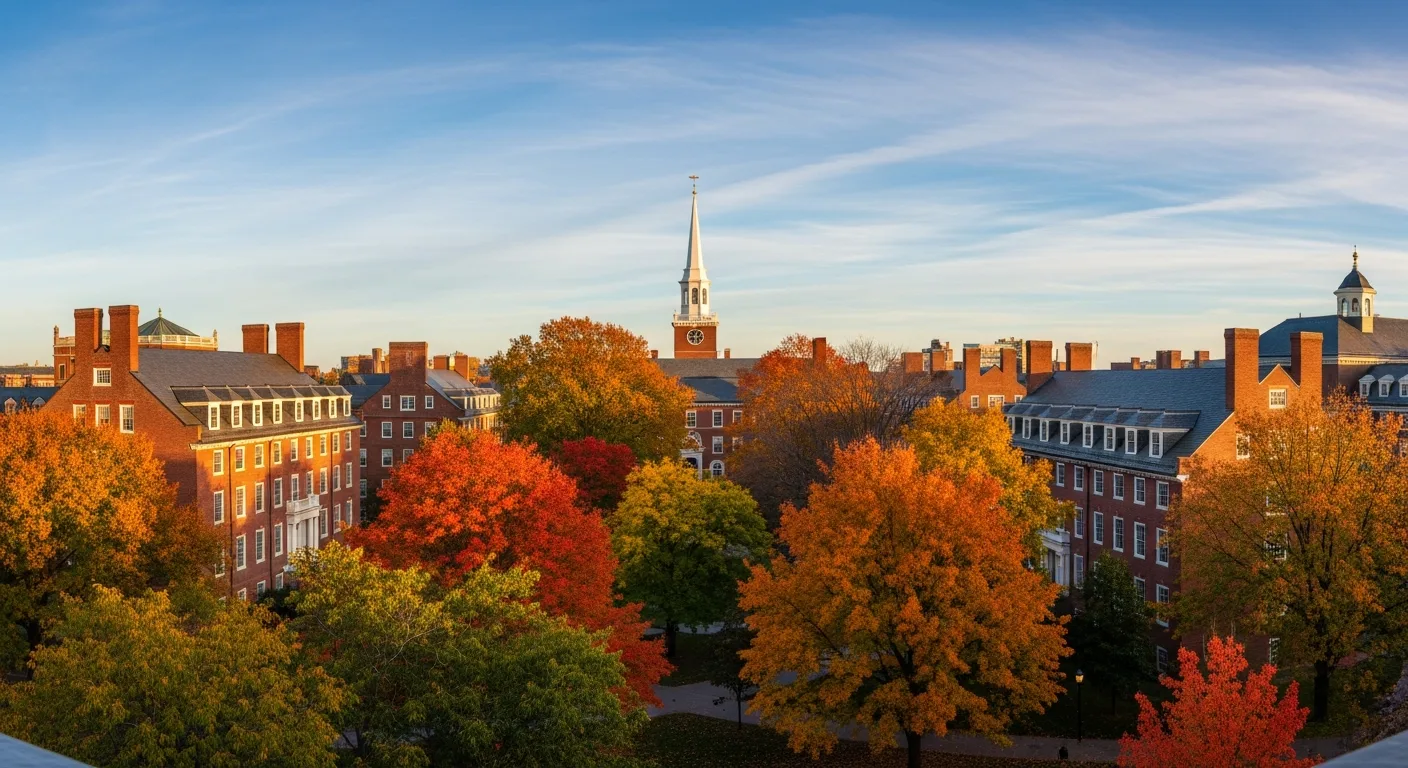
You stand in the middle of Harvard Yard on the first weekend of October. Under your feet, cobblestones dating back to the 18th century; above your head, the crowns of oaks and maples, just beginning to change from deep green to an exploding mix of orange, gold, and crimson. To your left, Massachusetts Hall, the oldest building on campus, erected in 1720. To your right, Widener Library with its monumental columns, behind which lie over 3.5 million volumes. Around you, students from six continents - wearing “VERITAS” hoodies - sit on the grass, head to a seminar section, or run to rowing practice on the Charles River. The air smells of leaves and espresso from nearby Harvard Square.
This isn’t a scene from a movie. This is a typical Tuesday in Cambridge, Massachusetts - a city that, since 1636, has been home to Harvard University, the oldest and most frequently cited institution of higher learning in the United States. Harvard is not in Boston; though the border between the two cities is so fluid that even locals sometimes get confused. Cambridge is a separate city with its own mayor, police, and identity, but it’s connected to Boston by bridges over the Charles River, a subway line (the Red Line), and the continuous urban fabric of the metropolitan area known as Greater Boston.
In this guide, I’ll walk you through everything you need to know about Harvard’s location: from the campus layout (Harvard Yard, the residential House system, riverside buildings) to Boston and Cambridge as a student city, the New England climate, flights from Europe to Boston, and the realistic cost of living in one of the most expensive regions of the USA. If you’re considering applying to Harvard, this article will give you a complete picture of the place where you could spend the four most formative years of your life.
To understand where Harvard is, you first need to understand Cambridge. This city, covering just 18 sq km (7 sq miles), is home to two of the world’s best universities - Harvard University and Massachusetts Institute of Technology (MIT) - as well as dozens of smaller colleges, research laboratories, and think tanks. With 118,000 residents, it hosts over 35,000 students. This proportion makes Cambridge arguably the most academic city on the planet.
Cambridge lies on the north bank of the Charles River - a river that separates it from Boston and is also one of New England’s most beautiful spots. Along the river stretches the Charles River Esplanade, miles of paths for running, cycling, and walking, with views of the Boston skyline on one side and Cambridge’s church spires on the other. In spring and autumn, the riverbanks fill with runners, rowers, and the boats of the Harvard rowing club practicing on the water.
Cambridge itself is divided into several distinct neighborhoods. Harvard Square - the city’s heart and the most important landmark for students - is a plaza surrounded by bookstores (the legendary Harvard Book Store has been operating since 1932), cafes, restaurants, and shops. The Harvard Square subway station on the Red Line is your main connection to Boston (20 minutes to downtown). Kendall Square, closer to MIT, is one of the world’s most important clusters of biotechnology and technology companies - home to Google, Amazon, Meta, Moderna, and dozens of startups. Central Square, between Harvard and MIT, offers a more urban, multicultural vibe with cheaper restaurants and bars.
The Greater Boston region, encompassing Cambridge, Boston, Somerville, Brookline, and a dozen other cities, is often called “the Athens of America.” And this is no exaggeration: within a 12-mile (20 km) radius of Harvard Yard, you’ll find over 100 institutions of higher education, including MIT, Boston University, Tufts, Northeastern, Boston College, Berklee College of Music, and Wellesley College. This concentration of academic talent creates an ecosystem where students from different universities mingle at parties, debate clubs, hackathons, and cafes. As a Harvard student, you can freely attend lectures at MIT (and vice versa) thanks to the cross-registration program.
Harvard Yard is the emotional and geographical center of the university; a rectangular, fenced area of about 9 hectares (22 acres), through which thousands of students, tourists, and professors pass daily. When Americans think of Harvard, they envision the Yard: brick buildings with ivy on the walls, the statue of John Harvard (whose shoe tourists rub “for luck” - students know it’s a photo trap), and trees that turn into a painter’s palette in autumn.
Massachusetts Hall (1720), the oldest building, now houses the university president’s office. Widener Library, built in 1915 in memory of alumnus Harry Elkins Widener, who died on the Titanic, is the third-largest library in the USA with over 3.5 million volumes and 57 miles (92 km) of shelves. Opposite stands Memorial Church, a neoclassical church from 1932, the spiritual heart of the campus. All freshmen live in the Yard - in historic dormitories such as Hollis Hall (1763), Stoughton Hall, and Thayer Hall. This tradition builds a sense of community from day one: it doesn’t matter if you’re from Mumbai, Lagos, or San Francisco, everyone starts in the Yard.
After their first year, students move into one of the 12 residential Houses - student residences located mainly along the Charles River. The House System is the heart of Harvard’s social life, modeled after the colleges of Oxford and Cambridge. Each House - Adams, Lowell, Dunster, Eliot, Leverett, Mather, Quincy, Winthrop, Kirkland, Pforzheimer, Cabot, Currier - has its own dining hall, library, common room, gym, and even a theater and darkroom. Each House also has its own Faculty Dean (a professor living with their family in the House) and Resident Tutors (Ph.D. students who serve as mentors). The Houses organize formals (formal dinners), intramural sports (athletic competition between Houses), cultural events, and traditions that have been upheld for decades.
Across the river, in Allston, Harvard is dynamically expanding its campus. In 2021, the Science and Engineering Complex (SEC) opened; a massive building with laboratories that symbolizes the growing role of STEM fields at a university traditionally perceived as humanities-focused. Allston is also home to Harvard Business School - a separate, luxurious campus with famous amphitheater-style rooms for case studies - and Harvard Stadium (1903), the oldest concrete stadium in the world, capable of seating 30,000 spectators for American football games. Further into Boston, in the Longwood Medical Area, operates Harvard Medical School with a network of teaching hospitals, including Massachusetts General Hospital - one of the best hospitals in the world.
It’s worth noting that Harvard boasts the largest academic library system in the world: 73 libraries with a combined collection of over 17 million volumes. In addition to Widener, students use Lamont Library (the only one open 24/7), Houghton Library (rare manuscripts), and dozens of specialized collections. If you’re interested in majors at Harvard, remember that these library and research resources are one of the main reasons Harvard remains number one in global rankings.
The main airport serving Boston and Cambridge is Boston Logan International Airport (BOS), located just 13 km (8 miles) from Harvard Yard, across the bay. From Europe, several airlines fly into Boston, either directly from major capitals or with a single layover via hubs such as Frankfurt (Lufthansa), Amsterdam (KLM), and London Heathrow (British Airways) - total travel time with a layover is typically 9-14 hours. From other parts of the world, you will usually connect through a European hub or through a US gateway such as New York.
Ticket prices range from 580 EUR / 630 USD (promotional offers with a layover, booked in advance) to 1,160-1,630 EUR / 1,280-1,790 USD during peak season (August, December). Student baggage programs and discounts for extra luggage are available with most carriers; it’s worth asking. From Logan Airport to Harvard Square, you can get there in 45 minutes by subway (Blue Line + Red Line, 2.40 USD), or by taxi or Uber in 20-30 minutes (25-40 USD depending on traffic). Harvard also organizes a shuttle bus from the airport for new students at the beginning of the semester.
An alternative is to fly to New York (JFK or Newark) - tickets there can be more frequent and cheaper; from there, an Amtrak train to Boston South Station (4 hours, from 49 USD) or a bus (Peter Pan, FlixBus - from 15 USD, 4-5 hours). From South Station, the Red Line goes to Harvard Square in 25 minutes. This option requires more time but can save a few hundred euros/dollars on the flight ticket.
It’s important to know that as an international student, you will need an F-1 visa to study in the USA. The visa process is a separate topic; you can find a detailed description in our guide to the US college application process. The F-1 visa allows for legal on-campus employment (up to 20 hours per week) and is valid for the entire duration of your studies.
Boston is one of the best student cities in the United States - and this isn’t a subjective opinion, but a consequence of simple math. Over 250,000 students study in the Greater Boston metropolitan area. This critical mass of young, ambitious people creates an environment where education, culture, sports, and entrepreneurship intertwine at every turn.
As a Harvard student, your daily world revolves around Harvard Square, a plaza that is simultaneously a subway station, a shopping center, a meeting place, and a stage for street musicians. The Harvard Coop (a student cooperative since 1882) is a multi-story bookstore and Harvard merchandise shop. Nearby are Leavitt & Peirce (since 1883), The Brattle Theatre (one of the last art-house cinemas in America), and dozens of restaurants: from inexpensive Asian eateries (Hokkaido Ramen, a portion for 14 USD) to elegant venues for special occasions. A five-minute walk in the other direction leads to Cambridge Common, a park where George Washington took command of the Continental Army in 1775.
Boston, across the river, offers even more. Back Bay with its elegant Newbury Street (Boston’s Champs-Élysées), the North End (the Italian district with the best cannoli on the East Coast), the Seaport District (modern restaurants and galleries), and Fenway Park (the legendary home of the Boston Red Sox baseball team - a game is a must-do experience). Culture? The Museum of Fine Arts (one of the largest art museums in the USA, free admission for Boston-area students), the Isabella Stewart Gardner Museum, the Boston Symphony Orchestra. Summer concerts at the Hatch Shell on the Charles River are free and gather thousands of people with blankets and picnics.
Transportation within the city is simple: the MBTA (popularly “the T”), the subway and bus system, covers all of Greater Boston. A monthly student pass costs 84.00 USD (with a student LinkPass discount). Many Harvard students don’t even need a pass; the campus is compact, and Harvard provides a free Harvard Shuttle running between main buildings. Biking is a popular option in spring and autumn (BlueBikes - the city’s bike-sharing system, 99 USD/year), though winter snows effectively limit this option for several months.
International students in Boston find support within the region’s diverse communities. Greater Boston is home to vibrant diaspora communities from around the world, with their own places of worship, restaurants, shops, and cultural organizations. At Harvard itself, dozens of country- and region-specific student societies organize cultural nights, film screenings, holiday celebrations, and meetings with visiting guests - so you can usually find a community that connects you to home.
| Season | Months | Temperature | Characteristics | Comparison to Central Europe |
|---|---|---|---|---|
| Autumn (Fall) | September - November | 5°C - 22°C (41°F - 72°F) | Warm September, spectacular fall foliage, cool November | Similar, but drier and more colorful |
| Winter | December - March | -6°C - 4°C (21°F - 39°F) | Freezing, snowy, windy. Nor'easters - powerful snowstorms | Colder than many European capitals, more snow, strong ocean winds |
| Spring | April - May | 6°C - 19°C (43°F - 66°F) | Short and unpredictable. Blooming magnolias and cherry blossoms. | Similar, but more humid |
| Summer | June - August | 18°C - 32°C (64°F - 90°F) | Hot and humid. Most students leave for internships/home | Warmer and more humid |
Let’s be honest; the climate in Cambridge isn’t for everyone, and winter in New England is serious business. If you think winters in some parts of Europe are harsh, Boston can surprise you. The average temperature in January is -3°C (27°F), but with Atlantic winds (wind chill), the perceived temperature regularly drops to -15°C, -20°C (5°F, -4°F). A phenomenon called a nor’easter - a powerful snowstorm with winds from the northeast - can dump 30-50 cm (12-20 inches) of snow on the city overnight. In the 2024/25 winter season, over 120 cm (4 feet) of snow fell in total.
However, Harvard doesn’t shut down in winter. The university efficiently clears snow from campus, buildings are well-heated, and a tunnel connecting some buildings allows for dry passage. In winter, students spend more time in libraries, cafes, and their House common rooms. It’s worth investing in a good down coat (Patagonia, North Face, Canada Goose - bought at outlets, they can be significantly cheaper than in Europe), waterproof boots, and layering clothing. Students from regions with continental winters may find it more manageable than those from warmer climates like California or Texas; but the oceanic wind is a different caliber than the frost in many European cities.
The compensation for the harsh winter is New England autumn - one of the most beautiful natural sights in the world. From late September to mid-November, tree leaves change colors to intense oranges, reds, and golds. This phenomenon, known as fall foliage, attracts millions of tourists to New England, and as a Harvard student, you have it literally outside your window. A weekend trip to Vermont (3 hours by car) or the White Mountains in New Hampshire is a Harvard autumn semester tradition.
Summer in Boston (June - August) is hot and humid; 28-32°C (82-90°F) with high humidity. Most students leave for summer internships (to New York, San Francisco, Washington D.C.) or research programs, but those who stay enjoy the beaches of Cape Cod (1.5 hours by car), sailing on the Charles River, and free outdoor concerts.
There’s no denying it: Boston and Cambridge are among the most expensive cities in the United States - alongside San Francisco, New York, and Los Angeles. But, and this is a crucial context, if you get into Harvard, the costs look completely different than you might expect. Harvard applies a 100% need-met financial aid policy: if you are admitted, the university will cover the difference between what your family can afford to pay and the full cost of attendance. Families with an income below 85,000 USD per year pay nothing; zero tuition, zero for accommodation, zero for food. For families with an income of 85,000-150,000 USD, the contribution is 0-10% of their income. We’ve described the details in our guide to Harvard’s costs.
The full Cost of Attendance for Harvard for the 2025/2026 academic year is approximately 83,000 USD (approximately 78,000 EUR / 87,000 USD). Sounds astronomical? Indeed - but over 55% of students receive financial aid, and the average grant (non-repayable scholarship) is over 59,000 USD annually. For a typical international family with an average income, Harvard will likely be cheaper than many European universities, as it will cover almost all costs.
Even if your family doesn’t qualify for a full scholarship, realistic living costs in Cambridge/Boston for a student living off-campus (which is rare at Harvard; 98% of undergraduates live in student Houses) are as follows: a room in a shared apartment in Cambridge is 1,200-2,000 USD per month, food (cooking at home) 400-600 USD, MBTA transport 84 USD/month, phone 30-50 USD, entertainment 200-400 USD. In total, 2,000-3,100 USD per month (approximately 1,900-2,950 EUR / 2,100-3,250 USD). This is expensive - comparable to London, more expensive than Zurich, and many times more expensive than Copenhagen. But I repeat: for students living on campus with financial aid, costs can be zero.
Let’s be very honest about this, because the internet is full of articles promising “how to get into Harvard in 5 steps.” Harvard’s acceptance rate is 3.6%, meaning that out of ~57,000 applications in the 2024/2025 cycle, only ~2,050 people were admitted. From any given country, probably only a few dozen people apply annually, and only a handful at best are admitted - if any.
Harvard does not publish admission data by country, but realistic estimates indicate that 1-3 international students from a given country are admitted annually for undergraduate studies. This is not a reason not to try - but it is a reason to have realistic expectations and a strong list of alternative universities. If Harvard is your dream, you’ll find a detailed application plan in our guide “How to Get into Harvard”, and SAT practice exercises on various test preparation platforms.
What do you need to have a realistic chance? Outstanding high school leaving exam results (e.g., A-Levels, IB, or equivalent, with 95%+ in advanced subjects), an SAT score above 1530 (preferably 1550+), proficient English (TOEFL 110+ or IELTS 8.0+ - prepare using reputable test prep resources), exceptional extracurricular achievements at a national or international level (Olympiads, scientific research, social projects with real impact), and application essays that truly show who you are. Harvard seeks people who will change the world - and you must convince them that you are one of them.
Alternatives worth having on your list alongside Harvard: Yale, Princeton, Stanford, Columbia, MIT. In Europe - Oxford, Cambridge, ETH Zurich. Studying at Harvard is a dream worth pursuing; but a smart applicant always has a Plan B, C, and D.
| Criterion | Harvard (Cambridge, MA) | MIT (Cambridge, MA) | Stanford (Palo Alto, CA) |
|---|---|---|---|
| Location | Cambridge, Massachusetts | Cambridge, Massachusetts (1.5 km / 1 mile from Harvard) | Palo Alto, California (Silicon Valley) |
| Climate | 4 seasons, harsh winter, beautiful autumn | Identical (same city) | Mild all year, 300 days of sun, no winter |
| Nearest Major City | Boston (10 min by subway) | Boston (15 min by subway) | San Francisco (45 min by car) |
| Public Transport | Subway (Red Line), buses, walkable | Subway (Red Line), buses, walkable | Weak - car or bike needed |
| Flight from Europe | ~8 h (direct or one-stop to BOS) | ~8 h (same flight) | ~13-15 h (always with a layover to SFO) |
| Cost of Living (monthly) | 2,000-3,100 USD | 2,000-3,100 USD | 2,200-3,500 USD |
| Campus Character | Historic, brick, traditional, integrated with the city | Modernist, concrete, industrial | Sprawling, mission style, palm trees, open space |
| Atmosphere | Academic, intellectual, traditions, House System | Nerdy, hacking, problem-solving | Startup-focused, sunny, laid-back, outdoorsy |
| Acceptance Rate | 3.6% | 3.9% | 3.7% |
Life at Harvard revolves around the House System - and this is what distinguishes Harvard from most American universities. At the end of their first year, each student is randomly assigned to one of 12 residential Houses, where they live for the remaining three years. The House becomes your family: you eat breakfast and dinner in the House dining hall, study in the House library, party at House formals, and cheer for your House team in intramural sports. The rivalry between Houses (known as Housing Day, an annual lottery full of shouts and running across campus, is one of the most viral events of the year) creates a sense of belonging that defines the Harvard experience for many alumni.
Sports play a bigger role at Harvard than one might expect from a “nerdy” university. Harvard has 42 varsity teams (the highest level of intercollegiate sports), more than any other university in the country. The rivalry with Yale - The Game (an American football match) - is a celebration that draws thousands of alumni, and students paint themselves in university colors (crimson for Harvard). Rowing on the Charles River is a tradition dating back to 1844 - the Harvard - Yale Regatta is the oldest sporting event in US collegiate sports history. The campus also features the Murr Center (a modern fitness center), an ice rink, tennis courts, and swimming pools, all available free of charge to students.
Student organizations? Harvard has over 450 of them. From the Harvard Crimson (the student newspaper - the oldest daily student newspaper in the world, founded in 1873) to the Harvard Lampoon (a humor magazine from which creators of “The Simpsons” and “The Office” emerged), to the Harvard Model United Nations, Harvard Debate Council, and dozens of ethnic, political, scientific, and artistic organizations.
Weekends? Fridays and Saturdays are for parties in the student Houses (known as “formals,” elegant dinners with a dress code - and “study breaks,” less formal gatherings with food and music). Some students take weekend trips to New York (4 hours by bus, 15 USD FlixBus), to the White Mountains (hiking in autumn, skiing in winter, 2.5 hours by car), or to Cape Cod (beaches in summer, 1.5 hours by car). Cambridge and Boston also offer nightlife - Brick & Mortar, Sinclair, Paradise Rock Club are popular music venues, and Faneuil Hall Marketplace in Boston is a spot where students from a dozen regional universities meet.
Harvard University is not an abstract brand on a CV - it’s a specific place on the map: Cambridge, Massachusetts, seven bridges from Boston, on the Charles River, in the heart of America’s most academic region. It’s a campus where 18th-century brick buildings stand alongside state-of-the-art laboratories, where in autumn the leaves blaze with color, in winter the snow crunches underfoot, and in spring magnolias bloom around Memorial Church. It’s a city where, within a 20-minute walk from your student House, you’ll find MIT, dozens of cafes, museums, theaters, and one of the best public transportation networks in the United States.
But Harvard is also an exceptionally difficult goal - especially for an international applicant. A 3.6% acceptance rate, 1-3 international students from a given country annually, and astronomical requirements. If you plan to try, prepare thoroughly: start with the SAT exam (practice with test prep resources), achieve the highest level on TOEFL or IELTS (aim for TOEFL 110+ or IELTS 8.0+ with dedicated training), check our Ivy League university rankings, and have at least a few “safety” universities on your list.
Harvard is worth dreaming about. Cambridge, Massachusetts is worth seeing. And solid preparation is worth every hour of effort. Good luck!