~30%
Acceptance Rate
Holistic admissions, rolling admissions
IE University has 75% international students from 140 countries, a futuristic campus tower, and top-ranked entrepreneurship programs. Admissions, costs, and scholarships.

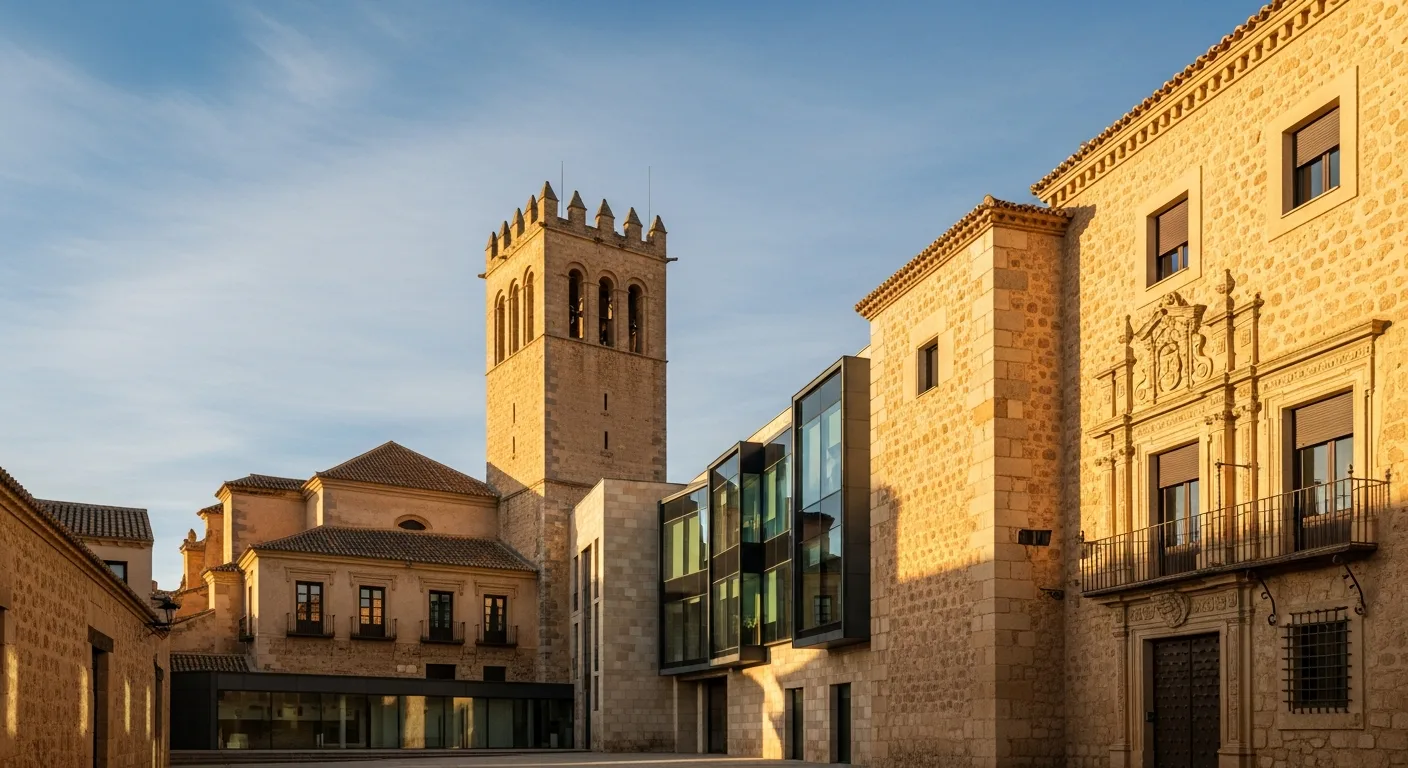
Photos: Wikimedia Commons
You’re standing on the IE Tower observation deck, 180 meters above Madrid, gazing at a panorama that stretches from the Cuatro Torres skyscrapers to the Sierra de Guadarrama on the horizon. Below, in the coworking spaces of the same building, a three-person team from Brazil, Korea, and Poland is finalizing a startup pitch deck they’ll present tomorrow to a jury composed of partners from Sequoia Capital and Telefónica Ventures. One floor down, a professor who advised the Spanish government on AI regulations two years ago is lecturing on behavioral economics. This isn’t a description from a futuristic recruitment brochure; this is a typical Tuesday at IE University.
IE University is an institution that doesn’t fit any European mold. It’s not an ancient, stone alma mater with traditions dating back to the Middle Ages like Oxford or Cambridge. Nor is it an inexpensive, public continental university like CBS in Copenhagen or Maastricht. IE is a private, globally oriented university, founded in 1973 as Instituto de Empresa, which in five decades has grown into one of Europe’s most innovative educational institutions: with campuses in Madrid (the futuristic IE Tower, opened in 2021) and Segovia (a 13th-century Santa Cruz la Real monastery, a UNESCO World Heritage site). Approximately 75% of its students are international from over 140 countries, and almost all undergraduate programs are taught entirely in English. Tuition is high - around €24,000 - €27,000 per year - but IE offers something many are willing to pay for: an education focused on entrepreneurship, technology, and a global career in the heart of one of Europe’s most dynamic capitals.
In this guide, I’ll walk you through everything you need to know as an international applicant considering IE: from the admissions process (rolling admissions, IE Global Admission Test, interview), to language and SAT requirements, the cost of study and living in Madrid, the scholarship system, and a comparison with Bocconi and CBS Copenhagen. If you’re looking for a university that will prepare you for a career at the intersection of business, technology, and innovation - read on.
IE University dominates rankings in a very specific way: you won’t find it in the top 100 of general university rankings (QS, THE) because it’s a specialized institution, not a large research university. But in what it does best - business, management, law, and innovation - IE plays at the absolute global forefront.
In the Financial Times Global MBA 2024 ranking, IE’s MBA program consistently places in the top 15-20 worldwide and regularly in the top 5 in Europe, just behind INSEAD, LBS, and HEC Paris. The QS Online MBA ranking has repeatedly placed IE first in the world, which speaks volumes about the university’s approach to educational technology. The Financial Times Master in Management positions IE’s master’s programs in the global top 10, and QS Master in Finance, in the world’s top 5-10. At the undergraduate level, IE ranks in the top 3 in Spain and top 30 in Europe in QS business categories.
What truly sets IE apart from the competition is its educational philosophy. Where traditional European business schools like LSE, Warwick, and CBS rely on academic research and theory, IE emphasizes learning by doing. Case studies, group projects with companies, startup incubators, hackathons: IE treats the campus as an entrepreneurship laboratory. It’s a university where you don’t just learn about business; you launch companies while still studying. IE Labs, the university’s incubator, has launched hundreds of startups, and IE’s alumni network (over 75,000 people in 160 countries) is one of the most active in the world in venture capital and entrepreneurship.
It’s important to understand IE’s position within the context of the Spanish education system. Spain has several universities with strong international reputations - ESADE Barcelona, Universidad de Navarra, Carlos III de Madrid - but IE University is the only one that has built a brand comparable to top private universities in the USA and UK, while maintaining a European structure and pricing.
The admissions process at IE University is fundamentally different from what you might know from British universities (UCAS), the Danish kvote system (CBS), or the Dutch Studielink (Maastricht). IE employs rolling admissions - there isn’t one rigid deadline. You submit your application when you’re ready, IE reviews it individually, and responds within 2-4 weeks. This is a huge logistical advantage: you don’t have to wait months for a decision, and if you don’t get in during the first round, you can refine your application and try again.
In practice, however, there are three informal rounds that carry real weight. Early Decision (November - December) is when the pool of places and scholarships is largest; IE openly admits that applying earlier increases your chances. Regular Decision (January - February) is the last optimal time. Late Decision (March - July) - IE still accepts applications, but with a dwindling scholarship pool and less flexibility regarding accommodation.
IE’s admissions are holistic - the university doesn’t look solely at grades. IE seeks students with leadership potential, creativity, and a drive to act. Your extracurricular activities, volunteering, projects, internships, sports - all of these have a real impact on the decision. IE openly states that a candidate with average grades but an impressive extracurricular profile and an excellent interview has a better chance than a candidate with straight A’s and an empty CV.
Here are the elements you need to prepare:
What’s important for international applicants: IE does not require a specific minimum GPA (there’s no cut-off GPA like at Danish universities). The university looks at the overall grade trend and appreciates consistent improvement. If your grades from your first year of high school were average, but significantly improved in your final year, IE will notice and appreciate this. Check our guide to converting school-leaving grades to international scales (using the Polish Matura as a worked example) to understand how national results compare internationally.
| Program | Polish Matura (approx.) | IB (points) | SAT (recommended) | IELTS | Competitiveness |
|---|---|---|---|---|---|
| BBA (Business Administration) | 80-95% from extended level | 34-38 | 1300-1400+ | 7.0 | High |
| Bachelor in International Relations | 75-90% from extended level | 32-36 | 1250-1350 | 7.0 | Medium-High |
| Bachelor in Data & AI | 80-90% from extended level (math) | 33-37 | 1300-1400 | 6.5 | High |
| Bachelor in Laws (LLB) | 75-85% from extended level | 32-36 | 1250-1350 | 7.0 | Medium-High |
| Bachelor in Computer Science | 75-90% from extended level (math) | 32-36 | 1250-1350 | 6.5 | Medium |
| Bachelor in Design | 70-80% from extended level | 30-34 | 1200-1300 | 6.5 | Achievable |
IE University offers over a dozen undergraduate programs, almost all of which are taught in English. This isn’t a typical business school with a single BBA program; IE has expanded its offerings to include law, technology, architecture, design, and social sciences, creating an interdisciplinary university with a business DNA. Programs last 4 years (8 semesters), which is standard in Spain, and many offer a dual degree option - combining two fields.
The Bachelor in Business Administration (BBA) is IE’s flagship program and one of the most recognized undergraduate programs in Europe. Its strong emphasis on entrepreneurship differentiates it from classic BBAs at LSE or Bocconi: IE students don’t just analyze case studies, they launch real companies as part of their coursework. The program covers finance, marketing, strategy, operations management, and, uniquely, modules in design thinking, AI in business, and venture building. Tuition: approximately €25,200 per year. BBA graduates go into consulting (McKinsey, BCG, Bain recruit from IE), tech corporations (Google, Amazon, Meta), and, to a large extent, start their own businesses. IE regularly ranks among the top 5 European universities for the number of alumni entrepreneurs.
The Bachelor in International Relations (BIR) is a program for those interested in diplomacy, global politics, and international organizations. IE combines classic international relations with political economy, security, and strategic communication. If you’re also considering Sciences Po in Paris, the BIR at IE offers similar themes but in a more English-speaking and global environment, with smaller classes and a greater emphasis on practical application. Graduates work in foreign ministries, the UN, think tanks, NGOs, and consulting firms.
The Bachelor in Data & AI (formerly Data and Business Analytics) is IE’s response to the growing demand for specialists who combine technical and business competencies. The program is not pure computer science; it’s data science embedded in a business context: machine learning, predictive analytics, data visualization, AI ethics, all framed with modules in management and strategy. If you see yourself in a role that combines programming with business decision-making, as a product manager in fintech, a data strategist in a corporation, or an AI startup founder, this is your program.
The Bachelor in Laws (LLB) is one of the few law programs in Europe taught entirely in English. IE has one of the strongest legal clinics on the continent and emphasizes international law, commercial law, and technology regulations. The program prepares students for careers in international law firms (Garrigues, Clifford Chance, Baker McKenzie), international organizations, and corporate legal departments.
The Bachelor in Computer Science is a purely technological program, but with an IE twist: in addition to programming, algorithms, and cybersecurity, students learn digital product design and understand the business context of technology. The program is smaller than at ETH Zurich or Imperial College, but more practical and market-oriented.
The Bachelor in Philosophy, Politics, Law and Economics (PPLE) is an interdisciplinary program for those who don’t want to confine themselves to one field. It combines philosophy, political science, law, and economics - a model inspired by Oxford’s PPE, but extended with a legal component. Ideal for individuals who envision themselves in public policy, think tanks, or at the intersection of the public and private sectors.
Source: IE University, program catalog and price list 2025/2026
Let’s be honest: IE University is not cheap. As a private university, IE charges tuition comparable to better British universities, and significantly higher than public European universities. Tuition for standard undergraduate programs is €24,000 - €27,000 per year, and dual degree programs can cost €30,000 - €35,000 per year. For four years of study for a BBA, you’ll pay a total of approximately €100,000 in tuition alone. This is a serious investment and should be treated as such - with a calculation of return.
Where does IE win on cost? In the cost of living in Madrid. Madrid is one of the cheapest Western European capitals: significantly cheaper than London, Paris, Amsterdam, or Copenhagen. Public transport for people under 26 costs just €20 per month (abono joven - one of the best deals in Europe). Food is affordable: a menu del día (three-course lunch) in a local bar is €10 - €14, and cooking at home with groceries from Mercadona or Lidl is surprisingly inexpensive.
A realistic monthly budget for an IE student in Madrid looks like this.
Accommodation is the biggest expense: a room in a shared apartment in popular student neighborhoods (Malasaña, La Latina, Chamberí, Moncloa) costs €450 - €650 per month. A studio apartment is €700 - €900. IE does not have traditional campus dorms but offers partnerships with private student residences (Resa, Collegiate); these cost more but provide convenience and community.
Food is €250 - €400 per month if you cook at home and use menu del día.
Transport, as mentioned, €20 (abono joven).
Phone and internet - €20 - €40.
Entertainment and personal expenses - €150 - €300, depending on lifestyle (Madrid has a rich cultural scene, many free museums and parks).
Total monthly cost of living: €950 - €1,500. Annually, this is approximately €11,500 - €18,000. Together with tuition, the annual cost of studying at IE is €35,500 - €45,000 - less than at LSE (over €43,000), comparable to Imperial College, but more than at Bocconi (around €26,000) and significantly more than at free continental public universities. For context, this annual cost is approximately €35,500 - €45,100.
IE University is a private institution and does not offer free tuition, but it does provide an extensive scholarship system that can significantly reduce costs. Key principle: apply for a scholarship simultaneously with your study application. IE does not require a separate process - you indicate in the form that you are applying for financial aid and attach additional documents (scholarship essay, possibly financial documents).
The IE Excellence Scholarship is the main merit-based scholarship, awarded based on outstanding academic results, leadership potential, and extracurricular profile. It can cover up to 50% of tuition, which for a BBA means savings of up to €12,600 per year. It’s not easy to get - IE estimates that about 15-20% of students receive some form of scholarship - but candidates with strong SAT scores (1400+), high grades, and a rich extracurricular profile have a real chance.
The IE Diversity Scholarship (up to 30% of tuition) is awarded to students who bring a unique cultural, social, or geographical perspective to the campus. As an international student, you might have a potential argument.
The IE Social Impact Scholarship (up to 50% of tuition) is for individuals with documented social engagement, volunteering, or charitable projects.
The Women in STEM Scholarship (up to 40% of tuition) is for women in technical fields (Data & AI, Computer Science).
Beyond IE scholarships, it’s worth considering external options. Erasmus+: IE participates in the program, so a semester exchange at another university may be co-financed. National scholarship agencies: many countries run government academic-exchange or study-abroad grant programs that can partially cover living costs for their citizens - check what your home country offers. Regarding work: EU citizens have the right to work in Spain without a permit, while non-EU students can work under the conditions attached to their student visa. Many IE students earn extra income as tutors, company assistants, or freelancers. The Madrid student job market is active, although hourly rates in Spain (€8 - €12) are lower than in Scandinavia or the UK.
Realistic expectations: most IE students pay full tuition or receive a scholarship covering 10-30%. A full scholarship (100% tuition) is extremely rare. Treat scholarships as a bonus, not as your primary plan for financing your studies. If budget is a key criterion, consider free public universities: CBS (€0 tuition + SU grant), Maastricht (€2,500), University of Amsterdam (€2,500) - which offer comparable quality for a fraction of the price.
| Criterion | IE University Madrid | Bocconi Milan | CBS Copenhagen |
|---|---|---|---|
| University Type | Private | Private | Public |
| Ranking (business/management) | Top 3 Spain, top 30 Europe | Top 1 Italy, top 15 Europe | Top 20 Europe (FT) |
| Tuition (EU) | ~€25,200/year | ~€14,000/year | €0 (free) |
| International Students | ~75% | ~30% | ~30% |
| Programs in English (BSc) | Almost all (~95%) | Several key ones | Several (IB, B&P) |
| Admissions | Rolling admissions, holistic | Bocconi Test + grades | Kvote 1 (grades) / Kvote 2 |
| Living Costs (monthly) | ~€950 - €1,500 | ~€1,000 - €1,400 | ~€1,100 - €1,500 |
| Strengths | Entrepreneurship, innovation, tech, global focus | Finance, economics, academic rigor | Interdisciplinarity, SU grant, free tuition |
| Startup Scene | Very strong (IE Labs, Madrid) | Growing (Milan) | Strong (Copenhagen) |
| Atmosphere | Global, dynamic, startup-friendly | Italian, academic, elegant | Large, diverse, Fredagsbaren |
IE vs Bocconi: Bocconi is cheaper (€14,000 vs €25,200 tuition), has a stronger reputation in pure finance and economics, and is more academic. IE wins on entrepreneurship, program innovation, and campus globality (75% vs 30% international students). If your goal is Goldman Sachs, Bocconi. If your goal is to start a startup or work in Big Tech, IE. More about Italian universities in our guide to studying in Italy.
IE vs CBS: CBS is free for EU citizens, offers access to the Danish SU grant, and provides studies practically debt-free. IE costs many times more. Why would someone choose IE? Due to its 100% English-speaking environment (CBS has a limited number of English programs), 75% international students (vs 30% at CBS), the warm climate of Madrid (vs dark Danish winters), and the startup ecosystem with a built-in incubator. If budget is a priority, CBS is the clear choice. If a global network of contacts and entrepreneurship are priorities, IE has a strong case.
Madrid is a city that lives differently from the rest of Europe. Lunch at 2 PM, dinner at 10 PM, going out to a bar at midnight, returning home at 4 AM - and that’s on a regular Thursday. The Spanish rhythm of life is completely different from Central European, Scandinavian, or British, and getting used to it takes a few weeks. But once you adjust, you’ll understand why Madrid regularly ranks among the top 5 best cities to live in Europe for young people.
IE Tower, the main campus in Madrid, is a 35-story skyscraper opened in 2021, located in the northern part of the city, in the Castellana business district. The building itself is impressive: panoramic windows, coworking spaces, innovation labs, lecture halls with technology you won’t see at any public European university. IE invested over €100 million in the campus, and it shows at every turn. From the terrace on the top floor, you can see the entire panorama of Madrid, from the Royal Palace to the Sierra de Guadarrama.
But the real life of an IE student happens off-campus. Madrid is a city of neighborhoods, and each has its own character.
IE’s second campus is in Segovia - a UNESCO World Heritage city, 30 minutes by train from Madrid. The campus is housed in a restored 13th-century Santa Cruz la Real monastery: stone walls, a cloister with a fountain, modern laboratories within historic walls. Some programs (especially design, architecture, and part of the first year of BBA) start in Segovia and then move to Madrid. Segovia is a small, quiet town with a Roman aqueduct, an Alcázar (a castle that inspired Disney), and an atmosphere that is ideal for focusing on studies before diving into the Madrid whirlwind.
IE has over 100 student clubs and organizations, from the IE Entrepreneurship Club (organizing hackathons and meetings with VCs) to the IE Finance Club (case competitions, prep for Goldman Sachs and JP Morgan), the IE Wine & Gastronomy Club, IE Music Club, and dozens of nationality clubs. With over 140 nationalities on campus, there’s almost certainly a community from your own country, and Madrid’s large international diaspora makes it easy to find familiar faces in the city.
Regarding weather: Madrid enjoys over 2,800 hours of sunshine per year, far more than London, Amsterdam, Copenhagen, and most of northern Europe. Summers are hot (35-40°C in July and August), but the summer semester ends in June. Winters are mild (5-12°C), dry, and sunny. For someone accustomed to cold, dark winters, Madrid’s December with sunshine and 12 degrees is a revelation.
One of the strongest arguments for IE is its alumni network, over 75,000 people in 160 countries, with a disproportionately large representation among startup founders, VC partners, and C-level executives. IE regularly ranks among the top 5 European universities for alumni entrepreneurship; it’s estimated that IE graduates have founded over 2,000 companies, generating combined revenues exceeding €15 billion.
Approximately 75% of IE graduates find employment within 6 months of graduation. IE Career Services organizes regular career fairs with participation from companies such as McKinsey, BCG, Google, Amazon, Santander, and Inditex. Madrid is the third-largest job market in the European Union (after Paris and Berlin) and home to the European headquarters of many global corporations. EU citizens have full right to work in Spain without additional permits; non-EU graduates can apply to convert their student status into a work or job-search permit after completing their degree.
Important note: learning Spanish is practically unofficially mandatory at IE. You can complete your studies entirely in English, but in the Spanish job market, especially outside international corporations, knowledge of Spanish is crucial. IE offers free Spanish courses for international students, and it’s definitely worth taking advantage of them. Spanish is the third most widely spoken language in the world - this skill will benefit you globally.
If you plan to prepare for tests before applying to IE, check out our TOEFL app for practicing TOEFL and IELTS with AI feedback, and our SAT app for SAT preparation: although IE is test-optional, an SAT score of 1300+ significantly strengthens your application, especially for scholarships. More about the SAT exam in our complete SAT 2026 guide and SAT requirements for European universities.
IE University is for a specific student profile. If you’re looking for the cheapest option, IE is not it. CBS offers free tuition plus an SU grant, Maastricht costs €2,500 per year, and even Sciences Po is cheaper. If you’re looking for the highest-ranked finance program, Bocconi or LSE would be better choices. If you’re looking for a traditional research university - Edinburgh, KU Leuven, or ETH Zurich offer deeper academic foundations.
But if you’re looking for a university that will prepare you for a career at the intersection of business, technology, and entrepreneurship, in an ultra-international environment, with a built-in startup incubator, a network of 75,000 alumni entrepreneurs, in one of Europe’s most exciting cities: IE University is one of the best options on the continent. It’s a university that doesn’t just teach you to work in a corporation (though its graduates do end up there); it teaches you to build something of your own. And Madrid, with its climate, cost of living, and growing tech scene, is the perfect backdrop for this adventure.
Also, check out our other guides to European universities: CBS Copenhagen, Sciences Po Paris, LSE London, University of Amsterdam, and the guide to studying in Spain. Good luck!