
#34
QS World Ranking
Top 35 globally - 2025
Explore the University of Manchester: admissions, tuition fees, scholarships, popular courses, and vibrant student life. Your complete guide to studying at UoM.

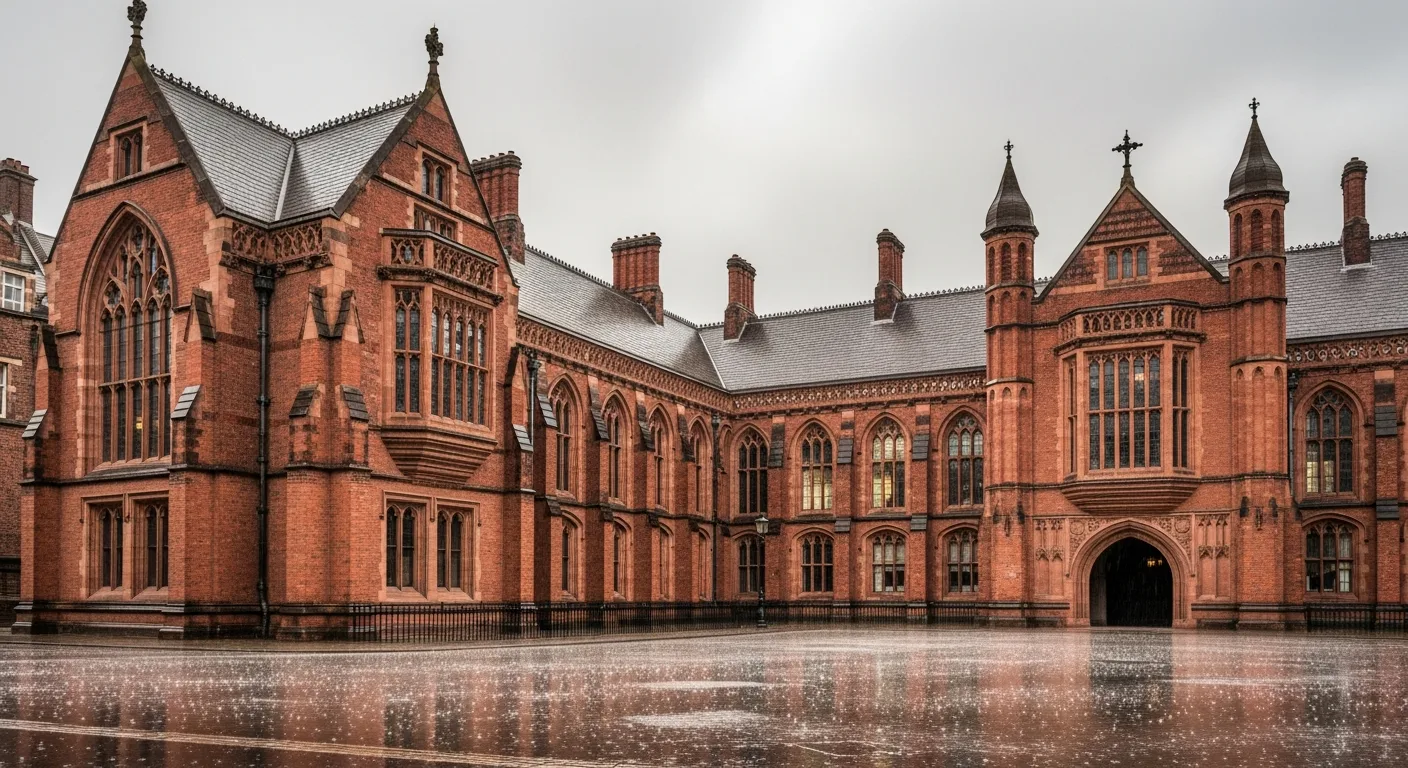
Photos: Wikimedia Commons
In 1948, in an unassuming building at the Victoria University of Manchester, three engineers - Frederic Williams, Tom Kilburn, and Geoff Tootill - launched a machine that changed the course of history. The Manchester Baby, the world’s first computer with a program stored in electronic memory, performed its inaugural calculation on June 21st of that year. A few floors above, Alan Turing was working on artificial intelligence before anyone even coined the term. Decades earlier, in 1917, Ernest Rutherford split the atom on the same campus. And in 2004, Andre Geim and Konstantin Novoselov isolated graphene here - a material one carbon atom thick, for which they received the Nobel Prize in 2010. 25 Nobel Prizes are associated with the University of Manchester. This isn’t a university that rests its prestige on tradition; it’s an institution constantly shaping the future.
But Manchester isn’t just about laboratories and groundbreaking discoveries. It’s a city that gave the world The Smiths, Oasis, and Joy Division, the cultural capital of Northern England, with a vibrant music scene, two of the planet’s most famous football clubs, and a cost of living 30-40% lower than in London. For international students seeking a university ranked in the global top 35 by QS, but without London’s prices, Manchester is one of the most sensible choices in the UK. The university belongs to the Russell Group - an association of the UK’s 24 leading research-intensive universities - and offers over 1,000 study programs across three major faculties covering science, engineering, medicine, humanities, and business.
In this guide, I’ll walk you through the entire process: from the UCAS system and requirements for international qualifications (such as the Polish Matura, the IB, or other national school-leaving diplomas), through tuition and living costs in Manchester, scholarships available for international students, to a comparison with other Russell Group universities and the realities of daily student life in Fallowfield. If you’re also considering other British universities, it’s worth reading our guides on the University of Edinburgh, UCL, or our general guide to studying in the UK.
The University of Manchester is an institution that needs no convincing of its standing; the numbers speak for themselves. In the QS World University Rankings 2025, Manchester holds the 34th position globally, placing it among elite global institutions, just behind institutions like the University of Edinburgh (#27), but notably ahead of many universities that cost significantly more - for example, King’s College London (#40) or the London School of Economics (#50). In the Times Higher Education 2025 rankings, Manchester is positioned around 54th place, and in the prestigious Academic Ranking of World Universities (Shanghai), it consistently ranks in the global top 40, making it one of only six British universities to achieve such a high standing.
What truly sets Manchester apart from its competitors is its exceptional academic breadth. This is not a specialist institution: Manchester is a world leader in physics, materials science, computer science, medicine, social sciences, and business simultaneously. The QS by Subject 2025 rankings place Manchester in the global top 50 in as many as 26 disciplines - from Materials Science (top 10) and Pharmacy (top 15), through Nursing and Geography (both top 20), to Engineering, Computer Science, and Business (all top 50). Such versatility is rare: Imperial College dominates in STEM, LSE in social sciences, but few universities combine so many fields at such a high level.
Manchester belongs to the Russell Group, an association of the UK’s 24 leading research-intensive universities, which generate over two-thirds of all research funding in the country. It’s the British equivalent of the Ivy League, including Oxford, Cambridge, UCL, Imperial, and Edinburgh. But Manchester boasts another title: it is the largest single-campus university in the UK - with over 40,000 students, three main faculties, and over 1,000 programs. This scale offers something smaller universities cannot: an unlimited choice of interdisciplinary pathways, hundreds of student organizations, and an alumni network spanning the globe.
Admission to the University of Manchester is managed through the central British system, UCAS (Universities and Colleges Admissions Service), the platform through which you apply to virtually all universities in the UK. The UCAS system is quite different from other national application systems; it requires a single common application form with a Personal Statement, a reference from a teacher, and predicted grades. Through UCAS, you can apply to a maximum of 5 programs, either at different universities or several at one institution.
The Personal Statement is the heart of your application and the most important element you have direct control over. Unlike American essays, which can be personal and narrative, a British Personal Statement should be academic: explaining why you are interested in the chosen subject, what you have read outside of the school curriculum (super-curricular reading), what research projects you have undertaken, and what work or volunteer experiences relate to your chosen field. Manchester does not conduct interviews for most courses (exception: Medicine and Dentistry require UCAT and MMI interviews), so your Personal Statement must convince the admissions committee on its own. Tip: be specific. Instead of “I’ve always been interested in physics,” write “after reading Geim and Novoselov’s 2004 article on graphene, I began experimenting with two-dimensional materials in the school laboratory.”
Manchester accepts a wide range of national school-leaving qualifications (including the Polish Matura, the IB, and others) - as an entry qualification, 3-4 subjects at the advanced/higher level are typically required, with strong results (for the Polish Matura, usually in the range of 75-90%), depending on the competitiveness of the course. You must also demonstrate English language proficiency: IELTS Academic 6.5 (minimum 6.0 in each component) for most courses, or IELTS 7.0 (minimum 6.5 in each component) for Medicine, Law, and TESOL. The TOEFL iBT equivalent is 87 points (minimum 22 in each section) or 100 points for higher requirements. Prepare for IELTS or TOEFL with our TOEFL app - the platform offers full practice tests with AI feedback, allowing you to identify weak points before taking the actual exam. You can find more about the differences between these exams in our TOEFL vs IELTS comparison.
Step-by-step:
Remember to consult our guide on converting Polish Matura exam results, which explains how your grades translate to international systems, including A-level and IB requirements.
| Course | Polish Matura (Advanced Level) | A-levels | IB (points) | Difficulty |
|---|---|---|---|---|
| Medicine (MBChB) | 90%+ in Chemistry, Biology, Math/Physics | AAA (with Chemistry) | 36-37 (HL 6,6,6) | Very High |
| Computer Science | 85-90% in Mathematics | A*AA - AAA | 36-37 (HL 6 Math) | High |
| Engineering (MEng) | 80-90% in Mathematics + Physics | AAA - AAB | 35-36 (HL 6,5 Math+Phys) | Medium-High |
| BSc Management (AMBS) | 80-85% in Mathematics | AAB | 34-35 (HL 6 Math) | Medium |
| Physics | 85-90% in Mathematics + Physics | AAA - AAB | 35-36 (HL 6 Math) | Medium-High |
| History / Politics | 80-85% in History + native language/English | AAA - ABB | 33-35 (HL 6,5,5) | Achievable |
Manchester offers over 1,000 study programs across three main faculties: the Faculty of Science and Engineering, the Faculty of Biology, Medicine and Health, and the Faculty of Humanities. This isn’t a university where you have to choose between quality and diversity - Manchester has both. Here are the courses where the university truly stands out from the competition, and why they are worth considering.
Materials Science and Engineering is the crown jewel of Manchester, and indeed, the crown jewel of materials science globally. In 2004, Professors Andre Geim and Konstantin Novoselov isolated graphene in a laboratory here - a single-layer carbon material with properties that are revolutionizing electronics, medicine, and engineering. For this discovery, they received the Nobel Prize in Physics in 2010. Today, Manchester hosts the National Graphene Institute (NGI) and the Graphene Engineering Innovation Centre (GEIC), two unique research centers that make the university an absolute leader in this field. In the QS Materials Science rankings, Manchester is placed in the global top 10. If you are interested in nanotechnology, materials engineering, or applied physics, there is no better place.
Computer Science at Manchester is a program with a pedigree unmatched by any other university in the world. Alan Turing, the father of computer science, worked here on artificial intelligence in the 1940s and 50s. The Manchester Baby, the first programmable computer with a stored program, was developed in a laboratory here. Today, the Department of Computer Science offers programs in AI, cybersecurity, data science, and software engineering, with strong ties to the technology industry: Manchester is the second-largest tech hub in the UK after London, with offices for Amazon, Google, Booking.com, and hundreds of startups. If you’re also considering computer science at Imperial College, Manchester offers comparable quality at significantly lower living costs.
Alliance Manchester Business School (AMBS) is one of the few business schools globally with Triple Crown accreditation (AMBA, EQUIS, AACSB), a prestige shared by only about 1% of business schools worldwide. The BSc Management program offers a solid foundation in finance, marketing, strategy, and analytics, with internships at companies like PwC, Deloitte, Unilever, and L’Oreal integrated into the curriculum. Manchester’s MBA consistently ranks in the UK’s top 10. For students interested in business in continental Europe, it’s worth comparing AMBS with Copenhagen Business School (free tuition for EU students!) or LSE.
Medicine (MBChB): Manchester has one of the largest medical programs in the UK, admitting over 400 students annually. The program is five years long, with early clinical contact from the second year. Students have access to placements in NHS hospitals throughout the Greater Manchester region - a metropolitan area with a population of over 2.8 million people, ensuring a vast diversity of clinical cases. Admission to Medicine requires the UCAT (University Clinical Aptitude Test) and interviews in the MMI (Multiple Mini Interviews) format. Requirements: top results in advanced/higher-level Chemistry + Biology (for the Polish Matura, 90%+ on extended level).
Physics and Astronomy, with a tradition dating back to Rutherford and the Jodrell Bank Observatory (one of the most powerful radio telescopes on Earth, belonging to the University of Manchester), physics at Manchester is world-class. The QS rankings place the department in the global top 40. The program combines theoretical and experimental physics, with opportunities to specialize in astrophysics, particle physics, and condensed matter physics. If you dream of working at CERN or on gravitational wave detection - Manchester has active collaborations with both programs.
Social Sciences and Development Studies: The Global Development Institute at Manchester is one of the most important centers for research on poverty and international development worldwide (top 30 in QS). Sociology, political science, development economics - Manchester has a strong tradition of research into social inequality and urbanism, which is natural for a city that was the cradle of the Industrial Revolution and the suffragette movement (Emmeline Pankhurst, a Manchester alumna).
Let’s be honest, studying at a British university isn’t cheap, especially after Brexit, as international students now pay international fees. But Manchester offers something that London universities cannot: world-class academic quality with a cost of living 30-40% lower than in the capital. This is a fundamental difference that, over a three-year undergraduate degree, translates into savings of around £15,000-25,000 (approximately €17,500-29,000).
Tuition fees for international students at the University of Manchester vary by faculty and program. The least expensive are humanities and social science programs, at £25,000-28,000 annually. Business at Alliance MBS costs £29,000-32,000, science and engineering - £30,000-36,000, while medicine ranges from £36,000 in preclinical years to £47,000-50,000 in clinical years. These figures are comparable to other Russell Group universities but significantly lower than at Imperial College (£38,000-46,000 for STEM) or some programs at UCL.
The real difference, however, emerges in living costs. Manchester is one of the most affordable large student cities in the UK. A room in university accommodation (guaranteed in the first year for international students) costs £120-220 per week, depending on the standard, from a shared bathroom room in Fallowfield to an en-suite studio in the city centre. From the second year, most students move into private accommodation in Fallowfield, Withington, or Rusholme - a room in a shared house with bills typically costs £400-600 per month. Compare this to London, where a comparable room costs £800-1,200.
In summary: the total annual cost of studying at Manchester (tuition + living) is £37,500-50,000 (approximately €43,875-58,500) for most non-medical courses. At UCL or Imperial, the same cost ranges from £53,000-72,000, primarily due to London’s accommodation and living prices. Manchester offers a comparable Russell Group degree for significantly less.
Let’s be realistic: the University of Manchester does not offer scholarships that cover the full cost of undergraduate studies for international students. Most forms of support are partial tuition fee reductions of around £3,000-5,000, which, with tuition fees exceeding £30,000+, represents 10-15% of the costs. This is a significant amount, but it doesn’t fundamentally change the financial situation. Nevertheless, it’s worth knowing the available options and applying for everything you can.
The Manchester Global Futures Scholarship is the flagship scholarship for top international undergraduate students. Value: £5,000 one-off (deducted from first-year tuition) or £3,000 annually for the entire duration of studies. The scholarship is awarded automatically; all candidates with a conditional or unconditional offer are considered based on academic merit. You do not need to submit a separate application.
The Alliance Manchester Business School International Excellence Scholarship offers up to a £5,000 reduction from tuition fees for top candidates on undergraduate programs at AMBS. The Engineering Dean’s Scholarship Award offers up to £3,000 annually for students with outstanding results in science subjects. The Science International Merit Scholarship provides reductions of £2,000-5,000 from tuition fees. Each faculty runs its own program, so check the specific department’s website.
For PhD students, the situation is significantly better: the President’s Doctoral Scholar Award covers full tuition plus a living stipend (approximately £18,000 annually) for 3.5 years. This is one of the most generous doctoral scholarships in the UK.
It’s also worth considering national funding sources. Many countries run their own schemes for students heading abroad - check your national scholarship agency, government study-abroad grants, and Erasmus+ opportunities, as well as private foundations that fund overseas study. Furthermore, a Student Visa allows you to work up to 20 hours per week during term time and full-time during holidays. At the minimum wage of £12.21/hour (National Living Wage, from April 2025), a part-time student job can generate £800-1,000 per month (approx. €935-1,170 or $1,015-1,270). Manchester has a vibrant job market for students - bars, retail, tutoring, and summer internships at companies like Deloitte, PwC, and the BBC (£1,500-2,500/month, approx. €1,755-2,925 or $1,905-3,175).
| Criterion | Manchester | Leeds | Edinburgh |
|---|---|---|---|
| QS Ranking 2025 | #34 | #75 | #27 |
| Russell Group | Yes | Yes | Yes |
| Tuition (International) | £25,000-50,000 | £23,000-43,000 | £26,000-37,000 |
| Cost of Living (Monthly) | £1,040-1,600 | £900-1,350 | £1,100-1,700 |
| Students | 40,000+ | 33,000+ | 35,000+ |
| Strongest Programs | Materials, Physics, CS, Business, Medicine | Business, Engineering, Medicine, Geography | AI, Linguistics, Veterinary, Medicine |
| Atmosphere | Metropolitan, music, sport, diversity | Student hub, compact, nightlife | Historic, festival city, cosmopolitan |
| Airport | Large International (MAN) | Small Leeds Bradford (LBA) | Medium Edinburgh (EDI) |
| Flights to Europe | Direct (Ryanair, Wizz Air) | Direct (Ryanair) | Direct (Ryanair, Wizz Air) |
| Unique Feature | Graphene, Turing, Triple Crown Business School | Otley Run, Leeds Festival | Arthur's Seat, Edinburgh Fringe, 4-year BSc |
Manchester wins in terms of academic prestige and ranking position, being notably higher than Leeds (#75) and close to Edinburgh (#27), but with lower living costs than the Scottish capital. Edinburgh offers a four-year degree structure (Scottish system) and a beautiful historic city, but tuition is comparable, and living is more expensive. Leeds is the most affordable option of the three - and a legendary student city - but its ranking is significantly lower. If you’re looking for the best balance of prestige and cost, Manchester is an optimal choice.
Manchester is a city with soul, and that’s something you won’t see in any ranking. If London is business-oriented, Oxford academic, and Cambridge intimate, then Manchester is authentic. It’s a working-class city that has transformed into a cosmopolitan metropolis without losing its character. It’s a city that gave the world the Industrial Revolution, the suffragette movement, Alan Turing, and - just as importantly - The Smiths, Oasis, Joy Division, and The Stone Roses.
Manchester’s music scene is legendary and still thriving. The Northern Quarter, a hipster district with independent cafes, vinyl shops, and galleries, is home to famous clubs like Band on the Wall, Night & Day Cafe, and Matt and Phred’s. Manchester Arena is one of Europe’s largest concert venues, and student tickets for concerts start from £10-20. The city hosts hundreds of music events annually, from jazz and indie to electronic and hip-hop. The Whitworth Art Gallery (part of the University of Manchester) and Manchester Art Gallery offer free admission, while the Science and Industry Museum tells the story of a city that changed the world.
Fallowfield, the legendary student district, is where most first-year Manchester students live and where the fabric of student life is woven. Imagine: rows of Victorian houses converted into student residences, pubs on every corner, a kebab shop at 3 AM after a night out, parks for Sunday strolls, and spontaneous house parties on Thursdays. From Fallowfield to the campus (Oxford Road), you can take the Magic Bus in 15-20 minutes or cycle in 10 minutes. Many students say that Fallowfield was the most important element of their Manchester experience, not the lectures or the lab, but those three years in shared houses with friends from all over the world.
Manchester is one of the most diverse cities in the UK. Over 42% of University of Manchester students are international, coming from over 160 countries. Curry Mile in Rusholme, a legendary street with hundreds of Indian, Pakistani, and Middle Eastern restaurants, serves some of the best curry in England for £6-10. Manchester’s Chinatown is one of the oldest in Europe. The Northern Quarter pulsates with independent culture. The city is also home to large and active international communities, with places of worship, shops, and cultural organizations from around the world, so familiar tastes from home are never far away.
Manchester is also the global capital of football. Two of the most powerful clubs on the planet, Manchester United (Old Trafford) and Manchester City (Etihad Stadium), play home Premier League matches every other week. Student tickets start from £25-30. The university has its own sports teams competing in BUCS leagues in football, rugby, cricket, rowing, and many other disciplines. On campus, you’ll find the Armitage Sports Centre and access to the Manchester Aquatics Centre, an Olympic-sized pool from the 2002 Commonwealth Games.
Manchester Students’ Union is one of the largest student organizations in the UK, with over 400 clubs and societies. International and cultural societies, the Engineering Society, Debating Club, Quidditch Club, Film Society - whatever your interest, there’s a high probability an organization exists here. The SU building on Oxford Road has its own bars, concert halls, study spaces, and café. The Freshers’ Fair in the first week of the academic year is an event where hundreds of organizations recruit new members - don’t miss it.
Manchester is the UK’s second-largest business hub after London, MediaCityUK (home to BBC North and ITV) is in nearby Salford, companies like Amazon, Google, Booking.com, Siemens, and BNY Mellon have offices here, and the startup scene is growing at a pace unseen in any other British city outside London. For international students, this means one thing: after graduating from Manchester, you don’t have to move to London to build a career.
The University of Manchester is an institution that combines qualities rarely found together: academic prestige at a global top 35 level, a cost of living 30-40% lower than in London, and a city with the most exciting culture, music, and sports scene in the UK outside the capital. It’s a university of 25 Nobel laureates, the birthplace of graphene, and the cradle of modern computer science, but also a place where on a Friday night you can catch an indie concert in the Northern Quarter for £5 and take a night bus back to Fallowfield with a £4 kebab. This blend of serious academia and authentic city life makes Manchester truly unique.
For international students, Manchester offers another distinct advantage: direct flights to many European and international cities, from an airport just 20 minutes by tram from the city centre, with prices on budget routes starting from £30 return. A weekend trip home is realistic and affordable, which cannot be said for many British university cities.
If you’re considering other UK universities, read our guides on the University of Oxford, Cambridge, Imperial College, UCL, Edinburgh, KCL, and Warwick. For a comparison with European universities, check out CBS in Copenhagen (free tuition for EU students!) or our guides to studying in the Netherlands and Germany. And if you’re preparing for the SAT, practice on our SAT app - although Manchester doesn’t require the SAT, a strong SAT score can bolster your application to other European universities.
Good luck: Manchester awaits.